Key Takeaways
- A practical 20 oz custom thermos order usually starts at 1,000-3,000 pcs per color
- 304 inner steel, 201 or 304 outer steel, and copper lining change cost by USD 0.25-0.70 per unit
- For wholesale vacuum bottles, test 6-hour and 12-hour temperature drop before mass production
- Plan 25-35 days production after artwork approval for a normal customized thermos order
You are sourcing a 20 oz stainless vacuum bottle for an outdoor retail chain or a winter promo order. On the sample table, they look close enough. The quotes don’t. One thermos supplier offers FOB Ningbo at USD 3.10, another quotes USD 4.35 with a heavier push-button cap, and a third says “same quality” but will not send a 6-hour insulation curve. We’ve seen buyers approve the cheap one after checking only the shell finish, then QC pulled the sample and found a loose inner stopper at 0.35 N·m torque.
To compare vacuum bottle wholesale offers properly, run one order from brief to inspection before you pay the deposit. Lock the steel grade, vacuum performance, logo process, carton packing, AQL limits, and shipment timing in writing. Small details bite. A 304 stainless body with 201 base, a 38 mm logo printed 2 mm off-center, or a PO typo on “matte black” versus “black powder coating” can change the whole order. From our factory in Zhejiang, China, the clean orders usually get decided in the first 7 days; after that, the math gets harder and the line has less room to fix mistakes.
Start with the selling scenario
Start with a real buying case. You sell outdoor gear through independent retailers in North America and need a private-label 20 oz bottle for autumn. The bottle has to look clean on a peg or shelf, survive two warehouse transfers, and still pass as a corporate gift thermos when a promo buyer asks for the same item. Asking ten thermos manufacturers for “your best price” before you define the sales channel is the wrong first question. We see this every September: the buyer sends one line in the RFQ, then QC pulls the sample and finds the lid rubs the powder coat at the thread.
A retail bottle and a giveaway bottle can use the same body mold, but the spec should be different. For retail, we run tighter powder coating checks, better lid fit, stronger packaging, and cleaner barcode placement. For a bulk thermos promotion, the buyer may accept a simpler lid and one-color silkscreen logo if the unit cost stays under USD 4.00 FOB China. For outdoor retailers, I would not cut the gasket, powder coating, or carton strength to save USD 0.12. The math doesn't work when one crushed master carton creates 24 pcs of returns.
A workable starting brief needs hard details: 20 oz or 600 ml capacity, 304 stainless steel inner wall, 201 stainless steel outer wall, double-wall vacuum insulation, leak-resistant screw cap, matte powder coating, single-position logo, individual kraft box, 24 pcs per export carton, and FOB Ningbo or Shanghai. Add the logo size in mm and the barcode position if retail is the channel. We ship fewer problems when the PO says “logo 38 mm wide, front center” instead of “same as artwork.” If you are comparing a thermos factory in Zhejiang with another manufacturer thermos quote from elsewhere in China, this brief keeps the discussion honest.
At BottleForge Industrial in Hangzhou, Zhejiang, our normal MOQ for stainless thermos bulk orders is 1,000 pcs per color, with monthly capacity around 450,000 stainless drinkware units across bottles, tumblers, and food jars. That does not mean every customized thermos order should start at 1,000 pcs. If you need four colors, 4,000 pcs is a safer commercial plan because color changeover, coating loss, and packaging setup hit the final price. On the line, one powder color change can burn 25–40 minutes and a few kg of coating before the finish is stable again.
Read the quotation like an engineer
When you compare vacuum bottle wholesale quotes, do not start with the bottom line. Start with what is inside the price. A USD 3.28 quote and a USD 3.85 quote can describe the same bottle, but we have also seen 2 bottles share one catalog photo: different steel thickness, different lid PP, different carton. Quote against one data sheet. Ask each thermos vendor to state steel grade, net weight, lid material, logo method, packaging spec, test standard, MOQ, sample fee, any mold fee, production lead time, and payment terms. Get it in writing. Last month QC pulled a 20 oz sample that was quoted as 304 stainless, but the lid spring was plain iron and failed the salt-spray check after 24 hours.
For a 20 oz stainless vacuum bottle, a realistic FOB China price range is often USD 3.20-5.20 depending on steel, coating, lid design, and packaging. A standard single-color silkscreen logo may add USD 0.08-0.18 per unit. Laser engraving often adds USD 0.12-0.30 depending on size and position. Full-wrap heat transfer or 360-degree UV print can add USD 0.45-1.20. If a supplier thermos quotation includes a full-color retail box, expect another USD 0.25-0.60 compared with a plain white or kraft box. The math does not work if the buyer wants 500 pcs, 4 colors, gift box, and 360-degree UV print at the same unit price as a plain stock bottle. On the line, we still need the UV jig, the film setup, and 1 extra inspection pass for logo scratches.
Weight is a useful truth detector. A cheap 20 oz bottle may be 245-275 g without cap, while a stronger outdoor-grade body may be 300-360 g. Wall thickness is often around 0.4-0.5 mm for the inner wall and 0.5-0.6 mm for the outer wall, but factories rarely hold those numbers perfectly on low-cost models. Ask for the actual sample weight and allow a tolerance, for example plus or minus 5%. Use a scale. We run the sample on a 0.1 g bench scale and check mouth diameter with a digital caliper, because a 0.3 mm drift at the threaded mouth can turn into cap wobble after coating.
Check Incoterms before you compare. FOB Ningbo is not the same as EXW Zhejiang. If you compare a thermos supplier quoting EXW against suppliers thermos quotes on FOB terms, your landed cost will be wrong. For outdoor retail, the buyer often cares more about carton cube and damage rate than saving USD 0.05 on the bottle. Request carton dimensions early so your freight forwarder can estimate cost per unit before purchase order approval. We have seen this go sideways: the PO said FOB Ningbo, the supplier PI said EXW Hangzhou, and the buyer flagged the missing local trucking only after the 42 cartons were packed.
Choose materials before colors
Color is what the sales team argues about first. Material is what causes the return claim six months later. For most custom thermos programs, we run 304 stainless steel for the inner liner because coffee, tea, sports drinks, and repeated washing punish cheaper steel fast. QC pulled one sample last year with tea staining near the weld seam after a 24-hour salt spray check; the buyer had approved the color chip but never asked about liner grade. The outer wall may be 201 or 304 stainless steel. 304 outer costs more, usually adding USD 0.20-0.45 per unit, but it makes sense for marine accounts, outdoor channels, or premium retail where rust complaints kill repeat orders.
Ask if the bottle uses copper plating between the vacuum layers. Copper lining reflects radiant heat and can improve insulation performance, but the math does not work for every order. It also raises cost, commonly by USD 0.15-0.35 per unit. You do not always need it. A promotional thermos for a 90-day campaign may pass customer expectations without copper if the target is a basic giveaway. A retail bottle claiming long hot and cold performance needs test data, not a nice catalog sentence; we usually check this with a 95°C fill test and log the temperature drop at 6 hours and 12 hours.
Lid construction gets too little attention. PP is common for the cap body, and silicone is standard for the gasket. For Europe, ask for LFGB or EU food-contact compliance where relevant. For the United States, ask about FDA food-contact grade materials and, if children may use the product, discuss CPSIA and applicable ASTM expectations. REACH matters for coatings and certain accessory parts when you sell in the EU. We have seen this go sideways when a PO said “silicon” instead of “silicone,” then the buyer flagged the gasket smell during incoming inspection. Small typo. Big delay.
Powder coating is usually the right finish for outdoor retail because it gives a grippy surface and survives normal shelf wear better than spray paint. Spray painting is cheaper but chips more easily. Polished stainless looks clean but shows fingerprints after 10 seconds in a showroom. If the bottle will ride in a backpack pocket, I prefer powder coating with a cross-hatch adhesion test requirement and a simple abrasion test in the pre-production approval. Your thermos manufacturer should confirm coating thickness, usually around 60-90 microns for many powder-coated bottles, though the exact range depends on the powder and line setup. On our line, the coating gauge reads in microns before packing, and QC will reject obvious orange peel before the carton tape goes on.
Approve samples with measurable tests
A golden sample is not golden because someone wrote “approved” on the box. It only works when the sample record has measurable details we can repeat on the line. For a custom thermos order, approve two stages at minimum: one pre-production sample before mass production and one finished production sample pulled from the actual line. QC should tag both samples with the order number, item code, date, and revision version. Simple stuff. The pre-production sample should match your logo, color, cap, gasket, box, barcode, and warning text, down to the 2 mm logo position tolerance if that is what your artwork calls for.
For insulation, run a controlled test, not a sales guess. Fill the bottle with water at 95°C, close the lid for 6 hours and 12 hours at room temperature around 20-25°C, then record the water temperature with a probe thermometer. A solid 20 oz stainless bottle may keep water above 65°C after 6 hours and above 45-55°C after 12 hours, depending on shape and lid design. Cold retention can be tested with 4°C water and measured after 12 or 24 hours. Do not print “24 hours hot” unless your test supports it. We have seen buyers flag this after Amazon listing review, and the math does not work if the lid has a wide mouth and thin PP plug.
Leak testing matters just as much. Fill the bottle, close it, invert it for 30 minutes, then shake it in several positions: upright, sideways, lid-down, and after 10 open-close cycles. Some lids pass a static leak test but fail when shaken after the gasket is slightly mis-seated. QC pulled the sample once and found the silicone ring sitting 1.5 mm proud on one side; that bottle leaked only after shaking. If your product is sold as leakproof, the inspection standard must be stricter than if it is sold as spill-resistant. Use the wording carefully on packaging and online listings.
For color approval, use Pantone references, but powder coating on metal will not look identical to ink on paper. Approve under daylight or D65 light if possible, and ask the factory to keep one signed color chip at the coating line. For logo placement, specify distance from the bottom, maximum artwork size, and orientation relative to the lid. A thermos customizable by laser and silkscreen needs separate artwork files for each process; one PDF for both is where we see mistakes start. If you are ordering thermos custom packaging, confirm UPC, FNSKU if needed, country of origin, suffocation warning for polybags, and carton marks before the box factory prints. One buyer once sent a PO with “FNSKU” typed as “FNSK,” and 8,000 boxes had to be held before shipment.
Control production without micromanaging
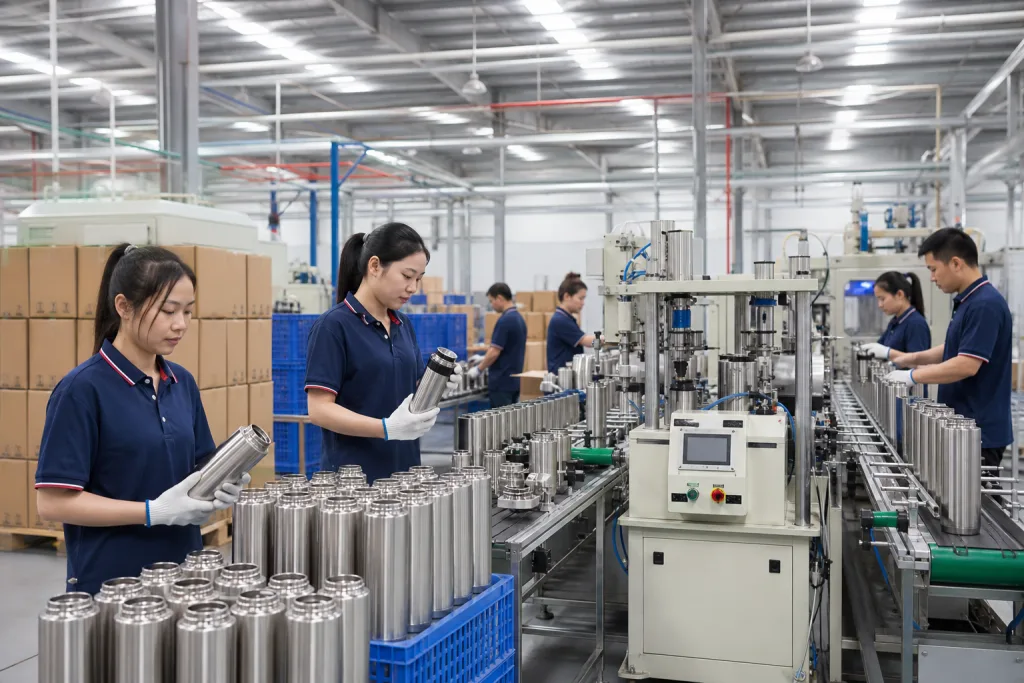
After the 30% deposit lands and the signed sample is approved, we run the thermos order through steel forming, welding, vacuuming, polishing, coating, logo printing, assembly, and packing. For 3,000-10,000 pcs, normal lead time is 25-35 days after artwork and sample approval. Peak season in China, especially before major shipping windows and before Chinese New Year, can push this to 40-50 days. Fixed retail launch? Add buffer. Last November, one buyer asked us to cut 7 days after the powder coating line was already full; the math did not work without switching to air freight.
You do not need to stand over every production step, but ask for three checkpoints with dates. Confirm raw material and accessories are booked within 3-5 days after deposit, including steel coil grade, lids, silicone rings, straws, and color boxes. Request production photos when coating and logo printing start, not just a clean sample on a desk. Schedule final inspection when at least 80% of goods are packed. For customized thermos orders, inspecting at 50% gives a false picture because the last 20% often includes rework, replacement caps, or late packaging. We have seen QC pull a carton where the bottle was correct, but the PO had a one-digit barcode typo.
Use AQL inspection instead of “please check carefully.” A common standard is AQL 2.5 for major defects and AQL 4.0 for minor defects, with critical defects not accepted. Major defects include leakage, poor vacuum insulation, wrong logo, exposed rust, sharp edges, cracked caps, wrong barcode, and coating peel that reaches the base metal. Minor defects include 1-2 small dust points, slight color variation within agreed tolerance, or tiny printing imperfections outside the main logo area. On the line, QC usually checks insulation with hot water and a surface thermometer after 6 hours; guessing by hand is the wrong way to judge a vacuum bottle.
For a distributor thermos order, carton quality matters because goods may pass through 3-5 warehouses before reaching a shelf. Ask for 5-ply export cartons for heavy bottles, with carton gross weight ideally kept under 15-18 kg where possible. Drop testing from 60-80 cm on a packed carton is a practical check, especially for 1L bottles with handle lids. If you are a thermos distributor selling to retailers, damaged color boxes can trigger chargebacks even when the bottle is perfect. We ship better when the master carton, inner divider, and color box thickness are agreed before mass packing starts.
Compare suppliers on risk, not charm
A polished catalog does not prove a solid manufacturer thermos program. Compare thermos suppliers by the risk they remove from your PO. Can the factory send BSCI or ISO 9001 files before your retailer asks? Can they issue REACH declarations for EU sales with the exact model code on the document? Can they split retail cartons by SKU and color, then apply carton labels and pallet labels to your routing guide? We once had QC pulled the sample because the outer carton showed “matte balck” instead of “matte black.” Small typo. Big delay.
For promotional brands, speed and logo accuracy often beat premium retail packaging. For outdoor retailers, drop performance, shelf presentation, and repeat batch consistency carry more weight. A good supplier thermos partner should push back when your target price does not match your claim. If you want a 20 oz powder-coated bottle, copper lining, laser logo, color box, and strict inspection under USD 3.00 FOB, the math does not work. Somebody will cut a corner: 0.4 mm steel becomes thinner, vacuum yield gets accepted too low, coating bake time is shortened, or inspection is rushed. We have seen this go sideways.
Fast replies are nice. Technical replies are better. A strong thermos factory answers with drawings, sample photos, test reports, packing dimensions, and tolerance notes in mm or grams. Weak suppliers thermos replies say “no problem” and avoid numbers. Push for numbers. Ask for cap torque range, carton size, unit weight, coating test method, and expected defect allowance under AQL 2.5 if that is your inspection level. On our line, the torque meter and 3M tape test tell the truth faster than a sales promise.
Location matters, but not as a slogan. A Zhejiang, China drinkware factory close to coating, packaging, and accessory vendors can fix problems faster than a trading office sending screenshots to another province. That does not make every Zhejiang supplier good, and it does not make every non-Zhejiang supplier weak. Check who controls the line, who signs the QC report, and who pays if the customized thermos shipment fails inspection. If the buyer flagged a leaking lid at pre-shipment, I want the cap supplier 40 minutes away, not two days away by truck.
Lock the order before shipment
Before balance payment, build a shipment release checklist and send it to the merchandiser, not just the sales rep. Ours usually has 9 lines: final inspection report, production photos, carton marks, packing list, commercial invoice, HS code check with your forwarder, booking status, label proof, and pallet requirement if any. For stainless vacuum bottles, 9617.00 is often used, but your importer or broker must confirm the right classification for your market. We have seen one PO list “961700” while the forwarder booked under a kitchenware code, and the buyer flagged it two days before CY closing. Messy timing. If you ship to Amazon or a 3PL, confirm FNSKU labels, carton weight limits, and master carton label placement before goods leave China; QC should pull 3 sealed cartons and check labels with a scanner, not by eye.
Payment terms for a first order are commonly 30% deposit and 70% before shipment after inspection. For repeat distributor thermos programs, a factory might offer better terms after 3 or 4 clean orders, but do not assume it on the first PO. The math does not work for every factory. If you are ordering thermos bulk for a fixed event date, price one small urgent air shipment against the cost of missing the event. Air shipping bottles hurts because stainless drinkware is bulky and heavy; a 500ml bottle with gift box can push a carton past 15 kg fast. We run this check on a floor scale before sealing cartons, because rescue freight is where margins disappear.
After delivery, keep a defect log for the first 60 days. Separate true manufacturing defects from handling damage and customer misuse. Share photos with your thermos manufacturer, including batch number, carton number, and defect rate. If 18 units out of 3,000 have minor coating scratches, that is a different conversation from 120 leaking lids. QC pulled the sample for one sports-lid order where the gasket sat 0.6 mm proud, and that small fit issue became leakage after courier drop tests. A professional thermos supplier will use that data to adjust gasket fit, coating handling, packing method, or the next inspection focus.
The buyer who wins is not the one who finds the cheapest thermos vendor once. It is the buyer who builds a repeatable specification, knows the cost of each choice, and checks the product before it becomes an expensive container on the water. We have seen this go sideways when the buyer approved a low quote but skipped carton drop-test photos. Compare vacuum bottle wholesale offers by total risk, not just unit price.
Send your thermos brief for a practical factory quote
Share capacity, logo, quantity, target market, and delivery date. We will return a clear FOB China quote with QC points.
Frequently asked questions
What MOQ should I expect for a custom stainless thermos order?
For a normal custom thermos with one logo and one color, expect 1,000 pcs per color as a practical MOQ from many China factories. If you need a special powder-coated color, a custom lid, or retail color box, 3,000 pcs is more realistic. For four colors, plan around 4,000-12,000 pcs total because each coating color creates setup loss and cleaning time. Some suppliers accept 500 pcs, but the unit price may rise by USD 0.40-1.20 and production priority is often lower. If you are testing a distributor thermos line, start with fewer SKUs rather than too many colors.
How do I compare vacuum bottle wholesale prices fairly?
Put every quote into the same format: capacity, body weight, 304 or 201 steel, copper lining yes or no, lid material, logo method, packaging, MOQ, lead time, FOB port, and inspection standard. A USD 3.50 bottle with kraft box and silkscreen logo is not cheaper than a USD 4.05 bottle with laser logo, copper lining, and retail box. Also ask for carton dimensions because ocean freight can add a meaningful cost per unit. For a 20 oz bottle, a serious wholesale comparison should include at least sample weight, insulation result at 6 hours, and leak test method.
Which logo method is best for promotional thermos orders?
For most promotional thermos orders, one-color silkscreen is the cheapest and works well on flat or gently curved areas. It usually adds about USD 0.08-0.18 per unit. Laser engraving costs more, often USD 0.12-0.30, but it is durable and looks more premium on powder-coated bottles. Full-color UV or heat transfer is better for complex artwork but can add USD 0.45-1.20 per unit and needs stricter artwork approval. If the bottle will be washed frequently or used outdoors, avoid tiny reversed text and large prints crossing strong curves.
What quality tests should I require before shipment?
Use an AQL final inspection when at least 80% of the order is packed. Common limits are AQL 2.5 for major defects and AQL 4.0 for minor defects, with zero tolerance for critical safety issues. Test leakage by filling and inverting bottles for 30 minutes, then shaking selected samples. Check insulation with hot water at about 95°C and record temperatures after 6 and 12 hours. Inspect logo position, barcode scanning, carton marks, coating adhesion, sharp edges, cap cracking, gasket fit, and retail box damage. For outdoor retail, do not skip carton drop testing.
How long does a customized thermos order take from China?
After artwork and pre-production sample approval, a standard customized thermos order of 3,000-10,000 pcs usually takes 25-35 days for production in China. Sampling may take 5-10 days for existing molds and longer if you need a new lid or body shape. Add ocean freight time, customs clearance, and domestic delivery. To the US West Coast, port-to-port shipping may be around 15-25 days in normal periods; to Europe, often 30-40 days. Before Chinese New Year, production and vessel space tighten, so place orders 45-60 days earlier than usual.