Key Takeaways
- A 500ml 304 stainless thermos usually lands around $3.20-$6.50 FOB China at 500-3,000 pcs
- MOQ often starts at 500 pcs for stock bodies and 1,000-3,000 pcs for custom lids, packaging, or molds
- Typical sample lead time is 3-7 days, mass production 25-50 days, and sea freight adds 25-40 days
- A Zhejiang factory running 180,000 units/month can be faster on repeat bulk thermos orders than a trading-only supplier
If you are comparing thermos wholesale offers, the cheapest quote is rarely the cheapest shipment. A 500ml stainless thermos can move from $3.20 to $6.50 FOB China because of 304 stainless thickness, vacuum performance, lid tooling, logo process, and 5-layer carton spec. We run into this every week: a buyer sends two PDFs, then QC pulls the sample and finds a 0.38mm inner wall where the quoted spec said 0.45mm. Price changed for a reason.
The useful comparison is factory thermos spec against factory thermos spec, with the same test standard, same print method, and same delivery term. Do not compare a laser logo quote with a 2-color silk-screen quote and call it equal. The math does not work. A Zhejiang manufacturer can look higher on paper and still save you money if the vacuum pass rate is 98% instead of 93%, and the lead time is 12 days versus 19 days. That is the real check when you compare thermos wholesale from China.
What really moves wholesale price
Compare thermos wholesale quotes line by line, not by the headline unit price. Steel grade is the first check on our cost sheet. 304 stainless is the standard commercial choice for custom thermos orders; 316 costs more and fits coastal markets, acidic drinks, or premium retail shelves. On a 500ml bottle, moving from 304 to 316 can add $0.35-$0.90 per piece depending on volume. Last month QC pulled the sample with an XRF gun because the PO said “304,” but the buyer’s test lab asked for 316 by mistake. That typo changed the price.
Wall construction moves the quote next. A common outer wall thickness is 0.35 mm to 0.45 mm, while the inner liner may sit around 0.30 mm to 0.40 mm. Thicker steel feels better in hand and takes dents better, but the math changes at the hydraulic forming station: more cracked mouths, more trimming loss, more scrap bins. We run 0.40 mm outer wall on some retail orders, but pushing every cheap promo bottle to that spec is the wrong question to ask. Add powder coat, satin polish, or a tight two-tone mask line, and the line slows down fast.
The lid can quietly eat the margin. A basic PP screw lid is not the same cost as a flip lid with a locking button, silicone sealing ring, or tea filter insert. For thermos customizable projects, the lid can be 20% to 35% of the total unit cost. Printing has the same trap. Laser engraving may cost $0.08-$0.18 per logo, while one-color silk screen is often $0.06-$0.12. Full-wrap UV print, gift box, and sleeve packaging all stack up; we’ve seen this go sideways when a buyer approved a $0.06 print quote, then added a 4-side gift box with barcode sticker after the PI was signed.
Practical rule: if a thermos supplier quotes far below the market, ask which of these five points they cut: steel grade, wall thickness, lid structure, coating process, or packaging spec.
MOQ tiers that make sense
MOQ is where 6 out of 10 distributor thermos projects start to get messy. A factory quote should split the cost for stock body selection, logo decoration by silk screen or laser, and any mold or color work on the lid. For a standard 500ml stainless thermos, a stock shape with logo only often starts at 500 pcs. If you need a special lid color, custom box, or mixed SKU carton with 2 colors per carton, the MOQ usually moves to 1,000 pcs. If you want a molded lid, altered shoulder, or a fully customized thermos shape, 3,000 pcs to 5,000 pcs is more realistic. We check this at the sample bench with a 0.02mm caliper before quoting tooling.
Here is a practical way to think about thermos bulk buying:
- 500 pcs: good for a market test, but unit cost is higher and decoration is usually limited to one logo position
- 1,000 pcs: the normal lane for distributor thermos orders, gift programs, and branded campaigns with retail box packing
- 3,000 pcs: the point where a thermos manufacturer can usually tighten pricing, run carton artwork properly, and give more finish options
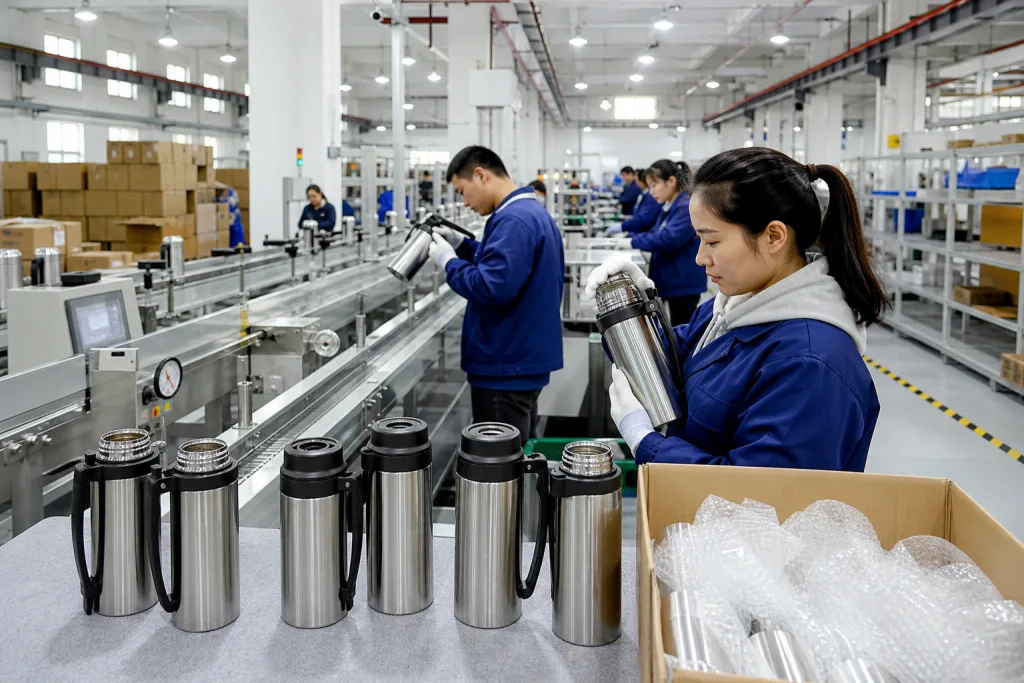
At our Zhejiang factory, monthly output can reach 180,000 units when the line is running on standard bodies and repeat lids. That scale helps with thermos bulk pricing, but it does not cancel tooling logic. This is the wrong question to ask: “Can you just do 300 pcs with a new lid?” The math does not work. If you ask a China supplier to break MOQ too hard, they will recover cost somewhere else, usually in packing thickness, surface finish, or inspection time. We have seen this go sideways when a buyer flagged a 0.5mm lid color mismatch after mass production. A clean quote should tell you exactly what is stock, what is semi-custom, and what is custom mold work.
Lead time from sample to shipment
Lead time is where a good thermos supplier earns their margin. The first sample for a standard stainless thermos usually takes 3 to 7 days if the body is already running on the line. We check the body OD with a digital caliper, and if the 304 stainless shell is from an active batch, sampling is fast. If you need a new logo plate, laser mark, or custom color proof, add 2 to 4 days. If the lid or mold needs a new tool, stop calling it normal sampling; it has moved into project timing, and the math doesn't work if the buyer still expects a Friday courier pickup.
For mass production, a normal stock-style custom thermos order takes 25 to 35 days after deposit and artwork approval. More complex thermos customized work, especially with special coatings or gift boxes, can stretch to 35 to 50 days because coating ovens, carton printing, and accessory packing do not always queue on the same day. We had one PO typo last month where the buyer wrote matte black on page 1 and PMS 426C on page 3; QC pulled the sample before bulk paint, which saved 3,000 pcs from rework. That is the factory clock in China, not the freight clock.
Freight matters too. Air shipping from China to Europe or North America can take 4 to 8 days after pickup, but the price destroys margin on promotional thermos campaigns. Sea freight is cheaper and usually takes 25 to 40 days port to port, depending on route and season. The buyer often asks for the lowest FOB price first; this is the wrong question to ask if the goods must hit a retail shelf by week 38. If you are a retailer with a fixed launch date, plan backward at least 70 to 90 days, including 1 day for AQL 2.5 inspection and 2 days for container booking paperwork. A real thermos factory in Zhejiang will tell you this early because the honest answer protects both sides.
For outdoor retail, the risk is missing a season. For a promotional brand, the risk is landing stock after the event. We ship bottles, not excuses. Timing beats a small unit-cost win every time, and we've seen this go sideways when a buyer saved USD 0.08 per unit but missed the event by 12 days.
Compare quotes line by line
Compare thermos wholesale quotes line by line, not by the bold unit price at the top. Use one spec sheet, one packing method, and one trade term. A quote at FOB Ningbo does not match EXW Zhejiang until you add inland trucking, export docs, local handling, and carton loading; last month we saw a 500ml bottle quote look $0.18 cheaper until the buyer added 12 CBM of inland freight from Yongkang to Ningbo. Same bottle. Different math.
Use this checklist on every supplier thermos offer:
- Material: 304 or 316, plus inner liner certification and steel thickness in mm if the supplier can provide it
- Capacity: 350ml, 500ml, 750ml, or 1L, with actual fill tolerance checked by measuring cup, not guessed from the mold name
- Decoration: laser, silk screen, pad print, UV print, including print area size and whether setup cost is included
- Testing: leak test, vacuum retention, dishwasher or drop testing if needed, with test time written on the PI
- Inspection: AQL 2.5 for major defects, AQL 4.0 for minor defects, and who pays if QC pulls a failed sample
- Compliance: FDA food-contact, REACH for Europe, LFGB if required by your market, with reports matched to the same material and coating
A thermos manufacturer should state whether cartons, polybags, barcode labels, and master carton marks are included. For distributors thermos programs, these details hit the warehouse bill, not just the artwork file. We have seen a $0.40 price gap disappear after adding 5-ply export cartons, EAN stickers, and side marks; the buyer flagged it only after their 3PL quoted a relabeling charge. Cheap can get expensive fast.
Ask for one pre-production sample, one production sample, and photos of the full carton stack before shipment. We run this on custom thermos orders because it catches wrong lids, PO typos, and mixed color cartons before the container is sealed. A serious thermos vendor can show what is on the line, what QC pulled, and what they will ship.
Outdoor retail versus promotion
Outdoor retailers and promotional brands need different thermos custom logic. If you sell to hikers, campers, and commuters, the bottle has to feel solid in hand. On our line, QC pulled the sample and checked the vacuum again before it moved to packing. That usually means a 500ml to 750ml body, powder-coated finish, a tighter vacuum spec, and a lid that survives repeated use. Your customers will spot the gap between a light promotional thermos and a real retail item within 30 seconds.
Promotional thermos orders, on the other hand, are about imprint area, fast approval, and predictable landed cost. A one-color logo on a matte bottle is often enough. Our pad printer has a 65 mm print field, and if the art runs past that, the buyer flags it before we cut the screen. If you are printing for a trade show or employee program, the goal is to keep the total cost under a target range such as $4.00-$5.50 FOB for 1,000 pcs, depending on size and box choice.
Outdoor retail can justify a higher spec because you can charge margin for perceived quality. I would rather see a lid seal that passes a 1.5 m shake test, a powder coat that holds after 48 hours in salt spray, and a finish that does not scuff in transit than a flashy package. The box looks nice, but the math does not work if the cap leaks. Promotional buyers should do the opposite: keep the bottle simple and spend the budget on consistent branding. That is the honest split between thermos manufacturers that sell for retail and thermos suppliers that are built for marketing campaigns.
For a distributor thermos program, use one core body and two decoration options. That keeps inventory manageable while still giving you a custom thermos line that feels flexible. On the packing table, one body, one lid, and two colorways cuts down PO typos and reprint fights. In practice, one body, one lid, and two colorways is usually the smartest starting point.
A first order that does not waste money
If this is your first bulk thermos order, start with a build that is easy to repeat. A clean starter spec is 500ml, 304 stainless, powder coat, screw lid, one-color laser logo, and kraft gift box. We run that setup a lot. QC pulled the sample on the bench, checked the laser mark after the rub test, and the order moved without drama. That mix keeps tooling low and lets a thermos factory finish the order in about 30 to 40 days after approval. At 1,000 pcs, FOB China lands around $3.85-$4.90, depending on print and box. This is the cheap lesson that saves cash.
Do not over-customize the first run. A custom lid shape, multi-color print, or internal tea filter adds 10% to 25% to the cost and slows the line. We have seen a buyer push for a new lid mold on a 1,000 pcs trial, and the math did not work once the mold fee hit the PI. If you need a thermos customizable program, ask the supplier to quote three versions at once: basic, mid, and premium. The pad printer, the lid mold, and the mesh insert tell you where the money goes. That is the clean way to compare thermos wholesale offers without guessing.
Payment terms are usually 30% deposit and 70% before shipment. For repeat business, a factory in Zhejiang may accept a balanced order schedule, but do not assume it on the first deal. We once had a PO typo on the product code, and the bank hold-up cost two days while finance fixed it. Ask for the production timeline, in-line QC checkpoints, and a final inspection report before balance payment. On our side, the packing team should show carton photos, quantity counts, and finished goods packed by SKU before we release the pallet wrap.
If the thermos distributor quote does not include testing, packaging, and delivery timing, you do not have a complete offer. You have a number on paper. We saw this go sideways on a quote that skipped the 1.2 m drop test and left the carton spec blank, then the buyer flagged it after the booking was already open. This is the wrong question to ask if you only chase unit price. Ask what is in the box, who checks it, and when it ships.
Get a real thermos quote, not a guessing game
Send your capacity, logo method, target MOQ, and delivery window. We will map the cost, sample timing, and China factory options in plain numbers.
Frequently asked questions
What MOQ should I expect for custom thermos wholesale?
For a standard stainless thermos with logo only, 500 pcs is a common starting point. If you want custom color, custom box, or a special lid, 1,000 pcs is more realistic. For molded parts or a fully customized thermos shape, 3,000 to 5,000 pcs is normal. If a supplier offers 100 pcs on a complex build, check where they are hiding cost. It is usually in packaging, finish, or a longer lead time. A proper thermos manufacturer in Zhejiang should tell you which parts are stock and which parts need tooling.
How much does a 500ml stainless thermos cost wholesale?
At 500 pcs, a 500ml 304 stainless thermos often sits around $3.20 to $6.50 FOB China depending on lid, coating, and logo method. At 1,000 to 3,000 pcs, the same item may fall to $2.45 to $4.80 if the spec stays simple. Laser engraving usually adds $0.08-$0.18. One-color silk screen is often $0.06-$0.12. If you add a premium box, budget another $0.25-$0.60. The best supplier thermos quote is the one that breaks these costs out clearly, not the one with the lowest headline number.
How long does custom thermos production take in China?
A standard sample can be ready in 3 to 7 days if the body already exists. Mass production usually takes 25 to 35 days after deposit and artwork approval for a simple custom thermos order. Complex thermos customized projects with special lids, coatings, or packaging may take 35 to 50 days. Then add freight: 4 to 8 days by air or 25 to 40 days by sea. If you are launching in Q4 or before a trade show, plan backward at least 70 to 90 days. That is the safe window when buying from a China factory.
Which customization method is best for a thermos?
For most outdoor retailers, laser engraving is the cleanest option because it is durable, precise, and does not rub off. It is ideal for a premium custom thermos look and usually costs $0.08-$0.18 per piece. One-color silk screen is cheaper and works well for promotional thermos programs, especially when you need a large logo area. UV print is useful for full-color branding, but it should be checked for scratch resistance. If you want a long-lasting retail item, choose engraving or high-temperature screen print. If you want fast, low-cost branding, choose silk screen.
What tests and certifications should I ask for?
At minimum, ask for food-contact compliance for your market, plus REACH for Europe and FDA-related material declarations for the US. For retail buyers, I would also ask for leak testing, vacuum retention testing, and an AQL 2.5 final inspection plan. If you sell into stricter channels, LFGB can be important. A serious thermos supplier should also show factory audit status such as BSCI or ISO 9001 if available. For cartons, ask for drop-test or compression-test evidence if your route includes long sea freight. Do not skip paperwork. A cheap quote without test records is not a good deal.