Key Takeaways
- Set vacuum performance by test time, not only by marketing words; check 95°C water after 6 or 12 hours
- For custom thermos orders, keep MOQ around 3,000 pcs per color for stable coating and logo setup
- Use 304 stainless steel at 0.4-0.5 mm inner wall thickness for most outdoor retail programs
- AQL 2.5/4.0 inspection catches visible defects, but add functional leak and insulation tests
When you compare thermos in bulk, the lowest quote is usually the wrong starting point. A $3.80 FOB bottle turns expensive fast if 6% arrive with weak vacuum, scratched powder coating, crooked logos, or cartons that fail a 1.2 m drop test before retail delivery. We have seen buyers push back harder on a 2 mm logo shift than on the unit price, because their customer sees the bottle on the shelf, not the purchase order.
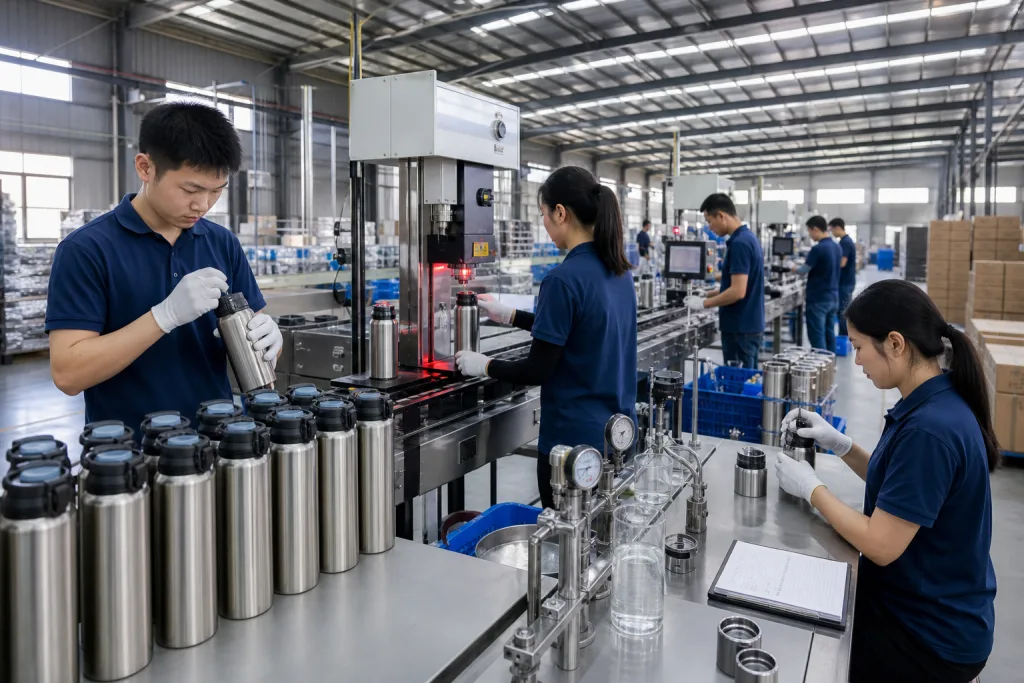
Our factory thermos lines in Zhejiang, China run stainless vacuum bottles for export programs from 3,000 pcs per SKU, with typical lead time of 30-45 days after sample approval. The real job is not finding a “perfect” supplier thermos on a PDF. Spec the failure points before the line starts: vacuum retention, coating thickness, logo position tolerance, inner wall material, lid torque, carton strength, and AQL 2.5 inspection points. QC pulled the sample at pre-production, not after 38 cartons were already sealed. That is where the math works.
Vacuum failure starts inside the shell
The costliest defect in a bulk thermos order is the one your customer misses on day one: vacuum loss inside the shell. A stainless thermos can look clean, pass a quick water-fill check at the packing table, and still drop heat after two hours. We see it come from three places: a pinhole at the laser weld, oil or dust left before vacuum sealing, or a pump cycle cut short to chase output. QC pulled a 500 ml sample last quarter that looked perfect, but the vacuum tester needle would not hold. If you compare a thermos manufacturer only by FOB price, this is where the cheap quote hides.
For a standard 500 ml or 750 ml customized thermos, ask for a written insulation test method. “Keeps hot 12 hours” is not a spec. A usable spec says: fill with 95°C water, close the lid, test ambient at 20°C ± 2°C, record temperature after 6 hours and 12 hours. For 8 out of 10 outdoor retail bottle projects we run, 6-hour hot retention above 65°C and 12-hour retention above 50°C is realistic. Higher performance is possible, but the math changes when you add better copper plating and tighter vacuum pump control; one buyer flagged a USD 0.18 increase, then rejected returns cost three months later.
Wall thickness also matters. For most manufacturer thermos projects, we recommend 304 stainless steel with 0.4-0.5 mm inner wall and 0.5 mm outer wall, depending on capacity and shape. Shells that are too thin save metal cost, then dent in carton drop tests or oval out during welding and polishing. We check this with a micrometer on incoming coil and again after forming, because 0.05 mm missing on paper becomes visible on the line. If you are buying promotional thermos for a short campaign, lighter gauge may pass. If you are placing distributor thermos into outdoor stores, dents and weak thermal performance come back as returns.
Ask your thermos supplier to run 100% vacuum testing after production and before coating. At BottleForge in Zhejiang, China, our stainless thermos output is about 180,000 units/month across multiple lines, and vacuum testing is not optional. We run the vacuum station before powder coating because a failed shell should not waste paint, decals, cartons, or labor. You should also request random destructive cut checks during development when making a new mold or new capacity; we normally cut 3 samples from the pilot run and inspect the weld bead, copper layer, and inner wall thickness.
Leaking lids are usually underspecified
A leaking lid can ruin a good stainless body. In our line checks, the problem is usually a stack-up of 0.1–0.3 mm tolerance gaps around the cap thread, silicone gasket, stopper, straw port, or push-button assembly. Small gaps. Big mess. When you compare thermos in bulk, ask how the factory controls lid parts with cavity records, calipers, and trial assembly, not just how shiny the bottle body looks.
For outdoor retail, a screw lid with a food-grade silicone gasket is the safer pick if the bottle will be packed in backpacks or side pockets. For promotional brands, one-touch lids look better in photos, but they add a spring, pin, hinge, lock, gasket, and sometimes a straw; we have seen one missing hinge pin stop a 3,000 pcs shipment during final inspection. More parts mean more failure points. If your product must pass REACH, LFGB, or FDA food-contact expectations, confirm the silicone hardness and plastic resin grade before sample approval.
A practical leak test is simple: fill the bottle with room-temperature water, close the lid, invert it for 30 minutes, then shake it horizontally for 30 seconds. For higher-risk designs, run 60°C water because heat softens gaskets and builds pressure inside the cup. QC pulled the sample. No shortcuts. Your purchase order should state acceptable leakage as zero for critical defects. Under common AQL inspection, leaking is not a minor cosmetic issue; it is a critical functional defect.
Check lid interchangeability too. If the thermos factory uses 4 lid cavities, every lid should fit every bottle from the same production lot, including bottles packed in different master cartons. This matters for thermos distributors who hold spare lids or mix inventory across cartons; we have seen buyers flag this after-sales, and the math does not work once replacement freight starts. Ask for thread go/no-go checks and torque feel review during pilot production. It sounds fussy, but a 0.2 mm mismatch can create 1,000+ annoying customer complaints.
Coating defects expose weak process control
Powder coating, spray painting, and plating can make a custom thermos look premium, but they also show whether the factory controls the line. We see 6 repeat defects: orange peel texture from poor atomization, pinholes after weak degreasing, color drift between batches, poor adhesion, scratches around the shoulder, and thin coverage near the base radius. QC pulled one 750 ml sample last month with visible shoulder scratches after the operator used a worn hanging hook. That is process control, not bad luck.
For outdoor retailers, powder coating is usually the safer pick. It gives better hand grip and stronger scratch resistance than ordinary spray paint, especially on 304 stainless bottles that sit in truck cup holders or bike cages. For promotional thermos campaigns where color matching is critical, spray painting can hit Pantone closer, but approval must be tighter: D65 light box, signed color chip, and one sealed golden sample. Simple rule. A sample viewed under a warm office lamp is not a production standard, and we have seen buyers flag “wrong grey” when the factory matched it under yellow office lighting.
Set a coating adhesion test before mass production. Use a cross-hatch cutter, 3M tape, and one coated sample from the same pretreatment batch, not a hand-picked show sample from the sample room. You can also request abrasion testing on high-contact areas such as the lower body and cap edge, where cartons rub during sea freight. For retail-grade customized thermos orders, we usually advise packaging only after a full curing window, not right after coating; on our line, 12 hours is risky, while 24 hours gives the coating time to harden before carton vibration starts. Fresh coating marks easily.
MOQ affects coating quality more than 8 out of 10 new buyers expect. A 500 pc color run can be done, but it often carries higher setup cost and less stable color because the sprayer has fewer bottles to tune air pressure, powder flow, and oven temperature. At 3,000 pcs per color, a thermos manufacturer has enough volume to set spraying speed, check curing temperature with a probe, and build a steady inspection rhythm. If you need six colors, do not split one MOQ into tiny batches and expect the same finish; the math doesn't work. For China production, coating line setup is a real cost, not a sales trick.
Logo mistakes are preventable
Logo failure hurts because the buyer sees it in 3 seconds. Crooked laser engraving, silkscreen ink bleed, poor registration, and logos sitting too close to the cup curve can make a solid thermos bulk order look like low-grade promo stock. Before you approve a thermos custom sample, match the logo method to the surface. Budget comes second. On our line, QC checks logo position with a 0.5 mm steel ruler and rejects samples when the mark drifts past the approved drawing.
Laser engraving stays clean on stainless steel, powder coating, and some painted finishes. We run it often for outdoor brands that need a permanent mark after 500 wash cycles. The catch is color: engraving exposes the steel or underlayer, so it cannot give you full-color artwork. Silkscreen works better for simple one- or two-color promotional thermos logos, but tapered bodies and orange-peel powder coating cause trouble. Heat transfer or UV printing can carry 4-color artwork, but test it first if the bottle will sit in car cup holders, backpacks, or sun. We have seen UV logos pass the desk review and then scratch at the shoulder after a 3M tape pull test.
Send your thermos vendor vector artwork, Pantone references, and a placement drawing measured from a fixed point such as the base edge or shoulder line. “Center front” is shop talk, not a spec. On a 750 ml bottle, a 1.5 mm logo tilt shows up fast when the logo is long and horizontal. For retail packaging, define whether the logo must face forward in the tray or gift box. One buyer flagged this after 2,400 pcs were packed; the math did not work, because repacking cost more than fixing the spec before production.
Pre-production samples should use the final logo process, not a sticker or digital mockup. If production uses laser engraving, approve laser engraving. If production uses silkscreen, approve silkscreen on the actual coating from the same powder batch. No shortcuts here. This prevents the old problem: the buyer signs off on a clean rendered image, then receives mass production that passes basic QC but looks weak on the shelf. Last month QC pulled a sample where the PO said Pantone 186C, but the artwork file named 185C; we stopped the job before 6,000 pcs went to print.
Packaging fails before the bottle does
About 6 out of 10 buyer complaints we see tagged as “product quality” start with packaging, not the bottle. Stainless bottles are tough, but two 304 stainless bodies knocking together inside a soft carton will leave flat spots on the shoulder or base. QC pulled a 500 ml sample last month after the line packed it too loose; the bottle passed leak testing, then dented after three hard shakes in the master carton. A distributor thermos program can pass factory inspection in China and still land in Europe or North America with corner dents after sea freight, warehouse sorting, and parcel reshipment.
For retail, specify individual polybag or tissue wrap, molded pulp or paper insert if needed, and a carton with enough edge crush strength. A common export carton for 500 ml stainless thermos might use 5-ply corrugated board, 12-24 pcs per master carton, depending on bottle weight and gift box size. We usually check carton size with a tape measure at packing, because a 10 mm gap inside the box becomes a dent claim after 30 days on the water. If you sell through e-commerce, run a drop test on the final packed unit, not only the master carton. For FBA or similar channels, barcode placement, suffocation warning text, carton weight limits, and FNSKU labeling must be fixed before the goods leave Zhejiang.
Gift boxes create a second failure point. White paper boxes show scuffs. Dark boxes show corner rub. Matte lamination looks premium, but it marks during packing if workers skip gloves, and we have seen this go sideways on orders where the bottle was perfect and the box failed the shelf test. If your order is for distributors thermos in retail stores, the box is part of the product. Define acceptable box defects under AQL, not after the buyer flags rubbed corners in the receiving photos.
Ask your thermos suppliers for carton dimensions, gross weight, and pallet loading before you place the order. Freight cost can change the real landed cost by 8-15% depending on bottle size and packaging volume. A tall bottle with a wide gift box may look good on a shelf, but the math does not work if you load 820 cartons instead of 1,050 in a 40HQ. Good packaging protects the product without shipping air at your expense.
Cheap steel creates expensive risk
Material swaps do happen when a quote lands too low. On our line, QC pulled a 304 inner cup and checked the wall with a caliper at 0.38 mm after a buyer pushed a sample that looked thin. For food-contact drinkware, 304 stainless is the normal inner wall. 316 fits acidic drinks or a premium claim. 201 shows up on some low-price outer shells, but say it clearly before the PO lands.
Ask for material certificates and chemical composition testing when the order value justifies it. A handheld XRF at the receiving table tells the grade in seconds, and we keep the printout with the work order. For Europe, REACH and LFGB paperwork comes up fast with retailers. For North America, FDA food-contact checks and California Proposition 65 review depend on the channel. If the bottle is for kids, ASTM and CPSIA checks enter the file, especially for coatings and small parts. A buyer once sent a PO with “stailess” in the material field; QC caught it before sample approval.
Do not spec everything at once. If you ask for 316 stainless, copper plating, premium powder coating, retail gift box, and 1,000 pcs MOQ, the math does not work like a basic promo bottle. A 500 ml stainless vacuum bottle with 304 inner wall and single-color powder coating usually sits around USD 3.80-6.50, depending on lid, finish, logo, packaging, and quantity. A 42 mm twist cap adds more labor than the shell. Add a complex lid or a 300-piece run, and the price climbs fast. We have seen the buyer flag that gap on the first quote and then try to squeeze the spec later. That goes sideways.
The best thermos manufacturer talk is direct: retail price, sales channel, annual volume, compliance market, and acceptable defect level. A good supplier will tell you where to spend money and where to cut. QC found two dented cartons in an AQL 2.5 spot check on one export order, and the fix was simple because the brief was clear. In China, that straight talk saves more than chasing another USD 0.08 from the shell.
Inspection must match the failure mode
A standard final random inspection has value, but a generic checklist misses the defects that cost money on a custom thermos order. Build the inspection around the real failure modes we see on the line: vacuum loss checked by hot-water hold testing, leakage checked with inverted bottles for 30 minutes, coating checked with 3M tape, logo position measured in mm, lid fit checked with the actual silicone ring, odor check after opening the inner bag, sharp rim check by hand, barcode scan, and carton mark match against the PO. AQL 2.5 for major defects and 4.0 for minor defects is common, but critical defects such as leakage, unsafe sharp edges, wrong material, or moldy odor should be zero tolerance.
Do not rely only on final inspection at 100% packed stage. Too late. By then, a coating scratch or crooked laser logo means rework, delay, or a discount fight nobody budgeted for. Ask for production photos after welding, after coating, after logo application, and before packing, with the order number and date card in the picture. For larger orders above 10,000 pcs, an inline inspection at 20-30% production is worth the cost. We had one buyer flag a 2 mm logo shift at 25% output; fixing the jig then saved roughly 7,000 bottles from rework.
Sample retention is practical, not paperwork. Keep one approved pre-production sample at your office and one sealed at the factory, signed across the carton tape if needed. The retained sample should include final bottle, lid, logo, color chip, printed box, instruction sheet, and barcode label from the approved artwork file. When a dispute happens, QC pulled the sample and compares steel color, cap thread feel, and carton wording against the same physical standard, not against a bright screen image.
If you are new to bulk thermos sourcing, start with fewer SKUs. One 750 ml bottle in two colors is easier to control than five capacities, six colors, and three lid types; the math does not work on the first run. We run fewer changeovers, the packing table makes fewer mistakes, and QC can catch lid mix-ups before cartons close. You can expand after the first shipment proves the supplier thermos process. A controlled first order protects your launch date and your margin, and it keeps your retailer from asking why black 750 ml bottles arrived with the white 500 ml barcode.
Send your thermos spec before you quote
Share capacity, lid, finish, logo, MOQ, and target market. We will review the failure risks before pricing your order.
Frequently asked questions
What MOQ should I expect for a custom stainless thermos?
For a serious custom thermos program, 3,000 pcs per color is a practical MOQ. Some factories accept 1,000 pcs, but unit price rises and coating color control becomes less stable. If you need a new mold, expect higher tooling cost and often 5,000-10,000 pcs to justify development. For simple logo customization on an existing 500 ml or 750 ml model, 3,000 pcs usually allows stable powder coating, laser engraving or silkscreen setup, export carton packing, and FOB pricing that makes sense for outdoor retail or promotional distribution.
How do I compare thermos in bulk quotes fairly?
Compare the same specification line by line: capacity, 304 or 316 stainless grade, wall thickness, lid structure, coating type, logo method, packaging, compliance testing, MOQ, lead time, and Incoterm. A USD 4.20 FOB quote and a USD 5.10 FOB quote may not be comparable if one includes powder coating, gift box, REACH-ready materials, and 5-ply carton while the other uses basic paint and bulk packing. Ask each thermos supplier to quote against your written spec sheet, not their nearest stock model.
What lead time is normal for bulk thermos production in China?
For existing stainless thermos models with custom logo and standard color, 30-45 days after sample approval is normal in China. Add 7-14 days for pre-production sampling if the color, logo, or packaging is new. New mold development can add 25-45 days before mass production starts. Peak season before summer outdoor campaigns and Q4 promotions can stretch schedules, so approve artwork and packaging early. If a supplier promises 15 days for 10,000 customized units, ask what process step is being skipped.
Which logo method is best for promotional thermos orders?
For durability, laser engraving is usually the safest logo method on stainless or powder-coated bottles. It does not peel and handles outdoor use well. For low-cost promotional thermos orders with simple artwork, one-color silkscreen can be economical, especially above 3,000 pcs. For full-color logos, heat transfer or UV printing may work, but you should test scratch resistance and dishwasher exposure if your claim mentions dishwasher safety. Always approve a real pre-production sample using the final logo method, not only a digital mockup.
Should I hire a third-party inspection company?
Yes, if the order is important, new, or above about USD 8,000-10,000. A third-party final inspection using AQL 2.5/4.0 can check appearance, quantity, packaging, barcode, leakage, and basic function. For stainless thermos, add specific tests for vacuum performance, lid leakage, coating adhesion, odor, and carton drop resistance where relevant. For larger distributor thermos programs, consider inline inspection at 20-30% production. It costs more upfront, but it is cheaper than discovering defects after the container arrives.