Key Takeaways
- For sport bottles, a practical MOQ is 1,000-3,000 pcs per color depending on coating and logo method
- 304 stainless steel at 0.4-0.5 mm outer wall thickness gives better dent resistance than thin promotional builds
- AQL 2.5/4.0 inspection is more useful than a vague promise of 100% good quality
- Lead time is usually 25-35 days after deposit and artwork approval for repeatable wholesale drinkware orders
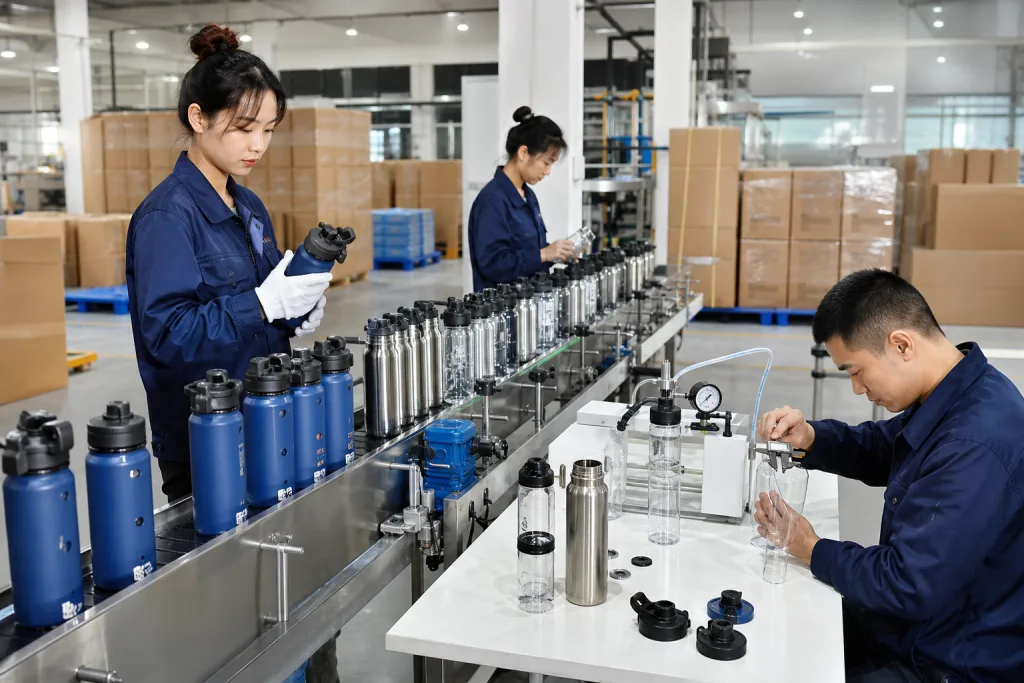
When you compare sport bottle wholesale offers, the lowest number on the quote is often the least useful one. A 750 ml bottle at USD 2.10 and another at USD 2.55 can look close in a spreadsheet, but the buyer gets a different product once you check steel gauge, lid material, coating, test method, carton pack, and defect allowance. On our line, QC pulled a 304 stainless sample last week and the wall thickness was off by 0.2 mm, which is enough to change feel and cost.
From our factory in Zhejiang, we see the same issue every peak season: procurement teams ask for drinkware wholesale pricing before the spec is locked. The result is messy quotes and sample rounds that waste time. If the PO says one thing and the lid drawing says another, the buyer flags it on day one. This is the wrong question to ask if you want the best wholesale drink bottle for retail, promotion, or distributor programs. Lock the spec first, then push for FOB pricing.
Start with volume and real use
The first line on most sport bottle spec sheets is capacity: 500 ml, 650 ml, 750 ml, 1,000 ml, sometimes 1,200 ml. Don’t treat it as a logo-position decision. This is the wrong question to ask. Capacity changes steel weight, carton cube, freight cost, cap torque, and whether the bottle actually sits in a bike cage or car cup holder. On our line, QC checks the bottle OD with a digital caliper; a 2 mm change can be the difference between “fits” and a buyer complaint.
For gym, school, and corporate bulk drinkware programs, 650-750 ml is the safer range. It feels solid without becoming a brick once filled. For outdoor and worksite channels, 1,000 ml sells better, but check packed carton weight before you approve the quote. We’ve seen a 1,000 ml stainless sport bottle push a master carton over 14-16 kg depending on the insert, polybag, and carton spec, which creates handling pushback at the warehouse. One buyer flagged this after their DC team refused hand unloading above 15 kg.
If you also source a bulk canteen or wholesale canteen program, don’t copy the same capacity logic. A canteen bulk order may need a flatter profile, carry strap, or military-style cap retention. A sport bottle is normally judged by one-hand drinking, leak resistance, and grip. A canteen is judged more by portability and ruggedness. We run separate drop checks for these; the canteen cap lug often takes the hit first when the sample lands on concrete from 1.2 m.
For brand owners, capacity affects perceived price. A 750 ml bottle with a powder-coated body and printed logo can sit in a mid-market retail range. A 500 ml bottle often looks promotional unless the finish and cap are upgraded. When you compare sport bottle wholesale suppliers in China, ask for the measured brimful capacity and the claimed usable capacity. A bottle advertised as 750 ml may hold 720 ml in comfortable daily use. That matters when your packaging says a number, and we’ve seen this go sideways because the PO said 750 ml while the retail box artwork promised “25 oz / 750 ml” without allowing headspace.
Material grade is not decoration
Most export sport bottles we ship use stainless steel, Tritan, PP, or aluminum. The material line on the spec sheet needs a real grade, not a lazy “food grade” note copied from an old quotation. For stainless steel, ask whether the inner wall is 304 or 316, and whether the outer wall is 201 or 304. For plastic sport bottles, ask for Tritan copolyester, PP, or PE grade and current test reports; QC pulled one 750 ml sample last month where the PO said Tritan but the mold room had loaded PP resin.
For mainstream stainless drinkware bulk programs, 304 stainless steel is the normal choice for the water-contact surface. It gives solid corrosion resistance for water, tea, and acidic drinks. 316 fits premium positioning or marine/outdoor markets, but the math does not work for every promotion order. Aluminum can work for low-cost sports channels, but it needs an internal liner and tighter compliance checking; we check the liner under a thickness gauge before packing, because one scratched batch can kill the shipment.
Wall thickness is where quotes hide the gap. A lightweight stainless bottle may use 0.30-0.35 mm material. A better retail-grade build often uses 0.40-0.50 mm for the outer shell, depending on shape. Thicker steel is not automatically better because it adds weight, but too thin means dents during canteen wholesale distribution, courier handling, and shelf stocking. We have seen a buyer flag 23 dents in a 200-piece carton inspection after a factory chased a lower FOB price with 0.30 mm steel.
If you are comparing wholesale drinkware for Europe or North America, request compliance documents before the deposit is released. Common requests include LFGB or EU food contact, REACH, FDA food contact, and sometimes Prop 65 assessment for California. At BottleForge Industrial in Zhejiang, China, we normally lock the testing plan before mass production because changing material after a failed test can cost 10-15 days. That delay hurts more than a few cents on a confirmed grade, and we have seen this go sideways when the buyer asks for test files only after the line has already welded 8,000 bodies.
Lid design decides complaint rates
Sport bottle buyers often spend 20 minutes on body shape and logo placement, then give the lid two lines on the PO. That is where complaints start. The spec sheet should name the lid material, gasket type, thread style, straw system if used, and spare-part availability. PP lids with silicone gaskets are standard on most orders we run. ABS can work for harder push buttons or lock tabs, but check whether it touches the drinking path. QC once pulled a sample where the PO said “PP lid,” but the inner stopper was unmarked ABS sitting against water contact. The buyer flagged it during FDA review.
We usually see three sport bottle lid styles on the line. A screw cap is the safe choice for promotional wholesale drinkware and outdoor programs because it has fewer parts, fewer molds, and fewer ways to fail. A flip lid sells better at retail, but the hinge needs cycle testing, usually 3,000 open-close cycles before we trust it. A straw lid works for fitness clubs and school channels, though it adds a straw, vent hole, silicone bite piece, and one more gasket seat. More parts mean more claims. If your order goes to distributors, ask whether the supplier can sell replacement lids in 1,000 pc lots. We have seen a USD 0.38 spare lid save a 5,000 pc reorder.
Leak testing belongs in the purchase requirement, not in a late email after goods are packed. A practical factory check is simple: fill the bottle to rated capacity, tighten the cap to standard torque, lay it horizontally for 30 minutes, then run an inverted shake test for 20 seconds. We use a torque meter at the packing table, and QC marks the test result on the inspection sheet before carton sealing. For vacuum bottles, check thermal performance as well. For single-wall sport bottles, this is the wrong question to ask. The math does not work if you pay for a thermal claim your customer will never use.
The same thinking applies when you branch into alcohol flask wholesale or alcohol flask bulk programs. Small caps, hinges, and gaskets matter more than body steel because leakage shows up fast in a gift box or suit pocket. For alcohol flask wholesale bulk orders, cap threading should feel smooth, not gritty, and the cap should not cross-thread after repeated use. We run a 10-time open-close check on pre-production samples with a go/no-go thread gauge beside the line. A pretty sample with a weak lid is a future claims file.
Coating and logo are production variables
Color and branding look simple on a PDF. On the line, they control MOQ, lead time, and defect risk. For sport bottles, the usual finishes are powder coating for a dry matte grip, spray painting for lower-cost color matching, silicone sleeve for impact feel, electroplating for a shiny gift look, and bare stainless polish for the simplest inspection. Powder coating is the safest pick for retail and corporate orders because it holds up better in a 3M tape test and gives buyers the hand feel they expect.
A normal MOQ for custom powder color is 1,000-3,000 pcs per color, based on the coating line and whether the pigment is already in stock. Standard black, white, navy, and stainless may be lower; last month we ran 600 pcs in black because the booth was already set up. If you need six colors at 500 pcs each, say it at the quotation stage. A supplier may accept it, but the unit price and setup charge will change, and the math often does not work after color change cleaning, masking, and first-piece approval.
Logo method matters too. Silkscreen is cost-effective for one or two colors on smooth surfaces, especially when the logo height is over 18 mm. Laser engraving is durable and clean on stainless or coated surfaces, but the look is subtle; one buyer flagged it as “too invisible” on matte navy samples. Heat transfer or full-wrap printing works for complex graphics, but artwork control must be tight, and we usually ask for pre-production samples before mass run. For textured powder coating, fine logo lines may break or fill in, and QC pulled the sample once because a 0.25 mm line closed up after curing.
If you source across sport bottle, beer tumbler wholesale, and wholesale growler categories, do not assume one decoration method fits all. That is the wrong question to ask. A beer tumbler bulk order often needs a bolder logo because condensation and foam residue reduce visibility during use. A bulk growler or growler wholesale project may need large panel printing, warning text, or brewery-specific artwork; we have seen a PO typo turn “64 oz” into “46 oz,” and the buyer caught it only at digital proof stage. For beer growler wholesale bulk and beer tumbler wholesale bulk, test ink adhesion and dishwasher claims with real samples, not guesses.
Packing affects landed cost
Packing is not an afterthought. It changes damage rate, warehouse labor, shelf presentation, and freight cost. We run basic export packing as one bottle in a polybag, egg-crate divider, then a 5-layer K=A master carton. Retail packing is different: color box, instruction sheet, barcode label, and carton drop-test requirement. The cost gap is often USD 0.12-0.45 per unit before freight, and QC will usually find the weak point on the first 1.2 m corner drop.
If you sell into ecommerce, ask for inner box dimensions, carton quantity, gross weight, and the drop-test plan before artwork approval. Do it early. For Amazon FBA or similar fulfillment, FNSKU labels, suffocation warnings on polybags, and carton weight limits must be locked before production. We have seen 5,000 pcs opened again because the buyer flagged a missing FNSKU on the side panel. The math does not work: two workers with carton knives and label guns can spend 2-3 days fixing a mistake that cost less than USD 30 to prevent.
For distributor wholesale drinkware, carton consistency matters. A carton with 24 pcs may work for a 500 ml bottle, but a 1,000 ml bottle often needs 12 pcs to keep gross weight under 15 kg. If you are ordering drinkware bulk for multiple SKUs, standardize carton length and label format where the bottle size allows it. Your warehouse will thank you. One buyer once sent us a PO with “ctn mark black” typed as “ctn mark blank,” and the line stopped for half a shift while sales confirmed the mark layout.
Growler bulk and beer growler in bulk orders need extra care because large bodies dent faster than buyers expect. A 64 oz stainless growler looks strong, but it can still pick up shoulder dents during container loading if the divider is thin or the carton has slack space. For beer growler wholesale or wholesale growler projects, consider thicker dividers, corner protection, or individual kraft boxes. We’ve seen this go sideways on a 20GP load where QC pulled the sample after loading trial and found dents near the handle weld area. The extra packing cost is usually smaller than replacing dented goods in North America or Europe.
Inspection terms belong on the PO
A good spec sheet should end with quality rules. If the quote says “QC before shipment,” the buyer has left the factory too much room. Put the inspection standard on the purchase order: AQL level with sample size, clear defect definitions with photos if possible, critical tests such as 24-hour leakage, and reinspection cost if the lot fails. We run PO reviews with a red pen because one missing line can turn into a 6,000 pc argument at final inspection.
For most wholesale drinkware orders, buyers use AQL 2.5 for major defects and AQL 4.0 for minor defects. Critical defects should be zero. Major defects include leakage, wrong material, sharp edges, severe coating scratches, wrong logo, or carton quantity shortage. Minor defects include small color variation, slight dust in coating, or tiny cosmetic marks inside the agreed limit. QC pulled a sample last month with a 1.8 mm scratch beside the logo; without an approved defect limit, that small mark became a long email chain.
At BottleForge Industrial, our current drinkware output is about 450,000 units per month across stainless bottles, tumblers, canteens, and related OEM items. Typical production lead time is 25-35 days after deposit, artwork confirmation, and approved pre-production sample. During peak season in Zhejiang, lead time can stretch by 7-10 days if powder coating or lid components are queued. Plan for it. We have seen buyers book a promotion for day 30, then lose 9 days because the black powder line was full and the lid supplier missed one silicone gasket size.
For alcohol flask in bulk, beer tumbler in bulk, and beer growler bulk categories, add checks tied to how the item is used. Flasks need leakage testing and cap fit checks. Beer tumblers need rim smoothness plus cross-hatch coating adhesion. Growlers need handle weld strength or cap seal testing. If you are importing into regulated retail channels, keep batch records, material declarations, and inspection photos in one file. When a retailer asks for traceability, a tidy file beats a fast excuse; we have seen this go sideways when the PO had the logo file name wrong by one digit.
Price comparison needs equal specs
FOB pricing means something only when the spec matches. If Supplier A quotes USD 2.18 for a 750 ml single-wall stainless bottle and Supplier B quotes USD 2.46, check 304 stainless versus 201, wall thickness in mm, powder coating grade, lid construction, logo method, export carton size, and inspection scope. Last month QC pulled the sample and found 0.42 mm body wall on one quote and 0.50 mm on the other. Different bottle. Different cost.
Ask each supplier to quote from the same sheet: capacity in ml, material grade with test standard, finish with Pantone or coating name, logo size plus color count, packing style and carton quantity, MOQ, sample cost, mass lead time, payment terms, FOB port, and validity period. For China exports, FOB Ningbo or FOB Shanghai are common for Zhejiang factories; we run both depending on vessel space and trucking cut-off. If you need DDP or delivered pricing, confirm duty, customs clearance, local delivery, and VAT handling in writing. I have seen a PO say “FOB Shanghai” in the header and “DDP LA warehouse” in the notes. That typo cost 6 emails before anyone talked about bottles.
There is also a category question. Sport bottles, canteen wholesale, alcohol flask wholesale, beer tumbler wholesale, and growler wholesale items can share suppliers, but they do not always share the same line. A factory strong in vacuum tumblers may run 2.0 L growlers well, yet struggle with plastic flip-top sports bottles because the mold fit, silicone ring, and lid torque checks are different. A supplier good at bulk canteen military-style products may lose time on glossy retail packaging when each color box needs barcode position within 2 mm. The buyer flagged it once. Fair point.
The practical way to compare sport bottle wholesale options is simple: lock the spec first, approve one golden sample, then ask for a quote that names every assumption. If you change the lid, coating, or carton after price approval, expect the cost to move; a new straw lid can add USD 0.12, and a thicker 5-layer carton can add 4 to 7 days if paper supply is tight. This is the wrong question to ask: “Can you match the cheaper price?” Ask what changed in the build. That is not supplier drama; it is manufacturing math.
Send us your sport bottle spec sheet
We will check material, MOQ, logo method, packing, and FOB assumptions before you commit budget to mass production.
Frequently asked questions
What MOQ should I expect for custom sport bottle wholesale orders?
For a standard stainless sport bottle with your logo, a realistic MOQ is usually 1,000 pcs per design if you use stock color and simple laser or one-color silkscreen. For custom powder coating, expect 1,000-3,000 pcs per color. If you need retail color boxes, the box supplier may also set a 1,000-2,000 pc print MOQ. Very small trial orders are possible only when the factory has blank inventory, but the unit price can rise by 15-30% because setup, artwork, and packing labor are spread over fewer units.
How do I compare stainless steel sport bottle quotes fairly?
Make every supplier quote the same spec. List capacity, 304 or 316 inner wall, outer wall material, wall thickness, lid material, silicone gasket, coating type, logo method, packing, AQL standard, and FOB port. A USD 0.25 difference can disappear if one quote includes color box packing and another uses bulk carton packing. Also ask for net weight per bottle. If one 750 ml stainless bottle is 165 g and another is 230 g, you are probably comparing different steel thicknesses, not just different supplier margins.
Can one supplier handle sport bottles, growlers, tumblers, and flasks?
Sometimes, but check the actual production capability. Stainless sport bottles, beer tumbler bulk orders, bulk growler projects, and alcohol flask wholesale bulk programs share some materials, but they need different forming, welding, polishing, and lid systems. A capable China supplier can manage the project, but may produce some accessories through audited partner workshops. Ask where each item is made, what monthly capacity is available, and whether one inspection can cover the mixed shipment. Mixed-category orders need tighter coordination than a single-SKU reorder.
What tests should I require before shipment?
For sport bottles, require leakage testing, coating adhesion check, logo rub test, capacity check, visual inspection, carton drop test if retail packed, and AQL inspection. For food-contact compliance, confirm FDA, LFGB, REACH, or other market-specific tests before mass production. If the bottle has a straw lid, add suction function and hinge cycling checks. For vacuum insulated models, include hot water temperature retention testing, usually measured after 6 or 12 hours. Put these tests on the PO, not only in email chat.
What lead time should I plan for a first order from China?
For a first custom order, plan 7-12 days for sampling after artwork approval, then 25-35 days for mass production after deposit and sample confirmation. Add 3-5 days for inspection, booking, and export documents. Ocean freight to North America or Europe can take another 25-45 days depending on port and season. If you need custom lids, special Pantone coating, or complex retail packaging, add at least 10 days. A safe launch calendar for new wholesale drinkware is usually 75-100 days from confirmed spec to warehouse arrival.