Key Takeaways
- Set MOQ, steel grade, capacity, lid type, logo method, carton spec, and Incoterm in the first RFQ, not after sampling
- A realistic factory-direct FOB China price for a 20 oz stainless travel tumbler is often USD 3.20-5.80 depending on lid, coating, and packaging
- Allow 7-12 days for custom samples and 30-45 days for bulk production after artwork and deposit approval
- Use AQL inspection with leak, vacuum, coating adhesion, barcode, and carton drop checks before final balance payment
Buying coffee tumbler wholesale bulk looks easy until the first quote sheet lands: six lid drawings, 304 versus 201 steel, laser logo versus powder-coat print, and freight terms nobody put in the RFQ. We see this every week. For coffee brands and corporate-gift buyers, the risk is not just unit price; it is a bulk coffee travel mug that leaks after QC fills it to 95%, fails the dishwasher claim after 20 cycles, or arrives with a logo 2 mm lower than the approved sample.
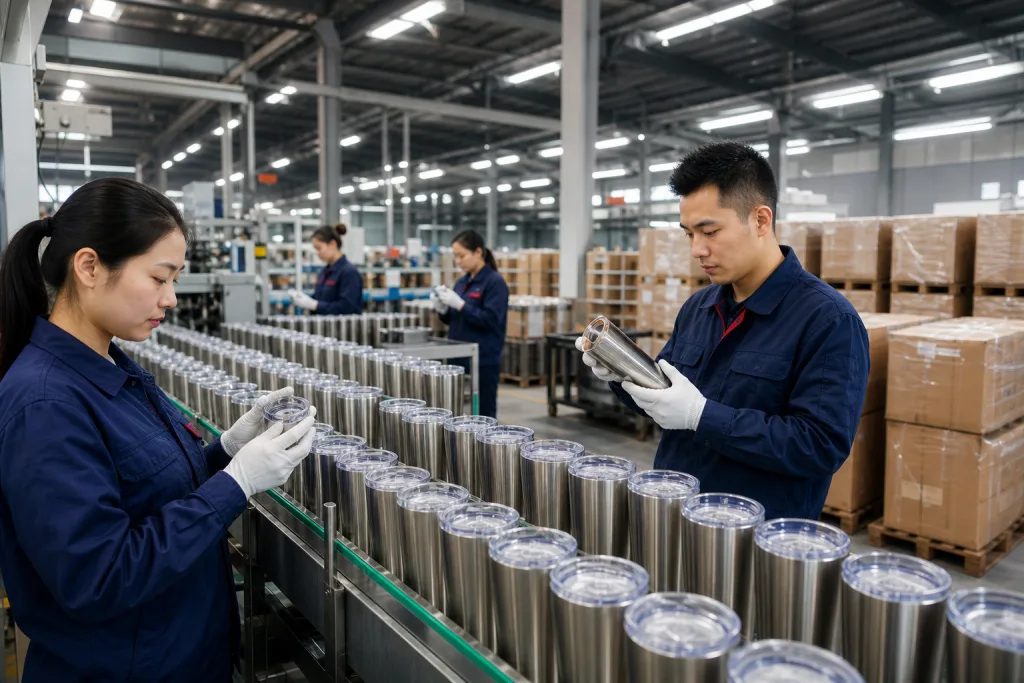
At our Zhejiang factory, we run the job through RFQ, engineering confirmation, sample approval, purchase order, production, inspection, then shipment. A typical MOQ is 1,000 pieces per color, and monthly capacity is about 450,000 stainless travel tumblers from Hangzhou, China. Get the assumptions on paper before the deposit. The math doesn't work if the buyer approves a sample on Friday, changes the lid on Monday, then expects the same ship date; we have seen that go sideways on the line when QC pulled the sample and found the straw hole diameter did not match the PO.
Start the RFQ with numbers
A clean RFQ for coffee tumbler wholesale bulk should not read, “Please quote 20 oz tumbler with logo.” On the line, that becomes guesswork, and guesswork turns into price disputes after sample approval. We had a buyer flag a PO typo on “20oz” versus “20 oz,” and the lid spec was still missing.
Put the commercial and technical lines in the first email: capacity, target quantity, target market, lid style, insulation requirement, branding method, packaging, certification needs, and Incoterm. Example: 5,000 pieces of 20 oz double-wall stainless steel bulk travel tumbler, 304 interior, powder coating, slide lid, one-color logo, individual kraft box, FOB Ningbo, delivery before 15 May. QC pulled the sample at 88 mm diameter, and that is enough for a factory to quote with real cost instead of a wild guess.
For a corporate-gift order, say whether the tumbler goes into a kit. A 20 oz tumbler that is 88 mm wide may miss a pre-cut gift box insert by 2 to 3 mm, and that small gap wrecks the pack plan. For a coffee brand, tell the supplier if it will be sold filled, bundled with beans, or shipped through ecommerce. If FNSKU labels, outer carton barcodes, or master carton weight limits apply, put them in the RFQ. We have seen a 12.5 kg carton limit blow up a standard ship plan.
PO line items to prepare at this stage:
- Item code and product name: 20 oz vacuum insulated travel tumbler, sample code T20-VI-01
- Quantity by color: for example, matte black 3,000 pcs, cream 2,000 pcs, packed separately
- Material: inner 304 stainless steel, outer 201 or 304 stainless steel, confirm both sides
- Finish: powder coating, spray paint, or raw stainless, with no logo loss on the seam
- Logo: laser engraving, silkscreen, heat-transfer, or UV print, one side or wrap print
- Packaging: white box, kraft box, color box, or gift box, with drop test requirement if any
- Trade term: FOB Ningbo, FOB Shanghai, CIF, or DDP by quotation, named port required
If you are comparing a coffee mug supplier list or a supplier directory, use the same RFQ format for every factory. Otherwise you are not comparing suppliers; you are comparing two different assumptions, and the math does not work. We run into this when one buyer asks for FOB Ningbo from one plant and DDP from another.
Choose the tumbler construction
The biggest price swing in a bulk coffee tumbler is not the logo. It is the body build, lid stack, and finishing steps. On our line, a switch from 201 outer steel to 304 outer steel changes the quote fast, especially on coastal retail runs. A standard insulated coffee mug in bulk is still double-wall vacuum stainless steel with a 304 food-contact inner wall.
Wall thickness usually sits around 0.4-0.5 mm before forming, but the gauge shifts with shape and draw depth. QC pulled a sample at 0.43 mm last week, and it passed the micrometer but failed a corner drop at 1.2 m. A thin body can look fine in photos and dent in transit. The buyer flags it later, not your warehouse team. For gifting programs, that is the wrong place to save money.
Capacity has to fit the use case, not the catalog mood. A 12 oz tumbler works for espresso retail. A 16 oz or 20 oz bulk coffee travel mug is safer for office desks and commuting kits. A 30 oz cup looks big on a showroom table, but it adds carton volume, inland trucking cost, and shelf load. We run this math every week. A 24 pcs master carton can jump from 52x36x34 cm to 58x42x40 cm fast. The math does not work if the carton gets bigger. The 16 oz and 20 oz range usually gives the best mix of perceived value and shipping efficiency.
Lids need a hard check. A press-fit slider lid is cheaper, but it is not leakproof. A threaded lid with a silicone gasket seals better, and the hand feel changes too. We test claim wording on a 30-minute inverted rig with room-temperature water. If it only holds back splash in a tote bag, call it splash-resistant. One buyer pushed back on that label last month, and they were right.
For a coffee mug private label program, ask for the technical drawing before sampling. Check height, top diameter, bottom diameter, weight, lid material, gasket material, and cup-holder fit. Zhejiang factories can make small changes, but a new mold or custom lid usually means 3,000-5,000 pieces MOQ and 25-40 days tooling time. We have seen a single typo on the PO, like a wrong lid code, waste a full sample round. Get the drawing signed off first.
Confirm branding before sampling
Lock the logo before paying the sample invoice. A coffee mug custom project goes sideways when the buyer approves the tumbler body first, then finds the 92 mm curved wall bends a 70 mm round logo or the matte coating will not hold 0.6 mm silkscreen strokes. For a coffee brand, the logo sells the cup. Treat decoration like a production spec, not a last-step artwork job.
Laser engraving is durable and clean on powder-coated 304 stainless steel. It cuts through the coating and exposes the metal, so we run it for 1-color premium corporate gifts when the buyer wants a sharper, longer-wearing mark. Silkscreen printing keeps the unit cost down for simple artwork, normally one or two Pantone colors. Heat-transfer and UV printing handle gradients and photo-style artwork, but QC should run a 3M tape test and a 500 g scratch check before anyone accepts dishwasher claims.
If you need coffee mug custom made packaging, send dielines early. A color box takes 5-7 days for proofing and 10-15 days for bulk printing, and we have lost 3 days on one order because the PO spelled the barcode file name differently from the artwork folder. A gift box with EVA insert costs more but reduces dents during premium corporate-gift distribution. For coffee mug private labeling, confirm the bottom label, care card, UPC/EAN barcode, warning text, and country-of-origin marking. For North America, around 8 out of 10 buyers ask for “Made in China” on the product or packaging; for Europe, distributors often request REACH and food-contact declarations.
PO line items to lock before sampling:
- Logo file version with Pantone references, including the actual AI or PDF file name on the PO
- Logo size in millimeters, plus exact placement from rim or base
- Decoration method with acceptance tolerance for color shift, position shift, and missing print
- Individual box artwork, barcode, insert card, and any retail sticker requirements
- Outer carton marks, carton quantity, and gross weight limit for the forwarder
A coffee mug customizable offer means little if the supplier cannot explain the limits. Fine text below 0.8 mm fills in during printing; we see it under the 10x loupe before the buyer sees it on the shelf. Large laser areas show slight tone variation. Powder coating color can vary by Delta E 1.0-2.0 between batches unless the factory controls powder source and curing settings. Ask before the first sample, not after 5,000 pieces are coated. The math does not work after that.
Use samples like a contract
The sample is not a souvenir. Treat it as the physical contract between you and the coffee mug oem manufacturer. For a new coffee mug customized project, we ask for two pieces: one plain structure sample to check capacity, lid fit, and hand feel, then one pre-production sample with final coating, logo, lid, and box. If the schedule is tight, we can combine them. That is the wrong question to ask if the lid is new. You might approve a nice-looking tumbler while missing a 0.4 mm gasket gap that QC would catch with a caliper on the line.
A normal custom sample timeline from Zhejiang, China is 7-12 days after artwork confirmation, plus courier time. If a new coating color, new lid, or molded accessory is required, sample time can run 15-25 days. We charge sample fees when artwork, coating, or packaging is customized because the line still needs film, spray tests, laser setup, or a digital box proof. Free samples often mean stock pieces only. Last month a buyer flagged a “free sample” because the PO said matte black, but the sample was our stock semi-gloss black, and the difference showed under a D65 light box.
Test the sample the same way your customer will use it. Fill it with 95°C water and measure outside wall temperature after 5 minutes. Check the lid after 30 opening-and-closing cycles, not just one snap at your desk. Leave coffee inside for 4 hours and inspect odor retention. Put the tumbler in a car cup holder. Wash it by hand and, if you plan to claim dishwasher safe, run 5 dishwasher cycles and inspect coating, logo, and gasket condition. Many factories avoid broad dishwasher-safe claims because alkaline detergents and high heat vary by market; we have seen this go sideways when a buyer used a retail claim stronger than the test report.
Sample approval notes to attach to the PO:
- Approved sample number and date, for example S-240618-02 signed on the hangtag
- Approved color standard or Pantone reference, checked under a light box instead of office lighting
- Approved logo method and location, with logo size in mm from rim and base
- Approved lid fit, gasket color, and drinking opening, including any buyer pushback on leakage angle
- Approved packaging sample and carton layout, with carton mark spelling matched to the PO
Keep one approved sample at your office and ask the factory to keep a signed duplicate on the production line. For coffee mug distributors, this simple step cuts inspection arguments fast. QC pulled the sample, puts it beside mass production, and checks coating shade, logo position, lid bite, and box print against the signed piece. When the inspector finds a deviation, the discussion becomes “match the approved sample,” not “I remember it looked different.”
Write a PO factories can follow
A weak PO says “5,000 tumblers as discussed.” The line cannot run on that. A usable PO reads like a production checklist, down to logo size, carton weight, and the artwork file date. It protects you, and it protects the factory team from crossed sales emails, three artwork revisions, and the Friday-night “small change” that changes the cost. For coffee tumbler wholesale bulk, the PO should spell out every point that affects cost, compliance, delivery, or final acceptance. Last month QC pulled a sample where the PO said matte black, but the approved photo showed powder-coated charcoal; that 1 shade difference stopped packing for 6 hours.
At minimum, include product specification, quantity by SKU, unit price, total amount, payment terms, Incoterm, delivery date, packaging details, inspection standard, document requirements, and agreed penalty or remedy terms. Do not write “standard packaging.” That phrase causes trouble. Payment is commonly 30% deposit and 70% balance before shipment after inspection for standard export orders from China. For larger repeat buyers, terms may be negotiated after several clean orders; we usually want 3 orders with no payment delay, no chargeback, and no open quality claim before discussing credit terms. The buyer may think the PO is paperwork, but this is the wrong question to ask—the PO is the job ticket for purchasing steel, booking the coating line, printing cartons, and setting AQL 2.5 inspection.
FOB pricing should state the port, usually Ningbo or Shanghai for our Hangzhou area production. If your forwarder collects cargo from the factory, use FCA or EXW carefully and confirm who handles export customs, commodity code, and factory loading photos. We have seen EXW go sideways when a buyer’s truck arrived without the right loading notice and the warehouse had 18 pallets blocked behind another order. For European and North American buyers, FOB China is often the cleanest starting point because you can compare factory cost separately from ocean freight, duty, and final delivery. Clean math matters.
Example PO lines:
- SKU: TT20-MB-LG, 20 oz vacuum insulated travel tumbler, matte black, 304 stainless inner wall, powder coating outside
- Qty: 5,000 pcs, MOQ 1,000 pcs per color, packed by SKU with no mixed-color cartons
- Unit price: USD 4.35/pc FOB Ningbo, price based on approved sample and current packaging spec
- Logo: laser engraving, 45 mm wide, front center, per AI file dated 2026-03-02, no resizing without buyer approval
- Packaging: individual kraft box, 24 pcs/master carton, carton under 15 kg gross weight, shipping mark printed on 2 long sides
- Inspection: AQL 2.5 major, 4.0 minor, special level for function tests, including leak test and lid fit check
- Lead time: 35 days after deposit and sample approval, counted from the later date if deposit and approval arrive separately
If you work through a trading company, coffee mug distributor, or coffee mug distributors network, still ask which factory is responsible for the product. A distributor can add value in consolidation and service, but you need clear accountability when there is a leak rate, coating defect, or delayed shipment. We once had a PO with the factory name misspelled by 1 letter, and the export document team caught it only when checking the packing list against the booking form. Small typo. Big delay.
Control production and inspection
Once the deposit lands, the real work starts. For a bulk coffee mug order, we run material cutting, tube forming, seam welding, vacuum pumping, polishing, powder coating, logo printing, assembly, packing, and final QC. One blocked station can eat the inspection time. Ask for line photos, vacuum test readings, and milestone updates at cutting, coating, and packing instead of waiting for the ship-date message. We once had QC pull 80 samples because a polishing wheel left hairline scratches near the bottom radius.
For a 5,000-10,000 piece order, 30-45 days is a normal lead time after approval. Peak season, usually late August through November for holiday corporate gifts, can stretch lead time by 10-20 days. Build a buffer if your coffee mug promotional campaign has a fixed event date. Do not count on air freight to save a late plan. The math doesn't work. Stainless tumblers take carton space: a 40HQ may carry around 28,000 standard 20oz units, while air freight charges by volume weight, so one schedule mistake can wipe out the margin on the whole program.
Inspection should be locked before production. AQL 2.5 for major defects and 4.0 for minor defects is common, but functional tests need separate sampling. Check vacuum performance, lid leakage, lid fit, coating adhesion by cross-hatch tape test, logo placement, sharp edges, odor, box print, barcode scan, carton marks, and carton drop resistance. For a bulk travel mug sold into retail, barcode readability and carton labeling are not small details. One wrong digit can stop inbound receiving. We have seen a PO typo change an EAN code, and the buyer flagged it only after 120 cartons were already sealed.
Compliance depends on market. For food contact, buyers may ask for LFGB, FDA food-contact related documentation, or EU framework compliance statements. For coatings and printed parts, REACH screening may be relevant. For social compliance, some buyers request BSCI, Sedex, or factory audit reports. A responsible coffee mug factory will tell you what is current, what is expired, and what needs a new test on your exact material. Ask for the report number and test date; a 304 stainless steel report from another model is not always accepted by a strict retailer.
Do not approve shipment from beauty photos alone. Photos help, but they do not test lid leakage or carton strength. Use your own inspector, a third-party QC company, or a trusted factory QC report with videos and measured data. We like short videos showing the leak test, the barcode scan, and a carton drop from the required height because arguments become shorter. Balance payment should be tied to passed inspection and correct shipping documents.
Ship without losing margin
Travel tumblers are light next to machined metal parts, but they eat carton space fast. Shipping is often where margin leaks on a bulk coffee tumbler order. We run a 20 oz tumbler in an individual box at 24 pieces per master carton, with carton size around 56 x 38 x 48 cm depending on body shape and lid height. On the line, a 3 mm change in the color-box tuck flap once dropped one pallet layer from the load plan. Small box changes are not small.
Before shipment, ask for the packing list with carton dimensions, gross weight, net weight, quantity per carton, and total CBM. Send that file to your forwarder before we book the vessel so they can quote ocean freight, LCL charges, duty, customs brokerage, and final delivery against real numbers, not guesses. For ecommerce or corporate-gift kitting, tell the factory if cartons must stay below 15 kg or if each unit needs FNSKU, UPC, or client-specific labels. QC will check labels with a barcode scanner, not by eyesight, because one wrong FNSKU can block a whole Amazon inbound carton.
For coffee brands selling retail packs, packaging has to protect the tumbler and carry the shelf look. For corporate buyers, the job is different: clean cartons, easy handout, no crushed corners. We have seen glossy gift boxes scratch inside the export carton after 18 days on the water, and the buyer flagged it before anyone filled the cup with coffee. Kraft boxes with firm inserts are usually better value than fancy paperboard that fails a simple 1.2 m drop test.
A coffee mug factory direct relationship matters when you need carton redesign, mixed-color loading, spare lids, or replacement parts. Ask for 0.5-1.0% spare lids or gaskets on larger programs if the lid is unique. If you are building a repeat coffee mug bulk program, keep the same lid platform across sizes where possible. The math doesn't work when every 12 oz, 16 oz, and 20 oz cup uses a different gasket. Our assembly bench labels spare lids by mold code, and fewer lid platforms mean fewer wrong picks during reorders.
The final shipment file should include commercial invoice, packing list, bill of lading instructions, certificate of origin if needed, test reports, inspection report, and product photos. Keep these records by PO number. We ship enough repeat programs to know the problem: six months later, a distributor asks for another 3,000 pieces of the same coffee mug promotional design, but the buyer only has a JPEG and a PO with one digit typed wrong. Keep the exact coating code, logo file, carton layout, and approved sample notes ready.
Send your tumbler RFQ for a factory review
Share quantity, logo, packaging, and deadline. We will reply with practical MOQ, FOB pricing, sample plan, and production lead time.
Frequently asked questions
What is a realistic MOQ for coffee tumbler wholesale bulk orders?
For stainless steel travel tumblers, a practical MOQ is usually 1,000 pieces per color for existing molds and standard lids. If you need a custom coating color, 2,000-3,000 pieces is more realistic because powder coating setup and color control take time. A new lid mold, special body shape, or coffee mug custom made structure may push MOQ to 5,000 pieces or more. For mixed corporate-gift orders, some factories can split 3,000 pieces across two or three standard colors, but the unit price will be higher. Always separate MOQ for the body, coating, logo, packaging, and accessories.
How much should a bulk coffee travel mug cost from China?
A typical 16 oz to 20 oz stainless vacuum bulk coffee travel mug from a China factory may quote around USD 3.20-5.80 FOB Ningbo or Shanghai. The low end usually means standard shape, 201 outer steel, simple lid, one-color logo, and basic box. The higher end may include 304 outer steel, better lid sealing, powder coating, laser engraving, premium gift box, or retail packaging. Prices change with stainless steel cost, exchange rate, and order volume. Be careful with quotes that are 20% below the market; they often remove weight, coating quality, packaging strength, or inspection support.
Which logo method is best for coffee mug promotional products?
For coffee mug promotional products, laser engraving is the safest durable option on powder-coated stainless steel, especially for corporate logos and café branding. It has no ink to peel and works well for 1-color artwork. Silkscreen is better when you need exact Pantone color at lower cost, but it should be tested for abrasion. UV or heat-transfer printing works for multi-color designs, but you should approve a decorated sample and run scratch and wash tests before bulk. For logos under 30 mm wide or with thin text below 0.8 mm, ask the factory to confirm printability before sample production.
Can I use one coffee mug supplier for both retail and corporate gifts?
Yes, if the coffee mug supplier can handle both packaging styles and documentation. Retail orders need barcode accuracy, shelf-ready boxes, compliance files, and consistent repeat SKUs. Corporate-gift orders often need faster deadlines, client logos, mixed colors, individual drop shipping labels, or kitting support. The product may be the same 20 oz tumbler, but the PO lines are different. Ask whether the factory has experience with UPC/EAN labels, FNSKU labels, AQL inspection, carton drop tests, and export documents. A supplier producing 300,000-500,000 units per month usually has stronger process control than a small workshop.
How long does coffee mug private labeling take?
For an existing travel tumbler mold, coffee mug private labeling normally takes 7-12 days for samples and 30-45 days for bulk production after deposit and final approval. Add 5-15 days if you need custom color boxes, care cards, or retail packaging proofs. Add 25-40 days if a new mold or special lid is required. Ocean shipping from China to North America or Europe may add 25-45 days depending on port and route. If the goods are for a fixed event or holiday campaign, start the RFQ at least 90 days before the required warehouse arrival date.