Key Takeaways
- For a 5,000-unit stainless travel tumbler order, expect 35-45 days after sample approval
- A practical MOQ is 1,000 units per color, but better unit pricing usually starts at 3,000-5,000 units
- Use AQL 2.5 for major defects and AQL 4.0 for minor defects on promotional drinkware
- Powder coating plus laser engraving costs more than screen print, but reduces logo wear on daily-use gifts
Your coffee campaign does not fail because the logo is ugly. It fails because the tumbler leaks inside a sales rep’s laptop bag, the powder coat rubs through after 600 km of truck freight, or the lid fit changes by 0.4 mm on the second production run. We’ve seen this go sideways. For coffee brands and corporate-gift buyers, coffee tumbler promotional products look simple on a spreadsheet, but QC pulled samples last month where 7 out of 80 lids failed the upside-down leak test.
Let’s walk one real-style order from brief to shipment: 5,000 stainless travel tumblers, custom logo, retail carton, delivered FOB Ningbo from Zhejiang, China. BottleForge Industrial runs this type of order every month in Hangzhou, Zhejiang, with practical MOQs from 1,000 units and typical output around 300,000 drinkware units/month across tumbler and bottle lines. On the line, we check rim diameter with a digital caliper, confirm carton drop-test results at 76 cm, and catch small PO mistakes like “matte balck” before artwork goes to laser or screen printing.
Start with the buyer brief
Say you are launching a winter coffee promotion for office clients. You need a bulk travel tumbler that feels better than a cheap giveaway, but USD 12 landed per piece will kill the margin. Your first email to a coffee mug manufacturer should not read, “Please quote your best tumbler.” We see that line every week. It sends the sales team digging through 30 stock SKUs, and the quotes come back all over the place.
A workable brief should state the product type, capacity, material, lid style, logo method, carton requirement, compliance market, and delivery target. Example: 350 ml or 12 oz vacuum-insulated stainless steel travel tumbler, 304 inner wall, 201 or 304 outer wall, powder-coated body, slide lid, one-color logo, individual kraft box, master carton suitable for UPS or pallet freight, REACH compliant for EU, FDA/LFGB food-contact documents available, 5,000 units, FOB Ningbo, delivery before October 15. Add the logo size in mm if you have it. Our pad-printing line will ask whether the mark is 35 mm wide or 55 mm wide before we can price the setup cleanly.
This is where 6 out of 10 coffee mug distributors lose 12 days vs 2 days. They ask ten factories from a coffee mug supplier list for a “similar item,” then compare prices that are not comparable. One quote uses 0.4 mm stainless steel, another uses 0.5 mm. One lid has a silicone seal, another has loose-fit PP. One price includes carton drop-test packing, another uses thin white boxes. QC pulled a sample last month where the PO said “black lid,” but the approved photo showed a clear slider. Small mismatch. Big argument. If you are buying coffee mug promotional products, treat the brief as a control document, not a mood board.
For most corporate-gift programs, the sweet spot is a 12 oz to 16 oz bulk coffee travel mug. It fits espresso-based coffee, cup holders, and office desks. A 20 oz size looks generous but costs more in steel and carton volume, and the freight math usually gets ugly once we load the CBM sheet. If your audience is commuters, choose a narrow bottom diameter around 68-72 mm. If your audience is desk workers, a wider base gives better stability. The wrong question is “which size looks premium?” Ask which size your buyer will actually carry on Monday morning.
Choose the tumbler construction
The sample you sign off on paper still has to survive hot coffee in a car cup holder. For a mid-range coffee mug custom made project, we usually run double-wall vacuum construction with 304 stainless steel inside, 0.4-0.5 mm inner wall thickness, and a food-grade silicone lid gasket checked with a simple pull test on the QC bench. The outer wall can be 201 stainless steel for cost-sensitive promotional runs. For premium retail or coffee mug private label programs, 304 outer wall looks cleaner after polishing and gives fewer complaints when buyers compare it side by side with retail brands.
Ask your coffee mug factory for the actual grade and wall thickness, not just “stainless steel.” We have seen one PO where the buyer wrote “SS body” and left the gauge blank; the line quoted 0.38 mm, while the approved counter sample was 0.45 mm. In China, a USD 0.25 difference can mean a different gauge, thinner powder coating, or a simpler lid. That is acceptable if you approved it. It is a problem if the factory quietly changed the spec to hit your target price.
For a 5,000-unit bulk coffee tumbler order, a practical FOB China price range is often USD 3.20-5.80 per unit depending on capacity, steel grade, lid design, coating thickness, logo process, and packaging carton strength. A plain 12 oz tumbler with screen print sits at the lower end. A 16 oz coffee mug customized with matte powder coat, laser logo, color gift box, and leak-resistant lid moves higher, especially when the buyer wants Pantone matching within 1 Delta E and no specks on dark colors. Tooling is usually not needed if you use an existing mold; a full coffee mug oem manufacturer project with a new body or lid can add USD 2,000-8,000 in mold cost and 25-45 days.
Do not over-spec the wrong feature. Buyers ask for “24 hours hot” because it sounds strong on a sell sheet. For a small coffee tumbler, this is the wrong question to ask. A realistic test is 6 hours heat retention starting at 95°C water, measured at room temperature around 20°C, with the lid closed and the sample placed away from an air-conditioner vent. If your marketing needs a formal claim, lock the test method before mass production. We have seen this go sideways when a sales team promised 24 hours hot, then QC pulled the sample at 6 hours and the temperature data did not support the carton copy.
Match branding to daily use
Logo method is the point where a travel tumbler stops being a stock cup and starts carrying the buyer’s brand. We usually quote four methods for coffee tumbler promotional products: silk screen printing for simple flat artwork, pad printing for small curved positions, laser engraving for a permanent metal mark, and full-wrap heat transfer for retail-style graphics. Same tumbler, different risk. Last month QC pulled 32 printed samples from the line because the logo sat 3 mm off the center line; that is the kind of issue buyers notice before they notice the steel grade.
Silk screen is still the safe choice for a one-color coffee mug promotional order. It keeps cost down and the line moves fast: one operator, one screen frame, one curing pass. On a powder-coated tumbler, expect solid results if the artwork has lines above 0.2 mm and avoids tiny reverse text. Pad printing works on curved or smaller logo areas, but I would not use it for a large front logo; the edge can look soft if the cup radius is steep. Laser engraving removes the powder coat and exposes stainless steel. It looks premium, does not rub off, and suits corporate-gift buyers who want an office item, not a giveaway cup. Full-wrap transfer can make shelf-ready graphics, but the math does not always work on a tight promo budget because setup time rises and reject rate can jump from 1.5% to 4% when the seam is not controlled.
For a 5,000-unit order in Zhejiang, a one-position screen print may add about USD 0.08-0.18 per unit. Laser engraving often adds USD 0.20-0.45 depending on logo size and production speed. Small logo, faster run. If you want a coffee mug customizable program with 20 names or department logos, variable laser engraving is possible, but send the name list in a locked spreadsheet and accept extra handling time. We once had a PO where “Finance Dept.” became “Finace Dept.” in 18 names; nobody caught it until the buyer flagged the carton photos. Lock the file.
Before production, insist on a physical pre-production sample with the real coating and real logo. Digital mockups help approval routing, but they do not show whether a beige logo turns muddy on a charcoal tumbler. For coffee brands, color control matters. Use Pantone references for print and give a tolerance, for example ΔE under 2.0 if your team measures color. If your brand brown is critical, say so. A factory cannot protect a color standard you never gave them, and we have seen this go sideways when the buyer approved “brown” in an email but expected Pantone 476 C on the production table.
Price the order like a distributor
A coffee mug distributor or agency buyer should price the full landed order, not just the unit FOB line. Your delivered cost includes the tumbler body, logo process, inner box, master carton, pre-shipment inspection, ocean or air freight, duty, and final truck delivery to your 3PL or client warehouse. We have seen a quote USD 0.35 cheaper at FOB lose the job after carton CBM was checked with a tape measure on the packing table. Oversized cartons, weak dividers, or a 4% lid defect rate will eat the margin fast.
Let’s price the scenario. You order 5,000 pieces of 12 oz stainless travel tumblers, matte black powder coat, laser logo, kraft box. FOB Ningbo target: USD 4.10 per unit. Sample fee: USD 80-150, usually refundable after order. Carton: 24 pieces per master, carton size roughly 50 x 38 x 42 cm, gross weight around 10-12 kg depending on wall thickness. On this spec, QC pulled the sample and checked coating thickness at the rim because thin powder coat there gets flagged first after a drop test. Sea freight to North America or Europe changes weekly, so do not build your campaign margin on last quarter’s freight rate.
MOQ is another place to be honest. BottleForge can run about 18 existing travel tumbler models from 1,000 units per color, but color consistency and setup efficiency improve at 3,000 units and above. If you ask for 300 units in four colors, this is the wrong question to ask; you are not buying coffee mug factory direct in a meaningful way. You are pushing sample-room economics onto the line. For lower volumes, stock bodies with one laser logo or one-color silk print work better, and the buyer gets a cleaner delivery schedule.
Payment terms for new buyers are commonly 30% deposit and 70% balance before shipment or against copy of bill of lading, depending on credit history. If you are sourcing through a coffee mug supplier directory, check whether the quoted supplier is the actual coffee mug factory or a trading company. Trading companies are not automatically bad, but you need to know who controls production, QC, and corrective action when a lid problem appears. We once saw a PO typo list “PP lid” while the approved sample used Tritan; the buyer flagged it two days before packing, and the math did not work for a rushed re-run.
QC before the cartons close
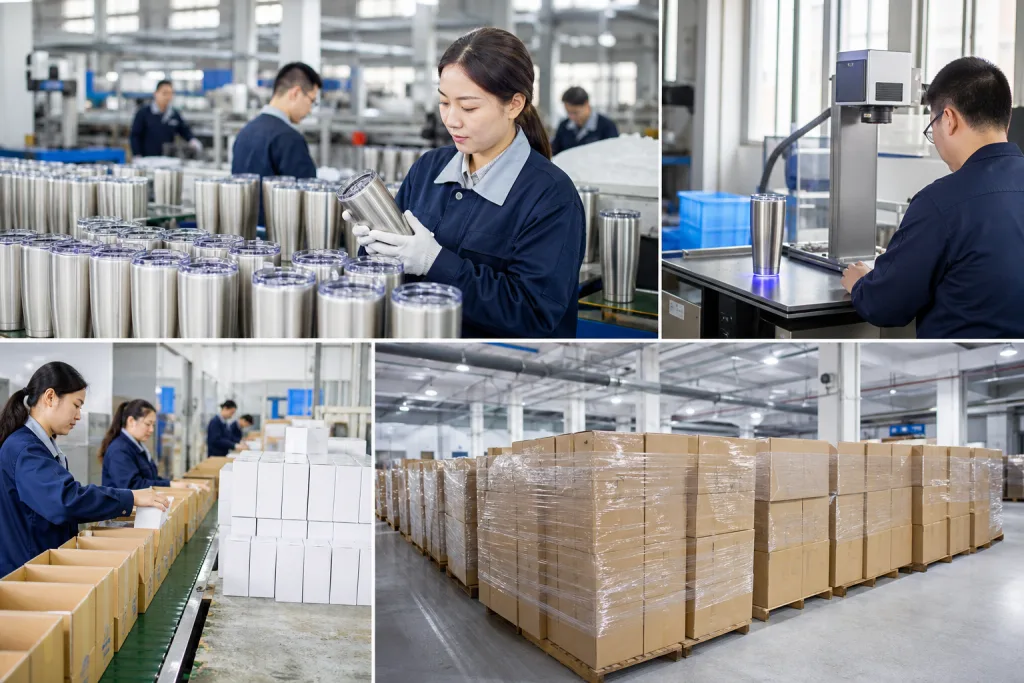
Quality control for a bulk coffee mug order is not just checking whether the logo looks straight. For this buyer scenario, put inspection stops at incoming material, first-piece approval, inline inspection at 20-30% completion, and final random inspection before shipment. We run the first-piece check with a Pantone book, caliper, 3M tape, and the signed pre-production sample on the table. If the factory refuses final inspection, find another coffee mug supplier. Full stop.
Write AQL levels into the purchase order, not just the email thread. A common setting is AQL 2.5 for major defects and 4.0 for minor defects, general inspection level II. Major defects include leaking lids, sharp rim edges over 0.3 mm burr, serious dents, wrong logo, wrong color, unstable base, failed vacuum, or contaminated interior. Minor defects include 1-2 small dust points in coating within the approved limit, slight print position variance, or small carton scuffing that does not affect retail display. We once had a buyer flag a PO typo where “matte black” became “mate black”; QC pulled the sample before the line packed 6,000 pcs the wrong way.
For vacuum tumblers, the factory should perform 100% vacuum checking, usually by hot water test or vacuum detection equipment. Ask for random heat-retention testing from production lots too; for a 500 ml tumbler, we often record starting water temperature, room temperature, and the reading after 6 hours on the QC sheet. For lids, test assembly fit, slide movement, gasket seating, and leakage under real handling: filled cup, closed lid, 30 seconds upside down, then 10 firm shakes. Be careful with the word “leakproof.” This is the wrong word for many coffee travel tumbler lids. They are spill-resistant, not bag-safe. If your product will be sold as bag-safe, specify a screw lid or locking structure, then validate it with inversion and shake testing before cartons close.
Packaging QC matters for promotional campaigns because one wrong label can delay the whole shipment. Check barcode or FNSKU placement if the order is going to e-commerce or fulfillment centers; Amazon-style labels often need a clean 50 mm x 30 mm scan area with no carton seam running through it. Confirm inner box artwork, country-of-origin marking, recycling marks, and warning text against the approved dieline. For Europe, REACH and food-contact compliance should be cleared before production, not after customs asks questions. For the United States, FDA food-contact expectations and state-specific packaging rules may apply. A serious coffee mug manufacturers partner in China should share test reports without drama, but the reports must match the material, coating, lid type, and exact model you are buying.
Approve samples without slowing production
Sampling is where the schedule either holds or starts losing days. For an existing tumbler model, a blank sample can usually ship in 3-5 days. A logo sample normally takes 7-10 days after artwork confirmation, once the AI or PDF file is checked on our laser marking jig or screen-print film. If you need custom powder coating, allow 10-14 days because the coating line must run or simulate your finish; we cannot match a Pantone from a phone photo. International courier to Europe or North America adds 3-6 days.
Do not ask for five rounds of “small improvements” without looking at the clock. We’ve seen this go sideways. If the delivery date is fixed, separate critical corrections from preferences. Critical: wrong logo size, poor lid fit, obvious coating defect, wrong capacity, wrong material. Preference: logo 3 mm higher, box kraft tone slightly warmer, matte finish slightly softer. Preferences still matter, but they should not reset the full timeline unless your campaign can absorb the delay. Last month QC pulled the sample because the lid gap measured 0.8 mm on one side, and that was worth stopping for; a 2 mm logo move was not.
For coffee mug private labeling, review the retail box early. Box dielines, instruction sheets, QR codes, and compliance icons take longer than a simple logo. If your legal team needs to approve claims like “keeps coffee hot for 6 hours,” send that text before the sample stage. Changing box copy after printing plates are made can cost USD 100-300 and delay shipment by 3-5 days. One buyer once flagged a typo on the PO after plates were finished; the math did not work, so we reprinted only the sticker label and kept the cartons moving.
A clean production timeline for this order looks like this: quote and spec lock, 2-3 days; sample production, 7-10 days; sample transit and approval, 5-7 days; mass production, 25-35 days; final inspection, 1 day; booking and loading, 3-7 days. Plan on 45-60 calendar days, not the optimistic “30 days” buyers like to hear. On the line, 5,000 pcs of 304 stainless tumblers still need welding checks, vacuum testing, powder coating, logo work, packing, and AQL 2.5 inspection before we ship.
Ship it with fewer surprises
Once goods pass inspection, the last risk is logistics. For 5,000 travel tumblers, sea freight is usually the only math that makes sense unless the promotion date is inside 25 days. Air freight can cost more than the tumbler itself; we had one buyer accept USD 3.80 air on a USD 4.10 cup because the event badge date was fixed. Rail to Europe can fit a 28–35 day plan, but space, customs routing, and battery-free product declarations still need checking before we book.
FOB Ningbo or FOB Shanghai is common for factories in Zhejiang, China. If you are comparing quotes from 3 coffee mug supplier options, make the port term match before you compare unit price. EXW Hangzhou, FOB Ningbo, and DDP Los Angeles are not the same price. The buyer flagged this last month after one PO showed “FOB Shanghai” in the header and “DDP CA warehouse” in the notes. If you want DDP, ask for a landed quote with duty assumptions shown line by line, not buried inside one clean number.
Master carton strength should match your channel. A palletized distributor order can run standard export cartons, usually 5-ply with corner protection if the carton weight is near 14 kg. Parcel-heavy fulfillment needs stronger cartons and better dividers; QC pulled one sample after a 76 cm drop test crushed the inner gift box corner. If the product goes to corporate offices, inner boxes need to look gift-ready. A crushed gift box turns a USD 4.10 tumbler into a customer-service problem.
The best coffee mug factory direct orders are boring at the end. That is good. Specs are locked, samples match production, inspection reports show acceptable defects, cartons are marked correctly, and the forwarder gets the invoice, packing list, and booking data on time. We ship smoother when the PO color code, carton mark, and barcode file all match; one wrong digit on a carton label can hold 5,000 pieces at the warehouse door. This does not happen by luck. It happens because you treated a bulk coffee mug as an engineered promotional product, not a commodity cup with a logo on it.
Send your tumbler brief for a factory quote
Share capacity, quantity, logo method, market, and delivery date. We will return practical options with MOQ, FOB pricing, and lead time.
Frequently asked questions
What MOQ should I expect for coffee tumbler promotional products?
For existing stainless travel tumbler models, 1,000 units per color is a realistic MOQ at many China factories, including our Zhejiang production network. If you need custom powder coating, private label packaging, or multiple logo positions, 3,000-5,000 units is more efficient. Below 1,000 units, you may still get a quote, but the unit price rises because setup, coating, logo alignment, and packing labor are spread over fewer pieces. For a corporate-gift buyer, 5,000 units usually gives better FOB pricing and cleaner production control than five small batches of 1,000.
Is laser engraving better than screen printing for a coffee mug custom order?
Laser engraving is more durable because it removes the coating and exposes the stainless steel underneath. It is a good choice for daily-use gifts, executive campaigns, and coffee mug private label projects where the logo should not rub off. Screen printing is cheaper and works well for one-color coffee mug promotional programs, especially if the logo is simple. As a rough FOB add-on, screen print may cost USD 0.08-0.18 per unit, while laser often costs USD 0.20-0.45. If your tumbler will be washed daily, I would lean toward laser.
How long does a bulk coffee travel mug order take?
For an existing model, plan 45-60 calendar days from confirmed artwork to goods ready for export. A normal flow is 7-10 days for logo samples, 5-7 days for sample transit and approval, 25-35 days for mass production, then 3-7 days for inspection, booking, and port delivery. If you need a custom lid, new mold, special coating, or retail packaging with several approval rounds, add 2-6 weeks. Buyers often ask for 30 days, but that leaves almost no buffer for sample corrections or QC findings.
What defects should I check before accepting a bulk travel mug shipment?
Check leakage, lid fit, vacuum performance, coating scratches, dents, sharp edges, logo position, color match, odor, dirty interiors, unstable base, and carton damage. Put AQL 2.5 for major defects and AQL 4.0 for minor defects in the purchase order. Major defects include wrong logo, failed vacuum, leaking lid, and unsafe edges. Minor defects may include small dust points or slight print variation within tolerance. For vacuum tumblers, ask the factory to do 100% vacuum checking and keep records by production lot.
How do I know whether I am working with a real coffee mug factory?
Ask for production photos, audit documents such as BSCI if available, business license details, sample lead time, monthly capacity, and the exact factory address. A real coffee mug factory should answer technical questions about stainless grade, wall thickness, coating process, lid material, AQL, and packing. A trader may still be useful, but they should be transparent. If a supplier from a coffee mug supplier directory cannot explain whether the tumbler uses 304 or 201 stainless steel, or cannot support inspection before shipment, treat that as a warning.