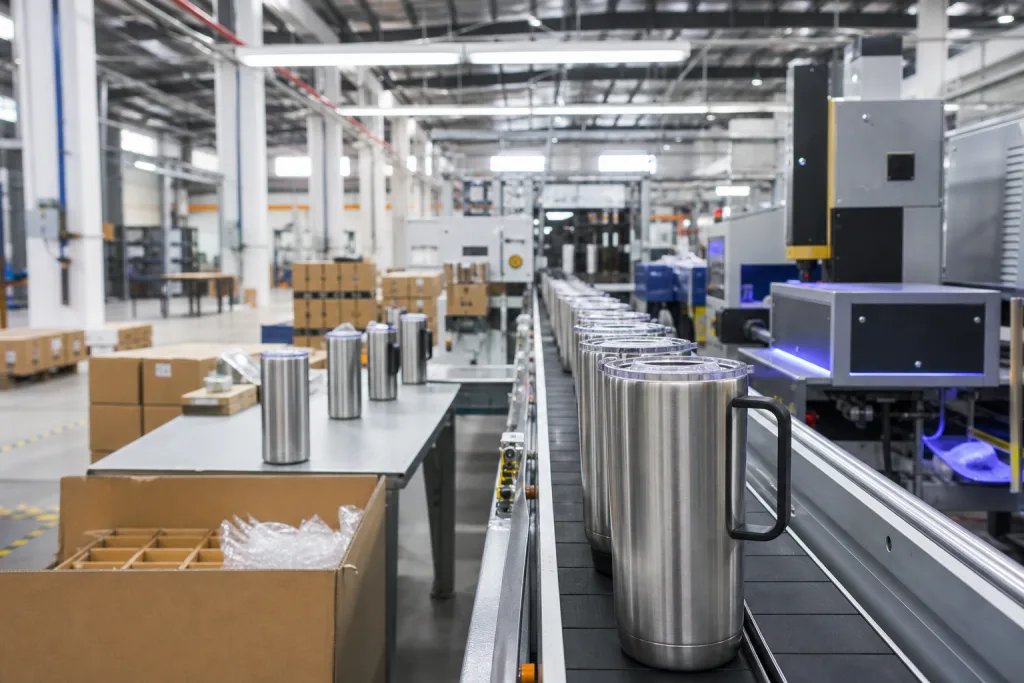
Key Takeaways
- A practical coffee tumbler private labeling MOQ is usually 1,000–3,000 pcs per color for factory direct production
- 304 stainless steel at 0.4–0.5 mm wall thickness is the normal baseline for reusable coffee tumblers
- Laser engraving is slower but more durable than pad print on powder coated bulk travel tumbler orders
- AQL 2.5/4.0 inspection and 80 cm carton drop testing reduce the most common private label failures
A travel tumbler looks simple until you put your logo on 5,000 units, split the shipment to three warehouses, and then get a photo of coffee leaking into a customer’s laptop bag. Coffee brands and corporate-gift buyers often start with the shape and logo position. Wrong starting point. The real buying risk sits in the spec sheet: 304 stainless or lower grade steel, lid gasket structure, powder coating thickness, carton drop strength, and AQL 2.5 inspection limits.
We manufacture in Zhejiang, China, and we see this pattern about 6 times a month. A buyer asks for a coffee mug custom made sample, then finds out that changing the flip lid, adding matte powder coating, or switching to a printed retail box moves cost by USD 0.20–0.90 per unit. QC pulled one sample last week because the silicone ring was 0.4 mm undersized. Small part, big complaint. Our Hangzhou line can produce about 180,000 stainless travel tumblers per month, but a clean order still starts with clear technical choices before the PO hits the line.
Capacity is a sales decision
The first spec line is usually capacity: 12 oz, 16 oz, 20 oz, or 24 oz. Do not pick it because it looks good in a catalog. For coffee tumbler private labeling, capacity decides cup holder fit, shipping cube, shelf space, and the price signal buyers feel at first glance. On our line, we check it with a car cup holder gauge before a sample moves to print.
For coffee brands, 12 oz and 16 oz usually win because they match common hot drink portions. A 12 oz tumbler is compact, easy to hold, and works well for subscription boxes or café merch. A 16 oz size sits in the middle for a bulk coffee travel mug program: good for commuters, not heavy in the hand, and still clean in a 24-piece master carton. QC pulled a 16 oz sample last week because the lid sat 2 mm too tall for the outer sleeve.
Corporate-gift buyers often ask for 20 oz because it looks bigger in photos. The math still has to work. A 20 oz vacuum tumbler may pack only 24 pcs per carton at around 60 x 42 x 28 cm, depending on lid height. If you are shipping by air for an event deadline, that extra carton volume costs more than the steel. We shipped one rush order where the buyer flagged the freight quote after the PO had already locked the date.
For most coffee mug private label projects, we ask for three checks before sample approval: body diameter under 74 mm for standard car cup holders, height under 180 mm if the retail shelf has tight spacing, and filled weight that feels stable without turning the mug into a brick. This is the wrong question to ask if you only look at capacity on paper. Use a caliper and a 5 kg scale, because a customer will judge the cup when it drops into the car, the office desk, or a backpack side pocket, not when they read the spec sheet.
Steel grade and wall thickness
Most stainless coffee mug manufacturers can type “304 stainless steel” into a quotation in 10 seconds. Ask where it is used. A proper vacuum travel tumbler normally uses 304 stainless steel for the inner wall and 201 or 304 for the outer wall. For food contact and coffee acidity, the inner wall carries the risk. We recommend 304 inner steel with 0.4–0.5 mm thickness for standard coffee mug customized projects; on our line, QC checks coil thickness with a 0.01 mm micrometer before deep drawing starts.
Thinner steel can cut FOB price by USD 0.10–0.25 per unit, but the math doesn't work if 3 cartons arrive with dented bodies. We saw this on a 5,000 pcs retail order where the buyer flagged 27 dented tumblers after drop handling at the warehouse. A coffee mug promotional order used once at a conference can accept a lighter build. A coffee brand selling drinkware next to roasted beans should not. The tumbler sits in the customer's hand every morning.
Vacuum performance depends on construction, not only steel grade. A normal double-wall vacuum coffee tumbler should keep water above 60°C for roughly 4–6 hours in a 20°C room, depending on capacity and lid design. Be careful with suppliers who promise 12 hours hot performance for every shape. Wide-mouth lids lose heat faster. Slider lids feel convenient, but they do not seal like screw lids; we run both through the same 95°C water test using a calibrated probe thermometer and the gap shows up by hour 4.
If you are comparing a coffee mug supplier directory or a coffee mug supplier list, ask each factory for the same test method: fill with 95°C water, close lid for 30 seconds, open and measure starting temperature, then measure again at 2, 4, and 6 hours. Without the same test, performance claims from any region are just sales language. We have even seen a PO say “keep hot 12 hours” while the approved sample sheet showed 6 hours, and that typo turned into a two-day email argument before production could start.
Lid structure controls complaints
The lid is the smallest part, but it creates the most emails after delivery. For bulk coffee tumbler orders, we usually quote 4 lid types: push-on slider lid, screw lid, flip lid, and handle lid. Different users want different lids. None is perfect. On the line, QC checks lid fit with a 0.20 mm feeler gauge and a simple pull test before we approve the golden sample.
A push-on slider lid sells well for coffee mug promotional products because the cost is low, cleaning is easy, and the shape looks familiar to end users. Call it spill-resistant, not leakproof. If your artwork page says “leakproof” and the cup falls sideways in a laptop bag, the complaint comes back to you, not the courier. We have seen this go sideways on a 5,000 pcs promo order where the buyer flagged 37 photos of wet notebooks. A screw lid with silicone gasket seals better, but it changes the drinking feel and slows the user at a drive-through window or office desk.
For coffee brands, we often recommend a transparent AS or Tritan-style lid with a silicone ring and replaceable slider. For corporate gifts, a black PP lid is often the safer choice because scratches and coffee staining show less after 30 days of use. Ask whether the lid material is BPA-free and whether the silicone ring can pass LFGB or FDA food-contact requirements. For EU buyers, request REACH and LFGB documents before mass production, not after goods reach port. We run this check before deposit release now because one old PO had “Trian lid” typed instead of “Tritan-style lid,” and the buyer still expected full material paperwork.
Use a simple test. Fill the sample with 80°C water, close the lid, invert it for 10 seconds, then shake lightly over white paper. A travel tumbler with slider lid may leave 2 or 3 drops. A product sold as leakproof should leave zero. The math doesn't work if sales copy promises more than the lid structure can deliver. Put the result into the approved sample note and the purchase order, including lid type, gasket material, and AQL 2.5 inspection standard.
Logo method affects durability
Private labeling is not just putting art on a cup. The method changes unit cost, lead time, reject rate, and how a bulk travel mug looks after 6 months on a desk or in a car cup holder. We run laser, silkscreen, pad print, heat transfer, water transfer, and powder coat with logo on the same line, and QC treats each one differently.
Laser engraving is our default recommendation for coffee tumbler private labeling on powder coated stainless steel. On the fiber laser station, the beam cuts through the coating and exposes the stainless base, so the mark does not peel. The tradeoff is color. You get a metallic mark, not a Pantone match. If the buyer wants a red logo, this is the wrong method. For a 2,000 pc coffee mug custom order, setup is low, but the run takes longer than one-color printing.
Silkscreen works well for a simple one-color logo on a straight wall. Once the body starts tapering, the jig and screen angle stop lining up cleanly. Pad printing handles curved areas better, but the print area is smaller. We use a 120T mesh screen for these jobs. If your brand guide calls for a fixed Pantone, ask for a pre-production sample under D65 lighting. A logo that looks fine in a PDF can look off on matte navy powder coating.
For coffee mug factory direct orders, send vector AI, EPS, or PDF files with fonts outlined. Our QC checks logo placement with a caliper, and we normally hold +/-1 mm on position and +/-5% on color for printed logos. Put those tolerances into the signed sample. Do not leave it verbal. We have seen a PO typo turn into a bad argument after 10,000 pcs are packed.
Surface finish changes the price
Surface finish is where 6 out of 10 coffee mug in bulk quotations stop matching line by line. A polished stainless tumbler, a matte powder coated tumbler, and a rubberized coating tumbler can use the same body tooling, but the coating risk is different. Powder coating usually adds USD 0.25–0.60 per unit compared with plain stainless, depending on color, order quantity, and reject rate. On our line, QC pulled one matte batch last month because the film thickness gauge showed 42–48 μm on the shoulder and only 28 μm near the bottom ring.
Matte black, white, navy, and charcoal are safer choices for bulk coffee mug programs. Light colors show dirt and carton rubbing faster; one buyer flagged grey scuff marks after a 1.2 m carton drop test. Bright Pantone colors are workable, but they need tighter color control and a higher MOQ when the coating booth must be cleaned between colors. In Zhejiang, China, a normal custom coating MOQ is often 1,000 pcs per color, while special colors may require 2,000–3,000 pcs.
Grip texture changes the user feel. A smooth powder coat looks clean in photos, but it can feel slippery when wet. A fine matte texture hides fingerprints and works well for office gifting because the logo area stays cleaner after handling. Rubberized finish feels premium on the first sample; the cheap version is where we’ve seen this go sideways, turning tacky after heat exposure or long storage. If your goods will sit in a summer warehouse in Texas or Spain, ask for an aging test at 50°C for 24–48 hours.
For a coffee mug customizable retail program, approve both a color chip and a finished tumbler sample. Flat chips lie. Coating color on a 0.5 mm stainless chip can shift once sprayed on a curved body, especially around the shoulder and base. The sample is the contract, not the catalog image, and we write that sample code on the PI so nobody argues over a screen photo later.
Packaging is not decoration only
Packaging protects the tumbler, carries the barcode, and affects how fast your warehouse can receive the order. For coffee mug distributor and coffee mug distributors serving corporate accounts, the wrong box can wipe out margin through relabeling, repacking, or damage claims. Choose packaging with the tumbler spec, not one week before shipment. We have seen this go sideways when a buyer approved the cup sample first, then sent a PO with “retail box TBD” in the packing line; the line waited 4 days for box dielines while finished 20 oz tumblers sat in trays.
Common options include white box, kraft box, color retail box, gift box with insert, and mailer box. A plain white or kraft box may cost USD 0.08–0.18 per unit. A printed retail box often adds USD 0.20–0.45, and a rigid gift box can add much more. For Amazon or marketplace delivery, you may also need FNSKU labels, suffocation warnings for polybags, and carton labels with SKU, quantity, gross weight, and country of origin. Small labels matter. QC pulled the sample last month because the FNSKU sticker was 3 mm too close to the box edge, and the buyer flagged it during warehouse scan testing.
Carton strength is a technical spec, not a design afterthought. A normal master carton should pass an 80 cm drop test on one corner, three edges, and six faces if you expect courier handling. For sea freight on pallets, the risk is different: compression and moisture matter more. Ask for 5-ply export cartons when shipping heavy 20 oz stainless tumblers. If the carton wall is too weak, your coffee mug customized goods arrive with dented lids and crushed retail boxes. The math does not work if you save USD 0.06 on carton board and lose 2 cartons per 500 pcs after the forwarder stacks 18 kg cartons four layers high.
At BottleForge in Hangzhou, standard lead time is 25–35 days after deposit and artwork approval for private label travel tumblers. Add 5–7 days for printed retail packaging and another 3–5 days if you need barcode application or mixed-SKU carton sorting. We run barcode checks with a handheld scanner before sealing master cartons, and mixed-SKU jobs need a packing table count sheet, not just a note from sales. Ship clean.
Inspection terms belong on the PO
A solid purchase order for a coffee mug oem manufacturer needs more than item name and price. Put the approved sample version, material, capacity tolerance, coating color, logo method, packaging, inspection standard, and shipment term on the PO. For example: “Sample 2025-03-14, 304 stainless inner, 500 ml ±5%, Pantone 426C powder coating, laser logo 35 mm wide, 1 pc/white box.” If these lines are blank, the low-cost reading wins on the line.
For bulk coffee mug and bulk travel tumbler orders, AQL inspection is the standard tool we run. We usually suggest AQL 2.5 for major defects and AQL 4.0 for minor defects, based on ANSI/ASQ Z1.4 general inspection level II. Major defects include leaking lids, sharp edges, wrong logo, severe dents, failed vacuum, and wrong packaging. Minor defects include small coating specks, slight print offset inside tolerance, or light carton rubbing. Last month QC pulled the sample after 500 pcs because the lid gasket sat 0.8 mm proud; that is a major issue, not a “small assembly difference.”
FOB Ningbo or FOB Shanghai is common for Zhejiang drinkware shipments. EXW may look cheaper, but it puts local trucking, export declaration, and handling coordination on your desk. New to China sourcing? FOB is cleaner. For urgent corporate-gift deadlines, air shipment works for 500–1,000 pcs, but the math doesn't work on a 5,000 pc stainless tumbler order by air because volume weight runs high; we have seen cartons hit 18 kg chargeable weight while the actual scale weight was only 11 kg.
Do not rely on a coffee mug manufacturer telling you “quality is good.” Ask for pre-production photos, in-line checks after the first 500 pcs, and a final inspection report before balance payment. A professional coffee mug factory will not be offended. We prefer buyers who put requirements in writing because it keeps production clear for both sides, and it stops arguments later when the buyer flagged “matte black” but the PO typo said “mate black.”
Send your tumbler spec sheet for a factory quote
Share capacity, logo method, color, packaging, and target quantity. We will return practical FOB pricing, MOQ, and lead time options.
Frequently asked questions
What is a realistic MOQ for coffee tumbler private labeling?
For factory direct production in China, a realistic MOQ is 1,000 pcs per color for an existing travel tumbler mold with laser logo or one-color print. If you need custom powder coating, retail box printing, or several Pantone colors, expect 2,000–3,000 pcs per color. A new mold for a coffee mug custom made body can require 10,000 pcs or tooling charges of USD 2,000–8,000 depending on structure. Smaller orders are possible with stock blanks, but the unit price is higher and logo placement options are more limited.
How much should a private label stainless coffee tumbler cost?
A typical 16 oz double-wall stainless travel tumbler from a coffee mug factory in Zhejiang may range from USD 3.20–5.80 FOB, depending on steel grade, coating, lid design, packaging, and order quantity. A simple stainless body with white box and laser logo sits near the lower end. Powder coating, printed retail box, screw leakproof lid, and barcode labeling push the price up. If a quote is 20–30% below the market, check steel thickness, lid material, vacuum performance, and carton quality before you compare it seriously.
Can I use the same tumbler for retail and corporate gifting?
Yes, but specify packaging and decoration carefully. Retail buyers usually need barcode labels, printed boxes, country-of-origin marking, and stronger shelf appearance. Corporate-gift buyers often care more about logo accuracy, delivery date, and individual gift boxes. The tumbler body can be the same 16 oz or 20 oz model, while packaging changes by channel. For a mixed order, we often run one bulk coffee tumbler production lot, then split packing into retail boxes and corporate kraft gift boxes during final assembly.
Is laser engraving better than printing for a coffee brand logo?
For long-term use, laser engraving is usually better on powder coated stainless steel because it does not peel or fade like surface ink. It is a good choice for coffee mug private labeling when your logo works in a single metallic tone. Printing is better when you need Pantone color, fine gradients, or a large full-color graphic. For café merchandise sold at USD 15–30 retail, we normally recommend powder coating plus laser engraving. For short-term coffee mug promotional products, one-color silkscreen may be more cost-effective.
What documents should I request before importing tumblers?
Ask for food-contact declarations for the stainless steel, plastic lid, and silicone gasket. For Europe, request LFGB or EU food-contact test reports and REACH compliance where applicable. For the United States, FDA food-contact compliance is commonly requested, and some buyers also ask for Prop 65 review depending on market exposure. If your client has ESG requirements, request BSCI, ISO 9001, or factory audit documents. Also get a final inspection report, packing list, commercial invoice, and bill of lading before cargo release.