Key Takeaways
- A practical coffee tumbler private label MOQ is usually 1,000-3,000 units per color, depending on coating and logo method
- 304 stainless steel with 0.45-0.55 mm wall thickness is the normal commercial range for travel coffee tumblers
- Powder coating adds about USD 0.25-0.55 per unit but performs better than basic spray paint for corporate gifts
- A 12-20 oz tumbler with a slider lid fits most coffee-brand and office-gift programs better than oversized designs
A coffee tumbler private label project looks simple until you put two quotes on the same desk and find a 35% gap while both suppliers say “same quality.” Price matters, but it is the wrong question to ask first. For coffee brands and corporate-gift buyers, the real check is hand feel, heat retention, courier drop survival, and whether the logo still looks clean after 30 washes. Last week QC pulled a 420 ml sample from the line with a 0.38 mm outer wall; it looked fine in photos, but it felt light the second you picked it up.
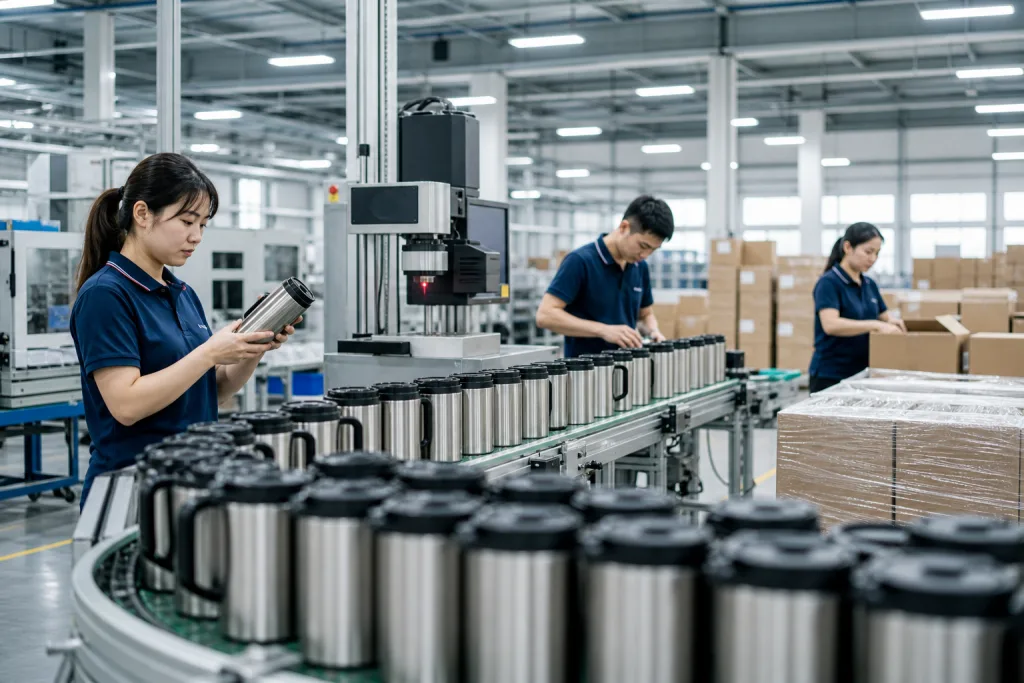
At our Zhejiang factory, we see the same buying mistakes about 12 times a month: choosing a thin body to save USD 0.20, pairing a flip lid with a car-cup brief, or approving a coating that scratches before retail packing. We’ve seen this go sideways. If you are sourcing from China for bulk coffee tumbler orders, compare wall thickness, lid seal, powder-coating adhesion, carton drop test results, and logo process before you compare the final unit price. Catalog photos won’t catch a lid that leaks after 3 shakes on the test bench.
The Head-To-Head Spec Check
Ask a coffee mug manufacturer for a quote, but don’t open with “send your best price.” That is the wrong question to ask. Send a spec table first. On our line in Hangzhou, two bulk coffee travel mugs can share the same PDF shape, then feel different once QC checks weight on a 0.1 g scale, measures wall thickness with a micrometer, and fills the cup with 88°C water for a lid shake test. The table below is close to what we use before we cut sampling steel or book a powder-coat trial.
| Spec | Budget gift tumbler | Coffee brand retail tumbler | Best fit |
|---|---|---|---|
| Capacity | 12-14 oz | 16-20 oz | 12 oz for events, 16 oz for daily coffee |
| Steel | 201 outer / 304 inner | 304 inner and outer | 304/304 for premium private label |
| Wall thickness | 0.35-0.40 mm | 0.45-0.55 mm | 0.50 mm feels more solid |
| Insulation | Basic vacuum | Copper-plated vacuum optional | Retail and coffee subscription packs |
| Lid | Push-on PP lid | Tritan slider lid with silicone seal | Commuter and office use |
| Finish | Spray paint | Powder coat or brushed steel | Powder coat for color programs |
| Logo | 1-color silk screen | Laser, UV print, or full-wrap | Laser for long service life |
For coffee mug private label work, the cheapest column seldom wins. The math doesn’t work for a coffee brand selling at USD 18-28 retail if the tumbler feels tinny, shows a rough weld seam, or leaks after 30 seconds upside down with hot liquid inside. QC pulled a sample last month with a 0.36 mm body and the buyer flagged the hollow feel before we even checked the logo position. A corporate-gift buyer can accept a lighter body when the campaign runs 2 weeks and the budget is fixed at USD 4.00-5.50 FOB China.
Our Hangzhou, Zhejiang team usually locks the body, lid, and finish before decoration. Change all four at once and sampling gets messy. We run one reference sample as the purchase order standard, then match carton packing, barcode placement, and AQL inspection against it; even a 3 mm logo shift or one typo on the PO color code can slow approval by 12 days vs 18 days. Set the cup first. Then brand it.
Retail Coffee Brand Versus Corporate Gift
A coffee brand and a corporate-gift buyer both search for coffee mug custom options, but they are not buying the same job. The coffee brand needs repeat use, shelf pull, and a tumbler that fits the story on the bag of beans. The gift buyer wants the logo centered, carton marks correct, and 2,000 units on site before the conference check-in desk opens. We’ve seen this go sideways when the PO says “matte black” and the approved sample is “sand black” from our powder-coating line.
For a retail coffee mug private labeling project, choose a product people will still use after 12 months. Start with 304 stainless steel inside, a lid the customer can take apart for cleaning, and a finish that survives being dropped into a car cup holder twice a day. A 16 oz bulk travel tumbler is usually the safest size because it covers hot coffee, iced latte, and office water. QC pulled one 16 oz sample last month after 48 hours of lid testing because the silicone ring sat 0.8 mm proud; small issue, big complaint risk.
For promotional campaigns, a 12 oz or 14 oz bulk coffee mug can work better. Lower unit price. Smaller carton. Less pain if the buyer suddenly asks for air freight. A typical 12 oz double-wall stainless tumbler may pack 24 pieces per export carton, while a 20 oz tapered travel tumbler often packs 25-30% more volume per unit. That changes landed cost, not just FOB price, and this is where buyers sometimes ask the wrong question. The math doesn’t work if you save USD 0.18 per piece and then pay for 9 extra cartons on DHL.
If your project is coffee mug promotional products for a company event, use a simple logo method: laser engraving on stainless steel, 1-color silk screen on powder coating, or UV print for multicolor artwork. If your project is a coffee mug customized retail line, spend more time on PMS color matching, retail box dielines, barcode placement, and drop-test packing. Same-looking tumbler, different risk. On retail orders, we run barcode scans on the packed master carton because one wrong EAN sticker can stop 1,200 pieces at a warehouse receiving dock.
Body, Lid, And Drinking Experience
The body shape decides whether your tumbler becomes somebody’s daily cup or sits in a drawer. Straight-wall tumblers look clean and print well on our rotary screen line, but a 78 mm lower diameter will fail in some car cup holders. Tapered bodies work better for commuters. Handle tumblers sell fast for cold drinks, but for a coffee tumbler private label project, the math does not always work: one 40 oz handle cup can take the carton space of 1.4 regular 20 oz tumblers, and several buyers have flagged them as too casual for office gifting.
For hot coffee, check 3 details on the sample, not just the product photo. The lip should feel smooth after polishing, with no sharp edge hiding under the powder coating; QC pulled one sample last month with a 0.2 mm burr near the rim. The lid needs a silicone gasket with even compression. The drinking opening should slow the flow. Too-wide sip holes feel cheap when the coffee is hot.
Common lid choices include PP push lids, Tritan slider lids, flip lids, and leak-resistant screw lids. Do not confuse “leak-resistant” with “leakproof.” This is the wrong question to ask if the buyer plans to throw the cup into a laptop bag. Most coffee travel tumblers with slider lids are fine for desk and car use, not backpacks; we run a 30-second inverted test on request, and slider lids often show small drops around the rail. If you need true leakproof performance, the lid structure changes and the unit cost can increase by USD 0.40-0.90.
Wall thickness also matters. We often see low-cost offers using 0.35 mm steel, and yes, it can pass a quick visual check under the inspection lamp. Drop it from 80 cm onto the packing table edge and the weakness shows. For a coffee mug custom made program that carries your brand name, 0.45-0.55 mm is a better range. The finished weight may increase by 20-45 g, but the hand feel improves immediately.
For coffee brands, a tumbler is packaging that customers keep touching. If the lid rattles or the coating chips, they blame your brand, not the factory in China.
Decoration Methods Compared Honestly
No decoration method wins every coffee mug customizable project. The right pick comes from artwork, surface finish, order quantity, and where the tumbler will be used—office desk, retail shelf, or daily car cup holder. We quote decoration as its own line on the PI; if a coffee mug factory direct price says “custom logo included” with no method, size, or position, the buyer should push back. We saw one PO last month list “black logo” while the attached AI file was PMS 7546C, and QC pulled the sample before the line wasted 3,000 bodies.
- Laser engraving: Clean and hard to wear off. Best on 304 stainless steel, powder coat, and premium corporate gift orders. Cost is USD 0.10-0.35 per logo depending on size and position; a 35 x 45 mm front mark runs faster than a wrap logo near the seam.
- Silk screen printing: Works well for 1-2 color logos on flat or slight-curve areas. It makes sense from 1,000+ units because the screen charge spreads out, but tiny gradients and 0.2 mm hairlines are where the math does not work.
- UV printing: Good for multicolor logos and small-batch visual punch. It costs more than screen printing, and we run cross-hatch adhesion testing on the coating because some matte powders reject ink after oven curing.
- Heat transfer or water transfer: Better for full-wrap patterns and retail-style graphics. Setup cost is higher, MOQ often starts at 2,000-3,000 units per design, and the buyer should approve the seam position before mass production.
- Embossed or debossed parts: Strong brand effect, but tooling is required. Better for long-term coffee mug oem manufacturer programs, not one-off campaigns; a lid mold change can add 12-18 days before the first approved sample.
If you are a coffee mug distributor building a line for several clients, standardize your decoration zones. Use one 50 x 60 mm front logo area across 12 oz, 16 oz, and 20 oz models, then keep the same artwork naming rule on every reorder. Faster approvals. Fewer mistakes. We ship repeat orders cleaner when the line sees the same jig setting instead of three logo positions for one customer.
We ask for vector artwork in AI, PDF, or EPS format. For PMS matching, expect one lab dip or coating plate before mass production, and ask for photos under a D65 light box instead of judging color from a phone screen. On powder coating, Delta E below 1.5 is hard to promise at normal pricing; Delta E 2.0-3.0 is more realistic for industrial production in Zhejiang, China. We have seen this go sideways when a buyer approved a sample under warm office lighting, then flagged the bulk cartons after AQL 2.5 inspection.
MOQ, Price, And Lead Time Reality
Buyers often ask for a coffee mug supplier list or coffee mug supplier directory because they think 20 quotes will show the “real” price. This is the wrong question to ask. Quotes only mean something when the spec sheet is locked: 201 steel vs 304 steel, 0.4 mm body vs 0.5 mm body, spray paint vs powder coat, white inner box vs 5-layer export carton. Last month QC pulled a sample where the quote said “304 stainless,” but the magnet check and material report showed 201 on the outer shell. Cheap quote, expensive problem.
For our Zhejiang production line, a typical coffee tumbler private label MOQ is 1,000 units per shape for laser logo on stock colors, 2,000 units per color for custom powder coating, and 3,000 units or more for full-wrap transfer printing. We run about 450,000 stainless travel tumblers per month, but the line still needs booking before peak season. April to August gets tight because Q4 promotional and retail programs start moving, and powder coating slots fill first. One buyer flagged this after sending a PO with “matte black” in the email and “gloss black” on the artwork file; that kind of mismatch can burn 3 days before production even starts.
As a practical FOB China range, a 12 oz stainless double-wall tumbler may land around USD 3.20-4.60 depending on lid and finish. A 16 oz retail-grade bulk coffee tumbler often sits around USD 4.20-6.80. A heavier 20 oz model with powder coat, Tritan lid, and retail box can reach USD 6.50-9.50. These are not promises for every project. They are a sanity check. If another factory quotes USD 2.40 for a powder-coated 20 oz tumbler with retail box, the math does not work unless they cut steel thickness, carton strength, lid material, or inspection time. We have seen this go sideways when the outer carton dropped from 12 kg burst strength to a soft local carton and arrived crushed at the buyer’s warehouse.
Sampling usually takes 7-12 days if using an existing mold and available color. Custom coating or full-wrap artwork can take 12-18 days. Mass production is normally 25-40 days after deposit and sample approval. Add 3-7 days for final inspection, booking, and inland trucking to Ningbo or Shanghai port. If you need 5,000 pieces for an event in 30 days, choose an existing color and a simple logo. Do not invent a new lid. The mold shop will not save you, and a new lid needs fit testing with the silicone ring, leak test rack, and cup-mouth tolerance checked in mm before we ship.
Compliance And Inspection Before Shipment
Coffee mug manufacturers should discuss compliance without looking shocked on the call. For Europe, ask for LFGB or EU food-contact test reports, REACH coverage for painted or powder-coated surfaces, and retail packaging checks such as German text, recycling marks, and polybag warning size. For the United States, FDA food-contact expectations and California Proposition 65 review can affect the artwork, the coating choice, and even the warning label position. For children’s products, ASTM and CPSIA questions get stricter, but 95 out of 100 travel coffee tumbler projects we run are adult-use items. QC still checks the mouth rim with a 0.05 mm feeler gauge because a clean lab report does not fix a sharp edge.
Factory audits are separate from product tests. If your customer requires social compliance, ask whether the factory has BSCI, Sedex, or similar audit experience before the PO lands in our inbox. Do not wait until the purchase order is signed. Audit scheduling can add 2-4 weeks if the report is expired or if the buyer needs a specific platform. We had one buyer flag an expired Sedex report after deposit payment; the line sat idle for 6 days while the auditor confirmed the booking.
For inspection, use AQL instead of writing “check carefully” on page 3 of the PO. A common setup is AQL 2.5 for major defects and 4.0 for minor defects. Major defects include lids leaking during a 180° inversion test, logo color outside the approved Pantone range, exposed sharp metal, vacuum insulation failing after the hot-water hold check, and dents deeper than the agreed limit. Minor defects include coating dust under 0.3 mm, slight print offset within the signed sample, or carton scuffing that does not affect retail display. Vague inspection language is the wrong question to ask; the math does not work when 12,000 pcs are already packed.
For a bulk coffee mug order, we recommend these checks before shipment: vacuum performance test with 95°C water, coating adhesion cross-hatch test using 3M tape, lid fit and leak test, logo rub test with alcohol or dry cloth as agreed, carton drop test, and barcode scan if retail or FBA is involved. If you are shipping to Amazon or a 3PL, confirm FNSKU labels, carton weight below your warehouse limit, and master carton dimensions before production packing starts. We ship too many cartons to accept “label later” as a plan; one 16.8 kg master carton rejected by the warehouse can slow the whole booking.
A good coffee mug supplier will welcome clear inspection rules because they cut arguments. A weak supplier prefers vague approval because it leaves room to bargain after problems show up. We have seen this go sideways: QC pulled the sample, the buyer flagged the logo, and the PO still had the old artwork code typed in by mistake.
Which Tumbler Should You Choose
If you are buying for a coffee roaster, café chain, subscription box, or corporate gift program, start with the drinking habit, then pick the cup. Wrong question: “Which model looks premium?” Better question: “Will their customer carry it in a car, drink at a desk, or toss it into a tote bag?” On our line, QC checks lid fit with a 180° tilt test before packing, and that test catches more complaints than the mirror polish ever will. The best bulk travel mug is not always the highest FOB model. It is the one your customer will actually use.
For coffee retail shelves
Choose a 16 oz stainless steel tumbler with 304 inner and outer, 0.50 mm wall, powder coat finish, and Tritan slider lid. For retail, we usually run laser engraving or one-color print under 70 mm wide because small text starts to fill in after curing. Add a retail box with barcode, care instructions, and country-of-origin marking; we once had a buyer flag 6,000 boxes because “Made in China” was missing from the bottom panel. This is the safer coffee mug private label route when brand reputation matters more than chasing the lowest FOB.
For corporate gifting
Choose a 12 oz or 14 oz tumbler with a clean tapered body and a reliable push lid or slider lid. Keep the logo under 60 mm wide for better print control, especially on curved bodies where the pad-print jig only gives so much forgiveness. Tight budget? Use stainless outer with laser engraving instead of custom color coating. It looks professional, ships faster, and avoids PMS disputes; we have seen a PO list PMS 186C while the artwork file said 187C, and nobody wants that argument two days before mass production.
For distributors
If you serve several coffee mug distributors or corporate clients, build a small platform: 12 oz, 16 oz, and 20 oz bodies with related lids and shared decoration zones. Make the spec sheet boring. That is a good thing. We can quote faster, hold 3-5 sets of approval samples, and reorder with fewer surprises because the lid mold, silicone ring, and carton insert are already proven. A coffee mug in bulk program gets messy when every SKU becomes a fresh engineering job.
For first orders, we advise one hero model, one color, and one decoration method. After the first 1,000-3,000 units sell through, add extra colors or seasonal artwork. Private label drinkware rewards discipline. We have seen this go sideways: 8 colors at launch, MOQ split too thin, then the buyer is stuck with 312 slow-moving pink units and a carton mark revision. Too many variations create slow-moving stock, longer defect meetings, and cartons that warehouse teams label wrong.
Send Your Coffee Tumbler Spec For Review
Share target size, logo, quantity, market, and deadline. We will respond with practical options, MOQ, FOB pricing, and sampling timing.
Frequently asked questions
What MOQ should I expect for coffee tumbler private label orders?
For an existing travel tumbler shape, expect 1,000 units for a simple laser logo on stock colors. Custom powder coating usually starts around 2,000 units per color, because the coating line needs enough pieces to control waste and color consistency. Full-wrap designs, molded accessories, or special lids often need 3,000-5,000 units. If a supplier accepts 100 pieces with custom PMS coating at a very low price, ask how they will run the coating and inspect color. Small trial orders are possible, but they usually use stock bodies and standard finishes.
Is 304 stainless steel necessary for a bulk coffee travel mug?
For the inner wall, yes, 304 stainless steel is the normal standard for hot coffee contact. Some budget tumblers use 201 stainless steel on the outer wall to reduce cost, which can be acceptable for promotional projects if clearly stated. For retail coffee mug private label products, 304 inner and 304 outer is cleaner and easier to explain to customers. The price difference may be USD 0.20-0.60 per unit depending on size and steel market pricing. Always ask the factory to state the steel grade on the quotation and test report.
Which logo method lasts longest on coffee mug customized products?
Laser engraving is usually the most durable because it removes or marks the surface rather than adding ink on top. On powder-coated tumblers, laser creates a clean permanent mark and performs well after repeated washing. Silk screen printing is fine for large one-color logos, but it depends heavily on ink, curing, and coating adhesion. UV printing gives good color detail, but you should request a rub test and dishwasher guidance. For coffee brands selling retail, we normally recommend laser engraving or a tested screen print, not untested multicolor decoration rushed before shipment.
How long does production take for coffee mug promotional products?
If you use an existing tumbler, stock color, and simple logo, sampling can take 7-12 days and mass production usually takes 25-35 days after approval and deposit. Custom coating, new packaging, or full-wrap artwork can push sampling to 12-18 days and production to 35-45 days. Add time for inspection, export booking, and ocean freight. From China to North America or Europe by sea, many buyers plan 30-45 additional days port to port, depending on route and season. For fixed event dates, approve a backup stock color early.
How do I compare coffee mug factory direct quotes fairly?
Put every quote into the same line-by-line format: capacity, steel grade, wall thickness, lid material, coating, logo method, packaging, MOQ, sample cost, lead time, and Incoterm such as FOB Ningbo or FOB Shanghai. A USD 4.10 quote may not be cheaper than a USD 4.70 quote if it uses thinner steel, a basic lid, and a weaker carton. Ask for product weight in grams and carton dimensions. For orders above 3,000 units, request AQL inspection terms and food-contact test options before you pay the deposit.