Key Takeaways
- A practical MOQ for coffee mug custom projects is usually 1,000-3,000 pieces per color, depending on coating and logo method
- A serious RFQ should include capacity, steel grade, lid type, logo process, packaging, test standard, and target delivery date
- Pre-production samples normally take 7-12 days; bulk production in Zhejiang typically runs 25-40 days after approval
- Your PO should list AQL level, carton marks, spare parts, FOB port, payment terms, and approved sample reference
A coffee tumbler looks simple until you buy 5,000 pieces and QC pulls 32 leaking lids from the first carton check. Then the matte coating scratches under a 3M tape test, or the gift box adds 6 mm and breaks your carton plan. Coffee brands and corporate-gift buyers rarely lose money because they picked 304 stainless instead of plastic. They lose it because the RFQ said “premium tumbler” and the PO missed the seal ring, coating thickness, barcode position, or insert card size.
As a coffee tumbler manufacturer in Zhejiang, China, we see this pattern 8 or 10 times a month: buyers ask for a bulk coffee travel mug price first, then come back for powder coating, private label packaging, FNSKU labels, or REACH documents. Wrong order. If you want factory-direct pricing without factory-direct mistakes, start with the product specification, not the unit price; the math changes fast when the line has to add a color logo, an individual polybag, and a 12 kg master carton limit.
Start With The Actual Use Case
Before you contact a coffee tumbler manufacturer, pin down where the tumbler will be used and who gets blamed if it fails. A coffee roaster selling merchandise is not buying the same cup as a bank ordering year-end gifts. The roaster will check shelf look, hand feel, barcode label position, and whether customers come back for the same 12 oz cup. The bank will ask about delivery date, logo position within 0.5 mm, carton marks, and leakage during handout. We have seen this go sideways when the buyer only says “premium tumbler” and QC pulled the sample later with the wrong lid for bag use.
For coffee brands, the usual sizes are 12 oz, 16 oz, and 20 oz. A 12 oz coffee mug custom made for café counters feels premium, but there is less room for vacuum structure once the inner wall, outer wall, and lip rolling are set. A 20 oz bulk travel tumbler works better for commuters, retail bundles, and customers who want one refill to last the morning. For corporate-gift buyers, 16 oz is the safe middle: it fits most car holders around 70 mm bottom diameter, does not look oversized in women’s bags, and still holds daily coffee. The math does not work if you choose 12 oz, add a thick powder coat, request 8-hour heat retention, then push for the lowest mold cost.
Your first sourcing note should include the drinking scenario. Say whether the buyer will use it in a car cup holder, office desk, café retail shelf, event welcome pack, or online store, and tell us which one matters most. Lid style changes the whole order. A sliding lid is convenient for desk drinking, but it is not fully leakproof when a carton is shaken or a bag is placed sideways. A flip lid with silicone seal is better for bags, but it changes drinking angle, tooling, and cost. Last month the buyer flagged a sample because the slide lid passed the visual check but leaked after our QC put it through a 3-minute inverted test.
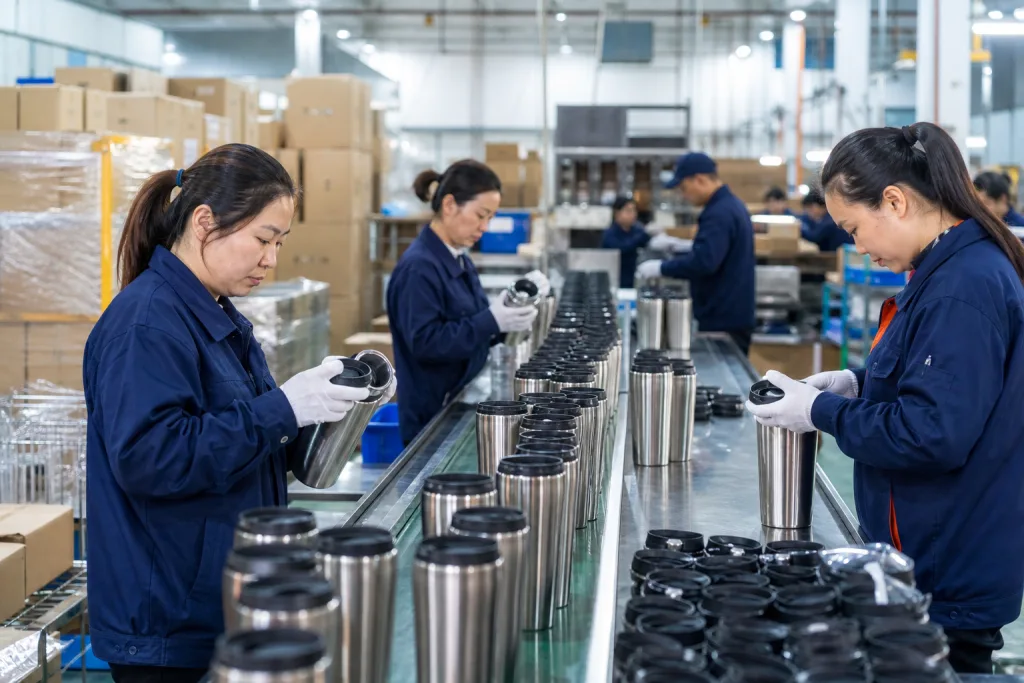
At BottleForge Industrial in Hangzhou, Zhejiang, our travel tumbler lines run about 450,000 units per month across stainless bottles, mugs, and tumblers. Capacity helps. It does not replace a clean brief. A vague request like “send price for bulk coffee mug” gets a vague quotation, usually with three lid guesses and no packing answer. A better first line is: “16 oz double-wall 304 stainless coffee tumbler, powder coated, laser logo, push-on slide lid, individual kraft box, 3,000 pieces, FOB Ningbo.” With that, we can check the line schedule, coating booth load, laser jig, carton size, and whether the MOQ matches the finish.
RFQ line items at this stage: capacity in oz/ml, target user with main drinking place, lid type with leakproof expectation, cup-holder bottom diameter, hot/cold use, retail or gift channel with packing style, target order quantity, expected delivery window, and destination market with compliance needs.
Build A Specification That Factories Can Quote
A coffee mug factory can only quote cleanly when the RFQ has measurements. “Good quality” means nothing on our costing sheet. We can quote 201 stainless steel, 304 stainless steel, or 316 stainless steel; all three can look the same in a supplier photo. For most coffee mug private label projects, 304 stainless steel is the safe commercial choice. The inner wall should be 304 food-grade stainless, usually 0.4-0.5 mm thick, checked with a micrometer before polishing. The outer wall can be 304 or 201 depending on target price, but buyers in Europe and North America usually ask for 304/304 because the story is cleaner and the buyer flagged mixed steel on two projects last quarter.
Vacuum insulation needs a test report, not a sales promise. For a 16 oz travel tumbler, a reasonable heat retention target is 60°C or above after 6 hours when filled with 95°C water at room temperature. We run this on the line with a calibrated probe and a 6-hour log sheet. Do not copy big numbers from retail packaging unless your margin can carry heavier construction, tighter welding control, and a higher reject rate. The math doesn't work on a budget promo tumbler.
Surface finish changes cost and defect risk. Powder coating gives grip and solid color, but white, cream, and pale Pantone shades show dirt specks and uneven spraying fast; QC pulled 38 pcs from one 500 pc pre-production run for black dots near the bottom radius. Spray painting costs less but scratches sooner. Stainless mirror polish looks clean on the shelf and shows fingerprints in five seconds. For coffee mug promotional products, powder coating with laser engraving usually beats low-cost silkscreen when the tumbler will go through office sinks or dish brushes every week.
If you are preparing a coffee mug supplier list or comparing entries from a coffee mug supplier directory, make each supplier quote the same construction. Otherwise one coffee mug manufacturer will quote 0.35 mm steel, another will switch to a cheaper PP lid, and a third will remove the retail box to cut USD 0.18 from the unit price. We’ve seen this go sideways: the PO said “gift box,” the supplier read “white box,” and the buyer only caught it when the carton mockup arrived.
RFQ line items at this stage: inner and outer steel grade with target thickness in mm; vacuum test requirement with water temperature and test hours; capacity tolerance such as ±5%; coating type with Pantone color code; lid material and silicone grade; logo method with artwork size in mm; packaging format with carton quantity and drop-test need; compliance documents such as LFGB, FDA, REACH, or California Prop 65 where relevant.
Ask For Pricing In A Useful Format
Unit price only means something after the scope is pinned down. A coffee mug factory direct quote should show product cost, logo cost, packaging cost, mold or tooling cost, sample cost, and freight terms as separate lines. We run into this often: the buyer compares two quotes, then QC pulls the sample and finds the “included” lid is PP, not Tritan. If a supplier sends one lump number, you cannot see whether the bulk coffee tumbler price is efficient or whether key parts of the requirement were left out.
For a 16 oz double-wall stainless travel tumbler, a realistic FOB China price range is usually USD 3.20-5.80, based on steel grade, lid structure, coating, logo method, packaging, and order quantity. A simple bulk coffee mug for an event can land near the lower end. A coffee mug customized for retail, with color box, barcode, instruction card, and tight Pantone matching, will price higher because the line needs extra packing checks and a color tolerance card under the light box. If someone quotes USD 2.10 for a full 304/304 powder-coated tumbler with retail box at 1,000 pieces, ask what was removed. The math does not work.
MOQ is not one fixed number. Plain stainless stock can sometimes start at 500 pieces. Powder coated coffee mug custom made orders usually need 1,000 pieces per color because the coating booth has wash-down loss and scrap at start-up. Custom molded lids, exclusive shapes, or coffee mug private labeling with fully printed packaging often require 3,000-5,000 pieces. If your project needs four colors at 750 pieces each, ask whether the factory can combine production under one PO or whether each color must meet MOQ. We have seen this go sideways when a PO says “assorted colors” but the factory reads it as one color only.
Payment terms should be visible early. Standard terms from China are often 30% deposit and 70% balance before shipment, with FOB Ningbo or FOB Shanghai for Zhejiang factories. For repeat buyers, terms can improve, but first orders usually stay conservative because 304 stainless coil, powder, lids, and cartons are paid before the goods leave the line. One buyer pushed for 100% after delivery on a first order of 1,200 pieces; no factory with normal cash flow will accept that without trade insurance or a long buying record.
RFQ line items at this stage: unit price by quantity break; MOQ per color; sample fee and whether it is refundable; logo setup fee with logo size in mm; packaging cost by white box, color box, or kraft box; carton quantity; gross weight; carton size; FOB port; payment terms; quotation validity; estimated production lead time.
Control Samples Before You Approve Bulk
The sample stage is where you catch 80% of preventable problems. Do not approve a coffee mug customizable design from a flat artwork file alone. Ask for a physical pre-production sample made with the real powder coating, the real logo method, the final lid, and the final packaging. A blank shape sample only tells you hand feel and mouth opening size. Not approval. Last month QC pulled a 20 oz tumbler sample where the PDF looked centered, but the laser mark sat 4 mm low after we checked it with a steel ruler.
Typical sample timing is 7-12 days for an existing mold with custom logo and color. If you need a new lid, new body shape, or special retail insert, allow 15-25 days. For urgent corporate-gift projects, use an existing mold and stock coating color to cut risk. Forcing a new Pantone three weeks before an event is usually the wrong bet; the line can lose 2-3 days just dialing in spray thickness and oven temperature. We have seen this go sideways when the buyer approved “close enough” blue by photo, then flagged the bulk cartons after arrival.
Check the sample like a buyer, not like a photographer. Fill it with hot water and leave it on white paper for 30 minutes. Open and close the lid 50 times. Put it in a car cup holder if that matters. Smell the silicone seal after hot water contact. Compare the logo position against the dieline using a ruler, not your eyes. For laser logos, check whether the engraving is clean on curved surfaces. For silkscreen logos, run a 3M tape pull and a light scratch check with a coin edge; if ink lifts at sample stage, the math does not work for 5,000 pcs bulk.
Packaging samples deserve the same attention. A coffee mug distributor may need a gift box that survives warehouse handling. Online sellers may need FNSKU labels, suffocation warning bags, or master carton labels matched to fulfillment rules. If you wait until bulk production to mention these, you may pay rework costs. We ship cartons with 5-layer K=A board for heavier sets, and one buyer once sent a PO with the FNSKU digit typed wrong, which would have stopped the whole Amazon inbound plan.
Sample approval line items: approved sample number, color standard, logo position tolerance such as ±2 mm, lid fit result, leak test result, packaging artwork version, barcode or FNSKU file, carton mark layout, and written approval date.
Turn The Quote Into A Real PO
A purchase order for a bulk coffee travel mug should read like a production instruction, not just a finance form. If the PO says “coffee tumbler, black, 5,000 pcs,” the factory will fill in 20 missing details on the line. Sometimes the guess is fine. Sometimes the team uses the nearest 61 x 45 x 38 cm export carton, changes the silicone ring from black to dark grey, or prints the logo 5 mm higher because the artwork position was never locked.
Your PO should repeat the approved specification and attach the signed sample report. Include item number, capacity in ml/oz, 304 stainless body or other confirmed material, body color with Pantone code, logo method with artwork file name, packaging type, quantity per color, spare lids or straws, and compliance requirement. For coffee mug distributors, carton marks are not a small detail. Warehouse teams need SKU, PO number, color, quantity, gross weight, net weight, and carton dimensions printed the same way on every master carton; we once had QC pull 12 cartons because the buyer SKU missed one letter on the side mark.
Quality terms belong in the PO. A common inspection setting for drinkware is AQL 2.5 for major defects and 4.0 for minor defects, with critical defects not allowed. Critical issues include leakage during a 30-minute inverted test, sharp edges found by glove check, wrong material, unsafe odor, cracked lids, or visible contamination inside the cup. Major issues include wrong logo, weak coating adhesion after 3M tape test, obvious dents over the agreed limit, and failed insulation. Minor issues include small cosmetic marks within agreed limits. Don’t leave this to email memory.
Define shipment terms clearly. FOB Ningbo is common for Zhejiang, China production. FOB Shanghai is also possible, but inland trucking can add 1 day and about RMB 1,800 to 2,500 per 40HQ depending on the warehouse address and loading date. If you are buying under DDP or CIF through a trading partner, still ask for carton dimensions and HS code planning because freight cost can jump between quote day and vessel booking; we’ve seen this go sideways when the buyer approved the price but forgot that 24 pcs per carton changed the CBM.
PO line items to include: supplier item code and buyer SKU; final artwork file name with Pantone code and logo size in mm; approved sample reference with signed date; quantity by color and packing ratio; unit price, total amount, and payment terms; AQL standard and inspection arrangement; FOB port and requested ETD; carton marks with gross weight, net weight, and carton size; document list such as commercial invoice, packing list, bill of lading, and certificate of origin if needed.
Manage Production Without Micromanaging
After the deposit lands, good buyers ask for proof at the checkpoints that matter. Daily “any update?” messages just slow the merchandiser down. Ask to see the 304 stainless coil or tube batch, the first tray of welded bodies, the coating line schedule, the approved laser file on the machine screen, and the packing method against the PO. We had one buyer flag a 12 oz carton mark typed as 120 oz on the PO, and QC caught it before mass packing.
A normal production timeline for a coffee mug oem manufacturer in China looks like this: 3-5 days for material and component preparation, 7-12 days for body forming and welding, 5-8 days for polishing and vacuum testing, 4-7 days for coating, 3-5 days for logo and assembly, and 3-5 days for packing. These stages overlap when the line is planned well, so total lead time is usually 25-40 days after sample approval for 3,000-10,000 pieces. On our floor, the vacuum test rack holds the tumblers for 24 hours, and one failed seal can stop the batch from moving to powder coating.
Ask for production photos at three points: raw stainless bodies before coating, finished color before logo, and packed goods before inspection. Make the photos useful. One wide shot of 2,000 semi-finished bodies tells you more than 15 close-ups of a perfect sample. For a coffee mug promotional order with a fixed event date, ask for a weekly production status table showing planned versus actual output, with the gap listed in pieces. If the factory says “no problem” but cannot show output, that is a warning. We have seen this go sideways.
Inspection should happen after at least 80% of goods are packed and 100% are finished. For bulk coffee mug orders, third-party inspection costs are usually small compared with rework or air freight, and the math does not work if you discover a logo shift after the vessel closes. The inspector should check quantity, workmanship, function, logo, packaging, carton drop condition, barcode scan, and a basic hot water test. If you are ordering coffee mug in bulk for retail, add color consistency and shelf packaging checks. QC pulled one sample last month with a 2 mm logo drift; the buyer accepted 1 mm, not 2 mm.
Production control line items: deposit date, material readiness date, coating start date, logo start date, packing date, inspection date, acceptable defect limits, required production photos, final document deadline, and latest shipment date. Put these dates in the PI or email chain, not only in a chat message, because one missed inspection booking can turn a 25-day job into a 32-day job.
Prepare Reorders And Private Label Growth
The first order proves whether your coffee mug supplier can execute. The second order is where margin gets fixed. Keep one production file with approved sample photos, AI/PDF artwork, Pantone codes, carton marks, AQL 2.5 report, customer complaints, and sales feedback by SKU. We run this file at the pre-production meeting, and QC checks the retained sample with a caliper, scale, and color card before the line starts. A serious coffee mug manufacturer repeats the approved result; they do not treat a reorder like a fresh inquiry from zero.
If you are a coffee brand, build a small family instead of one lonely tumbler. Start with a 12 oz café tumbler, a 16 oz commuter tumbler, and a 20 oz handle travel mug, but lock the shared parts first: same powder coat finish, same 35 mm logo position from the bottom, same carton style. Shared colors and packaging cut design time, and your shelf looks planned. For corporate gifting, keep one proven body and refresh color or packaging each season. Changing the full structure every campaign is where we have seen lids fail, inserts get misprinted, and delivery slip from 35 days to 48 days.
Private label upgrades should be staged. First order: standard mold, laser logo, individual kraft box. Second order: custom color box plus insert card after the buyer confirms sell-through. Third order: custom lid color, debossed silicone, or exclusive sleeve, with QC pulling samples for rub test and lid-fit check before mass packing. Full custom tooling only makes sense when your annual volume supports it, usually 20,000 pieces or more for a meaningful payback. Below that, the math doesn't work.
Do not switch factories only because another coffee mug supplier quotes USD 0.18 lower. If your current factory hits lead time, passes AQL, and keeps color stable, that reliability has value. We had one buyer flag a cheaper sample last year because the black powder coating shifted under D65 light, even though the quotation looked clean. A cheaper coffee mug factory can still serve you, but test it with 1 controlled SKU and 500 to 1,000 pieces before moving your main bulk travel mug program.
Reorder PO line items: previous PO reference, approved sample retention, complaint corrections, revised packaging file, repeat or new Pantone code, forecast quantity, split shipment request, spare lid percentage, and annual pricing review date. Also check the boring details: we have seen “matte balck” on a PO become a carton typo, and nobody wants to explain that after 120 cartons are packed.
Send Your Tumbler RFQ For Factory Review
Share capacity, quantity, logo, packaging, and delivery date. We will return a practical specification, MOQ, sample plan, and FOB quote.
Frequently asked questions
What MOQ should I expect from a coffee tumbler manufacturer?
For an existing stainless travel tumbler mold, a realistic MOQ is 1,000 pieces per color for powder coating and logo printing. Plain stainless or stock color projects can sometimes start at 500 pieces, especially if you accept standard packaging. If you need coffee mug private labeling with a custom color box, insert card, barcode, and carton marks, plan for 2,000-3,000 pieces. New body molds or custom lids may require 5,000 pieces or more because tooling and component setup need volume. For corporate-gift buyers testing demand, the safest route is usually an existing 16 oz mold with laser logo and standard box.
How long does a custom coffee tumbler order take from sample to shipment?
For an existing mold, allow 7-12 days for pre-production samples and 25-40 days for bulk production after sample approval and deposit. Add 3-7 days if your artwork needs dieline correction or your Pantone color requires several coating trials. Sea freight to North America or Europe may add 25-45 days depending on port and season. If your event date is fixed, work backward from the delivery date and include inspection time. A rush order is possible, but you may need to use stock colors, simple laser engraving, and air freight, which can add USD 1.50-4.00 per piece.
Is laser engraving better than printing for coffee mug promotional products?
Laser engraving is usually better for long-term durability on powder-coated stainless tumblers because it removes the coating and exposes the metal underneath. It does not peel, and it handles repeated washing better than low-cost silkscreen. Printing is useful when you need multi-color logos, gradients, or large artwork. For a coffee mug promotional order used at one event, silkscreen may be enough. For a coffee brand selling merchandise at USD 18-30 retail, laser engraving or higher-grade UV printing is safer. Always ask for an adhesion test, logo position tolerance, and a physical sample before bulk approval.
What compliance documents should I ask for when importing to Europe or North America?
For stainless steel coffee tumblers, ask for food-contact test reports that match your market. Europe buyers commonly request LFGB or EU food-contact testing plus REACH for restricted substances. North America buyers may ask for FDA food-contact compliance and California Prop 65 review if selling in California. For kids or family gift sets, additional standards may apply, including ASTM-related checks depending on the product design. Also ask whether the factory operates under ISO 9001, BSCI, or similar audit systems. Documents should match the material and model family, not be a random old certificate from a different coffee mug factory.
Should I buy factory direct or through a coffee mug distributor?
Factory direct makes sense when you can provide clear specifications, approve samples carefully, and manage import logistics or work with your own freight forwarder. You get better visibility on material, production status, and cost structure. A coffee mug distributor can be useful for smaller quantities, fast domestic delivery, or mixed-SKU programs where one factory MOQ is too high. The tradeoff is margin and less control. If your annual volume is below 500 pieces, distribution may be simpler. If you are buying 3,000-20,000 pieces per program, working with a China factory direct partner usually gives better pricing and customization control.