Key Takeaways
- Start with a 16 oz or 20 oz double-wall 304 stainless tumbler; 0.5 mm inner and 0.4 mm outer wall is a practical baseline
- A realistic MOQ for coffee mug custom made color and logo work is 1,000-3,000 pcs per SKU
- Plan 7-10 days for sampling and 30-45 days for mass production after approval
- Use AQL 2.5/4.0 inspection, 100% leak testing where applicable, and carton drop tests before shipment
Your buyer wants a travel tumbler that makes a coffee brand look premium, survives the subway bag and car cup holder, and lands before the campaign date. A bulk coffee mug price is only the first line on the sheet. You also need the right steel grade, lid structure, decoration process, carton spec, compliance file, and a factory that still picks up WeChat after the 30% deposit is paid. Last month QC pulled a 600 ml sample from the line and found the lid gasket sitting 0.4 mm proud; that tiny gap is how a good-looking tumbler becomes a complaint.
For coffee tumbler distributors, the risk is not finding another coffee mug supplier directory or coffee mug supplier list. The risk is turning a clean 3D rendering into 5,000 saleable units that pass AQL 2.5 and do not miss the vessel date. We run these orders in Zhejiang, China, and we have seen this go sideways when a buyer approved artwork on Friday but the PO had the Pantone digit typed wrong. So here is how we would walk through one real custom order with you, from first sample to packed cartons.
The order we are building
Assume you are sourcing for a regional coffee roaster and two corporate-gift buyers. The brief looks clean on the PO: 16 oz insulated tumbler, matte black and cream white, one-color logo, individual kraft box, 5,000 pcs total, delivery to a North American warehouse in eight weeks. We see this order at least 30 times a quarter from coffee tumbler distributors. This is where small spec gaps get expensive; last month QC pulled a sample where the artwork file said 48 mm logo width, but the PO showed 42 mm.
The first call is product architecture. For a hot coffee program, a double-wall vacuum tumbler in 18/8 stainless steel is safer than a single-wall bulk travel mug because it reduces temperature complaints and supports a steadier retail price. A workable spec is 304 stainless inner wall at 0.5 mm, 201 or 304 outer wall at 0.4-0.5 mm, PP lid, silicone gasket, and a powder-coated exterior. If the buyer wants dishwasher-safe claims, put that in the RFQ before sampling; the line uses different cure settings for powder coating, and not every logo process survives 20 high-heat wash cycles.
Do not let the client approve only a lifestyle mockup. Wrong question. Ask for capacity tolerance, finished weight, lid material, mouth diameter, cup-holder fit, carton quantity, and target FOB China price. At BottleForge Industrial in Hangzhou, Zhejiang, our monthly drinkware output is about 450,000 units across travel tumblers, sports bottles, and thermos lines, but capacity still has to be blocked by SKU and finish. A black powder-coated coffee mug customized with a laser logo does not run on the same schedule as a cream spray-painted coffee mug promotional item with pad printing; one buyer flagged this after assuming both colors could ship on the same pallet count, and the carton CBM changed by 0.8 m³.
Lock the commercial specification first
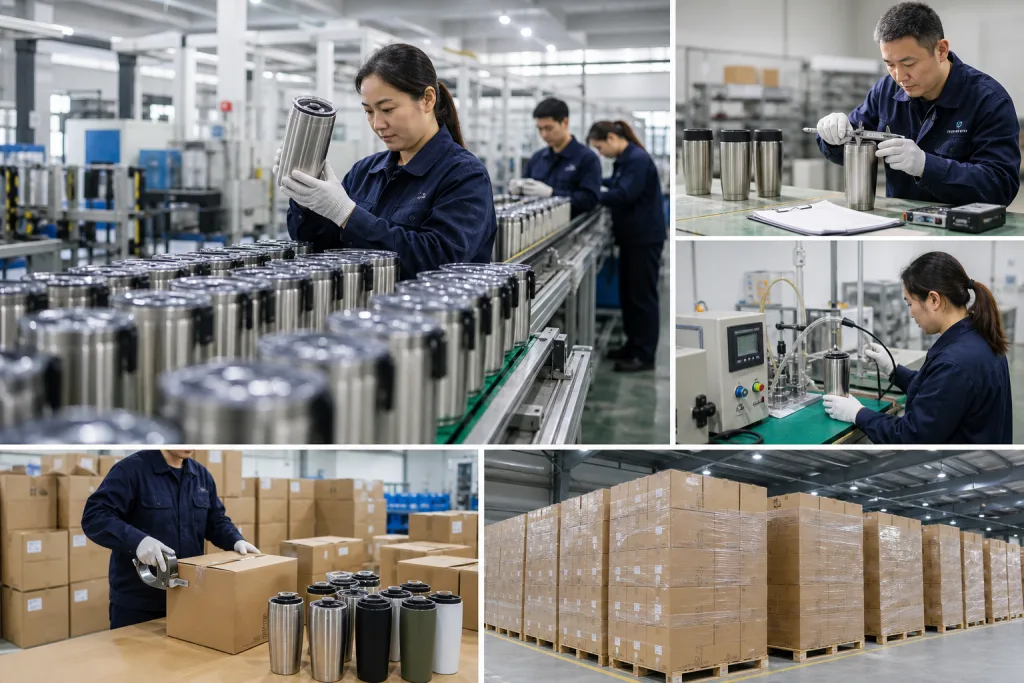
A serious quotation for coffee mug in bulk is not one line that says “16 oz tumbler, logo, cheap price.” You need a commercial specification sheet before you compare suppliers. Otherwise one coffee mug factory quotes thinner steel, another swaps in a low-cost slider lid, and a third quietly drops the carton spec. The numbers line up. The goods do not. On our line, QC pulls the sample with a caliper and checks wall thickness before anything goes to packing.
For this buyer setup, we quote three routes: standard factory mold, semi-custom color and logo, and private mold. Standard mold is the right call for most coffee mug distributors. Tooling is zero, sampling moves faster, and MOQ can stay around 1,000 pcs per color. Semi-custom work covers Pantone coating, laser engraving, silk screen, debossed sleeve, and custom box. Private mold only makes sense when you expect repeat orders above 30,000-50,000 pcs per year, because tooling can run from USD 3,000 to USD 12,000 depending on lid complexity. We run the Pantone spray booth one shade at a time, so this is not a place to guess.
Pricing should show Incoterm clearly. FOB Ningbo or FOB Shanghai is normal for Zhejiang and East China factories. For a 16 oz double-wall bulk coffee travel mug, a practical FOB range may be USD 3.20-5.80 depending on steel grade, lid, coating, logo method, and carton requirements. If you receive USD 1.80 on a vacuum tumbler with custom color, ask what has been removed. Usually it is wall thickness, vacuum performance, coating quality, or inspection. We have seen that one go sideways on a vacuum leak test bench when the buyer skipped the spec sheet.
- MOQ: 1,000 pcs for stock color with logo; 3,000 pcs for Pantone coating is more realistic.
- Payment: 30% deposit, 70% before shipment after inspection is common.
- Lead time: 7-10 days sample, 30-45 days production after sample approval.
Sampling is not just appearance
The sample stage is where a coffee mug oem manufacturer should prove process control, not just send a nice-looking tumbler. For a coffee brand or corporate-gift program, ask for 2 sample types. The first is a pre-production appearance sample with the approved logo, color, lid, and box. The second is a functional sample made with the same material grade and lid structure planned for mass production. We run these as separate checks because a golden sample from the sample room can hide problems that show up on the coating line. If the factory says color can be “adjusted later,” push back. Later usually means after the powder booth and curing oven are set, and then a small color change can cost 2-3 days plus a new sample courier fee.
For matte powder coating, ask the coffee mug manufacturer for a Pantone reference and a physical color chip. Powder coating cannot always match Pantone C exactly, especially on curved 304 stainless steel bodies where the coating thickness may vary by 5-10 μm near the shoulder. A Delta E tolerance below 1.5 is nice, but for industrial production 2.0-3.0 is more realistic unless the buyer pays for tighter controls. For logo work, laser engraving is cleaner on dark powder coating and resists abrasion well; QC pulled the sample after a 3M tape test last month and the engraving stayed clean. Silk screen is lower cost for larger logos but needs adhesion testing. UV printing gives color detail, but test scratch resistance before selling it as a durable coffee mug promotional products item. The math does not work if a low-cost print creates 300 after-sales complaints.
Check the lid like a user, not like a merchandiser. Fill with 90°C water, close the slider, invert for 10 seconds, shake gently, and watch the silicone seal, air hole, and slider gap. We ship a lot of travel tumbler lids that are splash-resistant, not fully leakproof. Say it plainly. If your sales sheet says leakproof and the lid is only splash-proof, you are writing claims your distributor will have to answer later. We have seen this go sideways because one PO said “leakproof lid” while the approved sample label said “spill-resistant.” Put the correct wording on the carton, product insert, and online listing.
Decoration choices that survive use
Coffee brands care about hand feel. Corporate-gift buyers care about logo accuracy. Distributors care about returns. Decoration has to pass all three desks. For a bulk coffee tumbler order, we usually run powder coating plus laser engraving for single-color brand marks, especially on 304 stainless bodies. It looks premium, setup risk is low after the first 2 pcs are signed off, and it avoids the ink adhesion complaints that come back after dishwashing. The tradeoff is real: the engraved logo color follows the coating and base metal, so it can read silver, grey, or a little warm. QC pulled one matte-black sample last month where the buyer expected bright white engraving. That is the wrong question to ask; laser removes coating, it does not add white ink.
Silk screen still earns its place in a coffee mug customizable program when the client wants a large white logo on a dark body. Ask for a 3M tape test after curing, a cross-hatch adhesion test, and a 50-cycle rub test with a wet cloth. Simple tests. They catch trouble early. For multi-color artwork, pad print or UV print can work, but approve a real sample, not only a digital proof from the art team. Curved tumblers distort artwork; a 38 mm round logo can look oval if the print area is stretched too wide around the cup wall. We have seen this go sideways when a PO said “front logo 70 mm,” but the buyer’s PDF showed 55 mm.
If you are selling coffee mug private label or coffee mug private labeling programs, packaging is part of the decoration cost. A plain kraft box with one-color print is economical and ships well. A full-color retail sleeve looks cleaner on shelf, but it can scuff when cartons are packed too tight on the line. Standard export cartons for a 16 oz tumbler often pack 24 pcs, with 5-ply corrugated board. Ask for carton dimensions and gross weight before you finalize freight quotes. One centimeter of unnecessary box height becomes real money when you ship 5,000 pcs by air for a deadline; we have paid for that mistake, and the math does not work.
Compliance files buyers will request
European and North American buyers now ask sharper questions than they did five years ago. A coffee mug factory direct offer means little if the compliance folder cannot match the actual SKU. For stainless steel travel tumblers, buyers usually request food-contact test reports for stainless steel, PP, silicone, and coating; LFGB or EU 1935/2004 for Europe; FDA-related food-contact testing for the United States; REACH/SVHC declarations where applicable. If the product is for children, the testing scope changes, and you may need CPSIA or ASTM-related review depending on design and market. We had one buyer flag a 0.6 mm straw tip on a kids cup because the lab scope did not cover the accessory. Fair pushback.
Factory social compliance also matters for corporate-gift and retail programs. Some buyers ask for BSCI, Sedex, ISO 9001, or a customer audit before they release the purchase order. Do not promise these after the PO lands. The math doesn't work. If your end client requires BSCI and your selected coffee mug supplier does not have it, switching factories mid-project can burn two or three weeks. We have seen a 20,000 pcs gift order sit on the line because the PO had “Sedex required” buried in a note, while the supplier profile only showed ISO 9001.
From China, test reports should be recent, product-specific, and issued by recognized labs. A five-year-old report for a different lid is not enough. For a bulk coffee mug order with a new coating, we normally recommend testing the actual production material or approved sample before mass production. QC pulled the sample from the pre-production run, not from a showroom shelf. Budget USD 250-800 for routine food-contact testing, depending on market and material count. That cost is small compared with a rejected shipment or a retailer chargeback on 1,200 cartons.
Practical rule: compliance must follow the exact material, color, lid, and market. Similar is not the same.
QC before the balance payment
Run the final inspection only when production is 100% finished and at least 80% packed. On a 5,000 pcs bulk travel tumbler order, we usually work to ANSI/ASQ Z1.4 with AQL 2.5 for major defects and 4.0 for minor defects, unless the buyer writes tighter limits into the PO. Critical defects stay at zero tolerance. That means unsafe sharp edges, wrong material, serious leakage, or contamination. No excuses. On our line, QC pulls samples from three pallet positions, not just the easiest carton near the door.
Your checklist should cover appearance, capacity, weight, dimensions, coating defects, logo placement, barcode scan, box artwork, carton markings, and functional testing. Measure capacity to the practical fill line with water, not to the rim. Use a graduated cylinder if you want clean numbers. Check lid fit across random samples from different cartons, and do not trust one perfect lid from the top stack. Run a hot water insulation test: fill with 95°C water, close the lid, then record the temperature drop at 2 hours and 6 hours. The exact result depends on size and lid design, but the readings should stay tight from sample to sample. A rim-fill number is useless here, and we have seen that go sideways on first export orders.
Write the leak or splash standard before inspection starts. “No leakage” means different things to different people. If it is a slider-lid commuter tumbler, call it splash-resistant unless the structure truly passes inversion and pressure tests. We pushed back on a buyer once who wanted a one-hand slider lid labeled as leakproof. The math does not work. For carton strength, run a drop test based on ISTA-style handling: one corner, three edges, and six faces from a height that fits the carton weight. If cartons split in the factory, ocean freight will not save them. We use 12 kg master cartons as a fast warning line, and the corners usually show the first crack.
Release the 70% balance only after the inspection photos, defect list, and corrective actions are clear. A PO typo, a missing carton mark, or a loose lid spring should be fixed before money moves. That is the clean way to do it. A solid coffee mug manufacturers partner will not fight normal third-party inspection. Good factories in Zhejiang and wider China expect it. Paying first and chasing evidence later is how disputes start, so we do not sign off until the AQL report and photo set are in hand.
Shipping and reorder planning
Once QC clears the lot, the risk moves from product defects to time on the water. For North America, sea freight from Ningbo or Shanghai usually runs 25-40 days port to port, then you still have trucking, customs, and warehouse receiving to deal with. We check this against the packing table on the line, because a fixed event date does not forgive a missed handoff. Build a 10-14 day buffer if the launch is locked. Air freight can save a late shipment, but for a coffee mug bulk order it often adds USD 1.50-3.50 per unit depending on carton size and season. The math does not work for every PO.
For Amazon or marketplace programs, get the label pack right before cargo leaves. FNSKU labels, carton labels, suffocation warnings for polybags if used, and master carton weight limits all need to match the receiving rules. We have seen a buyer flag a PO because “FNSKU” was typed as “FNSKU” on the carton mark file, and that one typo stalled intake. For retail or corporate gifting, confirm palletization, mixed-color carton rules, and whether the distributor wants blank cartons or branded shipping marks. The wrong question is, “Can we fix it at the warehouse?” No, you usually cannot.
The best coffee mug distributor programs are built for reorder from day one. Keep the mold, lid, coating code, artwork file, box dieline, and inspection standard locked after the first shipment. If the coffee brand adds a seasonal color later, you move faster because the structure is already approved. At BottleForge Industrial in Hangzhou, China, repeat travel tumbler orders with the same mold and approved logo process can usually skip structural sampling and go straight to color confirmation, saving about 5-7 days. QC pulled the sample from rack B-14 and that was it.
That is the gap between buying from a random coffee mug factory and running a controlled supply program. You are not just buying a bulk coffee mug. You are protecting the client’s launch date, margin, and brand reputation. We ship plenty of decent product, but one sloppy carton spec or a missed pallet height can burn a week. Buy on price alone and the program goes sideways fast.
Send your tumbler brief for a factory-level quote
Share capacity, logo, color, packaging, quantity, and destination. We will return practical options with MOQ, FOB pricing, and lead time.
Frequently asked questions
What MOQ should coffee tumbler distributors expect for a custom travel tumbler?
For a standard mold with stock body color and one logo, 1,000 pcs per design is usually workable. For Pantone powder coating, expect 3,000 pcs per color because the coating line has setup loss and color-change cost. If you need a custom lid or private mold, the MOQ may move to 5,000-10,000 pcs, with tooling cost from about USD 3,000 upward. Very small runs are possible only when you accept stock colors, stock box, and simple laser or silk screen decoration.
Which logo method is best for a coffee mug promotional order?
For most coffee mug promotional orders, laser engraving on powder coating is the lowest-risk premium option. It is durable, clean, and suitable for 1,000-20,000 pcs runs. Silk screen is better when the buyer needs a specific printed logo color or a larger artwork area, but adhesion testing is important. UV print works for multi-color graphics, yet it needs scratch and rub testing before approval. If the tumbler will be sold at retail instead of given away, spend more time on decoration testing.
How long does a coffee mug custom made project take from China?
A normal timeline is 7-10 days for samples, 2-3 days for buyer approval, 30-45 days for mass production, and 25-40 days for ocean freight to Europe or North America. That means you should start about 10-12 weeks before the goods are needed in your warehouse. If you need custom packaging, compliance testing, or a new coating color, add another week. Air freight can shorten transit, but it often damages margin on bulky drinkware.
What defects should I watch for when buying a bulk coffee travel mug?
Common defects include coating dust, uneven gloss, logo misalignment, small dents, loose lids, silicone odor, incorrect capacity, barcode errors, and weak export cartons. For vacuum tumblers, also check insulation consistency. Use AQL 2.5 for major defects and 4.0 for minor defects as a normal baseline. Ask the inspector to test samples from multiple cartons, not only the top cartons near the factory door. Packaging mistakes are just as serious as product defects when the order goes to retail or corporate gifting.
Is factory direct always better than using a trading company?
Coffee mug factory direct sourcing gives you better technical visibility, faster correction, and clearer cost structure if the factory is organized. It is not automatically better if the factory lacks export communication, compliance files, or inspection discipline. A good factory should provide drawings, material details, sample records, production photos, test reports, and carton data without drama. If you are a coffee mug distributor managing repeat programs, direct cooperation with a capable Zhejiang or China manufacturer usually improves control after the first order.