Key Takeaways
- 304 stainless inner wall at 0.4 mm is the normal baseline for coffee contact safety
- A 500 ml vacuum tumbler usually lands around USD 3.20-5.80 FOB Ningbo depending on lid and finish
- Private label MOQ is commonly 1,000 pcs per color, while custom mold projects start near 5,000 pcs
- AQL 2.5/4.0 inspection should cover vacuum failure, lid leakage, coating adhesion, and barcode scan rate
If you buy for a coffee brand or a corporate-gift program, the travel tumbler spec sheet is where the margin gets made or burned. We see two items both written as “500 ml stainless steel vacuum tumbler,” yet one lands $1.20 FOB higher because the body gauge is thicker, the lid mold has a silicone plug, and QC pulled 3 leaking samples after the carton drop test.
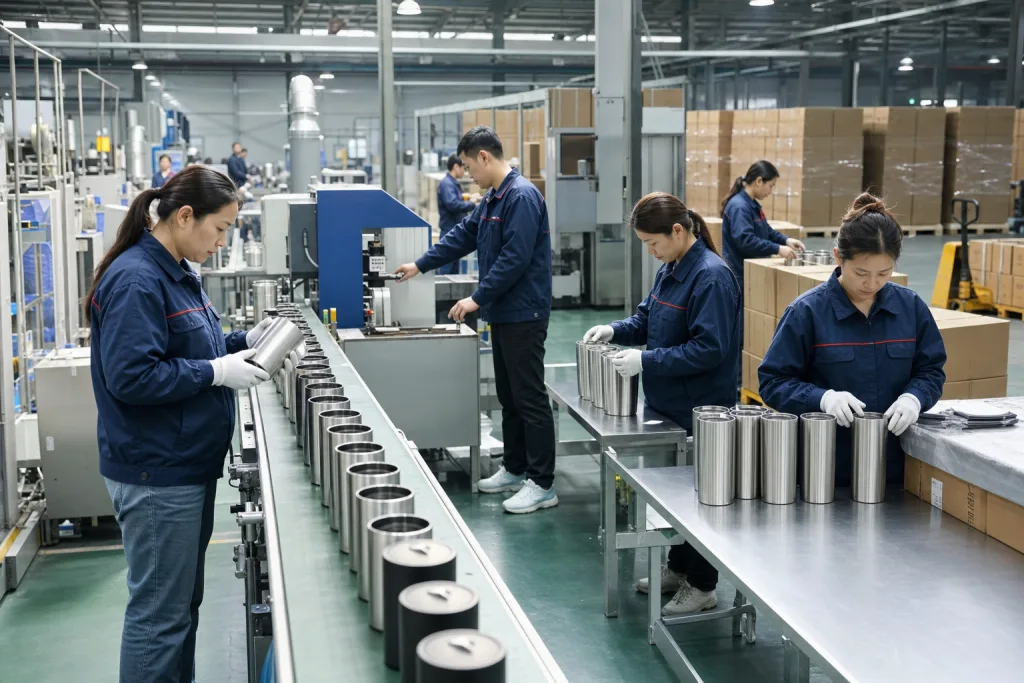
For a coffee tumbler distributor sourcing from China, catalog photos are the wrong place to start. Read the spec line by line. Our Zhejiang factory runs up to 450,000 drinkware units per month, with standard MOQ from 1,000 pcs per color for custom logo projects; before quoting, the line checks capacity with a 500 ml water fill, wall thickness with a digital caliper, and logo position against the buyer’s AI file.
Capacity is not just a size
Most distributor inquiries start with 12 oz, 16 oz, 20 oz, or 30 oz. That works for a retail label, but the PO should also state metric capacity: 350 ml, 500 ml, 600 ml, or 900 ml. North American buyers sell by ounce; China factories cut tooling, check water fill, and set laser-mark drawings in milliliters. We have seen a loose “20 oz tumbler” land at 580 ml from one coffee mug factory and 610 ml from another after QC pulled the sample on a 1,000 pc pilot run.
For coffee brands, 350-380 ml fits café retail and espresso-based drinks. It is lighter, cheaper to ship, and easier to pack into gift sets with beans or a coupon card. For corporate-gift buyers, 500-600 ml is the safer bulk coffee travel mug range because it feels solid without becoming a brick in a commuter bag. Large 900 ml models sell well for outdoor channels, but they can look oversized on an office desk. We ship them, but I would not push 900 ml for a bank giveaway unless the buyer already asked for a “big bottle feel.”
The buyer impact is carton efficiency. A 500 ml tapered travel tumbler may pack 24 pcs per master carton, around 12-14 kg gross weight. A handled 900 ml tumbler may pack only 12 pcs and push the carton close to 10 kg. The math changes fast. On one quote, the buyer saved USD 0.18 on the cup body, then lost more than that in freight because the carton CBM jumped after the handle was added. If you are building a bulk travel tumbler program for a national promotion, ask for carton size before you approve the sample.
Also check cup-holder diameter. For Europe and North America, we usually keep the bottom diameter at 68-73 mm when the product is positioned as a commuter tumbler. If your design exceeds 78 mm, do not call it car-friendly unless your customer has tested it in the target market. The buyer flagged this once after 3D artwork approval, not after tooling, and that timing saved a mold correction. A coffee tumbler distributor that ignores this detail will hear about it from end users.
Steel grade and wall thickness
The usual food-contact build for a stainless travel tumbler is 304 stainless steel inside and 201 or 304 outside. For coffee contact, we treat 304 inner wall as the red line, not a nice-to-have. Coffee acidity, milk residue, and daily washing are rough on cheaper steel; QC pulled one sample last year with tea-stain marks after a 24-hour soak test. For premium coffee mug private label programs, 304 inside and 304 outside is easier for the sales sheet and retail claim, but it raises cost by roughly USD 0.20-0.45 per piece depending on weight.
Wall thickness matters because it changes dent resistance, welding stability, and the hand feel buyers notice in 3 seconds. Common gauges are 0.4 mm inner wall and 0.5 mm outer wall. Some low-price coffee mug manufacturers cut the outer wall to chase a quote, then the math doesn't work after dents, soft mouth rims, and logo rejects hit the line. We check rims with a caliper; on a matte powder-coated tumbler, even a 1 mm dent under the coating still looks like a defect.
Ask the coffee mug oem manufacturer for the material declaration and food-contact test scope before mass production. Do it before the deposit. For Europe, REACH and LFGB-related testing may be requested depending on importer policy. For the United States, FDA food-contact expectations and California Proposition 65 review may apply. For kids or straw lids, ASTM or CPSIA considerations can enter the project, even if the body is a normal coffee tumbler; we have seen a PO say “adult coffee cup” while the artwork showed a cartoon bear with a straw.
One practical note from our Zhejiang production floor: heavier steel is not automatically better. A 500 ml vacuum coffee tumbler with too much steel can feel expensive on the table but tiring in a commuter bag. For distributor channels, a finished weight around 280-360 g is a reasonable target depending on lid type. If your sample is 450 g at 500 ml, check whether the retail price can support that feel, because the buyer will flag it after one showroom round.
Vacuum performance and temperature claims
Spec sheets often say “keeps hot 6 hours, cold 12 hours.” That line means little without the test method. Was the tumbler preheated? Was the starting water temperature 95°C or 90°C? Was the lid closed and locked? Was the room held at 20°C? Last month a buyer sent us a PO with “6H hot” typed in the remarks box, but no pass temperature; QC could not judge the sample. A coffee mug supplier that cannot answer these questions is selling copy, not engineering data.
For a typical 500 ml double-wall stainless vacuum tumbler, we run a basic internal test with 95°C water, lid closed, room temperature 20°C, and temperature readings at 1, 3, and 6 hours. Strong models stay above 55-60°C after 6 hours; weak ones drop to 48°C by the 6-hour mark, and the buyer will feel that before lunch. Cold retention is easier to print on a carton, but hot coffee performance is what your customer notices at 10:30 a.m. Our lab uses a K-type thermometer with the probe set 30 mm below the water surface, because touching the steel wall gives a false reading.
The buyer impact is return rate and review risk. A corporate gift recipient may forgive a color shade being slightly different from a catalog image. They will not forgive a “vacuum tumbler” that behaves like a single-wall cup. During production, vacuum testing should sit inside line control, not after the cartons are sealed. Some factories use hot water plus temperature drop testing; others use vacuum detection equipment. For large bulk coffee tumbler orders, we recommend sample retention from early, middle, and late production lots; on a 10,000 pcs run, we usually pull 3 sets and mark the carton number on the retention label.
If you are comparing a coffee mug supplier list or a coffee mug supplier directory, ask each supplier to quote the same performance requirement. Do not just ask for “best price.” This is the wrong question to ask. A cheaper unit may use a weaker vacuum process, a thinner copper layer if applicable, or a lid gasket that measures 0.2 mm under spec. These differences stay hidden until your shipment lands in your warehouse, and by then the math does not work.
Lid design decides daily usability
For coffee tumblers, the lid gets the most complaints. The stainless body can sit on a shelf for years, but a weak lid can leak before the buyer finishes the first carton check. We run five common options: slide lid, flip lid, press-fit lid, threaded leak-resistant lid, and straw-compatible lid. On one 8,000 pcs office-gift order, QC pulled 32 leaking samples, and 29 were lid-related.
A slide lid keeps cost down and works for desk coffee, but do not sell it as fully leakproof. A flip lid with silicone seal is better for commuting, if the hinge pin and snap force are stable. We check the hinge on a small torque gauge after 300 open-close cycles. A threaded lid performs best for bag carry, though it slows drinking and cleaning. For a coffee mug promotional products campaign, simple lids reduce cost and buyer questions. For retail coffee mug customized programs, a stronger lid can support a higher shelf price.
Check the silicone parts closely. They should come out for cleaning, but not fall out when the user rinses the lid. Ask whether the silicone is food-grade and whether color migration has been checked if you use bright lid colors. For black lids, we run a 95°C hot-water test for 30 minutes, then QC smells the lid after cooling. Cheap plastic can pass at room temperature and smell bad once hot coffee vapor hits it. We have seen this go sideways on matte black lids.
Lid tolerance also affects scrap rate. If the body mouth diameter moves even 0.3-0.5 mm beyond control, press-fit lids can turn too tight or too loose. Asking only for a nice product photo is the wrong question to ask. A coffee mug factory direct quote should include production tolerance, mold status, and whether the lid is from the same line as the cup body. For orders above 10,000 pcs, we normally suggest pre-production samples from actual mass-production components, not hand-adjusted showroom samples.
Logo process changes the whole quote
For coffee mug custom pricing, logo method is usually cost driver No. 2 after the tumbler body. Laser engraving, silk screen printing, pad printing, heat transfer, water transfer, UV printing, and full powder coating all change the setup fee, scrap rate, and approval time. On our line, QC checks logo position with a 0.5 mm steel ruler and a clear placement jig, because a 3 mm drift looks cheap on a 20 oz travel tumbler.
Laser engraving is durable and clean on powder-coated stainless tumblers. Good for corporate gifting. The logo does not peel in a dishwasher test, but the buyer must accept the exposed stainless or underlayer look instead of a bright Pantone color. Silk screen printing suits simple one- or two-color logos on smooth walls; we run a mesh screen and still ask for a flat AI file, not a screenshot pulled from a website. Full-wrap artwork can work, but tapered bodies need distortion adjustment or the back seam will look bent. UV printing gives more color range for coffee mug promotional projects, though we always suggest an abrasion test with 3M tape and a 500 g rub block before mass production.
For coffee mug private labeling, packaging can cost as much attention as the logo on the cup. You may need a printed gift box, barcode, FNSKU label, instruction leaflet, master carton shipping mark, and pallet label, and each one belongs on the approval sheet. We have seen this go sideways: one PO had “matte black” on the cup artwork and “gloss black” on the gift box file, so QC pulled the sample before carton printing. If you sell through online marketplaces, inspect barcode scan rate before shipment, not after arrival; a 98% scan pass in Hangzhou is cheaper than relabeling 120 cartons in a U.S. warehouse.
MOQ depends on decoration. A plain stock-color bulk coffee mug may start around 500-1,000 pcs. A custom Pantone powder coating usually starts at 1,000 pcs per color because the coating line needs setup and powder control. A new body shape or unique lid tool can push MOQ to 5,000-10,000 pcs. That is normal for China tooling economics, not a trick. The wrong question is “Can you customize everything?” Ask which parts are stock, which parts need a new mold, and whether the lid, gasket, slider, and straw already passed fit testing on this body. The math does not work if the buyer approves a coffee mug customizable concept first and finds out later that one small lid insert needs a 35-day tool build.
Cost structure behind FOB pricing
A realistic FOB Ningbo or FOB Shanghai price for a 500 ml stainless vacuum bulk travel mug sits between USD 3.20 and USD 5.80 on most live quotations we run. If the price drops under that band, check what was cut: body weight from 285 g to 245 g, thinner color coating, lighter lid parts, shorter QC time, weak export cartons, or skipped compliance testing. Above that band, the extra cost should be visible in handle tooling, premium powder coating, 304/304 steel, complex printing, gift packaging, or a small order that keeps the line half empty.
We break the cost into body material and vacuum welding, lid plus silicone parts, surface finish, logo work, packing, labor, factory overhead, inland trucking to port, and export documents. In our Zhejiang workshop, the vacuum furnace log and the 0.01 mm caliper check tell more than a neat quotation sheet. Ningbo port is close, so trucking time is predictable, often 1 day from Hangzhou when the booking is ready. Standard production lead time runs 25-35 days after deposit and artwork approval for repeat designs. New molds or complex coffee mug customized packaging can add 15-30 days, especially when the buyer changes the color box after the die-line is already approved.
For a new distributor account, payment terms are commonly 30% deposit and 70% before shipment after inspection. We may loosen terms after 3 clean orders with no late balance payment, but first orders stay conservative. Ask whether the quote includes export carton, individual polybag or tissue wrap, silica gel if needed, logo setup, and carton drop-test packing. This is where the math breaks. We have seen a PO show “white box” while the approved sample used a printed color box; QC pulled the sample, the buyer flagged it, and the shipment sat 4 days while the price gap was fixed.
Cheap samples are easy. Stable mass production at the same finish, lid fit, and packing strength is the real test.
When comparing coffee mug factory direct offers, put every quote into the same table: capacity in ml, steel grade such as 304 stainless, body thickness in mm, lid construction, coating type, logo method, packing spec, MOQ, lead time, test standard, and Incoterm. One buyer sent us 6 supplier quotes last month; 2 included LFGB testing, 1 quoted FOB Shanghai instead of FOB Ningbo, and 1 left out the inner box. Same tumbler? Not really. Only after the specs match are you comparing manufacturers instead of comparing guesses.
Inspection lines your PO should include
Your purchase order should read like a control document, not a friendly email. For a bulk coffee mug or bulk coffee tumbler shipment, we usually write AQL General Inspection Level II, with critical defects at 0, major defects at 2.5, and minor defects at 4.0. Put the defect list on the PO before we run the line. Last month a buyer sent “standard inspection” in one line, then rejected 43 cartons for lid scuffing; the math does not work when nobody defined the limit.
Critical defects include unsafe sharp edges, wrong material, severe leakage, contaminated inside surfaces, and failed food-contact documentation. Major defects include vacuum failure, obvious dents, coating peel, wrong logo position, lid looseness, barcode failure, and incorrect packaging. Minor defects include small dust points, slight color variation within the approved tolerance, and small carton printing issues that do not affect sale. QC pulled one sample with a 0.4 mm burr on the drinking lip during a 20 oz tumbler check; that goes straight into critical, not a debate on email.
For coffee brands, color control matters. Beige, cream, and dark green tumblers shift fast between sample and mass production if powder coating time, oven temperature, or film thickness is loose. Use a physical color chip or approved golden sample, then write the acceptance range on the PO. Pantone references help, but stainless powder coating is not paper printing. We check coated cups under a D65 light box because warehouse LED lights hide yellow shift. For corporate buyers, logo placement tolerance should be written clearly, such as ±2 mm vertical and horizontal from approved position.
China factories can produce strong drinkware, but results improve when the inspection standard is locked before production starts. At BottleForge Industrial in Zhejiang, our normal pre-shipment file includes random product photos, carton photos, logo close-ups, lid-fit checks, and packing list confirmation. We also record carton size and gross weight, because one PO typo changing 12.5 kg to 15.2 kg created a freight dispute at destination. Third-party inspection is welcome. A good coffee mug distributor does not treat inspection as mistrust; it is how both sides avoid expensive arguments after the container has sailed.
Send your tumbler spec sheet for factory review
We will check capacity, lid, steel grade, logo method, MOQ, packaging, and FOB cost before you commit to sampling.
Frequently asked questions
What MOQ should a coffee tumbler distributor expect for custom orders?
For a stock body with custom logo, MOQ is usually 1,000 pcs per color. Some plain coffee mug in bulk orders can start at 500 pcs if the color is already in production. Custom powder coating normally needs 1,000 pcs per color because the coating line has setup loss. New lid tooling or a coffee mug custom made body shape usually starts around 5,000-10,000 pcs. If you also need printed gift boxes, the box supplier may set its own MOQ, often 1,000-3,000 pcs depending on paper and print process.
How long does a private label coffee tumbler order take?
For an existing travel tumbler shape, expect 7-10 days for sampling after artwork confirmation, then 25-35 days for mass production after deposit and sample approval. Shipping to North America by sea can add roughly 25-40 days port to port, while Europe often runs 30-45 days depending on route and season. A coffee mug private labeling project with new packaging, FNSKU labels, inserts, and carton marks should allow extra approval time. If you need delivery for a fixed event date, work backward at least 90 days.
Which logo method is best for corporate gift coffee tumblers?
For long-term durability, laser engraving on powder coating is usually the safest choice. It handles washing and abrasion better than many printed logos, and setup cost is reasonable for 1,000 pcs or more. For colorful brand graphics, silk screen or UV printing may be better, but you should request adhesion testing, such as 3M tape test and alcohol rub test. For a coffee mug promotional order with a tight budget, one-color silk screen can be cost-effective. Full-wrap designs need more artwork control, especially on tapered travel tumblers.
What certifications should I ask a coffee mug factory for?
Ask for food-contact documentation related to your sales market. For Europe, buyers often request LFGB, REACH, and sometimes specific migration testing for plastic and silicone lid parts. For the United States, FDA food-contact compliance and Proposition 65 review may be needed. Factory-level audits such as BSCI or ISO 9001 can help corporate-gift buyers satisfy internal sourcing rules, but product testing still matters. A coffee mug manufacturer should confirm the tested components match your actual production: stainless body, lid plastic, silicone seal, coating, and printed decoration if applicable.
Can I use one supplier for tumblers, packaging, and Amazon labels?
Yes, but define every packaging line item before you pay the deposit. A capable coffee mug supplier can handle individual boxes, master cartons, UPC labels, FNSKU labels, warning labels, insert cards, and pallet marks. For Amazon-style shipments, carton weight and dimensions must be controlled because oversized cartons create receiving and fee problems. We suggest barcode scan testing during inspection, with at least 50 random scans across cartons. If your order is split by color or design, each SKU needs its own label control to avoid mixed inventory.