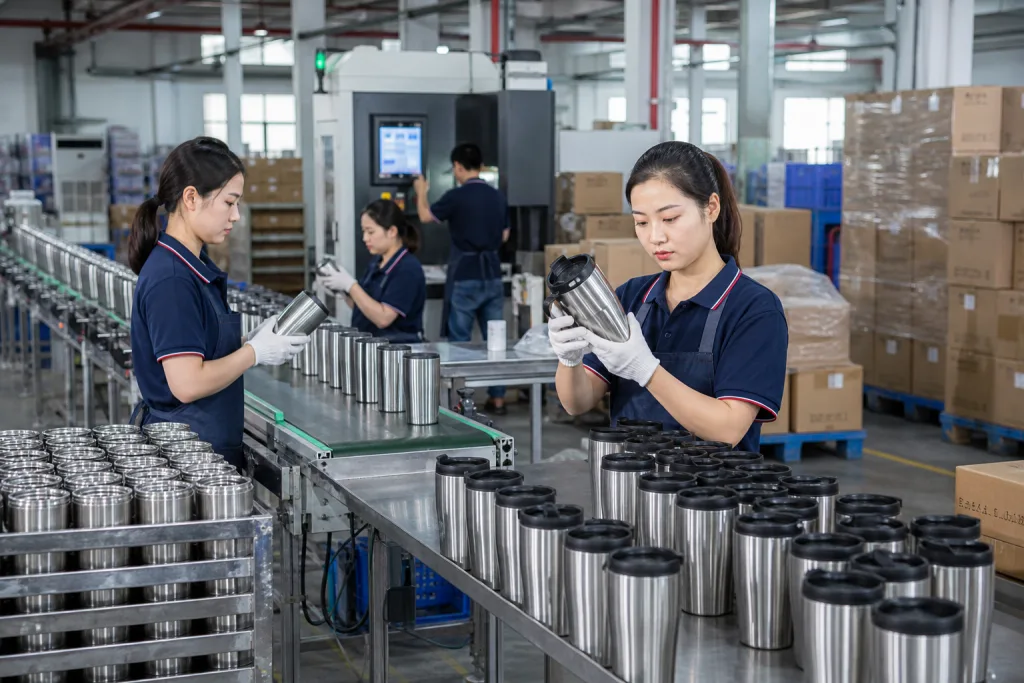
Key Takeaways
- Most coffee tumbler customized orders start at 500-1,000 pcs per color, with 25-35 day mass production after sample approval
- 304 stainless steel at 0.4-0.5 mm wall thickness is the practical baseline for retail and corporate-gift travel tumblers
- Laser engraving is usually safer than silkscreen for powder-coated bulk coffee tumbler orders above 2,000 pcs
- AQL 2.5/4.0 inspection, lid torque checks, and 6-hour heat retention tests should be agreed before deposit
A coffee tumbler customized order looks simple until the deposit invoice lands: 500 ml or 600 ml, powder coat or spray paint, laser logo or silkscreen, gift box or kraft box, direct drink lid or slider lid. Small choices bite. Last month QC pulled a 600 ml sample with a 0.35 mm lid gap after the buyer had already approved the catalog photo, and that one gap would have turned a clean coffee brand launch into cartons of leaking travel mugs.
We manufacture travel tumblers in Zhejiang, China, and we see the same 6 buyer mistakes on repeat: buying from photos, skipping a 30-minute upside-down lid test, paying USD 0.42 extra for packaging nobody opens twice, and asking a coffee mug factory to quote with no use case. This is the wrong question to ask. Start with how the tumbler will be used, then compare the body, lid, finish, logo method, and carton plan before sampling; the line runs smoother when the PO says “600 ml, slider lid, matte black powder coat, laser logo, 24 pcs/carton” instead of “same as picture.”
The real options on the table
For coffee brands and corporate-gift buyers, the decision is not just “travel tumbler versus mug.” You are buying how the cup behaves after it leaves the carton. Does it sit on an office desk, ride in a car cup holder, go into a coffee subscription box, or get handed out at a conference registration desk? A coffee mug custom made for a desk can live with a looser push lid. A bulk coffee travel mug for commuters cannot. We test this on the line with a simple 180° inversion check, and QC pulled the sample more than once because a buyer-approved lid looked fine dry but seeped after hot-water filling.
Here is the practical head-to-head comparison we use with buyers before quoting:
| Option | Typical size | Best fit | Main risk | Normal MOQ |
|---|---|---|---|---|
| Double-wall stainless tumbler | 500-600 ml | Coffee brands, retail, daily commute | Lid leakage if cheap tooling is used | 1,000 pcs/color |
| Handled travel mug | 600-900 ml | Corporate gift programs where the handle must clear car cup holders and outdoor users who care about grip with gloves | Higher freight volume, often 12-18% more CBM than a straight-wall tumbler in the same ml range | 500-1,000 pcs/color |
| Ceramic-lined tumbler | 350-500 ml | Premium coffee taste positioning, especially for roasters who reject any stainless smell in the first hot-fill test | Higher breakage rate in production, so we add extra checks after firing and before logo packing | 1,000 pcs/color |
| Plastic inner promotional mug | 350-450 ml | Low-cost event giveaway where logo exposure matters more than heat retention | Lower perceived value, and buyers sometimes flag the lighter hand feel during sample review | 2,000-3,000 pcs/color |
If your campaign depends on repeat daily use, choose stainless vacuum construction. For a one-day event, a coffee mug promotional item may be enough. FOB price is the wrong question to ask first. When buyers search a coffee mug supplier directory or collect a coffee mug supplier list, they often line up 6 quotes and pick the lowest number. The math doesn't work if the cheaper cup uses a thin wall gauge, soft PP lid, weak powder coating, or cartons that fail a 1.2 m drop test. Compare wall gauge, insulation time, lid material, coating system, carton drop performance, and after-sales risk. Small parts matter.
At our Zhejiang facility, a normal travel tumbler line can produce about 450,000 units/month across stainless bottles and tumblers. That capacity matters only if the specification is locked. Changing color, lid, or logo method after pre-production sample approval can add 7-12 days; we have seen 12 days become 18 days because the PO said matte black, the artwork file said PMS Black 6C, and the buyer flagged it only after the sprayed sample arrived. We ship faster when the spec sheet is boring.
Stainless beats cheap promotional shells
For a coffee tumbler customized program, 304 stainless steel sits in the safe middle of the market. We run most 500 ml vacuum models with a 0.4-0.5 mm inner wall and 0.5 mm outer wall, then check the vacuum gap after welding with a water bath test on the line. For premium retail, some buyers ask for 316 stainless inner wall. The added cost is usually USD 0.35-0.70 per unit, and the math often does not work unless your packaging and brand story can charge for it.
A basic stainless bulk travel tumbler from China may quote at USD 3.20-4.80 FOB Ningbo or Shanghai for 500 ml, depending on coating, lid, and logo. A ceramic-lined version may sit around USD 4.80-6.50. A low-grade plastic or single-wall metal bulk travel mug costs less on the PO, but this is the wrong place to save USD 0.60. QC pulled a cheap single-wall sample last month where the outer surface hit 58°C after hot coffee was poured in. Bad hand feel gets noticed fast. Weak insulation hurts the brand faster than a higher unit cost.
Use-case fit is the cleanest way to decide. Ask before tooling.
- Coffee roaster retail shelf: 500 ml stainless vacuum tumbler, powder coating checked by cross-hatch tape test, laser logo, retail box.
- Corporate employee gift: 600 ml handled mug with a wide logo area, individually boxed, optional thank-you card inserted by hand before carton sealing.
- Trade show giveaway: 350-450 ml coffee mug promotional product with silkscreen logo and bulk carton packing, often 24 pcs per carton to keep booth handling simple.
- Subscription box: 350-500 ml compact tumbler with lower carton volume, color matched to campaign artwork by Pantone code before mass coating.
A real coffee mug manufacturer should ask about beverage temperature, shipping channel, and user environment. We also ask if Amazon drop-test packaging is needed, because a standard white box and a mailer box are not the same job. If a coffee mug oem manufacturer only sends a catalog and asks “which model,” you may receive a product, but not the right product.
Logo methods compared without decoration hype
Logo work is where 7 out of 10 coffee mug custom projects start to drift. A buyer sends a clean AI or PDF logo, then QC pulls the first sample and the gradient breaks on the curved powder-coated wall. Or the bulk coffee tumbler sample passes the desk review, but the print starts wearing after 300 dishwasher cycles. Match the logo method to the coating, radius, and daily use. Don’t start with “which one looks best.” That is the wrong question to ask.
| Logo method | Best surface | Good for | Approx. cost | Watch point |
|---|---|---|---|---|
| Laser engraving | Powder coat, spray paint | Premium coffee mug customized orders | USD 0.15-0.35 | Logo cuts to metal color, not Pantone |
| Silkscreen | Smooth paint, stainless | 1-2 color logos with clear edges | USD 0.08-0.25 | Needs cross-hatch adhesion test |
| Heat transfer | Painted surface | Full-color artwork with photos or gradients | USD 0.35-0.80 | Higher reject rate on curved bodies |
| UV print | Flat or low-curve areas | Short-run colorful gifts under tight launch dates | USD 0.40-0.90 | Weak choice for heavy abrasion |
For coffee brands, laser engraving is usually the safest call. Clean look. Fewer arguments. It survives daily bag rub, café counter handling, and the wipe test we run with 75% alcohol on the line. It also avoids the classic Pantone fight where the buyer flags “warm white” on a PDF, but the actual coated cup shifts under warehouse lighting. For corporate-gift buyers, silkscreen works when the logo is one solid color and the order is 1,000-5,000 pcs. If your procurement team needs strict Pantone matching, approve a physical color chip, not just a PDF mockup.
Private-label buyers should separate the logo file from the packaging artwork from day one. Coffee mug private label and coffee mug private labeling orders often need three approvals: tumbler logo, bottom mark or legal text, and retail box. We’ve seen this go sideways because one PO said “matte black,” the box dieline said “black satin,” and the logo file name still carried “v3-old.” Each approval can add 2-4 working days if your supplier is not controlling artwork versions with dated files and signed sample photos.
Lids decide daily user complaints
The lid gets less attention than the powder-coated body, but it is where complaints start. We see 6 or 7 lid comments for every 10 after-sales issues on a coffee mug customizable order. A cheap slider lid can look clean in the catalog photo and still leak coffee onto a laptop bag after 3 subway stops. Buyers ask for “leakproof” all the time; this is the wrong question to ask unless the lid structure supports it. Most travel tumbler lids are splash-resistant, not leakproof, and we write that wording into the quote, carton mark, and packaging claim before the PO is signed. Last month QC pulled a 600 ml sample where the slider gap measured 0.8 mm with a feeler gauge. It passed photos. It failed real use.
Common lid choices compare like this:
- Slider lid: good for desk and car cup holder use, not for bags. Lower cost, usually USD 0.25-0.55 depending on material. We run this lid on many promo orders, but we do not call it leakproof.
- Flip lid with silicone seal: better spill control for commute use. The hinge pin, seal groove, and mold fit decide the result, so old tooling can ruin a good cup body.
- Straw lid: sells well for iced coffee and cold drinks. For hot coffee, the burn risk is real, and some buyers flag it during compliance review.
- Screw lid: stronger seal with slower drinking. Good for outdoor use or a long commute, but users complain if the thread feels rough after 20 open-close cycles.
For hot coffee, we usually recommend PP or Tritan lid material with food-grade silicone seals. Ask for LFGB or FDA food-contact documentation depending on your selling market. For Europe, REACH and LFGB-related checks matter. For North America, FDA food-contact compliance and, for some children’s items, ASTM or CPSIA considerations may apply. A standard adult travel tumbler is not tested like a kids bottle, but the material files still need to be in order. On our line, we match the silicone ring by inner diameter, usually checked with a digital caliper to 0.1 mm. If the seal is loose by 0.3 mm, the math doesn't work, no matter how nice the lid looks.
During sample review, do a simple test: fill with 90°C water, close the lid, invert for 30 seconds if the lid is claimed leakproof, then shake lightly. Test one-handed opening too. Short test. Big lesson. If the lid feels annoying in the sample room, it will not become better in 10,000 pcs production. We have seen this go sideways when a buyer approved a photo sample only; the production lid needed two thumbs to open, and the complaint came back after the first 3,000 pcs shipped.
Packaging changes your landed cost
Packaging is not just decoration. It changes freight, breakage claims, retail prep, and how fast a warehouse can receive the goods. We run plain white boxes for internal corporate distribution when the buyer’s team opens cartons on-site and hands out the tumblers one by one. A coffee mug bulk retail program usually needs color boxes, barcode labels, master carton marks, and Amazon FNSKU labels if it goes into FBA. Every layer adds cost and carton volume. Last month QC pulled one 40 oz handle tumbler sample and the color box added 4 mm on each side; that small change cut the master carton from 24 pcs to 20 pcs.
Typical packaging costs from a China coffee mug factory direct order are:
- Plain white box: USD 0.12-0.25 per unit.
- Kraft box with black print: USD 0.18-0.35 per unit.
- Full-color retail box: USD 0.35-0.80 per unit, depending on paper thickness and quantity.
- Insert card or manual: USD 0.03-0.10 per unit.
- Individual polybag or tissue wrap: USD 0.02-0.06 per unit.
For corporate-gift buyers, overbuilding the box is the common trap. This is the wrong question to ask if the tumbler will be handed to employees at an event and thrown into a tote bag five minutes later. A strong kraft box with a clean logo often works better than glossy retail packaging. For coffee brands selling online, the box must protect the coating and look credible when the customer opens it. We normally use 5-ply export master cartons for heavier handled mugs and run carton drop checks before shipment, 1 corner, 3 edges, and 6 faces on the packed carton.
If you ship to fulfillment centers, confirm outer carton dimensions early. A 600 ml handled bulk coffee mug may look attractive, but the handle increases carton volume by 15-25% compared with a straight-wall tumbler. The math does not work if you save USD 0.18 on FOB and then lose it on ocean freight or FBA storage. We have seen this go sideways when a buyer approved the cup sample but forgot to approve the packed carton size; the final master carton was 58 x 42 x 36 cm, and their warehouse flagged it before the container left Zhejiang, China.
Quality control should be quoted early
Do not leave inspection for the week before shipment. Give the coffee mug supplier your QC standard before they quote, because it changes line checks, rework hours, scrap allowance, and sometimes the unit price. For most export orders, AQL 2.5 major / 4.0 minor is a practical baseline. For premium retail coffee brands, 2 out of 10 buyers ask for AQL 1.5 major; the math does not work unless the quote includes the extra inspection time and higher rejection risk. We run this on the floor with a caliper, a 0.01 g scale, and a written defect board beside the packing line.
A sensible QC checklist for a coffee tumbler customized order includes:
- Capacity check within agreed tolerance, usually +/-5%, measured with water at room temperature.
- Vacuum insulation test, such as 95°C water with temperature recorded after 6 hours, using the same lid position for each sample.
- Coating adhesion cross-hatch test on painted samples, with 3M tape pulled at a steady angle.
- Logo position tolerance, often +/-1.5 mm for laser or silkscreen, checked from the rim or handle datum point.
- Lid fit, silicone seal presence, odor check, and open-close cycle test, because QC has pulled samples with the gasket packed loose in the carton.
- Carton drop test according to your carton weight and shipping route, especially for Amazon FBA or mixed-pallet LCL shipment.
Factory audits matter for some orders. If you sell into corporate channels, BSCI, ISO 9001, or Sedex documentation helps your customer approve the vendor. Not every coffee mug factory has every certificate, and some certificates cover only one production site. Ask for the scope page, not just the cover certificate. We have seen this go sideways when a buyer’s PO said “Sedex required,” but the audit address was for the old workshop, not the line making the 20 oz tumbler.
A responsible coffee mug supplier keeps golden samples. For repeat coffee mug distributors, we store approved color, logo, lid, and packaging samples so the reorder does not drift. Color drift of Delta E 1.0-2.0 may be acceptable on some powder coats, but define the tolerance before mass production. QC pulled the sample. If the approved red lid is 186C and the new batch reads closer to 187C under the light box, we flag it before packing 3,000 pcs into export cartons.
How to brief the factory
The fastest quote does not come from asking ten coffee mug manufacturers for “your best price.” We see this RFQ every week, and the numbers are useless. One factory assumes 0.4 mm inner steel, another prices a thin push lid, and a third skips the brown box. QC pulled a sample last month where the quoted lid looked the same in photos but weighed 18 g less. That is not a comparison.
Send a short RFQ with the details that change cost: target size and capacity, order quantity, delivery country, logo method, Pantone color, packaging, compliance market, and expected shipment date. If you compare coffee mug distributor pricing with factory direct sourcing, ask both sides to quote the same Incoterm. FOB Ningbo does not sit in the same column as DDP Los Angeles or DAP Hamburg. We run landed-cost sheets in Excel for buyers, and freight terms are where the math often breaks.
For a normal 1,000-3,000 pcs custom travel tumbler order, our sample lead time is 7-10 days, mass production is usually 25-35 days after approval and deposit, and MOQ starts from 500 pcs for selected stock colors or 1,000 pcs for custom colors. The line only opens custom powder coating after the approved color chip and signed sample are logged by QC.
A coffee mug distributor still has a job. If you need 96 pcs next week, buy from stock. A factory is the wrong tool for that order. If you need 2,000 pcs with brand control, private packaging, repeat supply, and the same lid fit on every reorder, coffee mug factory direct sourcing gives you tighter control. We have seen this go sideways when a buyer mixed distributor stock in June with factory stock in September, then flagged a 2 mm height difference.
Before deposit, ask for a proforma invoice that locks material grade, capacity, coating, logo process, packaging, inspection standard, Incoterm, and lead time. One page saves arguments. Our sales team also checks PO typos, because “matte black” and “matte blank” once reached our packing team before someone caught it. Once those details are fixed, a coffee mug custom made order becomes a controlled production job, not a guessing game.
Send your tumbler spec for a factory quote
Share quantity, logo file, packaging plan, and delivery market. We will return a practical FOB quote with MOQ, lead time, and options.
Frequently asked questions
What MOQ should I expect for a coffee tumbler customized order?
For most stainless steel travel tumblers, expect 1,000 pcs per custom color. If you use our existing powder-coated colors in Zhejiang, MOQ can start from 500 pcs for selected models. Logo-only orders are easier than custom mold or custom lid projects. A new mold can require 3,000-5,000 pcs to make the tooling cost sensible. For corporate-gift buyers testing a campaign, 500-1,000 pcs is a realistic starting range. For coffee brands planning retail, 2,000-5,000 pcs gives better packaging cost, more stable color control, and stronger leverage on FOB pricing.
How much does a bulk coffee travel mug cost from China?
A practical FOB China range is USD 3.20-4.80 for a 500 ml double-wall stainless tumbler with standard lid and one logo. Handled mugs or ceramic-lined tumblers can move into USD 4.80-6.80 depending on size and decoration. Packaging may add USD 0.12-0.80 per unit. Freight, duty, and local delivery are not included in FOB pricing. If a quote is far below this range, check steel thickness, lid material, vacuum performance, carton strength, and whether the supplier included logo and packaging.
Is laser engraving better than printing for coffee mug custom orders?
Laser engraving is usually better for powder-coated stainless tumblers because it is durable and clean. It normally adds USD 0.15-0.35 per unit, depending on logo size and order quantity. Silkscreen is cheaper for simple one-color logos, often USD 0.08-0.25, but it needs adhesion testing and can wear faster if the user washes aggressively. For coffee brands selling a premium daily-use product, laser is the safer default. For event giveaways or short-term coffee mug promotional products, silkscreen may be acceptable.
Can you make retail packaging for coffee mug private label orders?
Yes. A coffee mug private label order can include tumbler logo, bottom mark, full-color retail box, barcode, insert card, and master carton shipping marks. Full-color boxes usually need 1,000 pcs or more to keep unit cost reasonable, and box sampling adds about 5-7 days if artwork is complete. If you sell through fulfillment centers, provide FNSKU or barcode rules before production. Packaging should be approved with a dieline proof and a physical sample when timing allows.
What documents should a coffee mug manufacturer provide?
At minimum, ask for material declarations for 304 stainless steel, food-contact information for PP or Tritan lids, silicone seal documentation, and coating safety information. For Europe, REACH and LFGB-related reports are often requested. For North America, FDA food-contact compliance is common. If your buyer requires social compliance, request BSCI, Sedex, or ISO 9001 documents and check the factory name and address. Reports older than 2-3 years may still be useful, but large retailers often ask for current testing on the actual product or material.