Key Takeaways
- A realistic MOQ for a custom stainless travel tumbler is 1,000-3,000 units per color, with lower MOQ only for stock bodies
- FOB Ningbo or Shanghai pricing usually runs USD 3.10-8.50 depending on capacity, steel grade, lid, finish, logo, and packaging
- Normal production lead time is 30-45 days after sample approval and deposit; new mold projects can add 20-35 days
- Use AQL 2.5/4.0 inspection, REACH/LFGB or FDA food-contact testing, and carton drop tests before balance payment
If you are buying coffee tumbler bulk for a coffee brand launch, subscription box, office gift program, or retail shelf, the hard part is not picking a good-looking shape. That part takes 10 minutes. The real work is understanding why one quote lands at USD 3.20 and another at USD 7.80, then finding out whether the gap sits in steel thickness, lid tooling, export cartons, or the risk of failing inspection after QC pulls 80 pcs under AQL 2.5.
As a Zhejiang coffee mug factory selling factory direct from China, we hear the same buyer questions every week: “What MOQ makes sense?”, “How long before I can ship?”, “Can I private label at 1,000 units?”, and “Why did the sample look better than mass production?” Fair questions. The answers depend on 304 stainless gauge measured by digital caliper, vacuum structure, lid parts count, print method, gift box spec, and the inspection standard written on your PO; we have seen orders go sideways because the buyer approved a laser logo sample but the PO typo said silk print.
Start With The Real Unit Cost
For coffee tumbler bulk orders, unit cost is not just the cup body. A simple 12 oz stainless bulk coffee mug with a press lid and one-color logo may quote around USD 3.10-4.20 FOB China at 3,000 units. A 20 oz bulk coffee travel mug with vacuum insulation, powder coating, sliding lid, individual color box, and laser logo will often sit between USD 5.20-7.50. If you ask for ceramic coating inside, handle tooling, or a premium leak-resistant lid, the price can move above USD 8.50. We see buyers compare only the first FOB line, then get surprised when the final carton mark, barcode sticker, and drop-test packaging add another USD 0.42. The math doesn't work if those items are hidden.
The biggest cost driver is not always stainless steel weight. A 0.4 mm outer wall and 0.5 mm inner wall in 304 stainless steel is common for a reliable travel tumbler. Moving to thinner steel can save USD 0.15-0.35, but dent resistance drops. QC pulled one sample last season with a 0.32 mm outer wall; it passed vacuum, but the shoulder dented after a 76 cm carton drop. Moving from 201 stainless to 304 stainless can add USD 0.20-0.45 depending on size and market steel price, but it is usually worth it for coffee brands selling a reusable product. Cheap steel gets noticed.
Decoration changes the quote fast. One-position laser engraving is predictable and usually adds USD 0.15-0.35. Screen printing can be cheaper for one color, about USD 0.08-0.20, but needs clean vector artwork and proper curing time on the line. We run a 3M tape test after printing; if the ink lifts, the buyer will flag it before the promo event. Full-wrap heat transfer or water transfer can add USD 0.60-1.50. For coffee mug promotional products, the cheapest logo is the wrong question to ask if it scratches during a trade show giveaway.
Packaging is another common surprise. A white box may add USD 0.12-0.25. A printed retail box can add USD 0.35-0.80 plus plate charges. Gift packaging with sleeve, insert, and barcode label can add USD 0.70-1.60. One US buyer sent a PO with “color box” typed in the notes, while the approved quote was plain white box; that one line changed the invoice by USD 540 on 1,800 pcs. Ask your coffee mug supplier to separate cup, lid, logo, packaging, and carton cost instead of giving one blended number.
MOQ Tiers That Actually Work
MOQ is where 7 out of 10 new buyers misread factory economics. A coffee mug customized order carries setup cost before we pack the first carton: powder coating line cleaning, printing screens, laser fixture adjustment, lid color matching, box printing, and QC setup. On the line, even a simple logo needs a laser jig checked with calipers to keep the mark 18 mm from the rim. For a stock shape and stock color, a coffee mug manufacturer in Zhejiang may accept 500 units with a simple laser logo. For a custom color, 1,000-2,000 units per color is more realistic. For a fully coffee mug custom made body or lid, 3,000-5,000 units is a healthier starting point. The math doesn't work when the buyer wants 300 pieces, 4 colors, and free setup.
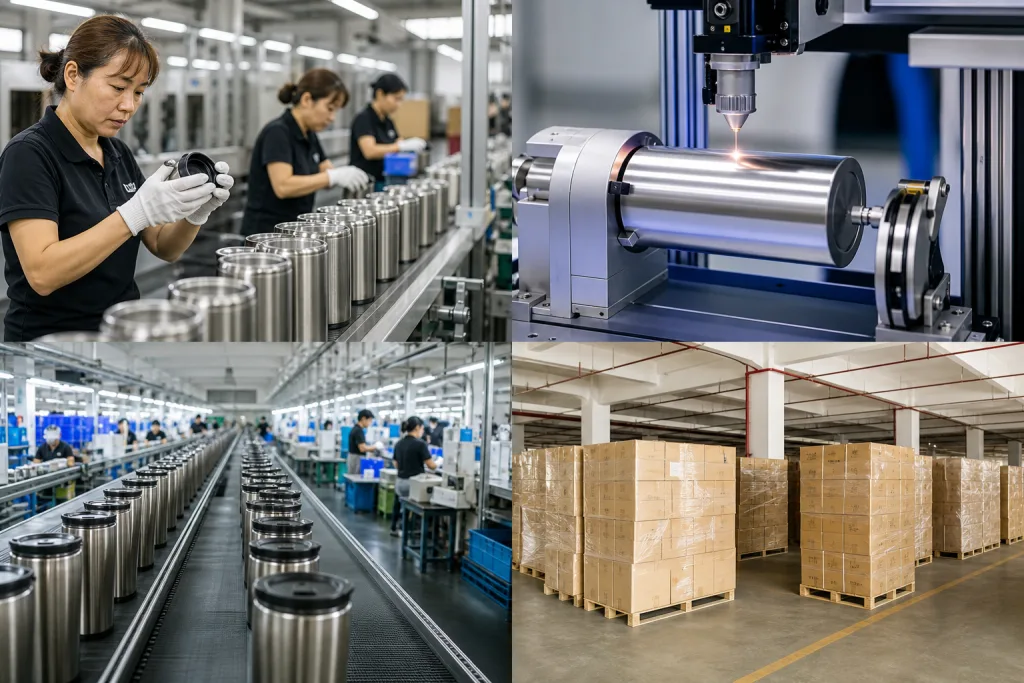
At BottleForge Industrial, our monthly capacity is about 650,000 stainless drinkware units across travel tumblers, sports bottles, and thermos products. That does not mean every small order can jump the production queue. A 500-unit urgent order can burn more line time than a 10,000-unit standard order because the same changeover is required: fixture swap, spray gun cleanout, oven temperature check, and first-article approval. We run batches for a reason. If you want factory direct pricing from China, plan around the factory’s batch logic, not the trade-show sample on your desk.
Typical MOQ tiers look like this: 500 units for stock body, stock color, one laser logo; 1,000 units for stock body with custom powder color; 2,000-3,000 units for custom lid color and printed retail box; 5,000 units for modified body, special handle, or exclusive finish. For the 2,000-3,000 unit tier, QC pulled the sample box last month because the Pantone code on the PO said 186C, while the artwork file showed 185C. Small typo. Big delay. If you are a coffee mug distributor or buying for multiple corporate gift clients, combining colors under one total order can work, but do not assume 12 colors at 200 units each will be accepted.
For coffee mug private label projects, the practical sweet spot is often 2,000-5,000 units. At that quantity, you can usually justify a proper printed box, UPC or FNSKU label, brand instruction insert, and pre-shipment inspection. We ship a cleaner order when carton marks, barcode placement, and the inner polybag spec are locked before mass production. Below 1,000 units, you may spend more time fighting setup charges than building margin. We've seen this go sideways: the buyer saved 600 USD on MOQ, then lost 12 days vs 18 days arguing over box cost and re-labeling.
Lead Time From Brief To Shipment
A normal bulk coffee tumbler job moves through four stops: quotation, sampling, production, and inspection/shipment. If you already have the capacity, finish, and logo method locked, our sales desk usually turns a quote in 1-3 working days. Send clean artwork, a target price, and the right pack info; send a random web photo and a vague “best price,” and the file bounces back. We ship faster when you give capacity, quantity, color, logo size, packaging, destination port, and the compliance market on day one.
Sampling usually takes 7-12 days for a stock tumbler with laser logo or screen print. Custom powder color sampling runs 10-18 days because the coating has to be matched, sprayed, cured, and checked in a 6500K light box. A new mold or a modified lid usually needs 20-35 days before you get a working sample. If a supplier says a new lid is ready in five days, ask if it is fresh tooling or just an old lid pulled from stock. That is the wrong question to ignore.
Mass production for coffee mug in bulk usually takes 30-45 days after sample approval and deposit. On our line, a 12-oz stainless run can move fast, but peak season pushes that to 50-60 days, especially before September and October gift shipments. Chinese New Year bites hard too. Once you count worker travel, line restart, and raw material lag, you lose 20-30 practical production days. We’ve seen buyers try to shave that window by a week; the math does not work.
Inspection and logistics add their own clock. Pre-shipment inspection needs 1 day on site, then 1-2 days for the report and any sorting call. QC pulled the sample, checked lid fit with a 0.3 mm gauge, and if the carton's drop test fails, the lot stays put. Sea freight to the US West Coast may be 18-28 days port to port; to Europe often 30-40 days. Air freight can move in 5-10 days, but it is seldom worth it for stainless bulk travel tumbler orders unless the campaign deadline is brutal enough to pay for it.
Lids, Coatings, And Failure Risk
In bulk travel mug orders, about 70% of the claims we see start with the lid, coating, or vacuum layer. The cup body is usually the quiet part if the coffee mug factory controls laser welding, vacuum testing, and polishing on the line. Lids are trickier. Buyers ask for one-hand drinking, leak resistance, easy cleaning, low cost, and a nice profile in the same RFQ, then push back when the sample has eight plastic parts and three silicone rings. The math does not work. You cannot max out all five without paying for it somewhere.
A basic press-fit lid is cheap, often USD 0.25-0.55, and works for desk or car use. A sliding lid may add USD 0.40-0.90. A flip straw or leak-resistant button lid may add USD 0.80-1.80 depending on parts and silicone. For corporate gifts, a simple lid may be acceptable. For a coffee brand selling a premium coffee mug private labeling range, lid feel affects reviews more than the shine of the box. QC pulled one sample last month because the slider rattled after 300 open-close cycles, even though the cup looked perfect in the photo.
Powder coating is the next risk area. A proper coating should pass cross-hatch adhesion testing and resist normal hand abrasion. Matte finishes look good on a catalog page, but they show oil marks from fingers and fine scratches from carton dividers. Metallic and gradient finishes cost more and have higher reject rates; on one 5,000 pcs run, our first spray check found 6% shade drift before curing was adjusted by 8°C. If your brand color is strict, use a Pantone reference but accept a realistic tolerance. Stainless drinkware is not paper printing; surface texture and curing temperature change the final appearance.
Vacuum failure should be tested during production, not discovered by your customers. We run vacuum detection after assembly and hot water temperature retention checks before packing, not after the container is booked. For example, a 20 oz tumbler may be tested with hot water at around 95°C, then checked after several hours against the agreed retention curve. For coffee mug manufacturers, the pass rate should be recorded by batch. Ask for the test method, not just the phrase “keeps hot for 12 hours.” We have seen this go sideways when a PO says 12 hours, the buyer expects 18 hours, and nobody wrote down the test room temperature.
Logo And Packaging Cost Choices
For coffee mug custom products, choose the decoration method based on where the cup will be sold or handed out. A café loyalty gift has a different job from a retail tumbler sitting under LED shelf lights. Laser engraving holds up well on 304 stainless steel and powder-coated bodies, and our QC team checks the mark depth with a 0.02 mm feeler gauge when the artwork has thin lines. It will not give you bright Pantone brand colors. Screen printing keeps cost down for one-color logos, but we have seen prints fail the 3M tape test when curing time was rushed on a textured coating. UV printing gives better color detail; test adhesion on 12 pcs before approving a 5,000 pcs coffee tumbler bulk run.
For coffee mug customizable programs where each corporate client wants a different logo, keep the tumbler body and packaging standard. Change the logo only. Simple wins here. It protects lead time and cuts factory mistakes, especially when the line is switching screens twice in one shift. If every order changes cup color, lid color, logo process, box artwork, and insert, the math doesn't work; you are not running one promotional program, you are running 18 small OEM jobs with more chances for a wrong lid or a PO typo like “matte black” becoming “mate black.”
Packaging should follow freight method and sales channel. For B2B corporate gifts, an individual white box plus master carton is usually enough; we run 24 pcs per export carton on several 20 oz models, then check drop-test corners before sealing. For retail or online resale, use a printed color box with barcode, country of origin, care instructions, and material statement. For marketplace fulfillment, add FNSKU or SKU labels and confirm carton dimensions before production. A carton that is 2 cm too large can create avoidable storage and shipping cost, and buyers do flag this after the first warehouse invoice.
For a coffee mug promotional buyer, we often suggest testing two packaging levels: basic individual box for giveaways and printed gift box for higher-value clients. The difference can be USD 0.30-0.90 per unit, but it changes perceived value. Put that line on the procurement sheet. Do not bury it inside one FOB price. On one 3,000 pcs order last season, the buyer pushed back on USD 0.48 for a color box, then accepted it after seeing the sample with foam bag, care card, and clean barcode placement.
Compliance, Inspection, And Payment
For Europe and North America, compliance cannot wait until the cartons are on the floor. Stainless travel tumblers touch hot coffee, lips, hands, dish racks, and sometimes children’s bags. We ask buyers for the target market before we cut the first sample, because one wrong test item can waste 7 days and 2 sample sets. Your coffee mug oem manufacturer should confirm food-contact requirements before sampling. For the EU, buyers often ask for LFGB, EU 1935/2004, REACH for restricted substances, and specific migration testing when the lid has PP, silicone, or Tritan parts. For the US, FDA food-contact expectations and California Proposition 65 screening may apply. If the product is for children, ASTM and CPSIA questions can enter the discussion. QC pulled one 350ml sample last month because the silicone ring supplier changed the batch code without telling the line. Small detail. Big risk.
Inspection should be written into the purchase order, not argued over after production. A practical standard is AQL 2.5 for major defects and AQL 4.0 for minor defects, with critical defects not accepted. Major defects include leaking lids, failed vacuum, wrong logo, severe coating scratches, sharp edges, or wrong material. Minor defects include small dust points, light color variation, or tiny carton marks within the approved limit sample. We normally check vacuum retention, lid fit, logo position within a 1 mm tolerance, carton drop marks, and coating adhesion with 3M tape. The buyer flagged it once because the PO said “matte black” but the approved sample was satin black. The math doesn’t work if inspection terms are loose.
Payment terms for coffee mug factory direct orders from China are often 30% deposit and 70% balance before shipment. Established buyers sometimes negotiate 20/80 or partial payment after inspection, but new buyers should expect standard terms. Do not pay the balance before you have production photos, packing list, and preferably a third-party or internal inspection report. We ship after the balance clears; for a 5,000 pcs tumbler order, that timing usually decides whether the vessel is caught this Friday or missed until next Wednesday. One buyer once pushed for release based only on a screenshot of the bank slip. We refused. That is how disputes start.
If you are comparing a coffee mug supplier list, ask each supplier the same set of questions: MOQ by color, FOB port, steel grade, wall thickness, lid material, logo method, packaging, lead time, compliance documents, AQL standard, and sample cost. Add the expected carton size and gross weight too, because freight can kill a cheap unit price. A cheap quote without these details is not a quote; it is a placeholder. Zhejiang factories are strong at stainless drinkware, but the buyer still needs a controlled specification. We run into this often: 304 stainless is written on the first email, then the PO arrives with no wall thickness, no lid drawing, and no Pantone code.
How To Brief The Factory
A clear brief saves more money than hard bargaining. If you want a bulk coffee mug program for a coffee chain, start with the use case: hot coffee takeaway, office desk, car cup holder, retail gift set, or subscription box. Then lock the capacity, such as 12 oz, 16 oz, or 20 oz. A 12 oz tumbler fits espresso-based drinks and corporate gifting. A 20 oz bulk travel tumbler works better for commuters and North American retail. Cup holder fit matters. We always ask for bottom diameter before sampling, and on the line a 74 mm base can save a round of rework.
Your brief should include target FOB price and order quantity. For example: “We need a 16 oz stainless vacuum tumbler, 304 inner, powder coated black and cream, one-position laser logo, printed gift box, 3,000 units per color, target FOB under USD 5.80, delivery to Ningbo in 45 days.” That line gives a coffee mug supplier enough to quote cleanly. If the buyer flags the 45-day lead time, we check whether the lid mold is already in stock and whether the packing line can hold 800 pcs per shift.
Send logo files in AI, PDF, or EPS format, not JPG alone. State whether the logo can be simplified for laser engraving. Confirm whether you need coffee mug custom made tooling or whether an existing body is acceptable. We had a buyer once insist on a new mold, then QC pulled the sample and found the stock body already passed the 48-hour leak test. This is the wrong question to ask if the sales target is speed and margin; a stock body with the right color, lid, and packaging often looks custom at a lower tooling cost.
If you are a coffee mug distributor serving several clients, build a core range of 2-3 tumbler bodies and 4-6 standard colors. Then offer controlled customization. That keeps the line moving. It also cuts mistakes from sloppy PO text; we once saw “matte bleck” on a purchase order, and the buyer lost two days while we confirmed the finish. A small range beats a random search through supplier lists, because factory discipline and buyer discipline usually beat endless options.
Send Your Tumbler Brief For A Real Quote
Share quantity, target price, logo, packaging, and market. We will return a practical FOB China quote with MOQ and lead time.
Frequently asked questions
What is a realistic MOQ for coffee tumbler bulk orders?
For a stock stainless travel tumbler with one laser logo, 500 units can be possible, but 1,000 units is a more normal starting MOQ. If you need custom powder coating, plan for 1,000-2,000 units per color. If you need custom lid color, printed gift box, insert, and barcode, 2,000-3,000 units is more practical. For new mold development or a unique handle design, expect 3,000-5,000 units minimum. Lower MOQ often means higher unit cost, fewer color choices, and less flexibility on packaging.
How much should a bulk coffee travel mug cost FOB China?
A basic 12 oz stainless bulk coffee travel mug can cost around USD 3.10-4.20 FOB Ningbo or Shanghai at 3,000 units. A better 16-20 oz vacuum tumbler with 304 stainless inner wall, powder coating, sliding lid, laser logo, and individual box commonly falls around USD 5.20-7.50. Premium lids, ceramic inner coating, gradient finishes, or gift packaging can push the cost above USD 8.50. Always ask the supplier to break out cup body, lid, logo, packaging, and carton cost.
Can I do coffee mug private label packaging at 1,000 units?
Yes, but keep the packaging simple. At 1,000 units, a printed color box is possible, but the box setup cost will add noticeable unit cost, often USD 0.35-0.80 plus printing preparation charges. If you also want custom inserts, retail sleeves, FNSKU labels, and multiple colorways, 2,000-3,000 units is smoother. For a first coffee mug private label test, many buyers use a stock tumbler, one logo method, one printed box, and one carton specification to avoid delays.
How long does production take after sample approval?
For coffee mug in bulk using an existing mold, normal mass production is 30-45 days after sample approval and deposit. Add 7-18 days before that for logo or color sampling. If you need new tooling for the body or lid, add 20-35 days for mold development and testing. Peak season, China holidays, and packaging revisions can extend the timeline to 50-60 days. You should also allow 1-3 days for inspection and 18-40 days for sea freight depending on destination.
How do I compare coffee mug manufacturers without choosing only the cheapest quote?
Use the same specification sheet for every coffee mug manufacturer: capacity, steel grade, wall thickness, lid type, coating, logo method, packaging, MOQ by color, FOB port, lead time, compliance documents, and AQL inspection level. Ask for photos of similar production, not just catalog renders. A quote that is USD 0.40 cheaper may use thinner steel, 201 stainless, weak coating, or a basic lid. For corporate gifts and coffee brands, complaint cost can be higher than the saving.