Key Takeaways
- A practical travel tumbler MOQ is usually 1,000-3,000 pcs per color for OEM branding
- 304 stainless steel at 0.4-0.5 mm wall thickness is the normal baseline for coffee use
- Laser engraving is durable, but 1-color silk screen is often cheaper below USD 0.18 per logo
- Plan 30-45 days production after artwork approval, plus 25-35 days ocean freight to North America
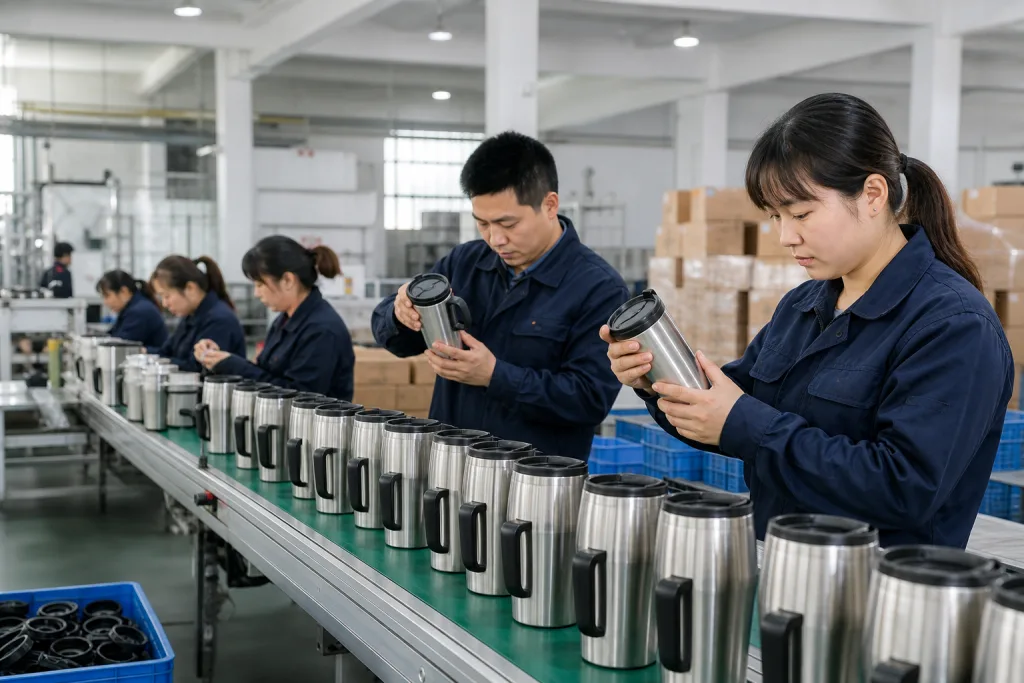
Choosing coffee travel mug vendors is not just picking a clean shape and pushing for the lowest FOB price. The real test comes after 20,000 pieces ship, get handed to staff or customers, go through dishwashers, hit car cup holders, and come back with lid leaks or logo scratches. We see it on the line: a 0.3 mm gap on a slider lid is enough for the buyer to flag the whole shipment.
You need to check construction, branding method, compliance, packing details, and whether the supplier can hold the schedule when the PO changes from 5,000 to 30,000 pcs. As a Zhejiang drinkware factory, we’ve seen buyers pay USD 0.42 extra for the wrong logo process, approve weak lids, and accept QC wording that says “standard inspection” with no AQL 2.5 written anywhere. Bad idea. A good bulk coffee travel mug program starts with wall thickness, leak testing, carton drop results, and confirmed lead time, not a nice catalog screenshot.
Start With The Use Case
Before you compare a coffee mug supplier list or ask ten coffee mug manufacturers for quotes, lock down the job the mug has to do. A coffee brand selling retail merch is not buying the same item as a corporate buyer ordering coffee mug promotional products for a 3,000-person annual meeting. Retail buyers usually push us on repeat use, shelf feel, barista-friendly size, and gift-box appearance; corporate-gift buyers push on Pantone logo accuracy, delivery date, carton marks, and landed cost down to the last USD 0.06. We see this go sideways when the PO says “premium tumbler” but the artwork file is a 72 dpi JPG.
For most coffee travel mug vendors, capacity drives the quote first. The normal range is 12 oz, 16 oz, and 20 oz. A 12 oz tumbler fits espresso-based drinks and smaller European coffee portions. A 16 oz bulk coffee tumbler is the safest middle size for cafés, subscription boxes, and office gifts, since it still fits most cup holders and does not punish the freight bill. A 20 oz bulk travel tumbler feels better in the hand, but the math changes: more 304 stainless, larger cartons, and fewer pieces per CBM. QC pulled one 20 oz sample last month at 318 g before lid, and the buyer flagged it as too heavy for a commuter set.
Then decide where the tumbler will actually be used. Car cup holder? Keep the base diameter under 74 mm, and have the supplier check it with a caliper, not by eye. Café shelf? A slimmer body with powder coating sells better than a fat body with a shiny finish, especially beside paper-cup inventory. Conference giveaway? A simple push lid is cheaper and faster on the line than a leak-resistant flip lid, and assembly workers make fewer gasket mistakes. Simple wins here.
Do not start with “send me your best price.” Start with capacity, lid function, finish, logo position, and packaging. The price only makes sense after those choices are fixed.
At BottleForge Industrial in Hangzhou, Zhejiang, a normal monthly output for stainless travel tumblers is about 450,000 units across standard and OEM lines. That production room helps when we ship a repeat SKU, but it does not fix unclear specs. If the buyer changes from kraft box to color box after pre-production sample approval, the schedule can move from 12 days to 18 days before mass production starts. The line can run fast; guessing still costs money.
Choose The Right Steel And Lid
A coffee mug factory should be able to tell you the steel grade, wall thickness, vacuum process, and lid material without hiding behind “food grade” language. On our line, we check the wall with a thickness gauge before the first deep draw, and QC pulled the sample again after forming. For coffee travel mugs, the standard build is double-wall vacuum insulated 304 stainless steel inside and outside. Some low-cost models use 201 stainless on the outer wall, but we do not recommend that for premium coffee mug private label work. Corrosion resistance is weaker, and that shows up fast in coastal markets.
For a bulk coffee mug program that ships cleanly, ask for 0.4-0.5 mm stainless wall thickness before forming. Thin bodies can pass a shelf check and still dent in pallet handling. We once saw a PO typo call out 0.05 mm on the drawing, and the buyer flagged it before tooling started. Vacuum performance should be tested with hot water at 95°C, with a typical benchmark of keeping liquid above 50°C after 6 hours, depending on capacity and lid design. The math does not work if the body is too thin and the lid is loose.
The lid is where a lot of coffee mug custom made projects go sideways. Tritan, PP, and AS are the materials we see most. Tritan is clearer and tougher, but it costs more. PP is practical and cheaper, but it looks less premium. On a recent lid trial, QC pulled the sample after the gasket seat flashed by 0.2 mm, and the buyer caught the mismatch between the render and the mold. If you need EU and North American compliance, ask for LFGB or FDA food-contact test reports for the lid, silicone gasket, coating, and stainless steel.
- Slider lid: good for sipping on the road, but not truly leakproof. Lower cost, fewer parts.
- Flip lid: better for commuting and one-hand use, but the hinge adds QC risk. We see more spring and seal checks on this style.
- Straw lid: popular for cold drinks and iced coffee, but it is a poor fit for hot coffee above 60°C.
- Screw lid: stronger sealing and fewer complaints in transit, but slower to drink from at a desk or in the car.
If a coffee mug oem manufacturer says a lid is leakproof, ask for the test method. We run a 10 minutes inverted test with 60°C water after opening and closing the lid 20 times, and that is the first thing we show buyers who push for a simple yes or no. Perfect leakproof performance is hard on sip lids. Honest vendors should say that straight.
Branding Is A Cost Decision
A coffee mug customizable project looks simple on a quote sheet, then the decoration line starts asking real questions: logo size, coating color, artwork tolerance, packing style, and MOQ. We usually compare five methods first: laser engraving, silk screen printing, heat transfer, water transfer, and full-wrap sublimation on coated blanks. Each one changes unit price, lead time, and defect risk. Last month QC pulled 32 samples from a 3,000 pcs run because the artwork sat 2 mm too low on the cup body.
Laser engraving is the low-risk choice for a coffee mug customized with a clean logo. The laser removes the powder coating and shows the stainless steel underneath, so the logo will not peel in normal use. Setup cost stays low. For a 50 x 50 mm logo, the added cost is often around USD 0.12-0.25 per piece depending on complexity and order quantity. We run this on a fiber laser machine, and the main thing we check is logo position against the handle line or lid drinking side.
Silk screen works better when you need a color logo on a bulk travel mug. A one-color print may cost USD 0.08-0.18 per piece, plus a screen charge. Multi-color silk screen needs tighter registration; a PDF mockup is not enough. Ask for a physical pre-production sample. The buyer flagged this once on a black 20 oz tumbler because the white underbase showed a 0.5 mm shadow around the red logo. For full-color artwork, heat transfer can look sharp, but it scratches faster if the coating thickness and oven curing time are off.
For coffee mug private labeling, packaging is part of the brand cost, not a side note. A plain white box is cheap, usually USD 0.08-0.15. A custom color box can add USD 0.20-0.45 depending on paper thickness, lamination, and MOQ. If you sell through retail or e-commerce, confirm barcode, warning text, recycling marks, and country-of-origin wording before mass production. Small detail, big delay. We have seen a PO typo on “Made in China” artwork hold shipment for 4 days while the buyer’s compliance team re-approved the box file.
The trade-off is direct: laser lasts, silk screen saves money on simple color, full-wrap graphics sell well online but need stricter inspection. This is the wrong question to ask: “Which branding is best?” Ask which method matches your retail price, return policy, and inspection standard. A serious coffee mug manufacturer will show past samples, explain defect limits, and tell you where the math does not work before you commit.
Compare Factory Direct Against Traders
Buyers often start with a coffee mug supplier directory or pull 30 names from trade platforms into a coffee mug supplier list. Fair enough. The first filter is simple: who is quoting you, a trading company, a decoration workshop, or a coffee mug factory direct supplier? None of these is automatically wrong, but control is where orders go sideways. We once saw a PO marked “matte balck” and the trader copied it straight to the coating shop without checking the color chip.
A factory-direct partner lets you see more of the real work: tooling status, 304 stainless steel purchasing, polishing marks, powder coating, lid assembly, and AQL inspection. A trader can fit small mixed orders or a shipment with 8 product categories packed into one container. For a coffee mug in bulk program above 3,000 pieces, factory direct usually gives cleaner technical answers because the line can check wall thickness with a caliper instead of guessing from a catalog photo. Short answer: the math doesn't work if nobody owns the defects.
Ask specific questions. What is the MOQ per color? Is powder coating done in-house or sent to an outside coating plant? What AQL level is used for final inspection? Can they support BSCI, ISO 9001, REACH, LFGB, or FDA documentation? What defect allowance do they use for coating pinholes over 0.5 mm, logo shift over 1 mm, lid scratches, and crushed export cartons? QC pulled the sample should be a real sentence in their factory, not sales talk.
For our China production line, a practical MOQ is 1,000 pieces for standard-color coffee mug promotional orders and 3,000 pieces for custom powder coating. Production lead time is normally 30-45 days after deposit, artwork approval, and sample sign-off. Rush orders can be done. But rush production should not mean skipping vacuum testing on the water bath machine or logo inspection under the 3M tape test. We run those checks because one missed batch can cost 12 days of rework instead of 2 hours of inspection.
Price gaps need context. If one quote is USD 0.40 lower than the others, check steel grade, lid material, carton thickness, coating type, and whether export packing is included. Ask for carton specs in mm and kg, not just “strong carton.” Cheap FOB becomes expensive when 4% of goods arrive scratched and the buyer flags photos from the warehouse before the first retail delivery.
Build The Landed Cost Properly
Procurement teams still compare only unit FOB price. Wrong question. For a bulk coffee mug or bulk coffee travel mug order, FOB alone misses too much. A 16 oz stainless travel tumbler might quote at USD 3.20-4.80 FOB Ningbo or Shanghai based on finish, lid, logo, and packaging. The landed cost also includes inland trucking from Hangzhou to port, ocean freight, duty, customs clearance, warehousing, and Amazon or 3PL prep when the buyer needs it. Last month we had a PO typo showing “FOB Shanghai” while the carton mark said Ningbo; that one line changed the trucking charge by USD 0.04 per piece.
Carton efficiency matters. A typical 16 oz tumbler may pack 24 pieces per export carton, with a carton size around 56 x 38 x 28 cm and gross weight around 8-10 kg. A wider handle tumbler may look better in the photo, but it can cut container loading by 20-30%. On a 20,000 piece order, the math does not work if the cup saves USD 0.08 but burns one extra CBM. We check this on the packing table with a tape measure and carton scale before the pre-production sample is signed off.
For corporate-gift buyers, delivery date beats saving USD 0.10. Work backward from the event date. Allow 7-10 days for sampling, 3-5 days for artwork revision, 30-45 days for mass production, 3-5 days for China export handling, and 25-35 days sea freight to a North American port. Europe can vary from 30-40 days by ocean depending on destination. We have seen this go sideways when a buyer approved the laser logo 6 days late, then asked the line to “just catch up”; stainless forming and powder coating do not move like that.
If you ship to Amazon or a distributor warehouse, specify FNSKU labels, carton labels, master carton weight limits, polybag rules, and drop-test requirements. Coffee mug distributors hate rework because relabeling in the destination warehouse can cost more than the original Chinese packing. QC pulled the sample carton after one drop test and found the lid scuffed through the thin PE bag, so we changed to a thicker bag before sealing the master carton.
A fair landed-cost comparison should show the same specification, same Incoterm, same packaging, same inspection level, and same shipping method. Same sample, same test. If Supplier A quotes AQL 2.5 inspection with individual color box packing and Supplier B quotes bulk egg-crate packing with no inspection, you are comparing guesses, not vendors.
Set Inspection Rules Before Deposit
Write the inspection rules before you pay the deposit. For coffee mug bulk orders, we set AQL during quotation, not after mass production starts. A common final inspection setting is AQL 2.5 for major defects and AQL 4.0 for minor defects, with critical defects not accepted. For premium retail orders, you can tighten the standard, but the math may not work if the order is only 3,000 pcs and every sorted carton adds labor on the line.
Major defects include failed vacuum insulation, sharp edges, leaking lids beyond the agreed test, wrong logo color, serious coating scratches, incorrect capacity, and unsafe odor from silicone or plastic parts. Minor defects include small dust points under coating, slight print position variation, light carton rub marks, or small cosmetic marks outside the main logo area. QC pulled one sample last month with a burr inside the drinking slot; it looked small, but a buyer in Germany would call that a safety issue.
You should also approve a golden sample. This sample becomes the reference for color, logo size, lid fit, box layout, and finish. Pantone matching on powder coating helps, but metal coating shifts under D65 light versus a shop-floor LED lamp. Define an acceptable Delta E range if color is critical; waiting until cartons are sealed is the wrong question to ask.
For coffee mug promotional products, inspect the logo early. We run an inline check after the first 200-300 pieces of printing or engraving. A 2 mm logo shift at 300 pieces is still fixable with a screen adjustment and operator reset. After 10,000 pieces are packed, the buyer flagged it, and nobody likes that call.
Ask your coffee mug supplier for vacuum test records, coating adhesion test results, and random lid assembly checks. A simple cross-hatch adhesion test, 3M tape pull, 1-hour hot water odor check, and carton drop test can prevent most practical complaints. We usually attach the test sheet with time, inspector name, and carton number. Good China factories know these requests; vague answers are a warning sign.
Pick A Vendor You Can Reorder
The best coffee travel mug vendors are not the ones who only get the first PO out the door. The better test is six months later: can they repeat the same Pantone color, lid version, laser logo position, carton mark, and gift box without starting the project again? This matters for coffee brands, mug distributors, and corporate buyers running annual programs where the buyer flagged “same as last shipment” on the PO and still expects the same shelf look.
Ask whether your color code, AI artwork file, carton mark, box dieline, and AQL 2.5 inspection standard sit under your account name. Ask how many months the factory keeps spare lids and silicone gaskets; we usually suggest 12-18 months for active SKUs. For private-label programs, buy 1-2% extra lids or seals with the main production run. Cheap then. Painful later. QC pulled one reorder sample last year where the cup body matched, but the new gasket was 0.4 mm thinner and the lid failed the leak test.
Talk about exclusivity early, but be practical. For a coffee mug custom design using private tooling, exclusivity makes sense if you pay for the mold and commit to a purchase volume in writing, such as 30,000 pieces across 12 months. For a standard open-market shape with your logo, full exclusivity is the wrong question to ask. The math does not work. A cleaner agreement protects your artwork, retail box, carton layout, and custom color formula while we run the standard body shape on the line for normal production.
At BottleForge Industrial in Zhejiang, we prefer buyers who treat the first order as a controlled launch: 1,000-3,000 pieces, clear QC terms, and a reorder plan. If sell-through is strong, scaling to 10,000-50,000 pieces is straightforward because the BOM, lid mold number, packing method, and inspection photos are already locked. If the market changes, you have not buried cash in the wrong lid, color, or carton format; we have seen this go sideways when a buyer ordered 20,000 matte beige mugs before testing the retail channel.
A good coffee mug factory should push back when your specification creates risk. If every vendor says yes in 10 minutes, you are probably not hearing the engineering truth. We ship drinkware for a living, and sometimes the correct answer is, “change the lid wall by 0.3 mm or expect complaints.”
Send Your Travel Tumbler Specification For Review
Share capacity, logo method, target quantity, market, and delivery date. We will reply with practical MOQ, lead time, and factory-direct pricing.
Frequently asked questions
What MOQ should I expect from coffee travel mug vendors?
For standard stainless travel tumblers with an existing color, a realistic MOQ is 1,000 pieces per logo design. For a custom powder-coated color, most factories in China prefer 3,000 pieces because coating line setup, powder loss, and color cleaning create fixed cost. If you need a custom lid, private mold, or special handle design, MOQ can move to 5,000-10,000 pieces. Smaller quantities are possible through stock programs, but the unit price may increase by USD 0.30-0.80 and color options will be limited.
Which logo method is best for a coffee mug custom order?
For long-term daily use, laser engraving is usually the safest choice because it does not peel or fade. It works especially well on powder-coated stainless steel and costs about USD 0.12-0.25 per unit for many standard logos. For a color logo, one-color silk screen is cheaper and good for corporate gifts, usually around USD 0.08-0.18 per unit. Full-color heat transfer is better for retail artwork, but you should test scratch resistance and dishwasher behavior before approving mass production.
How do I verify a coffee mug manufacturer is factory direct?
Ask for a factory business license, production photos, audit documents, and a live video walk-through of forming, polishing, coating, assembly, and packing areas. A real coffee mug factory direct supplier should know monthly capacity, MOQ by process, AQL standards, and which steps are outsourced. You can also ask whether they can host a third-party inspection at the factory address. If the company avoids technical questions or cannot explain wall thickness, lid material, or vacuum testing, treat the quote carefully.
What certifications matter for coffee mug private labeling?
For North America, request FDA food-contact documentation for stainless steel, plastic lids, silicone gaskets, and coatings when applicable. For Europe, LFGB and REACH are commonly requested, especially by distributors and larger retailers. BSCI may matter if your customer reviews social compliance. ISO 9001 is useful but does not replace product testing. If the tumbler is for children, requirements are stricter and may involve CPSIA or ASTM-related checks. Always match reports to the exact material and model, not a random old test.
How long does a bulk travel mug order take?
A normal OEM order takes about 7-10 days for sampling after artwork confirmation, then 30-45 days for mass production after sample approval and deposit. Ocean freight adds roughly 25-35 days to North America and 30-40 days to many European ports. Air freight can reduce transit to 5-8 days, but it is expensive for stainless tumblers because volume weight is high. For event orders, build in at least 10 extra days for inspection, customs, and warehouse receiving.