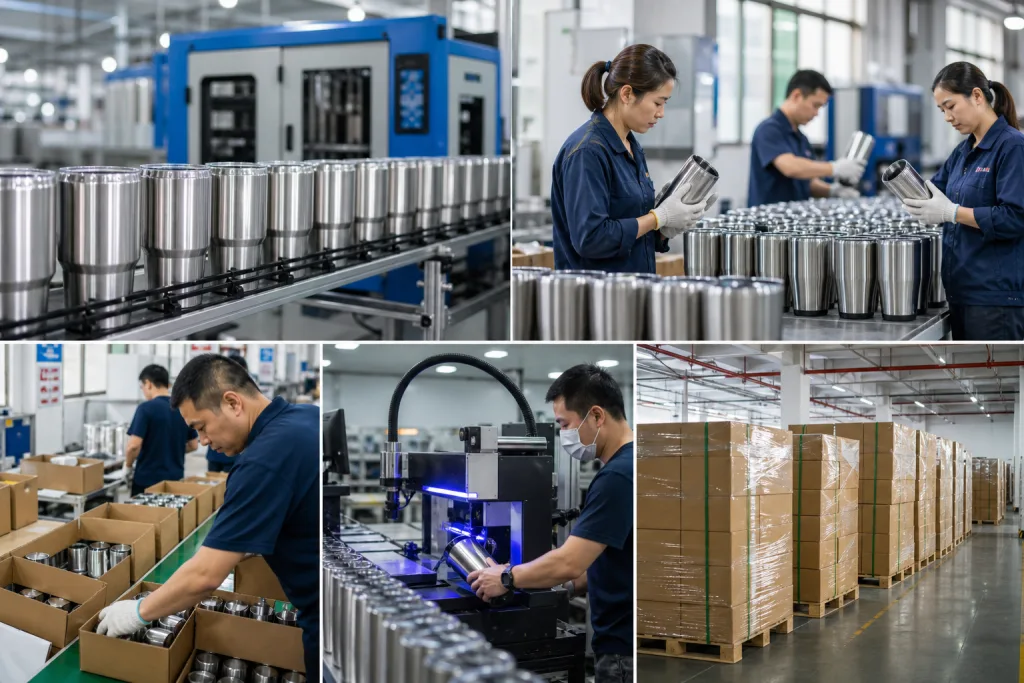
Key Takeaways
- A practical first MOQ for a custom travel tumbler is 1,000-3,000 pcs per color, depending on finish and logo method
- Ask for FOB pricing with wall thickness, steel grade, lid material, carton specs, and AQL level stated in writing
- A pre-production sample usually takes 7-12 days after artwork approval, while bulk production runs 25-40 days
- Your PO should separate product cost, tooling, logo setup, packaging, inspection, labeling, and spare parts
A custom travel tumbler looks simple until the quote sheet opens. Last Tuesday we priced a 500 ml 304 stainless mug for two buyers: same capacity, same “vacuum insulated, food grade, custom logo” request, but a 38% cost gap once lid tooling, powder coating, and carton spec were added. For coffee brands and corporate-gift buyers, finding a coffee travel mug manufacturer is not the hard part. The hard part is asking the right questions before artwork, deposits, and PO numbers get locked.
At our line in Zhejiang, China, we see 20–30 RFQs a week missing basics like lid type, carton drop-test standard, logo position tolerance in mm, or FNSKU labeling. QC pulled one sample last month where the laser logo sat 6 mm off-center; the buyer flagged it only after pre-shipment photos. These details set price, lead time, defect risk, and whether your bulk coffee travel mug order arrives ready to sell or ready for rework.
Start with the actual use case
Before you ask any coffee mug factory for price, pin down the actual use case. Price first is the wrong question. A corporate-gift buyer handing out 10,000 pcs at a trade show needs a different spec from a coffee roaster selling a premium retail mug next to whole beans. We have seen this go sideways when the buyer wrote only “stainless steel travel mug, logo printed,” then blamed the first sample for missing a lid style they never mentioned.
Start your RFQ with capacity, drinking style, and sales channel. For hot coffee, 380 ml, 500 ml, and 600 ml are the sizes we quote most. A 500 ml bulk travel tumbler usually works best for North American coffee buyers, while 380 ml fits European desk and commuter use. If the mug must sit in a car cup holder, ask for a base diameter around 68-72 mm. If it must stay leak-resistant in a bag, say that clearly; a slider lid and a screw lid are not the same engineering problem, and the leak test on the line is not the same either. QC pulled the sample after a 3 m drop test when the lid popped open.
Your first RFQ line should read like a product brief, not a wish list. One typo on a PO can send the wrong lid color into production.
- Item: double-wall stainless steel vacuum travel tumbler, 500 ml
- Material: inner 304 stainless steel, outer 201 or 304 stainless steel
- Finish: powder coating, Pantone matched, matte
- Lid: BPA-free PP or Tritan, sip opening, silicone seal
- Logo: 1-color silkscreen, 50 mm wide, front center
- Channel: retail coffee shop, gift box required
A good coffee mug supplier will come back with questions. A weak supplier will only send a catalog and a low USD price. For a coffee mug custom project, questions are a good sign because the factory is checking the real production route before quoting. We run that check before we lock the MOQ, not after the buyer flags a problem in the sample room.
Build an RFQ suppliers can price
After the use case is clear, send an RFQ the factory can price without guessing. This is where we see buyers burn 5-10 days. They pull names from a coffee mug supplier directory, build a coffee mug supplier list, then get 7 quotes that cannot sit in the same spreadsheet because one factory priced a slider lid, another used a flip lid, and a third quoted 201 stainless instead of 304 stainless. The math doesn't work.
For a bulk coffee mug or bulk coffee tumbler program, put the target quantity, delivery terms, packaging spec, compliance market, and inspection requirement in the first email. If you are importing into the EU, state LFGB or REACH expectations. For the United States, ask whether the coating and plastic parts can support FDA food-contact documentation where applicable. If your customer needs social compliance, ask for current BSCI or ISO 9001 status before the final audit week. We have seen this go sideways when a PO says “FDA approved” but the buyer actually needs test reports for the lid gasket and inner coating.
Use one clean table in your email:
- Quantity: 3,000 / 5,000 / 10,000 pcs price breaks
- Incoterm: FOB Ningbo or FOB Shanghai
- Sample: 2 pcs with logo, 2 pcs blank, courier by buyer account
- Packaging: individual kraft box, 24 pcs master carton, carton drop-test suitable
- Inspection: AQL 2.5 major / 4.0 minor, pre-shipment inspection allowed
- Labeling: barcode, FNSKU, country of origin, warning label if needed
At BottleForge Industrial in Hangzhou, Zhejiang, our standard travel tumbler MOQ is normally 1,000 pcs for stock colors and 3,000 pcs for custom powder coating. Monthly output is about 450,000 drinkware units across travel tumbler and thermos lines, with sports bottles run on a separate line when cap assembly needs torque testing. Those numbers matter. A coffee mug factory direct partner should tell you where your order fits in the line schedule, whether it ships in 12 days or 18 days, and what gets delayed if QC pulls the sample for coating thickness or logo adhesion.
Compare quotes beyond unit price
A USD 3.20 tumbler is not automatically cheaper than a USD 3.65 tumbler. We see this on quote sheets every week. For coffee mug distributors and brand buyers, the quote has to show what is inside the price, not just one neat FOB number. If it does not, ask again. The main cost gaps come from steel grade, wall thickness, lid structure, coating quality, logo process, and packaging. On our line, a 0.38 mm body and a 0.50 mm body may look close in a photo, but the caliper tells a different story.
For a mid-range 500 ml vacuum coffee travel mug from China, typical FOB pricing sits around USD 3.20-5.20 at 3,000-10,000 pcs, depending on specification. A thin promotional model with a simple PP lid may sit near the low end. A retail-ready coffee mug private label item with 304 stainless steel inside and outside, powder coating, custom gift box, and laser logo will cost more. If someone quotes far below the group, check whether vacuum insulation, copper lining, coating thickness, or carton quality has been cut out. We had one buyer flag a USD 0.42 gap last season; QC pulled the sample and found the coating was 18-22 μm instead of the approved 35 μm.
Ask each coffee mug oem manufacturer to state these items on the quotation:
- Inner and outer steel grade, such as 304/201 or 304/304
- Body wall thickness, commonly around 0.4-0.5 mm per wall for 500 ml and 600 ml tumbler runs
- Lid material and seal material, including PP, Tritan, and silicone
- Logo method: silkscreen for flat color, laser engraving for stainless finish, heat transfer or water decal for full artwork, embossing when tooling budget allows
- Sample fee, mold fee, logo setup fee, and refund conditions
- Carton dimensions, gross weight, and estimated CBM
Your PO later should not simply say “custom tumbler.” Copy the approved quote line by line. This is the wrong place to save typing. It protects you when the bulk coffee travel mug order is already on the production floor and a purchasing clerk tries to switch to a cheaper lid to save USD 0.08 per pc. We have seen this go sideways from one PO typo: “Tritan lid” became “PP lid,” and the buyer rejected 24 cartons at final inspection.
Approve samples like a buyer
Sampling is not a photo approval exercise. A coffee mug customized sample has one job: show the factory can repeat the build, not just make one nice piece. For most coffee mug custom made jobs, we ask for two rounds if the calendar allows, first a blank structure sample, then a logo and packaging sample. On our line, a blank body from an existing mold can be on the sample table in 3-5 days. After final artwork and Pantone confirmation, a logo sample usually takes 7-12 days.
Do not stop at the logo. Fill the mug with boiling water, close the lid, and leave it for 6 hours. Check the outer wall by hand, then with an infrared thermometer if you have one. Open and close the lid 30 times, then check the seal again. Put the empty tumbler in a car cup holder if that is part of the sales claim. Wash it by hand and rub the logo area with a damp cloth. We have seen buyers say the print looks sharp and miss a lid that pops loose after the third cycle. If you want dishwasher-safe claims, get the test method fixed first; a lot of powder coats and prints need specific conditions before anyone should say that on a PO.
Your sample approval email should include exact PO line items:
- Approved sample code: BF-TT500-PP-SIP, dated 18 March
- Approved color: Pantone Black 6 C matte powder coating
- Approved logo: laser engraving, 45 x 22 mm, opposite seam
- Approved packaging: 350 gsm kraft box with 1-color print
- Allowed change: none without written buyer approval
This is where a coffee mug promotional products order often goes sideways. One buyer signs off a digital mockup, not a physical sample, then bulk lands with the logo 8 mm too low. The math does not work. On the packing bench, that mistake shows up fast. Physical approval cuts the back-and-forth.
Write the PO for production
Your purchase order is the production instruction. If the PO is loose, our worksheet on the line fills the blanks, and that is where mistakes start. A solid coffee mug private labeling PO should split commercial terms, technical specs, compliance, and packing into separate lines. This is not paperwork for show. QC pulled one sample with a caliper last month and found a 0.3 mm wall-thickness note had been missed before coating.
For a 5,000 pc bulk coffee travel mug order, we would write the PO like this, then check it against the signed sample before the first pre-production run:
- Product: 500 ml double-wall vacuum stainless steel travel tumbler
- Quantity: 5,000 pcs, 2,500 pcs navy, 2,500 pcs cream
- Unit price: USD 4.15/pc FOB Ningbo, including logo and gift box
- Payment: 30% deposit, 70% after passed inspection before shipment
- Lead time: 35 days after deposit and final sample approval
- Inspection: AQL 2.5 major / 4.0 minor, buyer or third party allowed
- Spare parts: 1% extra lids or seals, packed separately if agreed
- Shipping marks: item number, quantity, gross weight, net weight, country of origin
If you sell through marketplaces or corporate fulfillment centers, put barcode position and FNSKU requirements in the PO, not in a side email. We had a buyer flag a carton label because the barcode sat 8 mm too low for the scanner gate. If you need individual polybags removed for a sustainability claim, write that line too. If one distributor serves three end clients, split each logo version and carton mark into its own PO line. That is the part people try to skip, and the math does not work.
Factories in Zhejiang move fast, but only the written version controls the line. A customizable coffee mug order can hide 12 small decisions before the first lid mold is set. Put them in the PO. We run lean, so if it is not on paper, it does not exist.
Control bulk before shipment
Bulk production should not disappear for 35 days. Ask your coffee mug manufacturers for three checkpoints: material preparation with steel grade, plastic resin, and carton paper confirmed before cutting; logo/finish start with one signed sample from the line; final packing with inner box, barcode, and master carton photos before sealing. Photos help, but they do not replace inspection. For orders above USD 10,000, we tell buyers to book a third-party pre-shipment inspection, more so when the supplier is new or the PO has custom Pantone, laser logo, and Amazon carton labels.
A standard inspection for a bulk travel mug order should pull cartons based on AQL sampling. Inspectors should check appearance, quantity, carton marks, barcode scanning, capacity, lid function, odor, coating defects, logo position, sharp edges, and basic leak testing. Use a caliper on the mouth diameter if the lid fit already looked tight on the approval sample. For vacuum performance, some factories run hot water temperature retention tests on random samples. Our QC team often fills mugs with hot water, records the starting temperature, then checks insulation after 4 hours on the bench; exact results still depend on mug capacity, lid structure, and room temperature.
Common defects to watch:
- Dust points or orange peel on powder coating, often found after the second color change on the spray line
- Logo scratches, pinholes, or wrong placement, such as a 3 mm shift from the approved artwork
- Lid too loose or too tight after repeated opening, which buyers flag fast during office testing
- Uneven bottom pad or wobbling on a flat table; QC should test it on glass, not on a rough packing bench
- Carton too weak for export handling, like 5-ply paper crushed at the corners before loading
- Mixed colors or mixed logo versions in one carton, often caused by a packing table changeover without a clear sample card
If inspection fails, taking a discount first is the wrong question to ask. Check the defect rate and the rework plan. A 3% logo defect may be reworkable. A 12% leaking lid problem may require lid replacement and schedule impact; we have seen this go sideways when the buyer had a promotion date locked. A reliable coffee mug factory will give a corrective action plan with quantities, dates, and responsibility, not just say “we will be careful next time.”
Plan repeat orders and variants
The first order proves whether the coffee mug supplier can execute. The second order proves whether the supply chain can scale without babysitting. If you are a coffee brand, the better margin often comes from one approved tumbler body split into real SKUs: matte black retail with laser logo, white corporate gift with 1C screen print, a seasonal powder coat, and a café co-brand lid color. We run this pattern often. Once the 500 ml body, lid gasket, and carton drop test are approved, coffee mug in bulk purchasing starts to save sampling time and tooling arguments.
Keep a specification sheet after the first shipment. It should include item code, mold number, lid code, coating supplier reference if available, Pantone, logo file version, box dieline, carton size, net weight, gross weight, and inspection report. Add photos too. A 2 mm logo shift or the wrong “matte” finish can start a long email chain. When you reorder, attach that sheet and say what changes. A serious coffee mug factory direct partner can quote faster and skip repeat samples unless the change affects risk on the line, such as a new powder coating, a changed lid mold, or a carton size that fails compression.
For coffee mug promotional campaigns, reserve production slots early. September to November is busy for corporate gifting, and China holiday periods can squeeze schedules. If you need delivery before a January trade show, placing a PO in early November is safer than waiting for late November, especially if sea freight is involved. We have seen buyers lose 12 days just waiting for artwork approval while the coating line moved to another order. For Europe and North America, ocean transit plus customs and inland trucking can add 25-45 days after production.
Do not choose a supplier only because it appeared on a coffee mug supplier list. That is the wrong question to ask. Choose the one that documents specifications, gives realistic lead times, accepts AQL inspection, and explains trade-offs before production. QC pulled one repeat sample last month because the PO said “white lid” while the approved sample had a transparent slider. Small typo. Big delay. That is the practical difference between buying coffee mug bulk inventory and building a repeatable private-label travel tumbler program.
Send your tumbler RFQ for a factory review
Share capacity, quantity, logo, packaging, and target market. We will reply with practical options, MOQ, lead time, and FOB China pricing.
Frequently asked questions
What MOQ should I expect from a coffee travel mug manufacturer?
For an existing travel tumbler mold, a realistic MOQ is usually 1,000 pcs per stock color with simple laser engraving or 1-color printing. For custom powder coating, Pantone matching, or retail packaging, 3,000 pcs per color is more common. Fully custom tooling can start around 5,000-10,000 pcs because mold, lid, and testing costs need volume. If you are testing a coffee mug promotional campaign, ask for stock color options first. You can still make the coffee mug customized with logo, sleeve, insert card, or gift box without forcing a high-risk custom body order.
How long does a bulk coffee travel mug order take?
A normal timeline is 3-5 days for blank sample, 7-12 days for logo sample, and 25-40 days for bulk production after deposit and approval. Custom colors, gift boxes, new lids, or compliance testing can add 7-20 days. Shipping is separate. Ocean freight to Europe or North America may add 25-45 days depending on port and inland delivery. If your corporate-gift deadline is fixed, work backward and put the required ex-factory date on the PO. Do not rely on a verbal “no problem” from any coffee mug manufacturer.
Which logo method is best for a coffee mug custom project?
Laser engraving is durable and clean, especially on powder-coated stainless steel, but it is usually single-color metal contrast. Silkscreen is cost-effective for simple logos and larger quantities, often with a setup fee around USD 30-80 per color. Heat transfer or water decal can handle more colors, but durability depends on coating, curing, and use conditions. For premium coffee mug private label programs, we often suggest laser engraving for long-term retail use and silkscreen for short-run corporate gifts where budget matters more.
What should I check before paying the balance?
Before paying the 70% balance, check a pre-shipment inspection report, production photos, packing list, carton marks, and barcode scans if used. Inspection should follow AQL 2.5 major / 4.0 minor or your own standard. At minimum, verify quantity, color, logo placement, lid function, smell, coating defects, carton strength, and random leak checks. If you are buying coffee mug in bulk for retail, also inspect gift boxes and printed inserts. Once goods leave the China factory, rework becomes expensive and slow.
Can one supplier handle both retail and corporate-gift tumblers?
Yes, but you need to separate the requirements. Retail coffee mug private labeling usually needs stronger packaging, barcode control, cleaner cosmetic standards, and consistent reorder specifications. Corporate-gift bulk coffee mug orders may prioritize deadline, logo accuracy, and budget. A capable coffee mug oem manufacturer can run both, but your PO should split SKUs, carton marks, packaging, and inspection rules. If 2,000 pcs are for retail and 3,000 pcs are for an event, treat them as separate line items even if the tumbler body is the same.