Key Takeaways
- For coffee use, 304 stainless steel with 0.45-0.55 mm inner wall thickness is the practical baseline
- A 12 oz or 16 oz tumbler fits corporate gifting better; 20 oz suits retail and commuter use
- Expect MOQ from 1,000-3,000 pcs per color for powder-coated coffee mug custom orders
- Lid design affects complaints more than vacuum insulation, especially for car and bag use
If you buy for a coffee chain, roaster, corporate-gift program, or merchandise distributor, finding a coffee travel mug distributor is the easy part. The risk starts when 3,000 units hit the line and QC pulls a sample with a lid leak at the sip hole, a powder coat that shows scratches after a 3M tape test, or a gift box that is 6 mm too tall for your retail shelf.
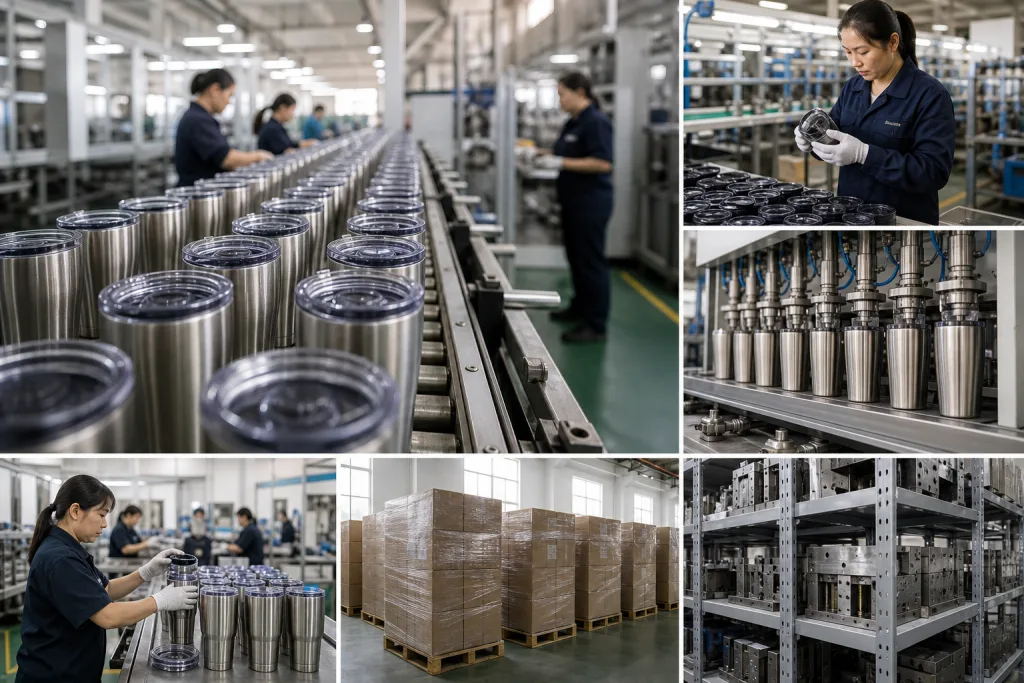
Most buyers send a picture and a target price. Wrong order. A bulk coffee travel mug should start with the use case: hot coffee commute, desk mug, retail gift set, event giveaway, or loyalty-program reward with barcode sticker and master carton limits. We run stainless drinkware in Zhejiang, China at 450,000 units/month, and we ship enough repeat orders to know which specs hold up and which ones turn into after-sales emails. The math does not work if the cup looks cheap after two weeks.
The comparison buyers actually need
A coffee mug distributor usually sends the same RFQ: “Send me your best price for a custom tumbler.” Simple request. Wrong question. Before we quote, we pin down 7 spec points: capacity, lid type, coating, decoration, packaging, compliance, and freight method. Last month QC pulled 32 samples from a 3,000 pcs pilot run because the buyer’s PO said “matte black,” while the approved sample was black powder coating with a 35-40 gloss reading.
Here is the side-by-side view we use with coffee brands and corporate-gift buyers when we run the first quotation sheet:
| Spec option | Best use case | Watch-out |
|---|---|---|
| 12 oz low-profile tumbler | Espresso drinks, office gifts, café retail shelves where shelf height is tight | Lower perceived value for premium campaigns, especially when packed in a plain white box |
| 16 oz coffee travel mug | Most balanced choice for roasters and corporate gifts; we see this size win on repeat orders | Must check cup-holder diameter under 74 mm, not just total capacity |
| 20 oz bulk travel tumbler | Commuter retail, loyalty rewards, outdoor use with stronger retail presence | Higher FOB cost and carton volume; one 40HQ fits fewer cartons than a 16 oz model |
| Flip lid | Hot coffee on the move, especially for train and car commuters | More parts, more leak-test control needed; the silicone plug is the usual failure point |
| Slider lid | Desk and car use where buyers care more about drinking comfort than bag leakproof claims | Usually splash-resistant, not fully leakproof; do not print “100% leakproof” on the gift box |
| Handle lid or side handle | Corporate gift with high perceived value and more space for a logo position | More tooling and packing space; handle clearance must be checked before carton drop test |
If you are ordering coffee mug promotional products for a 2-day conference, simpler lids and lighter packaging can work. If you sell through cafés at USD 18-30 retail, spend the extra money on a better lid, thicker powder coating, and cleaner packaging. We’ve seen this go sideways: a buyer saved USD 0.28 per pc on the lid, then rejected 600 pcs after a basic upside-down leak test on the line. A coffee mug in bulk order is not one product category; it is several risk profiles wearing the same shape.
Capacity versus real coffee habits
Capacity is where 7 out of 10 bulk coffee mug projects get corrected after the first sample. A 20 oz tumbler looks strong in a catalog, but most coffee brands sell hot drinks in the 8-16 oz range. Once the lid is opened, extra headspace lets the drink lose heat faster; we have measured 62°C dropping to 48°C in 18 minutes on an oversized sample. It also feels bulky. On the retail shelf, the buyer gets fewer units per facing, and that is usually when the buyer flagged it.
For most coffee mug private label programs, 16 oz is the safest starting point. It fits brewed coffee, latte, iced coffee, and office use without looking like a gym bottle. A 12 oz model works for specialty roasters that want a compact premium mug, especially in matte black, cream, or stainless finish; our powder coating line checks the body diameter with a 0.02 mm caliper before logo setup. A 20 oz bulk coffee tumbler makes more sense for commuter buyers, truck fleets, university stores, and outdoor campaigns where refill volume matters more than shelf density. The wrong question is “which size looks bigger?” Ask which size your customer will finish before the coffee goes flat.
Use this quick fit test before confirming any coffee mug custom made design. We run this check during sample review, right beside the lid torque test and carton drop record.
- Corporate gift: 12 oz or 16 oz, gift box, simple logo, neutral color; HR buyers usually reject loud colors after one mockup.
- Café retail: 16 oz, powder coating, retail sleeve or color box; leave space for barcode and price sticker.
- Employee onboarding: 16 oz or 20 oz, durable lid, individual white box; check the lid seal before packing 1 pc per carton.
- Event giveaway: 12 oz or 16 oz, silkscreen logo, bulk pack to reduce cost; MOQ pressure matters here.
- Subscription box: 12 oz, compact carton size, strong visual branding; keep the carton under the box program’s weight limit.
As a coffee mug manufacturer in Zhejiang, we normally recommend sampling two sizes before mass production. One size may photograph better, while the other feels better in hand; QC pulled the sample last month because a 20 oz body looked fine on the PO but felt top-heavy after filling 450 ml. That difference matters when you are buying 5,000 pcs, not 50 pcs. We have seen this go sideways.
Lids decide daily satisfaction
Vacuum insulation gets the attention, but lids drive most complaints. A double-wall stainless body can keep coffee hot for 4-6 hours in normal use. On the line, one gasket off by 0.3 mm can make a clean sample look cheap to the buyer.
There are three common lid paths for a bulk travel mug. A simple slider lid is the lowest-risk choice for desk, car, and office use. It is easy to clean and usually costs less. It is splash-resistant, not bag-leakproof. A flip lid gives better drinking control and seals better, but it brings more parts: hinge, stopper, silicone seal, and sometimes a locking tab. More parts mean more QC checks and more chances for a loose fit. A straw lid works for iced coffee. For hot liquid, we only sign off when the carton says hot-use only.
For coffee mug customized orders, ask for the lid material and test method in writing. Tritan or PP lids are common. Silicone gaskets should be food-contact grade. For Europe, discuss LFGB or EU food contact requirements. For North America, FDA food-contact expectations and, when relevant, California Proposition 65 documentation may be requested by larger retailers. We run a 24-hour 60°C water soak on sample lids before approval, and that test catches a lot of weak seals.
Our practical rule: if the mug may go into a backpack, do not call it leakproof unless the supplier has tested it upside down for at least 30 minutes with warm water.
A professional coffee mug oem manufacturer should run water-leak checks during assembly, not only on final cartons. On our China production line, normal practice is 100% visual check plus functional lid sampling under AQL 2.5/4.0, with tighter checks for new lid molds. This is not the place to save 2 cents on a gasket. We have seen that go sideways fast.
Material, coating, and logo choices
For stainless coffee travel mugs, 304 stainless steel is the normal inner material. We still see low-cost quotes using 201 stainless externally, and that is fine only if the buyer signs off on it. For coffee brands and corporate gifting, the spec sheet should state 304 inside and 201 or 304 outside, not hide it under “stainless steel.” Inner wall thickness around 0.45-0.55 mm is a reasonable commercial range; our QC checks it with a digital thickness gauge before polishing. Too thin, and the body dents when the line handles cartons. Too thick, and the math doesn't work for most distributors.
Coating is a direct cost and positioning decision. Powder coating gives a better hand feel and grip, and buyers usually notice it within 5 seconds of holding the sample. Spray paint is cheaper but scuffs faster in carton rub tests; we have seen black spray paint show silver scratches after 30 rubs with a dry cloth. Plain stainless is durable and clean, but some coffee buyers tell us it feels too generic for shelf display. For a coffee mug promotional campaign, one-color silkscreen on powder coating is often enough. For a premium coffee mug private labeling project, laser engraving or 2-sided print can justify the higher unit cost if the logo has clean lines and no tiny slogan text under 1.5 mm.
Here is the honest comparison:
- Silkscreen: good for solid logos and low unit cost; MOQ is friendly, but gradients and tiny registered marks often fail on curved cups.
- Laser engraving: durable and premium on powder coating or stainless; color is limited, and QC pulled the sample last month because a 6 mm logo looked too weak after engraving.
- Heat transfer: suits complex artwork with color blocks; setup needs tighter control, and we run abrasion testing before bulk packing.
- Full-wrap print: strong shelf impact for retail programs; reject risk rises on tapered bodies because a 1-2 mm seam shift is easy to spot.
For coffee mug customizable programs, do not choose decoration only from mockups. Ask for a pre-production sample with the actual coating, actual logo size, and actual lid; one buyer flagged a PO typo where the mockup said matte navy but the order sheet said glossy navy. A computer rendering hides alignment issues, color shift, and how small text prints on a tapered wall. We normally keep Pantone tolerance within an agreed visual range, because powder coating can shift slightly between batches.
Factory-direct pricing without fantasy numbers
Buyers pull a coffee mug supplier directory or coffee mug supplier list and get five prices that look close but are built on different bases. One quote hides a color box, one uses bulk packing, one is EXW, another is FOB Ningbo or Shanghai. We see this on the line all the time, and the carton sample usually tells the story faster than the quote sheet. If the packing spec changes, the number changes.
On our powder-coating line, a 16 oz double-wall stainless tumbler with one-position logo often lands around USD 3.20-5.80 FOB, depending on lid, order quantity, packaging, and steel cost. A simpler bulk coffee mug with slider lid and bulk packing may come in lower. A premium coffee mug custom design with molded handle lid, retail box, and multi-color artwork can move up fast. The buyer who asks for “the cheapest one” is asking the wrong question.
Typical commercial terms for a coffee mug factory direct order:
- MOQ: 1,000 pcs for existing shape and standard color, often 3,000 pcs for custom color.
- Sample time: 7-12 days for logo sample after artwork approval.
- Mass production: 30-45 days after deposit and sample confirmation.
- Payment: commonly 30% deposit, 70% before shipment.
- Port: FOB Ningbo or Shanghai is practical for Zhejiang factories.
If a coffee mug supplier quotes far below the market, ask what changed: thinner steel, cheaper lid, no vacuum test, weak coating, or no compliance paperwork. QC pulled the sample on a recent order because the lid fit was loose by 0.6 mm, and that was enough to stop packing. Coffee mug manufacturers can trim cost, but there is no magic. For a distributor, the real loss is not paying USD 0.40 more; it is replacing a failed order while your customer is already asking where the goods are.
Compliance and inspection before shipment
Corporate-gift buyers and coffee brands now ask for documents before they release a purchase order; last month 7 of our 10 tumbler RFQs asked for compliance files before price approval. Good habit. A coffee mug factory should be ready to show BSCI or social audit status, ISO-style quality procedures, food-contact material declarations, and REACH notes for coatings or plastic parts sold into Europe. On our line, QC keeps the latest coating supplier declaration in the same file as the 304 stainless steel test report, because one missing PDF can hold a PO for 3 days.
For North American programs, buyers often ask about FDA food-contact suitability, ASTM-related packaging concerns for children’s products if the item is bundled with kid-facing goods, and Prop 65 statements when selling into California. Not every travel tumbler needs every document. Asking for “all certificates” is the wrong question to ask; ask what applies to your market, channel, and age grade. If a supplier only replies “no problem” without naming the standard, slow down. We have seen this go sideways when the buyer flagged a Prop 65 line after cartons were already sealed with 48 pcs per master carton.
Inspection needs hard checkpoints. For a 5,000 pc coffee mug bulk order, we suggest pre-shipment inspection using AQL Level II, with critical defects set to 0. Major defects often use AQL 2.5 and minor defects 4.0. Check vacuum performance, lid fit, logo position, coating scratches, carton drop resistance, barcode readability, and carton marks. QC pulled the sample with a digital caliper last week and found the logo 3 mm off center; small issue in the workshop, expensive issue after delivery. If you ship to Amazon or a 3PL, add FNSKU labeling and master carton requirements before production, not after packing.
Our Zhejiang, China team usually builds a control sample file that includes the approved mug, lid, gasket, logo, box, carton mark, and packing method. Sounds boring. It prevents arguments. We run one sealed sample on the QC desk and one in the packing area, so the line leader can compare the lid color, gasket fit, and carton mark without guessing. When a coffee mug distributor has three corporate clients waiting, boring documentation beats dramatic troubleshooting every time.
Best tumbler spec by channel
The best bulk travel tumbler is the one that fits the sales channel. Coffee brands usually ask for a retail-ready look without locking up cash in slow colors; last month one buyer cut 8 PMS shades down to 4 after seeing the MOQ on powder coating. Corporate-gift buyers care about delivery dates, clean logo edges, and a box that does not look crushed when HR hands it to staff or clients.
For café retail, we run a 16 oz stainless tumbler with 304 inner wall, powder coating, slider or flip lid, laser logo, and color box. Simple sells. Keep the body shape clean so the line can repeat it without changing tooling, jig position, or carton inserts. For corporate gifting, use 12 oz or 16 oz with one-color logo or laser engraving, individual kraft or white box, and corner-safe carton packing; QC pulled a sample last week where the gift box corner failed after a 60 cm drop test. For promotional events, choose a standard mold and standard color, then use silkscreen logo and bulk packing if the item will be handed out in volume.
If you are building a coffee mug private labeling line instead of placing one trial order, spend money on consistency. Use the same lid family across 12 oz, 16 oz, and 20 oz where possible, because stocking 3 gasket sizes for 3 small runs makes the math ugly. Keep colors to 3-5 core SKUs. Confirm replacement gasket availability before deposit. Ask your coffee mug manufacturer to save reorder notes for coating code, logo position, lid torque feel, and carton layout; we have seen reorders go sideways because a PO said “matte black” but the first order used BK-19 sand texture.
A good coffee travel mug distributor does not need the fanciest product. You need a repeatable product with controlled defects, stable lead time, and a price your channel can defend. This is where factory experience beats a glossy catalog page: AQL 2.5 checks, lid fit gauges, and real lead-time control matter more than one nice sample on a sales desk.
Send us your target tumbler spec today
Share capacity, logo method, quantity, market, and delivery date. We will quote a practical factory-direct option from Zhejiang.
Frequently asked questions
What MOQ should I expect for a custom coffee travel mug order?
For an existing mold, a realistic MOQ is usually 1,000 pcs per design if you accept a standard body color. For custom powder coating, many factories set 3,000 pcs per color because coating lines need setup time and material minimums. If you need coffee mug custom artwork on 500 pcs, it may be possible through stock inventory, but the unit price can rise by 15-35%. For a coffee mug private label program, 3,000-5,000 pcs gives better pricing, more stable color control, and more packaging flexibility.
Which size is best for a coffee brand selling mugs in cafés?
A 16 oz tumbler is usually the safest retail size for coffee brands. It fits common hot and iced drinks, feels substantial, and still fits most car cup holders if the base diameter stays around 70-74 mm. A 12 oz mug works for premium specialty coffee positioning, especially for smaller drinks and gift sets. A 20 oz bulk coffee tumbler is better for commuter or outdoor retail. Before ordering 3,000 pcs, test the sample with your actual espresso machine clearance, cup holder, and shelf display.
Is laser engraving better than printed logos for corporate gifts?
Laser engraving is more durable and has a premium look, especially on powder-coated stainless steel. It will not peel like a poor print, and it handles dishwashing abrasion better, although hand washing is still safer for coating life. Silkscreen printing is better when you need a specific brand color, large logo, or lower cost on coffee mug promotional products. For 1,000 pcs, laser engraving may add roughly USD 0.20-0.60 per unit depending on logo size and position. The best choice depends on brand rules and budget.
How long does production take for bulk coffee travel mugs from China?
For a standard coffee mug factory direct order, plan 7-12 days for logo samples and 30-45 days for mass production after sample approval and deposit. Add 3-7 days if you need custom packaging artwork approved. Sea freight to North America or Europe can add 25-45 days depending on destination and season. Air freight is faster but often too expensive for stainless drinkware. If your event date is fixed, start at least 90 days before delivery to avoid rushed decisions.
What should I check before paying the balance?
Before balance payment, check a pre-shipment inspection report against the approved sample. For a coffee mug in bulk order, verify quantity, logo position, coating color, scratches, dents, lid assembly, gasket fit, leak performance, packaging, carton marks, and barcode or FNSKU labels if required. Use AQL Level II with critical defects at 0, major defects around 2.5, and minor defects around 4.0. Also confirm the booking details, gross weight, carton dimensions, and whether the shipment is FOB Ningbo, FOB Shanghai, or another agreed term.