Key Takeaways
- A realistic MOQ for coffee mug promotional products is 500-1,000 pcs per color for factory-direct custom production
- FOB China pricing for stainless steel travel tumblers usually ranges from USD 2.60-8.50 depending on capacity, lid, coating, and packaging
- Standard production lead time is 25-35 days after artwork and deposit approval, plus 3-7 days for sampling
- Logo method, powder coating, private label packaging, and inspection level can change both cost and schedule
A travel tumbler looks simple until you buy 3,000 pieces with your logo, ship them across the Pacific, and QC pulls 47 lids from the carton because the silicone gasket sits 0.6 mm off-center. Then it leaks in a buyer’s car. For coffee brands and corporate-gift teams, coffee mug promotional products are not throwaway merch. They are daily-use cups that carry your name into cars, offices, gyms, and meeting rooms.
From our factory in Zhejiang, China, we hear the same questions every week: What MOQ is realistic? Why does one bulk coffee travel mug cost USD 2.80 and another cost USD 7.20? Should the schedule be 12 days or 18 days before a campaign deadline? Here is the cost and lead-time breakdown we give serious buyers before they send a PO, including the parts that usually get missed on the first spec sheet.
Start With The Tumbler Specification
Before you ask a coffee mug supplier for a price, lock the spec first. A PO that says only “premium tumbler” gets messy fast. On our line, we have seen the buyer flag the same order because capacity, lid style, coating, and carton requirement were missing. A 12 oz single-wall cup and a 20 oz double-wall vacuum travel tumbler sit in different cost groups, and the math does not work if you mix them up.
For corporate gifts and coffee roaster merchandise, the common sizes are 12 oz, 16 oz, 20 oz, and 30 oz. The best selling range is 16-20 oz. It fits most car cup holders and still gives enough room for hot coffee or iced drinks. If you sell retail, check the bottom diameter with a caliper. We normally target 72-76 mm for travel use, and that number saves a lot of buyer pushback later.
Material matters. For stainless models, the inner wall should be 304 stainless steel, often 0.4-0.5 mm thick depending on the shape. The outer wall can be 201 or 304 stainless, but if the buyer wants a premium look, we run 304 inside and outside. Vacuum insulation adds cost, yet it also adds real shelf value. In normal conditions, a 20 oz tumbler usually holds hot liquid for 4-6 hours and cold drinks for 8-12 hours. QC pulled one sample last week and the wall thickness was 0.38 mm instead of the requested 0.5 mm, so the spec had to be reset.
Do not pick the cheapest lid. Slider lids, flip lids, screw lids, and straw lids use different molds, silicone rings, and leak tests. A desk-use coffee mug can take a sip lid. A commuter tumbler needs a tighter seal and a better gasket. We once shipped a sample where the PO typo said “slid lid,” and the buyer stopped the job until we confirmed the exact part. Start with the use case, then ask for price. That is the right order.
Where The Unit Cost Goes
For coffee mug promotional products, the FOB unit price comes from 304 stainless steel sheet, cup forming, vacuum sealing, lid parts, coating, logo work, packaging, labor, scrap rate, and factory margin. The wrong question is “why is your price higher?” Better question: what is inside the cup and lid. Last month QC cut open 8 samples with a pipe cutter and found one quote used thinner inner wall material, which explained a 30% price gap fast.
As a working range, a basic stainless steel bulk coffee mug in 12-16 oz may land around USD 2.60-4.20 FOB China with one-color printing and simple white box. A 20 oz vacuum bulk coffee tumbler with powder coating and laser logo may run USD 4.20-6.80. More complex coffee mug private label orders, with custom color box, insert card, barcode, and upgraded lid, often sit at USD 5.80-8.50. We run these quotes by material weight first; a 20 oz body at 230 g and one at 270 g will not price the same, even if the photo looks identical.
The coating is one of the biggest visible cost drivers. Spray painting is cheaper. Powder coating gives better grip and better scratch resistance after the line runs a 3M tape test and a 1 mm cross-cut check. A custom Pantone powder color usually needs a higher MOQ and adds setup time; 1,000 pcs is not the same job as 5,000 pcs because the booth cleanout still takes 2-3 hours. Laser engraving is durable and clean on powder coating, while silkscreen printing handles bigger artwork and 2-color logos but needs proper curing and adhesion testing. We have seen this go sideways when the buyer approved artwork at 60 mm wide, then the PO said 90 mm wide.
Packaging is another hidden line item. A plain egg-crate export carton is cheaper than a retail color box. If you need coffee mug private labeling with FNSKU, UPC, suffocation warning polybag, or display-ready packaging, budget another USD 0.20-0.90 per unit depending on structure and print quantity. The buyer often flags this late, after carton marks are already made; changing a 24 pcs master carton to 12 pcs can add carton cost and push shipping volume up by 8-15%.
Cheap is not the same as low cost. A USD 0.35 saving disappears fast if 6% of lids leak during a corporate event.
MOQ Tiers That Actually Work
MOQ is not just a factory rule. It comes from material buying, coating line setup, logo tooling, carton printing, and AQL 2.5 inspection time. If a coffee mug distributor asks for 96 pieces in four colors with a custom lid and color box, that is not factory production. That is sample-room work. The line still needs color matching, a silk-screen plate, lid trial fitting, and a packing test, so the price will look painful.
For our Zhejiang, China facility, a practical MOQ for existing travel tumbler molds is 500 pcs per color for simple logo orders. At 1,000 pcs, we run the coating line with less waste and the FOB price is easier to hold. At 3,000-5,000 pcs, custom color packaging, mixed lid accessories, and tighter carton loading start to make sense. Our monthly drinkware capacity is about 650,000 units across travel tumblers, sports bottles, and thermos items, but capacity does not erase small-run setup cost. Last month QC pulled the sample for a 20 oz tumbler because the buyer’s Pantone code on the PO was typed as 186C instead of 185C; that one digit stopped the coating approval for 2 days.
Here is a realistic way to view tiers:
- 300-499 pcs: possible for 6-8 limited models, but unit price is high, logo choices are narrow, and we usually keep it to stock colors and plain white inner cartons.
- 500-999 pcs: normal entry MOQ for coffee mug customizable orders with one logo, one body color, and stock packaging; this is where most promotional distributors should start.
- 1,000-2,999 pcs: better for coffee mug customized color, laser engraving, sleeve, or simple gift box, because the coating jig, laser fixture, and carton artwork cost spread out properly.
- 3,000+ pcs: suitable for coffee mug OEM manufacturer projects, private label packaging, and retail distribution, with room to tune master carton size by kg and CBM instead of guessing.
If you are testing a new coffee blend launch, start with one strong color and one size instead of splitting a 1,000 pc order across five colors. We’ve seen this go sideways. Fragmented SKUs mean five coating approvals, five label checks, and more leftover stock when the buyer flags one slow color after launch.
A Realistic Production Calendar
Lead time starts after the factory has usable artwork, confirmed specification, signed PI, and deposit. Not after the first inquiry. For coffee mug in bulk orders, plan backwards from the event date, retail launch, or warehouse receiving date. We once had a PO with the PMS code typed as 186C in the email and 185C on the attachment; QC pulled the sample, and that one digit cost 2 working days.
A normal schedule looks like this: quotation and specification confirmation take 1-3 working days if your request is clear. Digital artwork layout takes 1-2 days. Pre-production sample preparation takes 3-7 days for stock color with laser or print logo, and 10-15 days for custom powder coating or custom packaging. Once the sample is approved and deposit is received, mass production is typically 25-35 days for 1,000-10,000 pcs. On the line, we check logo position with a 0.5 mm tolerance jig; if the buyer changes the logo size after sample approval, the clock starts moving again.
Shipping adds another layer. Air freight to North America or Europe can take 5-10 days after pickup, but the cost per tumbler is high because stainless tumblers are bulky. Ocean freight is usually 28-45 days port to port depending on route, season, and customs clearance. For Amazon or 3PL delivery, add time for carton labels, pallet requirements, booking, and warehouse appointment. We ship a lot of 304 stainless tumblers in 54 x 38 x 42 cm cartons, and one missed FBA label can hold 120 cartons at the forwarder.
A safe calendar for corporate-gift buyers is 60-75 days from confirmed specification to goods arriving at your warehouse by sea. If your event is fixed, do not wait until the marketing team approves final artwork two weeks before production. The math doesn't work. That is how rush fees, air freight, and quality compromises happen, especially when the buyer flagged the gift-box barcode after the cartons were already sealed.
Logo And Branding Cost Choices
The logo method has to fit the tumbler surface, budget, and how the cup will be used after delivery. Coffee mug promotional products get handled 20-30 times a day, washed, dropped into laptop bags, and left in hot cars. Mockups lie. We have seen a clean PDF turn into chipped ink after QC ran a 3M tape test on the first 12 pcs from the line.
Laser engraving is our default recommendation for powder-coated stainless steel travel tumblers. It lasts, looks sharp, and usually costs around USD 0.10-0.35 per position depending on size and order quantity. It suits one-color brand marks and corporate logos. Silkscreen printing works for bold artwork, wider print areas, or white logos on dark surfaces. Expect USD 0.08-0.30 for a simple one-color print, plus screen setup. Heat transfer or water transfer fits full-color artwork, but the cost climbs and reject rate can move from 1-2% to 4-6% if the artwork wraps near a curve. The math doesn't work for every promo order.
For a coffee brand, logo placement needs more attention than buyers usually give it. A small logo opposite the drinking side often shows better when the cup is held in the right hand. A vertical logo can work on tall 20 oz tumblers, but it can look strange on a tapered body if the top and bottom diameters differ by 8-12 mm. We run a paper printout around the sample before plate making, because the buyer flagged this once after seeing the logo lean toward the seam.
If you need coffee mug custom packaging, prepare vector artwork in AI, EPS, or PDF format. Low-resolution PNG files slow sampling, and our designer will usually kick them back the same day. For coffee mug bulk campaigns with 3-5 departments or sponsors, freeze the artwork before sample production. Every late logo change can add 2-4 working days, especially when the PO has one spelling, the carton mark has another, and QC pulled the sample with the old sponsor logo still on the lid sticker.
Quality Checks Before You Pay
A solid coffee mug manufacturer should talk quality with numbers, not “don’t worry.” For stainless travel tumblers, the inspection sheet should cover actual capacity in ml, vacuum hold time, coating adhesion by 3M tape test, logo position tolerance in mm, lid fit, upside-down leak testing, odor check after hot-water filling, carton drop test, and barcode scan if the buyer needs retail cartons. QC pulled one 20 oz sample last month with the logo 4 mm off-center; small mistake, big argument if it reaches the buyer’s shelf.
For Europe, ask for LFGB or food-contact compliance where applicable, REACH for restricted substances, and the packaging documents your importer needs. For the US market, buyers usually ask for FDA food-contact material confirmation, CPSIA only if the tumbler is clearly for children, and Prop 65 review based on state exposure. If the factory claims BSCI or ISO 9001 systems, ask for current documents with valid dates, not a badge copied onto a sales deck. We’ve seen this go sideways when a PO says “FDA approved” but the test report only covers the silicone gasket.
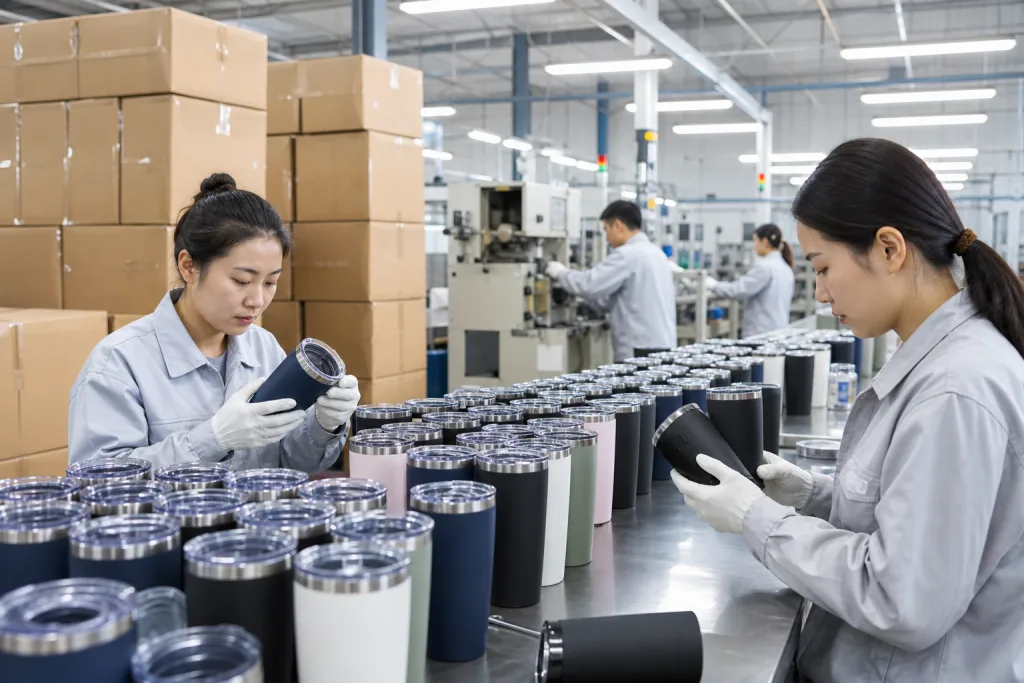
For mass production, write AQL inspection into the PI instead of using loose “check quality” wording. Most serious buyers we work with use AQL 2.5 for major defects and 4.0 for minor defects. Critical defects, such as sharp edges, serious leakage, wrong material, or unsafe contamination, should be zero tolerance. At BottleForge Industrial in Zhejiang, China, we run in-process checks during forming, polishing, coating, logo, and final packing because catching defects at the carton stage is already late. The line moves fast; once 3,000 printed bodies are packed, the math doesn’t work.
If you are buying through a coffee mug supplier directory or coffee mug supplier list, do not assume every listing is a real coffee mug factory. Ask who controls production, where inspection happens, and whether replacement terms are written into the PI. Factory direct only means something when the factory owns the mistake and fixes it. One buyer flagged a PI typo that changed “replacement before shipment” to “replacement next order”; those four words matter when 86 cartons fail leak testing.
How To Compare Supplier Quotes
Compare coffee mug suppliers in one sheet, line by line. The cheapest unit price often drops a real cost: inner box, logo setup, sample fee, export carton, test report, spare lids, or FOB handling. Ask each coffee mug supplier to quote the same capacity, same material, same lid, same coating, same logo size, same packaging, and same Incoterm. We run this in a simple 12-column RFQ table, because one buyer once missed a 0.35 USD inner box charge and the landed price jumped after PO confirmation.
FOB Ningbo or FOB Shanghai is common for Zhejiang drinkware exports. EXW looks cheaper on paper, then you pay local trucking, export handling, and customs declaration. DDP is convenient for corporate buyers, but you still need the product FOB value and the freight portion split out. If a quote for coffee mug factory direct supply is 25% below the market, ask what changed: wall thickness, steel grade, lid material, coating quality, carton strength, or inspection level. QC pulled a 600 ml sample last month with a 0.38 mm outer wall where the approved sample was 0.45 mm. The math doesn’t work unless something was cut.
For coffee mug distributors and brand owners, the best sourcing file includes a signed sample, Pantone reference, logo position drawing, carton mark, packing method, AQL standard, and shipment deadline. Add the lid drawing and carton drop-test requirement if the order ships by courier or Amazon prep warehouse. This avoids the common fight where the buyer expected a premium bulk coffee travel mug and the supplier made a budget item that matched a loose quote. We’ve seen this go sideways over one typo on a PO: “matte black” became “black,” and the line produced glossy powder coating on 3,000 pcs.
A reliable coffee mug OEM manufacturer will push back when your target price does not match the requested specification. That is not bad service. It is factory math. If you ask for 304 stainless, copper coating, individual kraft box, and laser logo at 1,000 pcs MOQ, a proper supplier should tell you where the cost sits instead of pretending the line can absorb it. Better to argue before deposit than receive a container of mugs your sales team refuses to hand out.
Price Your Custom Travel Tumbler Before Production
Send your capacity, logo file, quantity, packaging needs, and delivery country. We will return a practical FOB quote and production timeline.
Frequently asked questions
What is the normal MOQ for coffee mug promotional products?
For existing travel tumbler molds, a realistic factory MOQ is usually 500 pcs per color with one logo. At 1,000 pcs, pricing becomes more stable and you can add options such as custom powder color, better gift box, or multiple logo positions. Below 300 pcs, many factories either refuse the order or quote a high unit price because coating, logo setup, and packing labor do not scale well. If you need 5 colors, plan 500 pcs per color rather than 500 pcs total.
How much should a custom travel coffee mug cost in bulk?
For stainless steel coffee mug customized orders, FOB China pricing commonly ranges from USD 2.60 to USD 8.50 per piece. A simple 12-16 oz bulk coffee mug with one-color logo and plain box may be USD 2.60-4.20. A 20 oz vacuum insulated bulk coffee tumbler with powder coating and laser engraving is often USD 4.20-6.80. Retail color box, barcode, insert card, upgraded lid, and third-party testing can add USD 0.20-1.20 per unit depending on order size.
Can I get coffee mug private labeling for retail or corporate gifts?
Yes, coffee mug private labeling is common once your order reaches about 1,000 pcs, and much easier at 3,000 pcs or above. Private label options include logo on tumbler, branded lid card, custom color box, instruction leaflet, UPC or FNSKU label, carton mark, and pallet label. For retail packaging, allow 5-10 extra days for box artwork approval and printing. You should also budget for stronger cartons if the goods will move through parcel networks or e-commerce warehouses.
What lead time should I plan for a bulk travel mug order?
Plan 3-7 days for a standard logo sample, or 10-15 days if you need custom powder coating or custom packaging. After sample approval and deposit, mass production is usually 25-35 days for 1,000-10,000 pcs. Add 5-10 days for air freight or 28-45 days for ocean freight to Europe or North America. A safe schedule for coffee mug in bulk projects is 60-75 days from confirmed specification to warehouse delivery by sea.
How do I know if a coffee mug factory is reliable?
Ask for specific documents and process details, not just product photos. A reliable coffee mug factory should provide material information, food-contact compliance support, sample approval process, AQL inspection terms, packing details, and clear Incoterms such as FOB Ningbo or FOB Shanghai. Ask whether they run leak tests, coating adhesion checks, vacuum performance checks, and carton drop tests. If you are using a coffee mug supplier list, verify whether the company is a real manufacturer, trading office, or distributor before paying a deposit.