Key Takeaways
- A useful coffee mug custom spec should state capacity tolerance, steel grade, wall thickness, lid material, logo method, packing, and AQL level.
- For stainless bulk travel tumbler orders, 304 inner steel and 201 or 304 outer steel are common; the cost difference can be USD 0.20-0.55 per piece.
- Standard MOQ is usually 1,000 pieces per color for stocked molds and 3,000-5,000 pieces for new coating colors or private-label packaging.
- Plan 7-10 days for pre-production samples and 30-45 days for mass production after artwork, deposit, and sample approval.
A travel tumbler looks simple until you order 5,000 pieces and QC pulls cartons with sweating lids, scratched powder coating, or a logo sitting 4 mm off-center. It happens. For coffee brands and corporate-gift buyers, the hard part is not finding a coffee mug supplier. The hard part is writing a purchase spec that a coffee mug factory can quote, sample, inspect, and repeat without guessing.
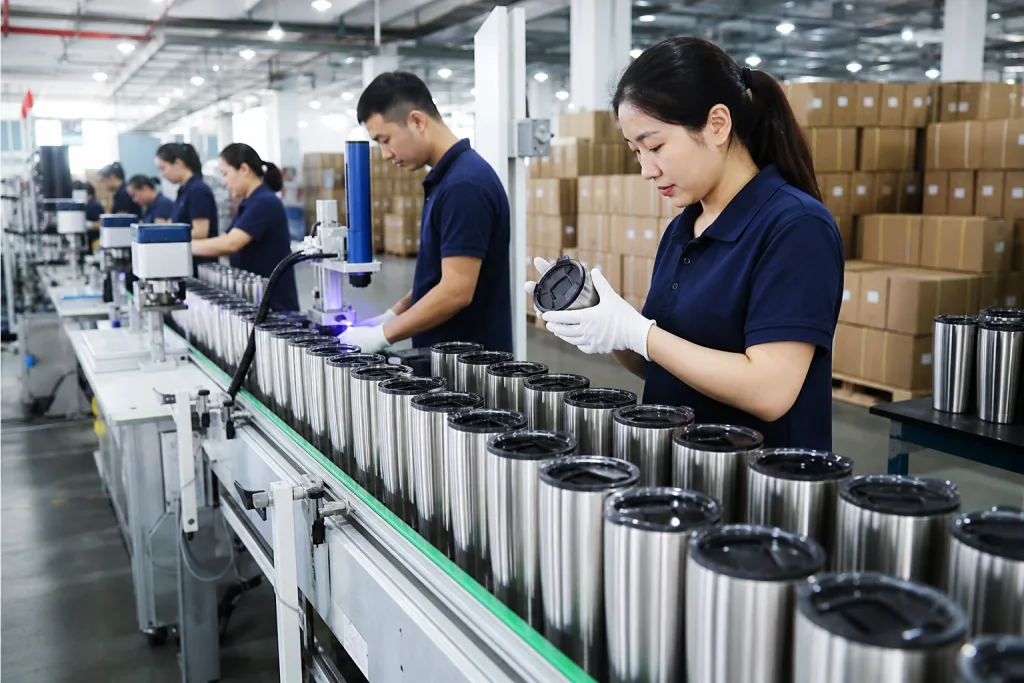
We manufacture in Zhejiang, China, and we see the same RFQ gap 8 or 10 times a week: “350 ml tumbler, custom logo, good quality.” The math doesn’t work from that sentence. A coffee mug custom project needs steel grade, wall thickness, insulation target, lid material, decoration method, carton drop requirement, AQL level, and delivery term written before we run the sample. Our Hangzhou line can produce about 420,000 stainless drinkware units per month, with typical MOQ from 1,000 pieces per color for standard shapes, and the buyer usually flags trouble only after the first PPS photo shows the wrong lid or a missing Pantone code.
Capacity is not just milliliters
A buyer may ask for a 12 oz, 16 oz, or 20 oz coffee mug custom made for retail or gifting. The first spec line should still separate usable fill capacity from brimful capacity. They are different. A 16 oz retail tumbler may hold 473 ml to the drinking line, while brimful capacity can be 500-520 ml. On the line, QC checks this with a graduated cylinder after lid fitting, not by reading the carton artwork. If your coffee brand sells a “large latte tumbler,” the usable fill is what the customer feels in hand and carries to the car, so the brimful number alone is the wrong question to ask.
For a bulk coffee travel mug program, we normally set capacity tolerance at ±5% and main diameter tolerance at ±2 mm. Height tolerance is usually ±3 mm depending on forming and welding. If the tumbler must fit a specific espresso machine, car cup holder, gift box insert, or vending equipment, send target dimensions in millimeters and one photo with a ruler in frame. “Fits most cup holders” is not a factory control point. We have seen this go sideways when a buyer approved a 70 mm base on the drawing, then flagged 72 mm samples because their gift box insert had no clearance.
A practical spec line looks like this: Capacity 500 ml usable, 540 ml brimful; height 175 mm ±3 mm; top diameter 88 mm ±2 mm; base diameter 70 mm ±2 mm. Short and testable. For coffee mug promotional products, this also lets your distributor quote carton size, pallet count, and courier cost without guessing. In our packing room, a 2 mm change on top diameter can push the white box from a 90 mm slot to a 95 mm slot, and that small change shows up fast on a 3,000 pcs air shipment.
For North America, 12 oz, 16 oz, and 20 oz are easiest to sell. For Europe, 350 ml and 500 ml feel more natural to buyers and retail shoppers. If you are a coffee mug distributor serving both markets, do not force one-size thinking. One mold can sometimes serve both markets, but the sleeve, barcode, and claim text must match the destination market. We run into this during pre-shipment checks when the PO says 500 ml, the hangtag says 16 oz, and the buyer asks why the shelf claim looks off.
Steel grade and wall thickness
Most coffee mug manufacturers in China will quote “stainless steel,” but that line can mean three builds: 304 inner with 201 outer, full 304 inner and outer, or lower-cost 201 construction. For hot coffee contact surfaces, we specify 304 stainless steel inside. It stands up better to coffee acidity and supports LFGB, FDA food-contact, and REACH documentation when the coil source, test report, and material declaration all match. QC checks this with an XRF gun on incoming sheet; last quarter we rejected 2 lots where the outer shell was marked 304 on the packing list but tested as 201.
Outer wall material changes cost, corrosion resistance, and hand feel. A bulk coffee tumbler for corporate gifting is usually safe with 304 inner and 201 outer if the powder coating passes cross-cut adhesion and the item is not sold for marine or heavy outdoor use. For premium coffee mug private label retail, full 304 construction is easier to defend when a buyer asks for a material breakdown on Amazon or in a chain-store audit. The price gap is usually USD 0.20-0.55 per piece depending on size, steel market, and order quantity. We’ve seen this go sideways when the buyer flagged rust marks near the bottom seam after a salt-spray check; saving USD 0.28 did not cover the replacement cost.
Wall thickness is another line buyers skip. Don’t skip it. Typical stainless travel tumblers use 0.4-0.5 mm inner wall and 0.5 mm outer wall before forming. Thinner steel can pass a desk review, then dent during carton drop handling or come back as retail returns. Thicker steel adds weight and raises the piece price. You should specify target net weight, not only material, because a 20 oz tumbler at 255 g feels different from one at 310 g in the buyer’s hand. On the line, our forming team measures sheet with a digital micrometer before drawing; if the PO only says “304 stainless,” the math doesn’t work.
A strong RFQ line is: Inner 304 stainless steel, outer 201 or 304 stainless steel, inner wall 0.4 mm minimum, outer wall 0.5 mm nominal, vacuum insulated, copper lining optional. Add target net weight, lid type, coating finish, MOQ, and test standard on the same sheet so the factory quotes the same cup you plan to sell. We ship cleaner when the RFQ is written this way. If a coffee mug supplier cannot state the steel grade and gauge, do not put them on your coffee mug supplier list yet.
Insulation claims need test conditions
“Keeps hot for 6 hours” is a marketing line, not a production standard. For a coffee mug custom order, put the test method on the spec sheet. At BottleForge in Zhejiang, we run 95°C water filled to a fixed level, lid closed, room temperature at 20°C ±2°C, then record temperature after 1, 3, and 6 hours with a calibrated probe thermometer. A decent 500 ml vacuum tumbler should stay above 60°C after 6 hours under this setup, but a 78 mm mouth will usually lose heat faster than a 55 mm mouth. The buyer flagged this once on a reorder because the carton printed “6 hours hot” while the wide-mouth sample only reached 57°C.
Wide-mouth coffee mugs lose heat faster than narrow-mouth bottles. Sliding lids are easy to drink from, but do not call them leakproof unless the test supports it. Push-on sip lids work for a bulk travel mug gift set and desk use. They are the wrong choice for a bag-carry claim. Screw lids with silicone gaskets perform better, though they feel less like a café cup, and some retailers push back because the lid looks more “outdoor bottle” than coffee mug.
If your buyer brief says “leakproof,” define it in plain test language. We suggest this basic check: fill with 50°C water, close lid, invert for 10 minutes, then shake horizontally for 30 seconds. QC pulled the sample last month and found two lids dripping at the slider slot after 18 seconds, so the math doesn’t work if the PO still says leakproof. For non-leakproof sipping lids, use “splash-resistant” instead. That wording saves arguments and keeps packaging claims honest.
For coffee mug customized retail programs, ask for vacuum failure testing during production. Common checks include hot water test, air pressure test, and visual inspection for weld cracks under the line lamp. AQL inspection should include functional lid checks, insulation spot checks, and gasket placement; we usually have QC cut 32 pcs from the lot before final packing. The extra inspection time is small compared with the cost of a container with weak insulation, and we’ve seen this go sideways when a buyer skipped the air pressure test to save half a day.
Lid parts decide complaint rate
The lid is where 20,000 pc bulk travel tumbler projects usually fail. Stainless bodies stay stable once tooling is approved and the go/no-go gauge passes. Lids carry the trouble: PP or Tritan plastic, silicone gasket hardness, slider fit, vent hole size, thread tolerance, color matching, dishwasher behavior. Small parts, big noise. A cheap lid can save USD 0.10 and create a 3% complaint rate when QC pulled the sample and found the slider leaking after 42 open-close cycles.
For hot coffee, ask for BPA-free PP, AS, or Tritan based on clarity target, heat resistance spec, and landed cost. PP is tough for daily use but not crystal clear. Tritan looks better on a retail shelf, but the math doesn't work if the buyer only wants a low-price giveaway mug. Silicone gaskets should be food-grade and removable for cleaning; we run a simple fingernail removal check on the line before packing. If the gasket cannot be removed, your customer will complain about odor after 3 to 4 weeks of milk coffee use.
A good spec line for a coffee mug factory direct order is: Press-fit clear Tritan lid, food-grade silicone gasket, sliding sip opening, splash-resistant, 50°C inversion test for 60 seconds without continuous dripping. Put that wording on the PO, not only in the WhatsApp chat. If you need true leakproof performance, use a threaded lid and say so from day one, because changing from press-fit to threaded after mold T1 can add 12 days vs 18 days depending on gasket rework.
Color is also a lid issue. Black lids hide coffee stains and help a coffee mug distributor stock across 6 body colors with one SKU. Transparent lids look clean in photos but show scratches after bulk carton rubbing; we have seen 0.3 mm scuff marks flagged during pre-shipment inspection. For coffee mug promotional campaigns, choose a lid that survives the event and commute, not the sample-room beauty test.
Coating, color, and logo tolerance
Brand buyers often spend the most time on Pantone color and logo size. Wrong first question. The better question is which surface process will survive the way the tumbler is used. Powder coating is common for a bulk coffee mug because it gives a matte finish and better grip; on our line we check coating thickness with a dry film gauge, usually around 60-80 μm for regular matte black. Spray painting costs less and gives more color options, but scratch resistance changes a lot with phosphating, dust removal, and oven curing time. UV printing works for full-color artwork, laser engraving lasts well on 304 stainless, and silk screen still makes sense for simple one- or two-color logos.
For coffee mug custom projects, write an adhesion standard into the spec. A basic cross-hatch tape test using 3M tape is clearer than “coating should be good.” We run the cutter, apply the tape, pull at a steady angle, and QC records the peeled squares before packing approval. For higher retail standards, add a 100-cycle abrasion test or dishwasher simulation. Be careful here: a lot of powder-coated stainless tumblers should be sold as hand-wash recommended unless the coating has passed real dishwasher validation. We have seen this go sideways when a buyer approved matte coating for gift sets, then their end customer washed samples 10 times and flagged whitening around the bottom radius.
Logo tolerance should be written too. For straight cylindrical tumblers, ±1.5 mm placement tolerance is reasonable. For tapered or curved mugs, ±2-3 mm is more realistic because the fixture and mug wall angle both move the print position. Small shift, big complaint. Wraparound artwork needs a seam tolerance; do not expect a perfect 360° join unless the print method and jig are built for it. On one 500 ml tapered mug order, QC pulled the sample and found the back seam off by 2.6 mm, which was within the signed proof but still looked wrong because the buyer used a thin vertical line at the join.
Typical decoration pricing on coffee mug in bulk orders ranges from USD 0.05-0.15 for one-color silk screen, USD 0.10-0.25 for laser engraving, and USD 0.25-0.80 for UV color print depending on area. If you are comparing coffee mug suppliers, check whether decoration setup, film, laser positioning, and artwork proofing are included in the quote. The math does not work if one supplier quotes only unit printing and another includes the screen charge. We once had a PO with “logo free” typed in the remarks, but the approved PI listed a USD 45 film charge, so we fixed it before mass production instead of arguing after shipment.
Private-label packing affects landed cost
Private-label packing looks like a marketing choice, but it changes carton size, line speed, QC time, FBA prep, and breakage claims. A coffee mug private labeling order with a white box is simple: we run it through the packing table at about 9-11 cartons per hour per worker. A retail color box with insert tray, barcode sticker, instruction sheet, and outer carton marks needs a packing specification as detailed as the tumbler itself, down to box flute, barcode position in mm, and whether the lid faces up or down.
For Amazon or marketplace programs, buyers usually ask for FNSKU labels, suffocation warnings for polybags, carton weight under 15 kg, and drop-test resistant packaging. QC pulled one sample last month because the FNSKU was 4 mm too close to the box seam, and the buyer flagged it before shipment. For corporate gifting, you may need gift sleeves, name-card inserts, or mixed-color cartons. For coffee mug promotional products delivered to an event date, simpler packing is safer; we have seen color-box rework go sideways when the vessel date was already booked.
Common packing options are: individual white box, color box, kraft box, egg-crate divider, bubble bag, tissue wrap, and master carton with 24 or 36 pieces. A 500 ml stainless tumbler in a color box may pack 24 pieces per carton, with carton weight around 10-13 kg depending on steel thickness and lid type. On the line, a 24-piece carton with 350 gsm color boxes usually measures about 54 x 36 x 42 cm, while a divider-only pack can cut carton volume by 8-12%. Small difference. Big freight bill.
Expect private-label packaging MOQ to be higher than tumbler MOQ. Standard item MOQ may be 1,000 pieces per color, while custom color box printing often becomes economical at 3,000 pieces because the printing plate, color proof, and die-cut setup do not care if you ship one pallet or five. If your first coffee mug bulk order is small, use a stickered kraft box or belly band before paying for offset-printed packaging inventory. The math does not work when a buyer orders 1,000 cups and leaves 2,000 printed boxes sitting in our Hangzhou warehouse.
Quote terms buyers should lock
A usable quote from a coffee mug oem manufacturer should spell out unit price, mold status, MOQ, sample cost, decoration cost, packaging cost, production lead time, payment term, Incoterm, HS code, and inspection standard. We reject “USD 3.20, good quality” as a quote. Last month a buyer sent us 6 supplier prices in one sheet, but 2 of them missed gift box cost and 1 used the wrong HS code, so the comparison was already broken.
For Zhejiang and wider China production, common terms are 30% deposit and 70% balance before shipment, with FOB Ningbo or FOB Shanghai. For standard molds, sample time is normally 7-10 days after artwork approval; we count from approved AI artwork, not from the first email with a low-resolution JPG. Mass production is usually 30-45 days after deposit and pre-production sample approval. Peak season before Q4 can add 10-15 days, especially when powder coating capacity is tight or the gift box supplier is waiting on 350gsm paper stock.
Put AQL inspection in the purchase order. A practical standard is AQL 2.5 for major defects and 4.0 for minor defects, with critical defects not accepted. Critical defects include sharp edges, contaminated interior, broken lid function, serious leakage where leakproof was claimed, and wrong food-contact material. Major defects include obvious dents, poor logo position, coating peel, color mismatch beyond approved sample, and carton shortages. QC pulled the sample on one 40oz tumbler order and found the logo 4 mm lower than the approved sample; that is not “close enough” when the retail buyer has planogram photos.
If you are building a coffee mug supplier directory or comparing coffee mug suppliers for a recurring program, track more than price. Track sample accuracy and response speed, then check defect rate, on-time shipment, document quality, and whether the sales team explains trade-offs before the PO is signed. A reliable coffee mug manufacturer is not the one who says yes to every spec. It is the one who tells you when a spec will raise cost, delay production, or create returns. We have seen this go sideways: the buyer pushed for a matte white coating at the cheapest price, then flagged scratch marks after a 1,200 pcs trial run.
Send your tumbler spec and target landed cost
We will review the spec, flag risky lines, and quote factory-direct options for your coffee brand or corporate-gift program.
Frequently asked questions
What MOQ should I expect for a coffee mug custom travel tumbler?
For an existing stainless travel tumbler mold, a practical MOQ is 1,000 pieces per color with one logo. If you need a custom powder-coat color, expect 1,000-3,000 pieces depending on the coating factory. Custom color boxes usually become economical at 3,000 pieces because printing setup cost is spread across more units. A fully new mold for a coffee mug custom made shape can require 5,000-10,000 pieces and tooling fees. For a first coffee brand launch, use a proven mold and customize color, logo, and packaging before investing in tooling.
How much does a bulk coffee travel mug cost from China?
A typical 350-500 ml stainless vacuum bulk coffee travel mug from China may quote around USD 2.60-5.20 FOB, depending on steel grade, lid type, coating, logo, packaging, and order quantity. A simple 201 outer and 304 inner tumbler with one-color print sits near the lower range. Full 304 steel, Tritan lid, powder coating, laser logo, and color box move the price up. Always compare FOB prices with the same spec. One supplier may exclude the color box, while another includes it, making the cheaper quote misleading.
Is laser engraving better than printing for coffee mug promotional orders?
Laser engraving is usually more durable because it removes or marks the coating rather than adding ink on top. It is a good choice for corporate gifts, café loyalty merchandise, and executive programs. The limitation is color: engraving is normally silver, dark, or tone-on-tone depending on coating and steel. Silk screen is cheaper for one-color logos, often USD 0.05-0.15 per piece, and works well for event giveaways. UV printing is better for full-color artwork but needs adhesion testing. For coffee mug promotional products used daily, choose durability over complex artwork.
Can I claim my coffee mug customized tumbler is leakproof?
Only if the lid design supports it and you test it. Many café-style press lids are splash-resistant, not leakproof. They handle walking, desk use, and car cup holders, but they may drip if placed sideways in a bag. A true leakproof claim usually needs a threaded lid, silicone gasket, and defined inversion or shake test. Put the test into the purchase order, such as 50°C water, inverted for 10 minutes, no leakage. If your product uses a sliding sip lid, “splash-resistant” is usually the safer and more honest claim.
What documents should coffee mug distributors request from the factory?
Ask for food-contact test reports for the stainless steel, plastic lid, silicone gasket, and coating where applicable. For Europe, buyers often request LFGB, REACH, and sometimes BSCI or ISO 9001 factory information. For the United States, FDA food-contact compliance and Prop 65 review may be relevant depending on the sales channel. Coffee mug distributors should also request a packing list format, HS code, product photos, artwork proof, pre-production sample approval record, and final inspection report. Documents should match the actual materials in your order, not a similar item from three years ago.