Key Takeaways
- A reliable coffee mug bulk project usually starts at 1,000-3,000 pcs per color for custom coating and logo work
- 304 stainless steel with 0.45-0.55 mm inner wall thickness is the safer baseline for daily-use travel tumblers
- Retail coffee mug private label orders need drop-tested gift boxes, barcode labels, and AQL inspection before shipment
- FOB China lead time is typically 30-45 days after artwork approval, depending on finish and lid tooling
If you buy coffee mug bulk for a coffee roaster, office gifting program, or retail campaign, the risky part is not finding a mug. It is picking a tumbler spec that passes the sample table but fails after 30 days on desks and in car cup holders: heat drops too fast, lids seep at the silicone ring, powder coating rubs at the rim, the logo sits 3 mm off center, or 5-ply cartons crush on the bottom layer of a pallet. QC sees this.
From our Hangzhou, Zhejiang factory, we hear the same buyer question at least 6 times a week: should we run a stainless travel tumbler, a handle mug, a ceramic-look steel cup, or a lower-cost promotional model? Price alone is the wrong question to ask. A bulk coffee travel mug for paid retail needs tighter lid fit, cleaner coating, and stronger export packaging than a coffee mug promotional giveaway; last month one buyer flagged a 0.4 mm lid gap on the pre-production sample, and they were right to stop the line before mass packing.
The spec table buyers actually need
Most coffee mug supplier quotes look tidy: capacity, logo, unit price, MOQ. Too tidy. For a coffee brand, corporate-gift buyer, or coffee mug distributor, the missing specs decide whether the order turns into a repeat SKU or a complaint file; last month QC pulled a 16 oz sample with a 0.28 mm thinner outer wall than the approved sample, and the buyer flagged the hand feel before the carton test even started.
Use this head-to-head comparison before you ask any coffee mug factory for pricing; if a salesperson cannot fill these lines without “checking later,” the price is not ready for your PO.
| Option | Best fit | Typical FOB China | Main risk |
|---|---|---|---|
| 12 oz stainless coffee tumbler | Cafe retail, espresso bars, office desks | USD 3.20-4.80 | Logo area is smaller |
| 16 oz slim travel tumbler | Corporate gifts, car cup holders, commute use | USD 3.60-5.60 | Lid sealing must be tested |
| 20 oz handle travel mug | Outdoor, staff gifts, premium bundles | USD 4.80-7.50 | Higher carton volume |
| Powder-coated promotional mug | Events, loyalty gifts, seasonal campaigns | USD 2.70-4.20 | Coating thickness varies by factory |
| Ceramic-lined steel tumbler | Specialty coffee brands focused on taste | USD 5.20-8.90 | Higher MOQ and more rejects |
A serious coffee mug manufacturer should confirm steel grade, wall thickness, vacuum performance, coating process, lid material, logo method, and packing details. Better: ask for 304 stainless inner wall, outer wall thickness in mm, powder coating thickness, lid PP grade, silicone gasket spec, carton drop-test standard, and logo artwork position in a 1:1 PDF. If the quote only says “stainless steel, custom logo,” you do not have a quote yet. You have a placeholder. We have seen this go sideways when the PO said matte black, but the factory sample used semi-matte powder because nobody wrote the gloss range.
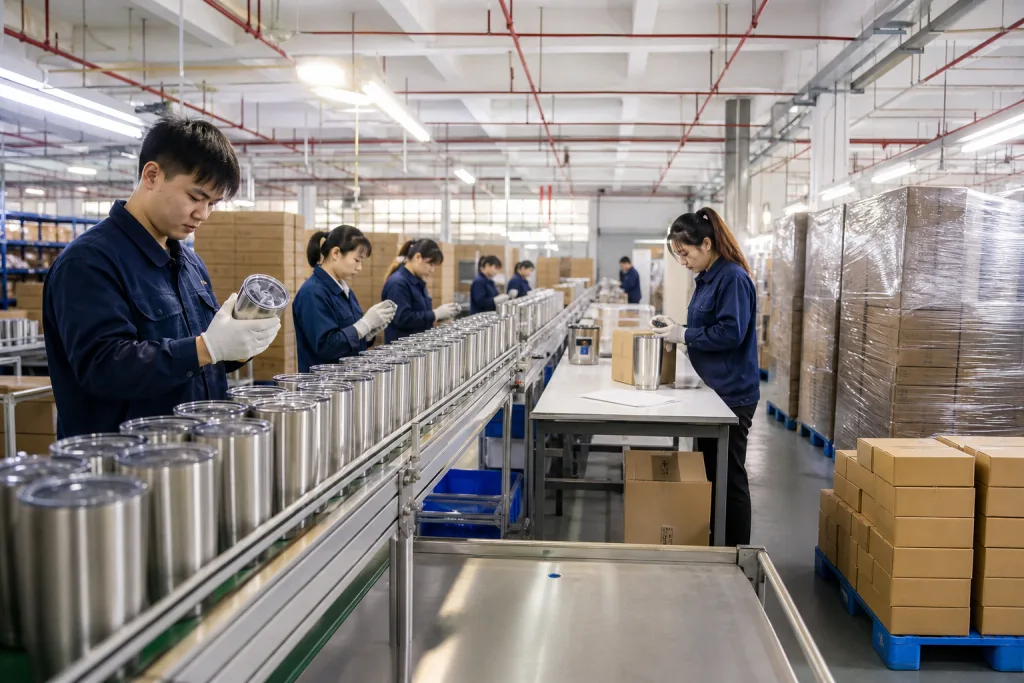
At BottleForge Industrial in Zhejiang, our regular custom travel tumbler lines run about 450,000 units/month, with typical MOQ from 1,000 pcs for laser logo and 3,000 pcs per color for custom powder coating. Those numbers matter because a coffee mug custom made project with a special finish must fit real production scheduling, not just a catalog promise. We run laser logo jobs faster because the line does not wait for powder booths, but custom coating needs color panels, oven temperature records, and 12 cartons from the first batch checked before we ship. The math doesn’t work if a buyer asks for 2,000 pcs in 6 colors and expects the same FOB as one-color bulk.
Stainless steel versus cheaper bodies
For most coffee mug bulk programs, double-wall vacuum stainless steel is still the safest choice. We run 304 stainless steel on the inner wall because it handles coffee acidity, milk residue, and repeated dishwashing better than low-grade steel. For Europe and North America, our usual spec is 304 stainless steel inside, 201 or 304 outside depending on budget, and PP or Tritan-compatible lid components where suitable. QC checks incoming coils with an XRF alloy tester before the line starts, because one wrong 201 inner batch can ruin a repeat order.
A good travel tumbler body usually has an inner wall around 0.45-0.55 mm and an outer wall around 0.50-0.60 mm. Some low-price coffee mug suppliers shave the gauge down by 0.05-0.10 mm to meet a target price, and the buyer only sees the nice render before deposit. Bad trade. The mug may look fine in photos, but it dents sooner, feels light in the hand, and can lose vacuum performance faster if the weld quality is poor. We have seen QC pull samples with a 12 mm side dent after a standard drop test, while the approved 0.55 mm outer wall sample passed with only paint scuffing.
Plastic mugs still have a place in coffee mug promotional products, especially for short events or campaigns under a tight unit price. For a one-day fair, the math can work. For a coffee roaster selling through cafes, the perceived value is often too low and the buyer flagged it before: “This feels like a giveaway, not merch.” Ceramic mugs feel familiar, but they are heavy and fragile, so a 1,000 pcs bulk travel mug program can turn into packing headaches. Glass looks premium, but breakage and thermal shock need stronger dividers, 5-ply cartons, and clearer use instructions.
If your audience is drinking hot coffee during a commute, choose stainless. If your campaign is a one-day trade show giveaway, a lower-cost body may work. If your brand message is specialty coffee taste, consider ceramic-lined stainless, but budget for higher inspection loss. In our China production experience, ceramic-lined tumblers can have 2-4% more cosmetic rejects than standard stainless powder-coated pieces, mainly from inner coating marks and kiln-related variation. On one 3,000 pcs order, QC pulled 86 pcs for tiny black specks inside the liner; the buyer accepted AQL 2.5, but the rework still cost us 2 extra days.
Lids decide the complaint rate
Buyers often spend 80% of the talk on color and logo, then accept the default lid. That is the wrong order. The lid is where the complaint log starts: a cup leaking in a laptop bag, coffee trapped under a slider, a bad drinking angle, or a silicone ring that drops out after washing. On one recent run, QC pulled the sample and found a 1.2 mm gap at the spout after the third wash.
There are four lid styles we ship all the time. A simple press-fit sipping lid is low cost and fine for desk use, but it is not bag-safe. A slider lid feels better for daily coffee, yet the track needs a cleaning path wide enough for a brush head, or old grounds stay inside. A flip lid can improve leak resistance, but the hinge needs cycle testing on the line. A screw lid seals best, though it changes the drink feel and usually adds USD 0.25-0.60 over a basic lid. We have seen buyers chase a lower unit price here, then pay for returns later. The math does not work.
For corporate gifts, tell recipients whether the product is “spill-resistant” or “leakproof.” Use the words correctly. Many travel tumblers are not made to sit sideways in a backpack for an hour. For a coffee mug customized order, the insert should say hand wash recommended, do not microwave, keep lid open when washing, and check the silicone gasket before use. One PO typo said “microwave safe,” and the buyer flagged it before we packed 5,000 pcs.
Ask your coffee mug factory direct supplier to test lids with hot water at 90°C, 30 minutes upside-down, and 10 shake cycles. It is not a full lab standard, but it catches weak designs early. We run that check with a 500 mL beaker and a simple clamp jig. For formal QC, add lid fit, leakage, odor, and gasket assembly to the AQL checklist. AQL 2.5 for major defects and 4.0 for minor cosmetic defects is common for drinkware shipments from China. We have seen this go sideways when the buyer skips the upside-down test and only looks at the print.
Logo methods compared without romance
A coffee mug custom project usually wins or fails at the logo station. The right method depends on surface finish, artwork detail, and daily use, not on which option looks best in a sales deck. Laser engraving is clean on 304 stainless steel and powder coating, and we run it with a rotary fixture when the body is not perfectly straight. It normally gives one metal-tone mark. Good for executive gifts and coffee mug private label orders where quiet branding is acceptable, but the buyer should approve a 1:1 engraving sample before mass production.
Silkscreen printing is the budget choice for one-color logos, especially on straight-wall tumblers. We usually see the price break start around 1,000 pcs, while 300 pcs often lose the advantage after screen setup and color matching. Curved bodies and tapered cups need a proper jig; if the cup moves 1 mm during printing, the logo edge looks soft. Heat transfer or water transfer handles multi-color artwork, gradients, and larger wrap designs, but the AI or PDF file has to be built with bleed and seam position marked. Bad registration on a wrap design is easy to spot. QC pulled one sample last month with a 3 mm mismatch at the back seam, and the buyer flagged it before we even quoted the repeat order.
UV printing can look sharp for small batches and colorful logos, but durability depends on coating, ink, and curing time. For a paid retail bulk coffee mug, ask for rub tests, tape tests, and a dishwasher-simulation plan before approval. This is the wrong place to save two days. If your brand colors are strict, request a Pantone-coated reference and accept that powder coating has tolerance; Delta E control should be discussed before the PO, not after cartons are packed. A matte black tumbler from one batch and the next should be close, but it will not be identical unless the powder supplier, spray thickness, and oven temperature are controlled on the line.
For coffee mug private labeling, branding is more than the logo on the cup. You may need a bottom mark, insert card, kraft gift box, barcode, carton label, and FNSKU labels for Amazon or 3PL fulfillment. We have seen this go sideways when the PO says “white box” but the artwork folder contains kraft box dielines, so our merchandiser now checks packing files against the carton mark sheet before pre-production. A coffee mug customizable enough for retail should allow these packing details without turning the factory floor into hand-labeling chaos. An experienced Zhejiang export team can save more than a few cents on unit price here, because wrong labels can hold 80 cartons at the warehouse gate.
MOQ, price, and use-case fit
There is no honest single price for coffee mug bulk. A 12 oz laser-engraved stainless tumbler and a 20 oz handle mug with custom powder coating, gift box, and barcode are different jobs. On our line, QC pulled the sample cartons and the packing count was not the same burden at all. Buyers still need a working number to plan cash.
For standard factory colors with laser logo, we can start around 500-1,000 pcs, but the unit price climbs fast. For custom powder coating, 3,000 pcs per color is the cleaner MOQ because the spray booth changeover, oven cure time, cleaning, and color match checks eat hours. A new lid mold is a separate cost item: plan USD 3,000-8,000 tooling cost and 25-40 days for mold trial, depending on the lid structure. The buyer once sent a PO with the color code typed wrong by one digit, and we had to stop the line before the first 200 pcs were wasted.
Use-case fit beats chasing the lowest FOB price. A cafe retail tumbler needs a solid hand feel, 4-6 hours of coffee heat retention, and a shelf look that does not read cheap. A corporate annual gift needs safe delivery, clean logo placement, and a gift box that survives courier drops; the buyer flagged it after one test box split at the corner seam. An event giveaway can accept simpler packaging and lighter construction if the budget is tight. A coffee mug distributor buying repeat inventory should care about stable parts, repeatable colors, and reorder lead time. This is the wrong question to ask if you only compare unit price.
From our Hangzhou facility, a 16 oz bulk travel tumbler with 304 inner steel, powder coating, one-position laser logo, and white box often lands around USD 3.80-5.20 FOB Ningbo or Shanghai at 3,000 pcs. Add a retail gift box, printed insert, and stronger lid, and the cost can rise by USD 0.45-1.20 per unit. We run a 0.2 mm lid fit check before packing; if the coffee mug supplier list shows prices far below that, check steel grade, wall thickness, coating process, and carton packing before you get excited.
Compliance and inspection before shipment
For Europe and North America, discuss drinkware compliance before the first sample is cut, not after 20,000 pcs are packed. Stainless steel drinkware usually needs a food-contact safety review. For the EU, buyers often request LFGB-related testing; for the U.S., FDA food-contact documentation is common, with REACH checks on coatings and Prop 65 review if the tumblers will ship into California. For children’s items, ASTM and CPSIA can come up, but adult coffee travel tumblers are usually a cleaner file. We check the test scope against the BOM, because one buyer once approved 304 stainless steel but forgot the painted lid ring in the report.
Factory audits also matter. BSCI, ISO 9001, and responsible sourcing documents are not magic shields, but they show whether a coffee mug oem manufacturer has basic process control on the line. If you are buying for a large corporate-gift program, your client will often ask for social compliance files before the supplier is approved. Get those files early. We have seen orders sit for 12 days because the PO said “ISO 90001” and the buyer’s compliance portal rejected the upload.
Pre-shipment inspection should cover more than appearance. Your checklist should include capacity in ml, unit weight in g, key dimensions in mm, color against the signed sample, logo position, print adhesion by 3M tape test, lid fit, leakage test, odor check, vacuum performance sample test, barcode scan, carton drop condition, and packing quantity. We normally recommend inspection when 100% of goods are produced and at least 80% are packed. AQL sampling then has a real chance to catch mixed cartons, wrong inserts, or lid mismatches. QC pulled one sample last month where the cup body was right, but 6 cartons carried the wrong sliding lids.
Do not rely only on golden samples. Golden samples are made slowly and checked by the best worker on the bench. Bulk production runs faster, and the line has less patience. A practical coffee mug supplier will define tolerances: logo position within ±2 mm, color within agreed sample range, carton weight limit under courier rules, and acceptable minor cosmetic marks. This is the wrong question to ask: “Can the bulk be exactly like the sample?” Better ask what tolerance both sides will sign before deposit. That level of clarity cuts arguments when the goods are already on a vessel leaving China.
How to shortlist a real supplier
Search results can give you a coffee mug supplier directory or a 40-page coffee mug supplier list, but a list is not a sourcing decision. You need to sort traders, small assembly shops, and factories that run the body forming, powder coating, lid assembly, packing, and final QC under one roof. None of these is automatically wrong. The risk starts when nobody can say who owns the mold, who checks the 0.3 mm rim tolerance, or who signs off the carton drop test.
Ask direct questions. What is your monthly capacity for this exact shape: 30,000 pcs or 120,000 pcs? Which parts are made in-house? Can you provide recent AQL inspection reports with buyer names blacked out? What is the MOQ for repeat orders? Can you hold 2% spare lids? How many days from artwork approval to pre-production sample, 7 days or 14 days? If the answers stay soft, you may be talking to a sales office that has never stood beside the coating line when QC pulled the sample for tape test.
For coffee brands, I would rather see you choose a coffee mug manufacturer that costs USD 0.15 more but keeps stable tooling than a cheaper quote that changes lid supplier every order. We have seen this go sideways. One buyer saved on the first PO, then the second batch had lids 0.6 mm loose and the barista team flagged leaking during training. For corporate-gift buyers, spend USD 0.20 more on carton strength before you replace 5% of dented boxes after delivery. Factory direct is useful, but coffee mug factory direct only helps if the factory speaks export terms clearly: FOB, HS code, carton dimensions, lead time, compliance, and inspection access.
When you contact us in Zhejiang, send annual capacity target, retail or gift channel, logo file, packing needs, destination country, and target delivery date. Even a rough number helps: 3,000 pcs for a launch order is different from 50,000 pcs for a chain promotion. With that, we can tell you whether a stock shape, semi-custom finish, or full coffee mug custom made program makes sense before anyone burns 12 days passing around pretty renderings that never match the actual mold.
Send your tumbler brief for a factory quote
Share logo, quantity, destination, packaging, and target date. We will return practical specs, MOQ, lead time, and FOB pricing.
Frequently asked questions
What is the normal MOQ for coffee mug bulk orders?
For a standard stainless travel tumbler with an existing color and laser logo, 500-1,000 pcs is often workable, but the price is not the best. For custom powder coating, plan around 3,000 pcs per color because the coating line needs setup, cleaning, color loss, and QC time. For a fully coffee mug private labeling project with gift box, insert, barcode, and carton marks, 1,000 pcs can be possible if the body is stock, while 3,000-5,000 pcs gives better control over cost and production scheduling.
Which size is best for a bulk coffee travel mug campaign?
For coffee brands, 12 oz and 16 oz are the most practical. A 12 oz tumbler fits espresso-based drinks, cafe retail shelves, and lower price points. A 16 oz bulk coffee travel mug is better for commuting and corporate gifts because it feels more substantial and usually fits car cup holders. A 20 oz handle mug works for premium gift sets, but shipping volume rises quickly. One 20 oz handle mug carton may hold 24 pcs, while a slim 16 oz model may pack 50 pcs.
How long does production take after we approve artwork?
For a stock body, standard color, and laser logo, production is usually 25-35 days after artwork and deposit approval. For custom powder coating, retail packaging, or multi-color printing, 35-45 days is more realistic. If you need a new lid mold or special body tooling, add 25-40 days for tooling and trial samples before bulk production. Shipping is separate: sea freight to the U.S. West Coast may take around 18-25 days port-to-port, while Europe can be 30-40 days depending on route.
Can we use our own packaging for coffee mug private label?
Yes. A coffee mug private label order can include a printed gift box, kraft box, belly band, insert card, barcode label, FNSKU label, master carton mark, and pallet label. The important part is to design packaging around the actual mug and lid, not only around brand appearance. We usually request dielines after the sample is confirmed, then test fit and carton strength. For courier-heavy corporate gifting, use a stronger E-flute or double-wall outer carton and consider a 60-80 cm drop test.
How do we compare different coffee mug suppliers fairly?
Ask every coffee mug supplier to quote the same specification: capacity, 304 inner steel, wall thickness, lid type, coating, logo method, packaging, MOQ, lead time, FOB port, and inspection standard. If one quote is USD 0.70 lower, check whether it changed steel grade, reduced wall thickness, used a cheaper lid, or removed gift box cost. Also ask for sample photos from recent bulk production, not only catalog renderings. A fair comparison includes AQL terms, compliance documents, carton size, and replacement policy.