Key Takeaways
- Realistic MOQ starts at 1,000-3,000 pcs for stock-color logo orders and 5,000-10,000 pcs for custom molded parts
- Typical FOB China pricing runs from USD 1.20-5.80 per kids bottle depending on material, lid, print area, and testing
- Normal lead time is 25-45 days after deposit and artwork approval, plus 25-38 days ocean freight to North America
- For school use, specify BPA-free materials, AQL inspection, carton drop testing, and age-grade labeling before quoting
A children water bottle promotional order looks simple until you price the artwork film, lid mold, export carton, safety testing, and vessel space. A school district may need 8,000 bottles before term starts. An importer may need 30,000 units split across three colors and two lid styles. Price is only one risk. We have seen this go sideways when QC pulled 32 samples from a 304 stainless kids bottle run and the drop test cracked the flip cap hinge at 1.2 m.
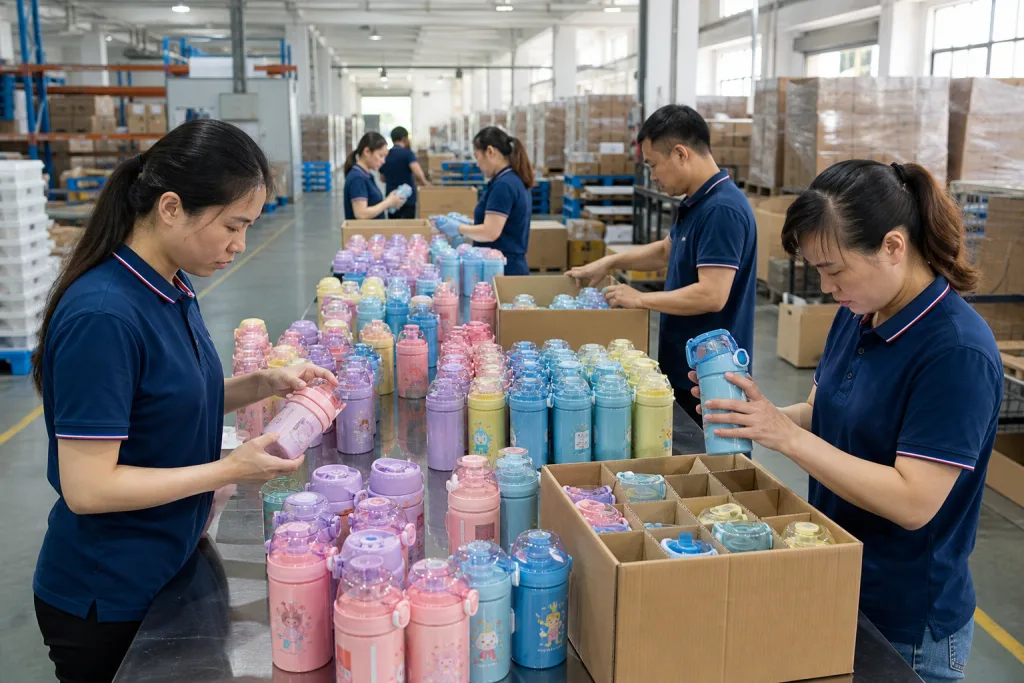
From our kids bottle lines in Hangzhou, Zhejiang, we hear the same buyer questions almost every week: What MOQ is realistic? What makes one custom kids water bottle cost USD 1.40 and another USD 4.20? How long does China production really take? For a normal repeat order, we run about 18–25 days after artwork approval; new color matching with Pantone chips and a printed sample usually adds 5–7 days. Below is the practical breakdown to check before you send a PO, especially if your buyer has already flagged FDA, LFGB, carton drop, or shelf-date requirements.
Start With The Bottle Type
Before asking any children water bottle factory for a quote, lock the bottle type first. Price is the wrong first question. For school districts, we usually quote PP plastic, Tritan-style copolyester, stainless steel single wall, or stainless steel vacuum insulated. Each choice changes the mold, lid assembly, logo method, carton weight, and lab test plan. On our line, a PP bottle might need a simple pad-print jig, while a vacuum bottle goes through air leak testing at the bottom seam before QC even checks the logo.
A basic PP bulk school water bottle with flip lid can land at a low FOB price, often USD 1.20-1.80 for 5,000 pcs, but it feels more promotional than retail. A clear copolyester custom school water bottle is usually USD 1.80-2.80, depending on lid complexity and whether you need a silicone straw or carry loop. A single-wall stainless bulk kids bottle is stronger but dents if dropped hard, usually USD 2.20-3.50. A vacuum insulated custom kids bottle costs more, often USD 3.80-5.80 FOB, because the inner and outer shells, vacuum process, powder coating, and leak test add real factory time. We have seen buyers push back on a USD 0.42 jump without noticing the vacuum model needs a 6-hour temperature hold test and separate powder coating racks.
Capacity matters too. Most school buyers choose 350 ml, 400 ml, 500 ml, or 12-16 oz. Younger children handle 350-400 ml better; older students usually prefer 500 ml. For promotional giveaways, oversized bottles look generous but increase freight by 12-25% per carton. The math gets ugly fast. A 500 ml bottle may pack 48 pcs per master carton, while a chunky 16 oz insulated kids bottle may drop to 24 pcs, and the buyer flagged that freight jump only after the PO was issued. A smart children water bottle supplier will ask the age group first, not just the target price.
What Actually Drives Unit Cost
The lowest quote usually has a hole in it. A workable children water bottle promotional price should break out the bottle body, cap, decoration, packaging, testing, and shipping terms. If a children water bottle vendor sends one lump-sum number with no BOM detail, comparison is fake. Last month we saw a PO with “OPP bag” typed as “OP bag,” and the buyer flagged it only after carton marking approval.
Material drives the bill first. Food-grade PP keeps cost down. Copolyester costs more, with clearer walls and a better shelf look for retail packs. 304 stainless steel sits above plastic and moves with China steel pricing; we check the coil quote before holding price beyond 7 days. For vacuum bottles, wall thickness matters: many kids bottles use about 0.4-0.5 mm stainless steel sheets before forming. Go thinner and you save a few cents, but QC pulled more dented samples after polishing, and the powder coating reject rate climbs.
Lids come next. A basic screw cap is cheap. A flip straw lid with dust cover, silicone mouthpiece, spring pin, handle, and spare straw can add USD 0.35-0.90 per unit. That is not a small add-on when the target price is USD 2.20. If you need a children water bottle customizable with mascot-shaped parts or a custom cap color, MOQ rises because the lid factory must run separate plastic injection batches, often 3,000-5,000 sets per color on the line.
Decoration changes the math fast. One-color silk screen may add USD 0.08-0.18. Multi-color UV printing may add USD 0.25-0.60. Laser engraving on stainless is clean and durable, but only works on metal and gives a single-tone mark. Full-wrap heat transfer looks bright, yet the artwork needs tighter control; we normally ask for a 300 dpi file and a wrap size in mm before opening the film. For a custom logo kids bottle program, ask for decoration size in millimeters, not just “logo included.” We have seen this go sideways when a 45 mm logo was quoted, then the final art needed 80 mm.
FOB Ningbo or Shanghai is the cleanest comparison point for Zhejiang factories. It cuts out unclear domestic freight and lets you compare bottle cost before international shipping.
MOQ Tiers That Make Sense
MOQ is not a punishment; it is the point where raw material, setup, printing, inspection, and packing stop burning money. For a stock bottle with a one-color school logo, 8 out of 10 children water bottle suppliers in Zhejiang can support 1,000-3,000 pcs. At this tier, expect available body colors, standard lids, standard carton packing, and a higher unit cost. Simple job. On our floor, the pad-printing plate still needs setup, ink matching, and first-article approval with a 0.2 mm logo position tolerance.
At 5,000 pcs, pricing improves because printing setup and packing labor spread across more units. This is a realistic tier for a district-wide bulk children water bottle purchase or a regional fundraiser. You can usually request two body colors, one or two logo positions, and custom hang tags, as long as the PO does not change after the PP sample is signed. Our Hangzhou line can produce about 180,000 kids plastic bottles per month and 90,000 stainless kids bottles per month, but color splitting still slows the line. We run one color, purge, clean the hopper, then restart; that is where the extra 1-2 days goes.
At 10,000-30,000 pcs, a children water bottle distributor or importer can start negotiating custom Pantone colors, retail packaging, barcode labels, and mixed carton plans with real weight. For children water bottle bulk orders in this range, expect better FOB pricing, stricter artwork deadlines, and tighter deposit terms. The buyer often asks for 10 designs under one price. The math doesn't work. If you split 10,000 pcs into 10 designs of 1,000 pcs, QC still checks each design against the signed artwork, and the factory will not price it like one efficient run.
For custom made kids bottle projects with new molds, new lid tooling, or character-shaped components, MOQ often starts at 10,000-20,000 pcs per design. Tooling can run from USD 800 for a simple plastic part to USD 5,000+ for a more complex lid assembly. We have seen this go sideways when the buyer approved a cute 3D lid, then found the 40 mm straw brush no longer fit inside the retail pack. If your annual demand is only 2,000 pcs, choose a stock mold and spend your budget on better decoration and testing instead.
Lead Time From Artwork To Shipment
Most failed promotional projects fail on calendar discipline, not factory capacity. A normal children water bottle customized order from China takes 25-45 days after deposit, final artwork, and sample approval. The clock does not start when the first inquiry arrives; it starts when we have print-ready AI/PDF files, confirmed specs, and the deposit booked. Last month QC pulled a sample where the logo was 38 mm wide on the artwork but the PO said 35 mm. That lost 2 days before the line even opened.
A practical timeline looks like this: quotation and specification check, 2-4 working days; digital artwork proof, 1-3 days; pre-production sample, 5-10 days for stock molds and 15-25 days if special color parts are needed; mass production, 20-35 days; final inspection and export packing, 2-4 days. Ocean freight to the US West Coast is often 18-28 days port to port, while East Coast or inland delivery can reach 35-45 days door to door. Europe is commonly 30-40 days by sea depending on port and season. We run the pre-production check with a Pantone book, caliper, and 3M tape test; if the buyer changes the lid color after that, the math changes too.
Air freight solves timing but can wreck the budget. A 500 ml plastic custom children water bottle may weigh 90-140 g; a stainless insulated bottle may weigh 220-320 g. Air freight on 10,000 stainless bottles is rarely a good plan unless your launch date pays for the premium. For schools, place the PO 90-120 days before the first classroom distribution date. For importers, build in another 7-14 days for FNSKU labels, pallet configuration, or retailer routing requirements. We ship cartons around 12-15 kg each; one buyer flagged the pallet height at 1.55 m after packing, and re-stacking cost them 3 extra warehouse days.
Chinese New Year is the other trap. If your delivery date is March or April, placing the order in late January and asking for miracles is the wrong question to ask. Zhejiang factories lose 2-4 production weeks around the holiday when workers travel and subcontractors close. We have seen this go sideways: the bottle line was ready, but the silicone straw supplier in Yongkang closed early, so 6,000 finished cups sat without straws.
Safety And Compliance Costs
Kids products need tighter compliance control than adult promotional drinkware. A children water bottle manufacturer should talk plainly about food-contact resin, BPA-free declarations, migration testing, small parts risk, and age grading; if the sales rep looks surprised, we see that as a red flag. For Europe, buyers often ask for LFGB or EU food contact testing, REACH screening for coatings and straps, and EN-related physical checks where applicable. For the United States, common requests include FDA food-contact suitability, CPSIA-related checks for children’s products, and ASTM physical safety considerations. On the line, QC pulled one 350ml straw lid last month because the silicone bite valve came off at 68N in a pull test.
Testing costs are small next to a failed shipment. A basic material migration test may cost a few hundred USD per material and color. If you have three plastic body colors, two silicone colors, and painted stainless surfaces, the lab scope grows from one report into 6 to 8 line items fast. The math does not work if the buyer saves USD 180 on testing and then holds 12,000pcs at the port. A serious bulk kids water bottle quote should state whether third-party testing is included, excluded, or charged at cost. We also check the PO wording; one buyer wrote “PP lid” while the approved sample used Tritan, and the lab would have tested the wrong part.
Inspection is separate from lab testing. We recommend AQL Level II for general workmanship, often with critical defects set at 0, major defects at 2.5, and minor defects at 4.0. For school buyers, inspect leak rate and cap function with water filled to the marked capacity, then check sharp edges, odor, print adhesion, carton strength, and barcode accuracy. A 10-carton internal drop test is useful before final packing, especially for children water bottle wholesale orders that pass through 3 or 4 warehouses. We run the drop from 76cm on corner, edge, and face; if one carton seam opens, the buyer will flag it before the kids even see the bottle.
Do not accept vague claims like “safe material” or “export quality.” Ask for the material grade, the test standard, and the latest report date. This is the wrong question to ask: “Is it safe?” Ask, “Is the body Tritan TX1001, is the silicone food grade, and was the report issued within the last 12 months?” A good children water bottle supplier in China will not treat compliance documents as an afterthought. We ship better when the file has the test report, BOM, carton mark, and signed golden sample on the same day.
Packaging, Cartons, And Logistics
Packaging often adds more cost than buyers expect. Bulk polybag packing may add only USD 0.03-0.08 per unit, while a printed color box can add USD 0.18-0.45 depending on paper weight, size, and finish. We had one school buyer push for a full retail box, then QC pulled the sample and the line found the box crushed in transit tests. That is the wrong question to ask if the order goes straight to classrooms. A simple recyclable sleeve, name label area, or kraft insert usually does the job. For retail importers, you may still need UPC labels, warning text, language versions, and display-ready cartons.
Carton size hits freight fast. A 500 ml bulk children water bottle might pack 50 pcs per master carton if plastic and unboxed, but only 24 pcs if stainless with individual boxes. That changes CBM in a hurry. We ran one packing test with a 580 x 380 x 320 mm master carton, and the pallet count dropped before the buyer even asked for a second quote. For example, 10,000 unboxed plastic bottles may ship in roughly 12-18 CBM, while boxed insulated stainless bottles may need 25-35 CBM. If you compare only FOB price, the math doesn't work; the cheaper bottle can land at a higher warehouse cost.
For a children water bottle distributor, carton marking discipline matters. Ask for SKU, color, quantity, PO number, gross weight, net weight, and country of origin on every carton. We have seen a PO typo on one line of carton marks turn into a 3-hour delay at the packing bench because the barcode scanner rejected it. If you sell online, confirm FNSKU placement and scannability before mass labeling. If you deliver to schools, request pallet labels by district, campus, or grade level when the order is large enough to justify it.
Most Zhejiang drinkware exports move through Ningbo or Shanghai. FOB terms are common, but DDP works for buyers who do not want to handle customs, duty, or local delivery on their side. Just remember that DDP quotes hide freight, duty, and last-mile cost inside one number. Handy, yes. Easy to audit, no. On our side, we ship from a 40HQ loading plan all the time, and the difference shows up the moment a buyer asks why the landed total is 8% higher than the factory quote.
How To Compare Factory Quotes
Use one sheet. Send every supplier the same spec and make them price the same job: capacity, material, lid type, leak requirement, color, decoration method, logo size, packaging, testing, inspection level, Incoterm, delivery port, and target ship date. If one factory quotes 350 ml and another prices 500 ml with a 6 mm straw, you are not comparing apples to apples. We had a PO once with “kids botle” typed wrong, and the sample team still caught it before the line ran.
A low quote often hides a thinner body, a cheaper silicone straw, no spare parts, a smaller print area, or cartons that fail a 10 kg drop test. A better quote may include pre-production sampling, AQL 2.5 support, REACH testing, and stronger outer boxes. On paper, USD 0.12 looks small. On a 20,000 pcs order, that gap is not small at all. QC pulled two samples last month: one wall measured 0.8 mm, the other 1.2 mm, and the buyer flagged the thin one in five minutes.
Judge how fast the factory answers and what they ask back. A capable children water bottle factory will ask about 3-5 year old users, cap opening force, dishwasher cycles at 50°C, 1.2 m drop resistance, and whether the market is the US or EU. A trading-only vendor usually says yes to everything, then checks with the real factory later. That is the wrong question to ask if artwork, testing, or compliance can still move. We run a torque gauge on the cap for this reason; if the lid needs 15 N·cm and the sample misses, the quote is just noise.
For a first order, keep the spec tight: stock mold, proven lid, one or two colors, one decoration method, and clear AQL terms. Start with 3,000 pcs if that is the MOQ, ship the golden sample, and do not add new parts midstream. After the first lot sells through or reaches stores without problems, then move to special colors, retail packaging, and new accessories. We have seen this go sideways when a buyer changed five details before approval and blamed the factory for the delay.
Send your kids bottle specs for a factory quote
Share quantity, capacity, logo method, destination, and deadline. We will return MOQ, FOB pricing, sample timing, and compliance options.
Frequently asked questions
What is a realistic MOQ for a children water bottle promotional order?
For a stock kids bottle with one logo, a realistic MOQ is 1,000-3,000 pcs, depending on the bottle model and color availability. At 5,000 pcs, most factories can offer better pricing and more flexible color splits. For custom Pantone plastic parts, retail packaging, or a custom logo kids bottle with multiple print positions, expect 5,000-10,000 pcs. New molded lids or special character parts usually start at 10,000-20,000 pcs because injection tooling and material color setup must be justified.
How much should a bulk kids water bottle cost from China?
FOB China pricing usually ranges from USD 1.20-1.80 for basic PP plastic bottles, USD 1.80-2.80 for clear copolyester bottles, USD 2.20-3.50 for single-wall stainless bottles, and USD 3.80-5.80 for vacuum insulated kids bottles. Decoration, lid complexity, packaging, and testing can move the price by USD 0.20-1.00 per unit. If a quote is far below this range, check material grade, wall thickness, carton quality, and whether compliance testing is excluded.
How long does production take for children water bottle custom orders?
For stock molds with logo printing, plan 25-35 days after deposit and artwork approval. If you need custom color plastic parts, special packaging, or a pre-production sample, 35-45 days is more realistic. New tooling can add 20-35 days before mass production. Sea freight then adds about 18-45 days depending on destination. For school launch dates, place the purchase order 90-120 days before distribution.
Which material is best for school water bottles?
For younger children, PP is lightweight and low cost, but it looks more promotional. Copolyester is clearer and more retail-friendly, usually a good middle option for bulk school water bottle programs. Stainless steel is more durable and premium, but heavier and more expensive. Vacuum insulated stainless keeps drinks cold but may be excessive for a short school event. For any material, require BPA-free documentation, food-contact testing, leak testing, and smooth edges around the mouth and lid.
Can one order include several school logos or colors?
Yes, but each split affects cost and lead time. A 10,000 pc order split into two colors and two logos is manageable. The same order split into 20 school logos creates more screen setups, proofing time, packing separation, and inspection risk. For many campuses, digital UV printing may be better than screen printing despite a higher unit print cost. Ask your children water bottle manufacturer to price by artwork count, color count, and packing plan.