Key Takeaways
- Start with 3,000 units per color as a realistic MOQ for a children water bottle custom order
- Specify LFGB, FDA, CPSIA, ASTM F963, and REACH expectations before sampling
- Budget 30-40 production days plus 7-10 days for pre-production sampling and approval
- Use AQL 2.5 major / 4.0 minor inspection, plus 100% leak testing on finished lids
A school district buyer does not buy kids bottles the way a lifestyle brand buys adult tumblers. The users have 55-65 mm hands, throw bottles into backpacks, chew silicone straws, and bring every leaking lid complaint back through parents by week two. If you are checking a children water bottle manufacturer in China, the low quote means little until the supplier confirms material grade, cap construction, test method, and carton marks. We have seen this go sideways: QC pulled 80 samples from a pilot run and found 6 lids leaking after a 1.2 m drop test.
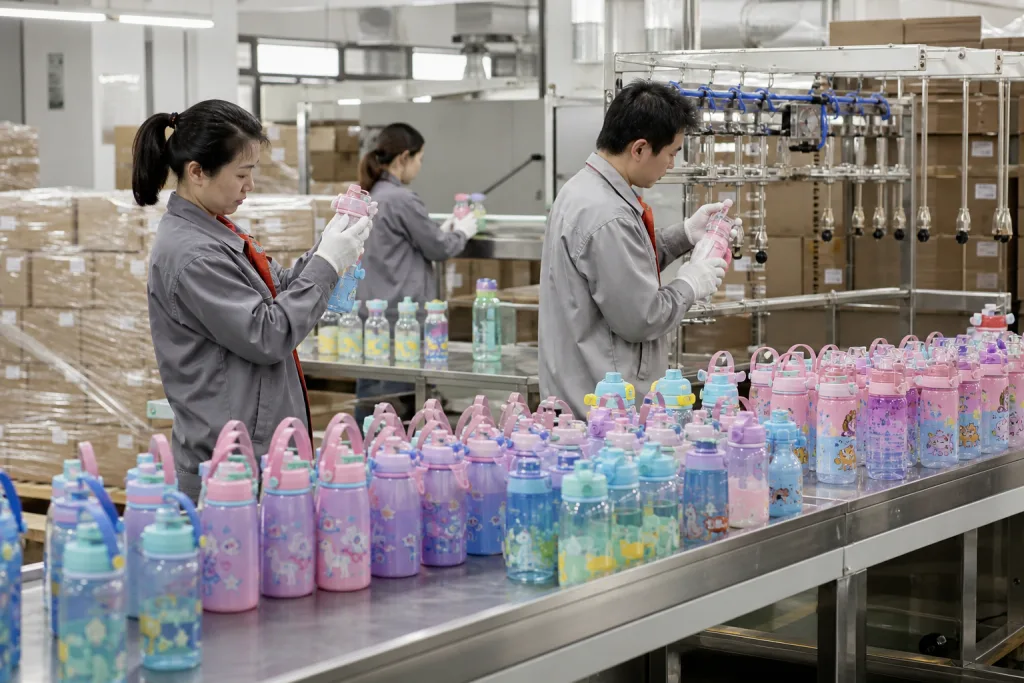
Use a real order as the baseline: 12,000 custom kids water bottle units for a back-to-school program, shipped FOB Ningbo from Zhejiang. BottleForge Industrial runs stainless and Tritan kids bottle lines in Hangzhou, Zhejiang, with practical MOQs from 3,000 units per color and normal production lead time of 30-40 days after artwork approval. The line checks lid torque with a digital torque meter, and buyers often flag the same issue on the PO: logo color written as “navy” with no Pantone number. That costs days.
The buyer brief comes first
Assume you are buying for 40 elementary schools, grades K-5, one bottle per student, plus a 5% reserve for new enrollment and breakage. That puts you at 12,000 units, not 10,000. We run this kind of count on a floor scale before sampling, because school orders slip when people forget the spare cartons. So do not ask a children water bottle supplier for “your best kids bottle.” That is the wrong question to ask. You get a catalog page, not a usable quote.
A proper RFQ says: 12,000 pieces, 400 ml to 500 ml capacity, leak-resistant flip straw or push-button lid, school mascot logo in two colors, individual polybag or kraft box, master carton under 15 kg, delivery to Ningbo port, and compliance documents for North America or Europe. If you are a children water bottle distributor selling into multiple districts, add carton labeling, SKU separation, and mixed-color packing rules. We have seen POs that said “5,000 pcs” in the body and “50,000 pcs” in the attachment; the buyer flagged it only after we started quoting. Clean paperwork saves a week.
For a bulk school water bottle program, we usually push three colorways with 4,000 units each, not six colors with 2,000 units each. The math does not work on short runs. Color change takes time, resin matching drifts on tiny batches, and inspection gets messy when QC pulled six preproduction samples from one line. A children water bottle factory can run the split, but your landed cost goes up and your ship date gets fragile.
Here is a realistic starting spec. Our print bench checks the 50 mm x 70 mm logo area with a steel ruler before the first carton is sealed.
- Capacity: 450 ml for ages 5-10, 550 ml for older students.
- Body: 304 stainless steel single wall, or BPA-free Tritan if transparency is required.
- Lid: PP cap with silicone seal, straw or chug spout.
- Logo: one-side silkscreen, 50 mm x 70 mm print area.
- MOQ: 3,000 pieces per color for custom children water bottle production.
Choose materials before choosing shape
About 7 in 10 first-time buyers start with the cute shape. That is the wrong question to ask first. Kids bottles get abused: dropped on classroom tile, forgotten in buses at 38°C, chewed at the spout, washed with a stiff dish brush, then packed beside a laptop. Material choice decides whether your order becomes a repeat program or a claim folder. We have seen this go sideways after QC pulled 20 samples with tooth marks on soft spouts before shipment.
For stainless steel, 304 is the normal food-contact grade for school bottles. A single-wall bottle can use 0.5 mm to 0.6 mm body thickness depending on the diameter and forming process. Double-wall vacuum bottles usually run 0.4 mm to 0.5 mm inner and outer walls, with higher cost and better temperature retention. For a school-funded giveaway, single wall is often enough. For a retail custom made kids bottle, vacuum insulation can support a higher shelf price. On the line, we check wall thickness with a micrometer because a 0.1 mm change can decide dent resistance after the 1.2 m drop test.
Tritan works when teachers need to see water level and parents ask for lighter weight. It is not the same as cheap PC plastic. A decent Tritan body costs more, but it keeps BPA questions out of the buyer meeting and supports FDA and LFGB testing. PP is common for lids. Silicone is used for seals, bite valves, and straw parts. Ask your children water bottle manufacturer to list every food-contact component, not just the bottle body. Last month one PO said “Tritan bottle,” but the buyer flagged the straw after testing because the straw material was never written down.
If you are sourcing children water bottle wholesale for Europe, REACH and LFGB matter. For the U.S., look at FDA food-contact requirements, CPSIA lead and phthalate limits for children’s products, and ASTM F963 where applicable. Some importers also request California Proposition 65 review. The exact test plan depends on your sales channel, but the supplier should not act surprised when you ask. We usually send the BOM, color chips, and 2 sets of pre-production samples to the lab before mass production, because fixing a failed lid after 10,000 pcs are packed is slow and expensive.
Practical rule: if the lid has five parts, you need material control on five parts. Most leaks and claims start at the cap, not the bottle body. In our factory, the leak tester catches cap issues at 80 kPa long before the carton reaches the warehouse.
Lid design is the risk point
For kids bottles, the lid is where a purchasing spec turns into a line problem. A low-cost cap can pass a PDF review and still leak inside a school bag on day 3. When we run a bulk kids water bottle project in Zhejiang, QC checks the hinge pin diameter, lock-button travel, silicone ring groove depth, straw fit, and closing force with a simple push-pull gauge. Small parts decide returns.
We usually quote two practical choices. A screw cap keeps tooling cost low, but grade 1 and grade 2 children lose it fast; one buyer told us their lost-cap rate hit 7% in the first semester. A flip straw lid costs more, yet it fits elementary school use because kids can drink without tilting the bottle. The straw and bite valve need a cleaning note printed clearly, not buried in tiny copy. A push-button chug lid looks premium, but the spring, button, and latch add failure points. For school district buyers, I usually push back on fancy lids. A flip straw with a carry handle and a simple safety lock is the safer buy.
Ask for leak testing in three positions: upright, inverted, and horizontal after shaking. On our line, a reasonable factory test is 100% water leak testing for finished lids, then random carton inspection before packing with AQL 2.5 if the buyer requires it. For a children water bottle customized order, we also suggest a drop test from 1.0 meter onto plywood or a tile-like surface. Stainless bottles will dent; that is normal. Reject the lot if QC pulled the sample and found cap breakage, spout splitting, or seal displacement.
Spare parts should be settled before the purchase order, not after the first complaint email. For every 12,000 bottles, ordering 1% extra lids and 1% extra straws is cheap insurance; that is only 120 lids and 120 straws. We have seen this go sideways when a PO typo listed “straws” but the buyer meant “straw lids.” A children water bottle vendor who refuses spare parts is thinking like a trader, not a manufacturing partner. For distributors, spare lids protect margin because shipping one cap costs far less than replacing a full bottle.
Artwork, color, and school branding
A custom logo kids bottle looks simple on a mockup and gets tricky on a curved body. School logos often carry 0.3 mm lines, mascots, gradients, or 6 pt text, and those details blur once the print width is only 50 mm. Before we release a children water bottle order, we convert the logo to vector artwork and lock the Pantone colors. A JPG copied from a website is not production artwork. We run a 600 dpi proof on the line, and QC will stop it if the file is fuzzy.
For stainless steel bottles, silkscreen printing works well for 1 to 3 colors. Laser engraving is durable, but it gives a metal-tone mark, not school-color artwork. Heat transfer can carry a full mascot, yet we still ask for abrasion testing and a tape test before approval. Tritan needs ink compatibility checks because its surface energy and curing temperature are different from steel. If a buyer asks for one process to cover every material, that is the wrong question to ask.
If you want a children water bottle customizable program for 8 schools or 80, split the bottle from the decoration. Keep the same mold, same cap, and same carton, then change only the logo and bottle color. That keeps MOQ under control. On one PO, the buyer typed Pantone 286C as 2806C, and QC pulled the sample before we printed anything. One shared body and lid can turn 15 orders of 800 units into a clean 12,000-unit run if the line changeover is planned well.
Color matching has limits. For plastic lids and bodies, Pantone matching usually lands in Delta E 1.5-2.5, depending on resin and pigment. Stainless powder coating has its own finish window. Approve a physical color chip or a pre-production sample, not only a screen rendering. We once had a lid sample pass by eye and fail at Delta E 3.1 on the spectro. Zhejiang factories ship fast, but they cannot fix unapproved artwork after the print film is cut.
Packaging matters for schools. Bulk pack is cheaper, usually 24 pieces per master carton, while individual kraft boxes reduce scratches and make classroom handout easier. For a bulk kids bottle order, a kraft box may add USD 0.12-0.25 per unit, but it can save a district warehouse two hours per 1,000 bottles. Skipping the box to save a few cents often backfires when the buyer flags scuffed lids at delivery.
Pricing that is actually comparable
Bad sourcing starts with incomplete pricing. One children water bottle supplier may include custom color, logo setup, individual box, and FOB Ningbo. Another may quote a stock bottle, no decoration, ex-works Hangzhou, and a thinner carton board. Those numbers do not belong in the same basket. On our pad-printing line, QC pulled a sample with the wrong logo position more than once because the buyer compared the wrong quote.
For a 12,000-unit bulk children water bottle order, a realistic FOB China range might look like this: single-wall 450 ml stainless with one-color print at USD 2.20-3.10; Tritan 500 ml flip straw bottle at USD 2.60-3.80; double-wall vacuum kids bottle at USD 4.20-6.20. These are not promises. Resin price, steel price, cap structure, packaging, and test requirements move the number. If a quote lands 30% below market, the math does not work until you see what got cut. We ran one lot with a cheaper cap and the leak rate jumped on the 1.5 bar air test.
Break the quote into lines. Ask for unit price, mold fee if any, logo setup charge, sample cost, packaging cost, testing cost, spare parts, inner carton, master carton, and incoterm. For school buyers, DDP looks simple on paper, but it hides duties and freight assumptions. Importers and children water bottle distributors usually prefer FOB Ningbo or FOB Shanghai so they control freight and insurance. We once caught a PO typo that read “FOB Nignbo,” and the buyer flagged it before the booking went out.
Payment terms for a first order are commonly 30% deposit and 70% balance before shipment after inspection. For established buyers, a children water bottle manufacturer may discuss 20/80 or partial credit insurance, but open account on order one is a stretch. A factory wants clean specifications, approved samples, and payment that lands on time. Then the line stays yours when peak season hits. We ship faster for buyers who lock the art file, the cap color, and the pack list before mass production starts.
QC plan for the purchase order
Quality control belongs in the PO, not in a fight after the line starts. For children water bottle bulk orders, we lock three checkpoints: material confirmation, pre-production sample, and final random inspection. The pre-production sample is the golden sample. It must fix the final color, final logo, final cap, final straw, final packaging, and carton marks. I have seen a PO typo turn “sky blue” into “baby blue” on a 5,000-piece run, and that one line cost two extra days.
Use AQL standards for inspection. A common setting is AQL 0 for critical defects, 2.5 for major defects, and 4.0 for minor defects. Critical defects include sharp edges, contaminated interior, wrong material, choking-size loose parts where applicable, and severe leakage. Major defects include non-functioning lids, obvious print errors, wrong capacity, carton shortage, or failed drop tests. Minor defects include small cosmetic scratches within agreed limits. On one export lot, QC pulled the sample with a 0.5 mm gauge at the cap seam and found a flash line before packing started. That saved the shipment.
For a custom school water bottle, the QC checklist should include:
- Capacity check with water fill, tolerance usually ±5%, using the marked fill line on the line.
- Logo position tolerance, for example ±2 mm from approved sample, checked against the printed jig.
- 100% factory leak test and random inspector verification, with lids held under pressure before carton close.
- Odor check after 24 hours closed storage, because a new silicone ring can still smell if curing is off.
- Carton drop test, often ISTA-style internal check for export cartons, usually from 76 cm or the buyer’s own spec.
- Barcode, SKU, PO number, and carton quantity verification, one carton at a time against the packing list.
If you sell through marketplaces or retail channels, add FNSKU or UPC scan checks. If you supply directly to schools, carton marks should show school name, color, quantity, and classroom allocation if requested. A children water bottle factory in Zhejiang can print that level of carton labeling, but the packing instruction has to land before the cartons are made. We once had 1,200 cartons with a PO number off by one digit; the buyer flagged it at loading, and we reworked the outer boxes that same night.
Do not skip inspection because the order is “only for schools.” Children are harder on bottles than adult buyers. A 450 ml bottle with a loose lid fails fast in a classroom. Your QC standard should match that reality.
Shipping and reorder planning
After inspection passes, logistics decide whether the order feels professional. A 12,000-piece bulk kids water bottle order usually ships by sea unless the deadline is already in trouble. Based on color box size and whether each bottle has a straw brush, the load often comes out around 20-35 cubic meters; our shipping clerk checks this against the carton mark file before booking Ningbo space. Ocean transit from Ningbo to the U.S. West Coast may be around 18-25 days port to port, while Europe often runs 30-40 days. Add customs clearance and inland trucking.
For back-to-school delivery, place the purchase order no later than late April if you need goods in North America by July. That leaves room for sampling, production, inspection, ocean freight, customs, and district distribution. Shortcuts get expensive. Air freight is possible, but a bottle that costs USD 3.00 FOB becomes bad math when you fly 4,000 or 8,000 units because the buyer flagged the mascot artwork three weeks late.
Reorders are easier if you protect the specification file. Keep the Pantone references, approved artwork, cap version, material test reports, carton dimensions, and inspection checklist; we have seen a reorder go sideways because one PO said “blue lid” while the approved sample was Pantone 2925C. If you are a children water bottle vendor serving several districts, this file protects your margin. Without it, every reorder turns into a new development job.
BottleForge Industrial in Hangzhou, China can produce about 300,000 stainless and plastic drinkware units per month across standard and custom lines, depending on model mix. That capacity helps, but capacity is not magic. During May and June, the line may be full of 350 ml school bottles and 500 ml retail sets, and QC pulled samples still need time for leak testing and carton drop checks. Peak season rewards buyers who approve samples quickly and send a clear forecast. A good children water bottle manufacturers relationship is built on boring details: correct drawings, honest timelines, written QC standards, and no surprises at loading day.
Send your kids bottle specification for review
Share quantity, market, logo file, material preference, and delivery date. We will return a practical MOQ, timeline, and QC plan.
Frequently asked questions
What MOQ should I expect for a custom children water bottle order?
For a true custom children water bottle, 3,000 pieces per color is a practical starting MOQ. If you use an existing bottle shape and only add a one-color logo, some programs can start around 1,000-2,000 pieces, but color customization usually pushes the MOQ higher. For plastic parts, custom Pantone resin matching often needs 3,000-5,000 pieces per color because the lid, straw, handle, and body may each require separate setup. If you are buying for several schools, combine them under one shared bottle specification and change only the logo. That gives the children water bottle manufacturer enough production volume while keeping your school-level quantities manageable.
Which material is best for a bulk school water bottle?
For most bulk school water bottle orders, 304 stainless steel single wall or BPA-free Tritan are the safest commercial choices. Stainless is durable, accepts silkscreen or laser logos well, and feels more premium. Tritan is lighter, transparent, and useful for younger students because teachers and parents can see the water level. A 450 ml stainless single-wall bottle is usually suitable for elementary schools, while 500-550 ml works better for older students. Ask for food-contact documentation on the body, lid, silicone seal, and straw. The cap is often the highest-risk part, so do not judge material safety only by the bottle body.
How long does a children water bottle factory need for production?
A normal timeline is 7-10 days for pre-production sample preparation after artwork confirmation, then 30-40 days for mass production after sample approval and deposit. Add 3-5 days for final inspection, booking, and loading. If new mold work is required, add 25-45 days depending on mold complexity. For back-to-school projects, do not plan backwards from the first day of class only. Include ocean freight, customs clearance, inland trucking, and district distribution. From China to North America or Europe, a safe full project timeline is often 90-120 days from RFQ to warehouse delivery.
What tests should I require for kids water bottles?
For North America, discuss FDA food-contact requirements, CPSIA lead and phthalate limits, and ASTM F963 if the product presentation creates toy-like concerns. For Europe, ask about LFGB, REACH, and relevant food-contact requirements. For physical performance, specify 100% leak testing at the factory, random capacity checks, drop testing from 1.0 meter, print adhesion testing, and carton drop checks. Use AQL 0 for critical defects, 2.5 for major defects, and 4.0 for minor defects. A serious children water bottle supplier should be comfortable building this into the inspection plan before production starts.
Can one order include different school logos and colors?
Yes, but structure it carefully. The most efficient approach is to keep the same bottle body, cap, lid color, packaging, and carton size, then change only the printed school logo. If each school wants a different bottle color, lid color, and box design, the factory will treat it like many small custom runs, which increases cost and delay. For 12,000 total units, three body colors at 4,000 pieces each is much easier than twelve colors at 1,000 each. For a children water bottle customizable program, confirm logo files, Pantone colors, packing splits, and carton labels in one spreadsheet before sampling.