Key Takeaways
- A realistic custom kids bottle MOQ is 3,000 pieces per color for stainless steel and 5,000 pieces for molded plastic parts
- Ask for CPSIA, FDA/LFGB food-contact, REACH, and phthalate reports before paying a 30% deposit
- Leak testing should cover 100% of production, not only AQL sampling
- A school district order needs carton labels, spare parts, and lead time planning 60-90 days before delivery
A school bottle order looks simple until the buyer approves the wrong lid, misses one CPSIA test line, or finds out the master carton is 62 cm long and will not fit the distributor’s shelf plan. We have seen this go sideways. If you sell to school districts or import kids products, chasing the lowest FOB price is the wrong question to ask. You need a children water bottle supplier that can control safety, leakage, printing, packing, and repeat availability, down to the torque test on the cap and the drop test after printing.
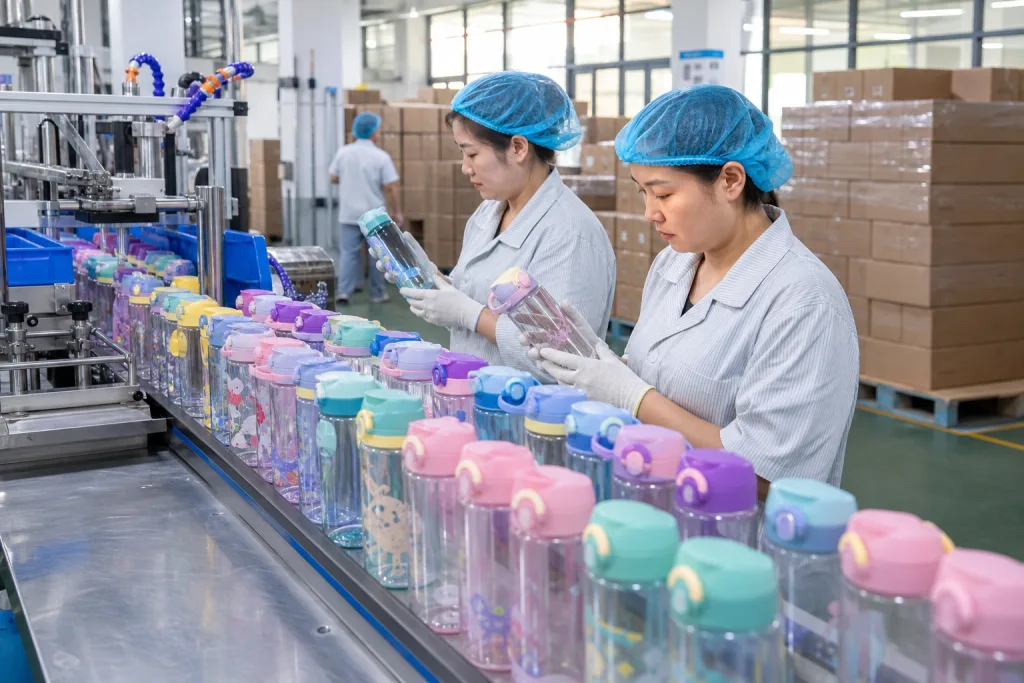
At our Zhejiang, China factory, the real discussion usually starts with one order: 5,000 to 20,000 pieces of a custom kids water bottle for a back-to-school program. The line checks lid fit with a simple leak tester before QC pulls the sample, because one loose silicone ring can turn into 300 wet cartons at destination. Below is how we run the order: specify, quote, sample, inspect, and ship before your name goes on the carton.
Start with the actual user
The first mistake children water bottle distributors make is treating a kids bottle like a small adult bottle. Wrong question. A 6-year-old checks whether the button opens with one thumb; the school nurse checks bite marks and loose straw parts after lunch; the district procurement officer checks CPSIA, FDA food-contact wording, and whether the carton label matches the PO. The child wants easy opening. The school wants dry backpacks. The importer wants no compliance surprise at customs or after retail launch. We once had QC pull 32 samples from a 1,200 pcs pilot run because the push button needed 2.8 kg of force, which was fine for adults and bad for grade 1.
For a typical bulk school water bottle order, we start with age range and use case. For kindergarten to grade 2, 350-450 ml is enough in most bids, with a carry handle sized for small fingers, a flip straw that does not pinch, and a rounded body that fits a 65-70 mm backpack side pocket. For ages 8-12, 500-600 ml works better, especially for sports and after-school programs. Too large is not premium. It comes back half full, then dents faster because children drop it from desks, bus steps, and cafeteria benches; we see the same flat spot near the base during incoming return checks.
Material choice changes the entire order. Stainless steel 304 inner wall with PP lid and silicone straw gives better durability and stronger shelf value. Tritan or PP can meet lower price points for a children water bottle promotional campaign, but watch scratch resistance and temperature limits; buyers have flagged cloudy Tritan after dishwasher testing at 70°C. Glass is rarely the right answer for school distribution, even with a sleeve. The math doesn't work once you add breakage claims, heavier cartons, and stricter drop-test handling on the line.
For stainless kids bottles from our Hangzhou-area line in Zhejiang, China, a common build is 304 stainless interior, 201 or 304 exterior, 0.4 mm wall thickness, powder coating, and a one-touch lid. We run this style often. Our monthly capacity for kids and sports bottles is about 450,000 units, but lid tooling and color batching still control the delivery calendar. A 6-color order with custom Pantone lids can ship 12 days later than a 2-color order because injection molding, powder coating, and carton sorting do not finish at the same speed; we have seen a PO typo on “mint green” versus “mint blue” stop packing for half a shift.
Lock the specification before pricing
A serious children water bottle manufacturer cannot quote correctly from one photo and a target price. Send a short specification sheet before asking three children water bottle suppliers for FOB pricing. We see this every month: QC checks a sample with a digital caliper and finds 0.32 mm steel on one quote, 0.4 mm on another, then the buyer asks why the “same bottle” differs by USD 0.38. Same bottle? It is not.
For a custom children water bottle, specify capacity, body diameter, height, material grade, lid type, straw material, coating, logo method, packaging, test standards, and target market. Put the numbers in mm and grams where possible. If you need a custom logo kids bottle for a school district, state whether the logo is one color, full-wrap, student name area, or individual school mascot artwork. The line needs this before we open the BOM, not after the deposit lands.
For example, a clean RFQ might read: 500 ml double-wall stainless kids bottle, 304 inner, 201 outer, powder coated, flip straw lid, silicone straw, leakproof when closed, FDA and CPSIA compliant, 1-color school logo on front, individual white box, 24 pieces per export carton, FOB Ningbo, order quantity 12,000 pieces in 4 colors. That is enough for our costing engineer to check lid mold, carton size, and print fixture time in one pass.
That RFQ lets a children water bottle factory price honestly. As a rough China factory range, a 500 ml stainless custom kids water bottle often lands around USD 3.20-5.80 FOB depending on lid complexity, coating, printing, and packaging. A plastic bulk kids water bottle may fall around USD 1.10-2.40 FOB, but tooling, compliance, and odor control still matter. Do not compare prices until the wall thickness, lid, and test requirements match. The cheapest quote before that is usually just a missing detail; we have seen this go sideways during AQL 2.5 inspection when the buyer flagged leaking straws after production.
Choose decoration that survives school use
Children abuse bottles. They scrape them on desk legs, drop them on asphalt, and put them in dishwashers after the care card says hand wash. Decoration is not cosmetic; it drives the complaint rate. On one back-to-school run, QC pulled 32 returned samples and 19 had logo wear at the thumb grip. For children water bottle customized programs, we usually quote silkscreen for simple 1-2 color logos, heat transfer for full-wrap cartoon artwork, and laser engraving when the buyer cares more about wear resistance than bright color.
Silkscreen is economical for simple school logos and works well on powder coating. It is usually the best choice for a bulk children water bottle order with 1-2 color artwork. The setup cost is modest, often USD 40-80 per screen, and production stays steady when the powder coat thickness sits around 70-90 microns. We run a 120-mesh screen for most school logos. Heat transfer gives bright full-color designs, mascots, or wrap artwork, but the surface must be clean and the film needs abrasion testing before we book the line. Laser engraving is durable and clean, but it only exposes the metal or underlayer, so the look is not as fun for 5-8 year-old buyers.
If you are selling to a school district, do not promise dishwasher safety unless the coating and artwork have passed real cycles. This is where the math does not work: saving USD 0.03 on print process can create 200 angry parent photos in the distributor’s inbox. We often test printed bottles through 20 dishwasher cycles and perform tape adhesion tests after cooling, usually with 3M 600 tape cut to a 25 mm strip. For promotional campaigns, a lower durability standard may be acceptable, but for children water bottle wholesale programs that repeat every year, poor print adhesion hurts the distributor more than the factory.
Ask your children water bottle vendor for artwork proof, Pantone references, logo size in millimeters, and pre-production photos under neutral lighting. No guessing. A customizable children water bottle should not turn into an open-ended art project after deposit. We have seen this go sideways when the buyer approved a 45 mm logo by email but the PO showed 54 mm; the line stopped for half a day while sales, prepress, and the customer argued over the file. Freeze the logo file, print position, and color tolerance before mass production.
Build compliance into the order
Kids products are not the place to gamble on paperwork. If you import into the United States, ask for CPSIA-related documents, total lead content results, phthalates where applicable, and FDA food-contact reports for every surface touching water or the child’s mouth. For Europe, check LFGB or EU food-contact requirements, REACH, and any country-specific school procurement rules. Treat coatings, printed logos, plastic lids, straws, and silicone seals as separate test items. We once had QC pull a 12 oz sample because the straw supplier changed the silicone gasket by 0.3 mm without telling the merchandiser. Small part. Big risk.
A responsible children water bottle manufacturer should show recent test reports from recognized labs. Reports older than 2 years are fine as background, but they should not protect a new material batch or a new coating color. For large children water bottle bulk orders, most serious buyers we ship to run third-party testing on pre-production samples or first production pieces. Budget USD 300-1,200 depending on test scope and market. The wrong question is “Do you have a report?” Ask whether the report matches the exact lid, straw, coating, ink, and production lot on your order.
Factory audits also matter. BSCI, Sedex, ISO 9001, or a customer audit can reduce risk, especially for school district buyers who must answer public procurement questions. BottleForge Industrial works with export orders from Zhejiang to North America and Europe, so we expect buyers to ask for audit documents, material declarations, and traceability by production lot. On our line, that means carton labels, batch stickers, and an inspection sheet tied to the PO number, not a loose PDF sent after shipment. Buyers have flagged this before.
Put compliance requirements in the purchase order, not just in email conversation. The PO should list the destination market, standards, approved materials, labeling rules, and who pays if a retest fails because the factory changed components. We have seen this go sideways when a PO says “kids bottle, blue lid” but the email thread mentions CPSIA and the factory planner only follows the PO. Spell it out. This is how you stop a children water bottle distributor issue from becoming a recall issue.
Sample like you will inspect
Sampling is not a beauty check. It is the first QC drill. For a custom children water bottle order, ask for one stock sample first and check size in hand, lid torque, straw angle, coating grip, and whether the base sits flat on a glass table. Then approve a pre-production sample built with your real Pantone color, logo file, lid set, straw material, and retail box. For most custom made kids bottle projects, pre-production samples take 7-12 days after artwork approval; new mold parts can add 25-40 days. We usually mark the PPS with calipers, a 3M tape test, and a carton drop corner note before the line gets the green light.
When the sample arrives, do not pass it straight to marketing. Fill it to rated capacity, close it, shake it upside down for 30 seconds, leave it on its side overnight, open it with wet hands, and let a child press the button if the design has one. Measure capacity, net weight, logo position from the bottom edge in mm, and carton fit. Backpack fit matters. If the bottle is for school use, test it beside lunch boxes and folders, because a 72 mm diameter bottle that looks fine on a conference table can jam in a side pocket. We have seen this go sideways after the buyer flagged it only after shelf photos were finished.
Before mass production, lock the inspection criteria in writing. Common AQL settings are Critical 0, Major 2.5, Minor 4.0, but leakage needs a tighter rule. In our factory, every bottle with a sealing lid is leak-tested on line; final inspection uses AQL for cosmetic defects and packaging mistakes. QC pulled the sample last month after 3 caps out of 80 showed slow seepage at the silicone ring, even though the print looked clean. That distinction matters. Sampling 200 bottles cannot replace 100% leak screening.
Define defects clearly: sharp burrs on the mouth, loose straw after a pull test, bad odor after warm-water rinse, coating bubbles over 1 mm, logo shift over 2 mm, dented body, weak button return, missing warning label, or carton label error. Put the limit in the PO, not only in a WeChat message. A children water bottle vendors list is easy to build; a vendor who accepts written defect limits is harder to find. The wrong question is “Can you make it cheaper?” Ask whether they will reject a full carton because one barcode digit is wrong.
Plan packing, labels, and shipping
Distributors often win the bottle price and lose money on packing. A bulk kids bottle for school programs may need inner boxes, district labels, barcode stickers, master carton marks, pallet height limits, and 2 or 3 spare lids per carton. We ship this every week, and one PO typo on carton count can turn into a reprint at the line. If you sell through e-commerce or to regional school warehouses, packing is part of the product.
For a typical 500 ml stainless bulk kids water bottle, export packing is often 24 pieces per carton, with carton weight around 9-12 kg, using dividers or white boxes based on finish. Powder-coated bottles need rub protection in ocean freight, so we add sleeves and corner pads before QC pulls the sample. If cartons go straight to a school district warehouse, print the school PO number, item number, color, quantity, country of origin, and carton sequence. For marketplace distribution, add FNSKU or UPC labels and run a scan test before booking the truck. The buyer flagged a label once because the barcode sat 1.5 mm too low. That was enough.
Lead time follows the season. Back-to-school orders need to land early, not after July. For repeat colors and existing lids, our Zhejiang production schedule is usually 30-45 days after deposit and sample approval. New lid tooling, custom molded handles, or full-color transfer printing can push the timeline to 55-75 days. Add 25-35 days ocean freight to the US West Coast, then plan more for inland delivery. If you are still asking in August, the math does not work.
FOB Ningbo or Shanghai is common from China. DDP can suit small importers, but experienced children water bottle distributors usually move to FOB or FCA with their own forwarder once volume hits a full container. We run cartons on 1,100 x 1,100 mm pallets, and one extra centimeter of carton height can change the load count and warehouse cost. Confirm carton dimensions before final freight booking. This is the wrong question to leave vague.
Negotiate for repeatable supply
Good children water bottle distributor programs repeat without drama. A fall school order of 24,000 pcs can turn into spring sports bottles, summer camp bottles, then next year’s custom school water bottle tender if the files are controlled. Your supplier agreement should make repeat orders faster, not send everyone back to sample-room guessing with a caliper on the desk.
Ask the children water bottle supplier to keep approved samples, AI artwork files, Pantone records, component drawings, and packaging specifications under your item number. We run this by SKU, not by memory. Confirm how long they will hold a custom color formula or lid mold; 24 months is common, 36 months needs to be written. If you paid for tooling, state whether it is exclusive and what happens after 2 years of no orders. We have seen this go sideways when a buyer assumed the mold was locked, but the PO only said “custom lid.”
MOQ is a practical point. For children water bottle customizable projects, we usually recommend keeping colors limited on the first PO. Instead of 12 colors at 1,000 pieces each, choose 4 colors at 3,000 pieces. Cleaner line changeovers. Better matching. The price usually lands lower because the spray room spends less time washing guns and the packing team has fewer mixed-carton risks. For repeat children water bottle wholesale programs, add colors after sell-through is proven, not because the sales sheet looks nicer.
Negotiate spare parts early. A 1-2% spare lid or straw allowance can save a distributor from replacing full bottles for small issues, especially after Amazon or retail returns start coming in. Ask for defect replacement terms based on documented photos, batch codes, and carton numbers; QC pulled the sample for a reason, and the carton mark matters. A reliable China children water bottle manufacturer should not promise zero defects. That is the wrong question to ask. We will promise controlled process, clear inspection, and a workable fix when a batch has a real problem.
Send your kids bottle RFQ for review
Share capacity, material, logo, quantity, destination market, and delivery date. We will return practical specs, MOQ, lead time, and FOB pricing.
Frequently asked questions
What is a realistic MOQ for a custom kids water bottle order?
For stainless steel custom kids bottle orders, 3,000 pieces per color is a realistic starting MOQ when using existing bottle bodies and lids. For plastic molded parts, 5,000 pieces per color is more common because color changes and injection setup take time. If you need a new lid mold, expect tooling cost from USD 1,500-8,000 depending on complexity. For school districts, we often recommend one 12,000-piece PO split across 3-4 colors instead of many small color runs. That keeps price, color matching, and QC more stable.
Which material is best for school district bottles?
For most school district buyers, 304 stainless steel interior with a PP lid and silicone straw is the safest premium choice. It is durable, odor-resistant, and suitable for repeated daily use. A 500 ml double-wall stainless bottle is heavier and more expensive, often USD 3.20-5.80 FOB China, but complaint rates are usually lower. Tritan or PP works for lower-cost bulk school water bottle programs, often around USD 1.10-2.40 FOB, but you should confirm BPA-free, food-contact, odor, drop, and dishwasher-related claims before approval.
What tests should importers require for children’s bottles?
For the US market, ask for CPSIA-related lead and phthalate testing where applicable, plus FDA food-contact testing for water-contact and mouth-contact parts. For Europe, request LFGB or EU food-contact reports and REACH documentation. Do not forget coating, ink, silicone straw, and plastic lid components. For a new children water bottle custom project, many importers run third-party testing on the approved pre-production sample or first production batch. A practical test budget is USD 300-1,200 depending on the number of components and destination rules.
How long does a children water bottle customized order take?
Using existing molds and standard materials, sample approval usually takes 7-12 days after artwork confirmation. Mass production typically needs 30-45 days after deposit and approved pre-production sample. New lid tooling, special color matching, or full-wrap heat transfer can extend the timeline to 55-75 days. For North American school programs, add ocean freight and inland delivery time, often another 30-45 days. If you need bottles in classrooms by August, the purchase order should usually be placed by April or May.
How should we inspect a bulk children water bottle shipment?
Use AQL inspection for appearance, dimensions, logo placement, packing, and labeling, commonly Critical 0, Major 2.5, Minor 4.0. Leakage deserves stricter handling: the factory should perform 100% leak testing during production, not only final random sampling. Your inspector should also check lid function, straw fit, odor, coating adhesion, carton drop condition, barcode scanning, and country-of-origin labels. For a 10,000-piece children water bottle bulk order, inspection should happen when at least 80% is packed and before final balance payment.