Key Takeaways
- Start with a 1,000-3,000 pcs MOQ target before asking for children water bottle custom pricing
- Confirm CPSIA, FDA/LFGB, REACH, ASTM, and AQL 2.5/4.0 before deposit
- Budget 7-10 days for samples and 30-45 days for bulk production after approval
- Put capacity, material, logo method, packing, barcode, and spare parts directly on the PO
Buying a children water bottle customizable for a school district or kids-product import program is not the same job as buying adult tumblers. A 450 ml bottle has to survive backpack drops, cafeteria floors, and 65°C dishwasher cycles, then pass the safety file when the buyer flags the ink, lid, or straw.
We run these projects from Zhejiang with a simple rule: turn the idea into a spec sheet before the line starts. Tight RFQ, paid samples, test standard on paper, and a PO that does not leave room for guesswork. We have seen the wrong thing go sideways from a single typo on cap color, so we check every detail before QC pulls the sample and the order moves.
Start the RFQ with exact use
A solid RFQ for a children water bottle customizable project starts with the child using it, not the artwork file. A grade-one student in a school program needs a different bottle from one sold by a kids-product importer to retail chains. Tell the children water bottle supplier the age range, daily use case, sales channel, country of sale, and backpack side-pocket target. We usually ask for the pocket width in mm; last month a buyer flagged a 74 mm sample because it jammed in a 70 mm schoolbag pocket.
For school district buyers, the common sizes are 350 ml, 400 ml, and 500 ml. Younger children usually handle 350-400 ml better. For importers selling children water bottle wholesale, 500 ml works if the bottle has a carry loop and a slim diameter under 72 mm. Stainless steel wall thickness is normally 0.4-0.5 mm for inner and outer walls on vacuum models. Tritan or PP lids need a clear bill of material because some markets still ask for BPA-free declarations and food-contact test reports. QC pulled one lid sample on the line because the silicone straw hardness tested 5 Shore A lower than the approved sample.
Your RFQ should not say only “custom kids water bottle with logo.” That is the wrong question to ask. It should state the product limits before the design talk starts, or the quote will come back cheap and wrong; we’ve seen this go sideways when a PO said “pink lid” but the approved Pantone was typed as 706C instead of 7606C.
- Target capacity, bottle height, and diameter tolerance in mm, including backpack-pocket fit if needed
- Material: 304 stainless steel for the body, Tritan or PP for lid parts, silicone straw grade, or any special gasket requirement
- Insulation requirement, such as 6 hours above 45°C for warm water, with test starting temperature stated
- Logo method: silk screen, heat transfer, laser, UV print, or full-wrap print, plus print size and position
- Packaging: white box, color box, egg-crate carton, or retail display, with carton drop-test needs if the retailer asks
- Destination port and Incoterm, usually FOB Ningbo or FOB Shanghai from Zhejiang, so freight timing is not guessed later
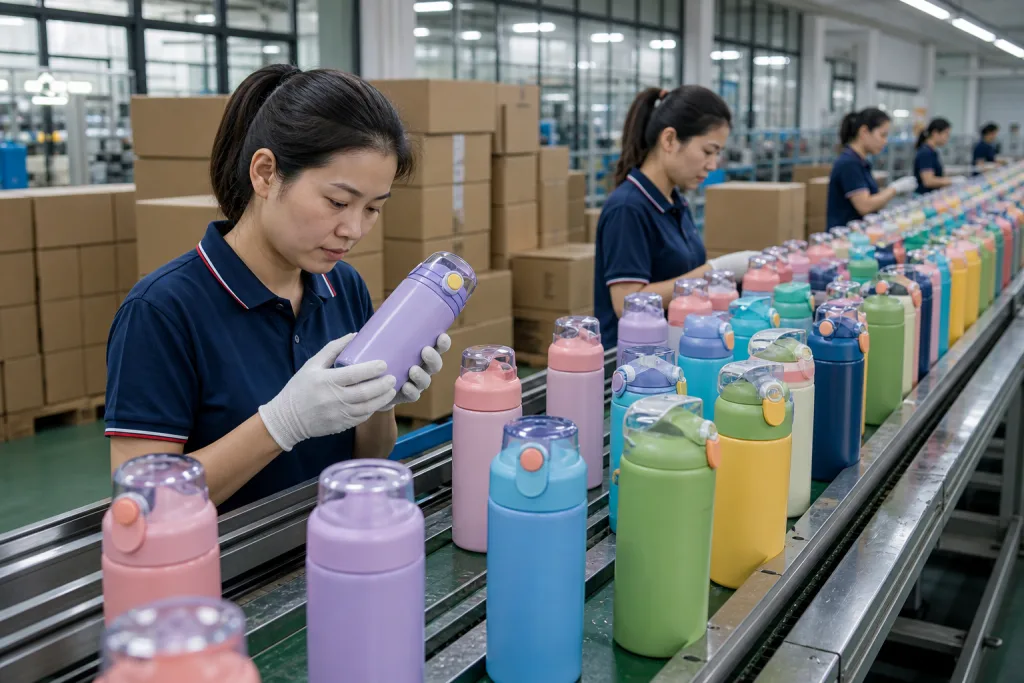
At BottleForge Industrial in Hangzhou, Zhejiang, our normal children water bottle factory output is about 600,000 drinkware units per month across stainless steel bottles, kids bottles, and tumblers. For new children water bottle customized projects, realistic MOQ starts around 1,000 pcs per color for simple logo work and 3,000 pcs when you need a private mold color, full custom packaging, or multiple printed panels. We run first-article checks with a digital caliper, 3M tape test, and carton weight check before mass production; if the buyer wants 800 pcs split into 4 colors, the math doesn't work for stable printing or lid color matching.
Build the first PO lines
Before sampling, write the quotation request like a PO line. We do this with buyers because it stops side-by-side quotes from becoming nonsense. In one RFQ last season, 3 suppliers priced 3 different bottles: one used a 0.38 mm thinner body, one switched the lid to a cheaper press cap, and one left out export cartons and FDA test fees. The buyer flagged it only after finance approved the “lowest” price.
Your early PO line items should look like something the line can run, not like legal copy. For example:
- Item: 400 ml children water bottle custom, 304 stainless steel body, PP flip lid, silicone straw
- Decoration: one-color silk screen logo, 45 x 35 mm, front position
- Color: powder coating, Pantone matched, 2 colors, 1,500 pcs each
- Packing: individual white box, 24 pcs per export carton, carton mark printed
- Compliance: FDA food-contact, CPSIA lead/phthalate for children’s item, ASTM F963 where applicable
- Inspection: AQL Level II, Critical 0, Major 2.5, Minor 4.0
- Trade term: FOB Ningbo, China
If you are buying a bulk school water bottle for student distribution, add a spare-parts line from the start. Lids and straws take the abuse. We usually suggest 1-2% spare lids because the math works better than handling 60 parent complaints after delivery. Small part, big headache. For a children water bottle promotional campaign, add the delivery deadline and a buffer the factory can actually meet. A 35-day factory lead time can turn into 45 days if QC pulled the sample for Pantone powder coating rework, or if the carton artwork arrives with the campus name misspelled on the PO.
Do not hide the sales channel. This is the wrong question to ask after production starts. A bottle for Amazon FBA needs FNSKU labeling, cartons that pass a 76 cm drop test, and sometimes a suffocation warning on polybags. A bottle for school district direct delivery may need carton sorting by campus and grade, with program codes printed on the carton mark. The children water bottle vendor cannot quote that cleanly once bottles are already coated and packed.
Choose safer materials and lids
For kids bottles, the lid matters more than the body. A strong stainless body with a weak straw lid still means wet homework and angry parents. When we quote a custom children water bottle, we ask the lid drawing, gasket material, straw ID in mm, and hinge cycle result before we talk artwork. On our line, QC checks the first 20 flip lids with a 180-degree open-close jig; a school lid should open with a child’s thumb, but it cannot pop open after one drop inside a backpack.
For stainless models, 304 stainless steel is the standard request. Some children water bottle manufacturers offer 201 stainless for lower cost, but we do not recommend it for school programs in Europe or North America. The savings may be USD 0.15-0.30 per unit. The math does not work if 3 cartons come back with rust spots after a salt-spray check or dishwasher complaint. For plastic bodies, Tritan is common for clear bottles, while PP is often used for lids because it takes impact well and keeps the mold cost under control.
Typical FOB China price bands for a bulk children water bottle are:
- 350-400 ml single-wall stainless bottle with PP lid: USD 2.20-3.20
- 350-500 ml vacuum insulated kids bottle with straw lid: USD 4.20-6.80
- 450-600 ml Tritan kids bottle with flip lid: USD 2.00-3.50
- Custom made kids bottle with full-wrap print and color box: add USD 0.35-0.90
These are working ranges, not promises. Steel price, order size, logo coverage, test requirements, and packaging all move the number. A children water bottle supplier in China should separate bottle cost, logo cost, packaging cost, and testing cost on the quote sheet. We ship better projects that way. If a quote is one neat number with no details, the buyer loses control as soon as the PO changes from 1-color logo to full-wrap print or LFGB testing gets added.
For younger children, avoid small detachable decorative parts. They look cute in renderings, but we have seen this go sideways when a silicone charm failed the pull test at 90 N. If the bottle is for children under 3 years old, the compliance path becomes much stricter, and 8 out of 10 standard school bottle designs we see are not the right starting point.
Sample before you trust artwork
A digital mockup is useful, but it is not approval. For a children water bottle customizable order, ask for at least one physical pre-production sample before bulk production. If timing allows, sign off in three steps: blank bottle construction first, logo print second, final packed sample last with barcode and carton mark. Yes, it burns a few days. It also catches the problems a PDF hides: lid squeak, warped logo on a curved body, Pantone drift under coating, soft export carton board, or a barcode sitting 8 mm too close to the box edge. QC pulled a sample last month where the artwork looked fine on screen, but the dinosaur’s eye stretched into an oval after heat transfer. The buyer flagged it immediately.
Our usual sample timing in Zhejiang is 3-5 days for a stock bottle with a simple logo and 7-10 days for a custom logo kids bottle with matched coating or heat transfer artwork. New molds take longer, often 25-40 days depending on tool complexity. For a school district program with a fixed semester start date, the wrong question is “what is your fastest sample time?” Ask how many days are left after one artwork correction and one courier delay. We run DHL samples out of Hangzhou often; a clean 7-day sample plan can become 12 days if the PO lists “blue” but the artwork file says Pantone 2925C.
For the sample PO, include these lines:
- 2-3 pcs blank bottle samples for functional review
- 2 pcs logo samples per artwork, with print position marked in mm from the bottle base
- 1 final packed sample with box, insert, barcode, and carton mark if available
- Sample fee and courier fee, refundable or non-refundable stated clearly
- Written approval method: signed sample, email approval, or both
Check the sample like a buyer, not like a designer. Fill it, invert it for 30 minutes, put it in a backpack side pocket, wash the straw, let a child open and close it 20 times, and drop it from desk height. Simple tests work. A formal lab test still matters, but these desk-side checks find issues before the line is packed with 3,000 bottles. We have seen this go sideways when the approved PDF passed, then inspection found weak flip lids and tilted carton marks under AQL 2.5. If you are a children water bottle distributor serving multiple school accounts, keep the approved sample in your office until the bulk shipment passes inspection. It becomes your physical contract.
Lock compliance before deposit
Kids products draw tighter checks from customs, retailers, and parents. For a bulk kids water bottle, lock compliance before the 30% deposit. After the order is running on the line, fixing it costs time and scrap. For Europe and North America, expect food-contact testing and a child-safety review. QC pulled the sample on the packing table before we ever signed off the PO.
Common paperwork includes FDA food-contact for the United States, LFGB for Germany-focused buyers, EU 1935/2004 declarations for food-contact materials, REACH for restricted substances, CPSIA for lead and phthalates in children’s products, and ASTM F963 when the product has toy-like features. If the bottle has printed decoration, the ink or coating area may need a separate migration or heavy-metal check. Ask one direct question: does the report match the same material, color, coating, and supplier? A three-year-old report for a different lid is weak proof. We have seen a buyer flag a PO typo on the cap color, and the test file no longer matched.
Factory audits matter too. Children water bottle suppliers are often asked for BSCI, Sedex, ISO 9001, or similar documents. A school district may never ask the factory for the file itself, but its procurement team may still want proof of responsible sourcing. If you buy through a children water bottle vendor, check whether the actual production site is audited, not just the trading office. We run into this gap on 2,000 pcs orders all the time.
Testing is not a decoration cost. Treat it as product insurance and put it on the PO.
For a 3,000 pcs order, third-party testing may add USD 300-1,200 depending on the test package and number of colors/materials. That looks heavy on a small order, but one failed compliance question after import costs more. For repeat children water bottle bulk orders, keep the same material suppliers and color system where possible. Every change can reopen the test file. We’ve seen this go sideways on a 12-day lead time shift versus 18 days because the lid resin changed at the last minute.
Move bulk only after checkpoints
After the sample and compliance direction are signed off, the bulk PO has to lock every loose end. A PO for a customizable children water bottle is not just quantity and unit price. It should state the deposit, artwork version, Pantone color, logo size in mm, packing method, carton dimensions, inspection standard, shipment date, destination port, and document requirements. We once had a buyer send “blue lid” on the PO while the approved sample card said PMS 299C; QC pulled the sample before mass packing, or that job would have gone sideways.
Typical payment for new buyers is 30% deposit and 70% before shipment after inspection. For repeat school or importer accounts, terms can improve after 3 clean orders, but first orders need tight control. Bulk lead time is usually 30-45 days after deposit and approved sample for standard models. Back-to-school season is different. The line gets booked fast, and July delivery orders placed in late June usually mean air freight, fewer model choices, or both. The math doesn't work if the buyer expects sea freight, custom color, and a full retail box in the same 18-day window.
Your production PO line items should include:
- Final SKU code and product description
- Order quantity split by color, lid type, and artwork version
- Unit price, mold fee if any, sample fee, testing fee, and spare-part fee
- Approved artwork file name and revision date, such as “KidsBottle_Logo_V3_2025-04-18.ai”
- Inner box, master carton, gross weight, and carton quantity
- Required shipping marks, PO number, FNSKU, or district label
- Inspection date window and AQL standard
- Required export documents: commercial invoice, packing list, bill of lading, certificate of origin if needed
Pre-shipment inspection should run when at least 80% of goods are packed and 100% are produced. Inspectors should check leakage, print adhesion, coating defects, lid fit, capacity, barcode scanning, carton drop condition, and quantity. Use real tools: a vacuum leak tester, 3M tape for logo adhesion, a barcode scanner, and a scale for gross weight. For a children water bottle distributors’ program with mixed cartons, check assortment accuracy carton by carton. A perfect bottle in the wrong carton still creates warehouse cost, and the buyer will flag it before the pallets are even received.
If a defect appears, separate cosmetic from functional. Small coating specks can be discussed within AQL. Leaking lids, wrong materials, sharp edges, loose small parts, or failed barcode labels should stop shipment. No shortcut here. A serious children water bottle manufacturer fixes functional defects before asking for the final balance, because one loose straw plug in a kids order can turn into a full claim at destination.
Plan reorders and after-sales parts
The first order proves the product. The second order proves the supply chain. If you are a children water bottle distributor, importer, or school procurement team planning annual programs, ask the factory to keep the mold number, color formula, lid spec sheet, and packaging dieline after the first shipment. Reorders move faster when the line does not need new setup. At our Hangzhou, China site, repeat orders using approved materials and artwork can often ship in 25-35 days, compared with 30-45 days for a new children water bottle customized project. Last month, a buyer changed only the silicone straw length by 3 mm, and QC still had to pull the sample for a fresh fit check.
Keep a reorder file with approved sample photos, test reports, PO, inspection report, Pantone code, carton mark, and complaint notes. If 0.8% of parents ask for replacement straws, that is useful data. If one school reports lids cracking after dishwasher use, check whether the care instruction promised dishwasher safety or only hand washing. We have seen this go sideways: the bottle was fine, but the insert card said “dishwasher safe” while the signed spec said “hand wash only.” Around 7 out of 10 after-sales arguments we see start with unclear use instructions, not factory defects.
For long-running custom school water bottle programs, consider buying spare lids and straws separately at 2-3% of bottle quantity. Ask for one carton of undecorated stock parts if the design allows it. Cheap insurance. On a 10,000 pcs school order, 300 spare straw sets usually cost less than one urgent DHL carton after the buyer flagged missing replacements six months later. The math does not work if every small complaint turns into a new production request.
A good children water bottle factory should push you not to over-customize the first run. Start with a proven mold, safe materials, controlled decoration, and clear packaging. Once your market accepts the item, then look at private molds, character graphics, or multi-SKU color sets with a proper MOQ check. We run trial decoration on 20 pcs before mass printing because one tiny logo stroke can blur on a curved bottle body. It is the boring path, but it keeps children’s products compliant, on time, and profitable.
Send your kids bottle RFQ for factory review
Share capacity, age range, logo, quantity, and destination. Our Zhejiang team will return practical options, MOQ, pricing, and sample timing.
Frequently asked questions
What MOQ should I expect for a children water bottle customizable order?
For a simple logo on an existing kids bottle, expect 1,000 pcs per color as a practical starting MOQ. Some children water bottle vendors may accept 500 pcs, but the unit price and setup cost are usually poor. For custom coating, color box packaging, or full-wrap artwork, 3,000 pcs is more realistic. A private mold or custom made kids bottle can require 5,000-10,000 pcs because tooling, testing, and production setup must be recovered.
Which logo method is best for a custom logo kids bottle?
For school programs, one-color silk screen is usually the most economical and durable choice, often adding USD 0.08-0.18 per unit depending on size. Laser engraving works well on stainless steel but is less colorful. Heat transfer or UV print is better for full-color characters, mascots, and wraparound designs, but can add USD 0.25-0.60 per unit. For younger children, choose decoration that passes adhesion and migration testing, not only the method that looks brightest in a mockup.
How long does a bulk school water bottle order take?
A normal timeline is 7-10 days for samples, 2-5 days for buyer approval, and 30-45 days for bulk production after deposit and final sample approval. Sea freight to North America or Europe can add 25-40 days port to port, depending on routing. If your district needs bottles before term starts, work backward at least 90 days from the required delivery date. Rush orders are possible, but they reduce color, packaging, and inspection flexibility.
Do I need testing for children water bottle promotional giveaways?
Yes, if children will use the bottle, treat it as a children’s product, not a cheap giveaway. For the U.S., ask about FDA food-contact and CPSIA lead/phthalate requirements. For Europe, ask about EU food-contact rules, REACH, and sometimes LFGB if Germany is involved. If the bottle has toy-like parts, ASTM F963 may apply. Testing costs can range from USD 300 to over USD 1,200 depending on materials, colors, and the number of components.
Should I buy from a children water bottle manufacturer or a trading vendor?
Both can work, but you need transparency. A direct children water bottle manufacturer can usually control tooling, material changes, and production timing better. A trading vendor may offer more product variety but should disclose the actual factory, audit status, and inspection process. For school district or importer projects above 3,000 pcs, ask for factory photos, audit documents, sample history, and a written QC plan. The key is not the label; it is whether the supplier controls the production line.