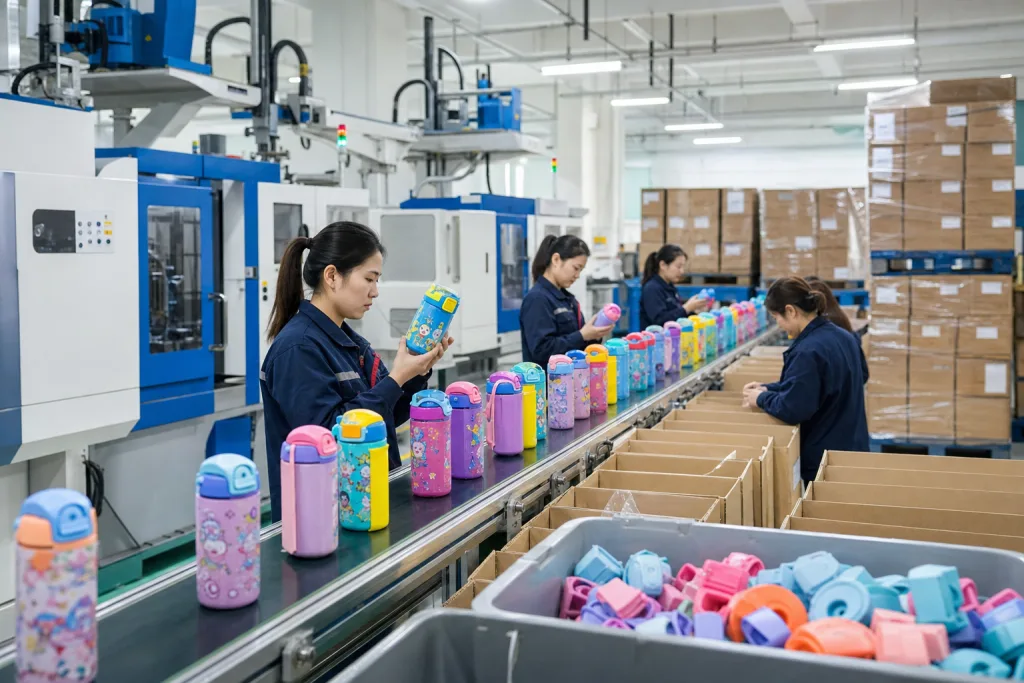
Key Takeaways
- Typical MOQ is 1,000-3,000 pcs per color for custom children water bottle projects
- For school use, 350-500 ml is the practical capacity range for ages 4-12
- AQL 2.5/4.0 inspection should cover leaks, coating adhesion, logo position, and carton drop tests
- Realistic China production lead time is 25-40 days after artwork and deposit approval
Children water bottle bulk orders look easy until the spec sheet lands on your desk. We have seen a school district ask for 500 ml bottles that survive a 1.2 m drop test, while an importer wants margin, carton count, and FBA labels that pass receiving on the first try. The wrong cap thread or spray coating can turn a $1.20 unit into a replacement claim. That is the wrong question to ask first.
At our Zhejiang factory, we run these builds every season, and the first mistake is always the same: buyers compare FOB prices before they check the actual build. A 350 ml plastic bottle, a 500 ml 304 stainless bottle, and a custom kids bottle with a straw lid can all sit side by side in a PDF, but the line sees different wall thickness, lid torque, and leak rates. QC pulled the sample on a 24-hour inverted test, and the one with a loose silicone ring failed fast. We ship what passes, not what looks cheap.
Start With Capacity And Age
Capacity comes first. Color and logo can wait. For preschool and kindergarten programs, 300-350 ml is the right starting point. It keeps the bottle light, fits small hands, and does not jam up a backpack side pocket. We run this check on the line with a 65 mm pocket gauge, because a nice-looking sample is useless if it falls out of the bag.
Weight is the part buyers miss. A stainless steel 500 ml kids bottle with double-wall vacuum construction can weigh 260-330 g before water. Add 500 g of water and the child is carrying close to 800 g. That is a real load for a six-year-old. For a school district buying 10,000 units, the math does not work if the bottle is meant for daily desk use. In that case, a single-wall stainless or Tritan-style plastic body is the cleaner call. QC pulled the sample once and the buyer flagged the 318 g unit as too heavy after a 20-minute walk test.
For a children water bottle wholesale program, put the age on the RFQ: “ages 5-8, backpack side pocket, daily school use.” That one line saves time on lid choice, neck size, and body diameter. A common body diameter is 65-72 mm for kids bottles, which fits most school bag pockets and car cup holders. Once you go beyond 75 mm, the bottle starts feeling bulky in smaller hands, and we see more pushback on the first buyer sample. One PO even came in with “500ml” typed as “500 mlx”; small typo, big delay.
Material Line Drives Compliance Risk
Material is the first place a cheap bulk school water bottle turns expensive. For children’s products shipping to Europe or North America, “food grade” on a quotation is not enough. Ask for the exact resin or steel grade, then match it to the test report scope. For stainless steel bottles, we usually see SUS304 or 316 on the inner liner. SUS304 works for water and diluted juice in most school tenders. SUS316 gives better corrosion resistance, but it adds USD 0.20-0.45 per piece depending on body size and order quantity. Last month QC pulled a 500 ml sample marked “304 stainless” on the PO, then the incoming sheet showed 201 on the coil tag. Stop the line there.
For plastic custom kids water bottle programs, buyers usually choose PP, Tritan-type copolyester, or PE based on price and shelf look. PP is light and low-cost, but it looks milky rather than glass-clear. Tritan-style material gives the buyer a cleaner retail display and stronger drop performance, but the FOB price moves up. If the bottle is for children under 12, ask your children water bottle factory for BPA-free documentation and the right testing scope, such as LFGB, EU 10/2011, FDA food-contact, REACH, and CPSIA where relevant. We run PP parts at different shrinkage settings than Tritan, and a 0.3 mm cap tolerance can decide whether the bottle leaks after a 1.2 m drop test.
Paint and coating belong in the material decision, not the decoration discussion. A matte powder coat looks good in a sample photo, but the math does not work if it chips after two weeks in a school bag. For stainless children water bottle custom orders, we normally recommend powder coating with adhesion testing, cross-hatch tape test, and a clear dishwasher warning if the coating is not made for machine washing. If you want a children water bottle customizable for retail, align the coating spec with the logo process and care label. We have seen this go sideways: the buyer approved laser logo, the final PO said silk print, and the care card still claimed dishwasher safe.
Lid Design Is The Failure Point
Most claims on a custom school water bottle start at the lid. The body may pass drop tests, then the cap snaps after a week in a first-grade classroom. Kids bite spouts, over-tighten threads, and toss bottles sideways into bags. On our line, QC pulled a sample after 20 open-close cycles and the hinge pin already showed wear. A showroom sample is not the real test. For school district buyers, start with a flip straw lid or a screw cap with a wide silicone seal. For younger children, skip small decorative parts. They turn into choke risks, and they disappear fast.
Ask the children water bottle vendor to list every lid component: PP shell, silicone gasket, PE straw, spring pin, carry loop, dust cover, and replacement straw availability. We ask for the gasket thickness too, usually 1.2 mm or 1.5 mm, because a vague spec causes trouble at assembly. If you are a children water bottle distributor planning repeat seasonal orders, spare lid programs are worth a look. A 1-2% spare lid allocation can cut service complaints without pushing the main bottle price off target, unless the PO is sloppy and the carton count is wrong.
Leak testing should be written into the purchase order, not assumed. We run it on the bench: fill to nominal capacity, close the lid, lay the bottle flat for 30 minutes, then shake 10 cycles. For straw lids, test with the straw open and closed as appropriate. A small air vent can improve drink flow, but if the valve material is soft or cut off-center by 0.3 mm, it leaks. A reliable bulk children water bottle spec defines the leak acceptance before mass production starts. The buyer flagged this on a 12,000-piece order when a missing test line in the PO turned into a wet master carton.
For kids bottles, “cute lid” is not a specification. Component material, gasket hardness, pull force, and leak test method are specifications.
Custom Logo And Artwork Tolerance
A custom logo kids bottle order usually gets rejected for looks before any leak test fails. We see this on school crests, mascot artwork, sponsor logos, and retail characters: placement shifts 3 mm, red turns too orange, or a thin line fills in after curing. For a simple one-color school logo, silk screen printing is still the best value; we run it with a mesh screen and check the first 20 pcs before the line opens up. For stainless steel, laser engraving gives strong durability, but it only shows a metal-tone finish unless the design uses coating removal effects. Heat transfer or UV printing works better for full-color children water bottle promotional designs, but the artwork file has to be controlled tighter. Low-resolution JPGs cause trouble.
On a round bottle, curvature limits the print area. A typical safe logo zone on a 500 ml kids bottle is 60-80 mm wide by 80-120 mm high, depending on diameter. If the artwork wraps too far, distortion and registration drift increase; QC pulled one sample last season where the mascot’s face stretched almost 5 mm near the side seam. For children water bottle customized projects, approve a digital mockup, then approve a physical pre-production sample. Do not rely on screen color alone. Pantone references reduce disputes, but coated stainless, plastic, and silicone can still show different tones after baking or molding.
MOQ changes with decoration. A stock-color bottle with a one-color logo may start at 1,000 pcs. A custom made kids bottle with new mold color, full-color print, and retail packaging may need 3,000-5,000 pcs per SKU to make production efficient. At our Zhejiang facility, monthly drinkware capacity is about 600,000 units across stainless, plastic, and kids categories, but 8 small color splits can still slow a line change because each screen, fixture, and carton label needs setup. We’ve seen this go sideways when a buyer asked for 300 pcs per color across 10 colors; the math doesn’t work. Fewer SKUs with cleaner artwork often give a better landed cost than too many tiny color splits.
Packaging Must Match The Channel
Packaging is not decoration; it is part of the supply chain spec. For a school district order, we often pack each bottle in an OPP bag or recyclable paper sleeve, then load 24 or 48 pcs per export carton with a 60 × 40 mm side label for campus sorting. Retail is different. A kids-product importer may need a color box, barcode, warning text, hang tag, instruction sheet, master carton marks, and we need the artwork file before the line opens the first carton. A children water bottle distributors program for multiple school branches may need inner cartons labeled by school name or delivery location; we once had QC pull 11 cartons because “Lincoln East” was typed as “Licoln East” on the PO.
For Amazon or marketplace importers, packaging needs tighter control. Confirm FNSKU labeling, suffocation warning for polybags, carton weight under the receiver’s limit, and scannable barcodes on a flat surface at least 35 mm wide. If you are importing a bulk kids bottle with multiple colors, give each color separate SKU labeling. Do not mix cartons unless your warehouse asks for it in writing. We have seen this go sideways: the buyer flagged one mixed-color carton, then the whole inbound shipment sat 9 days before relabeling.
Carton strength should be written into the spec, not left to the cheapest packing quote. For ocean shipment from China, we normally use 5-layer export cartons for drinkware, with moisture-resistant tape and edge protection when the retail box is easily crushed. A common carton weight target is under 15 kg for safer warehouse handling. Add a carton drop test to the QC checklist, especially for plastic bottles with protruding lids; on the floor we run a 76 cm corner-edge-face drop before sealing the golden sample carton. A cheap carton can save USD 0.03 per bottle and cost far more in crushed retail packaging claims. The math does not work.
Price Depends On The Hidden Specs
Buyers asking for children water bottle bulk pricing usually want one number before the spec is fixed. That is the wrong question to ask. For a clean FOB quote, we need seven inputs: capacity in ml, body material, lid type, coating finish, logo process, packing style, and quantity per color. If those are missing, the quote sheet becomes guesswork. Last month, QC pulled a 500 ml sample with the same photo as the buyer’s RFQ, but the wall thickness was 0.38 mm instead of 0.50 mm. That “cheaper” price was not the same bottle.
As a rough China factory reference, a simple 400 ml PP children’s bottle may start around USD 1.10-1.80 FOB at 3,000 pcs. A 500 ml single-wall stainless bottle with silk screen logo may sit around USD 2.20-3.20. A double-wall vacuum insulated kids bottle with straw lid, powder coating, and color box can range from USD 4.20-6.80 depending on lid tooling, gasket count, spray loss, and print coverage. These are working ranges, not promises. We run the powder coating line with a 2-3% normal loss allowance; if a quote ignores that, someone is hiding cost or planning to ship weaker finishing.
Payment and Incoterms change the real comparison. FOB Ningbo or FOB Shanghai is common for Zhejiang and nearby China production. EXW may look cheaper on the first line, but you take over inland trucking, export handling, customs paperwork, and coordination with the forwarder. We have seen buyers save USD 0.08 per pc on paper, then lose three days because the factory address on the PO had one wrong district name. For first orders, many importers use 30% deposit and 70% balance before shipment after inspection. If your school purchasing rules require different payment terms, raise it before sampling, not after the line is booked.
A good children water bottle manufacturer will push back when the target price does not match the spec. If your target is USD 2.50 FOB and you ask for vacuum insulation, full-color wrap, individual color box, and 1,000 pcs split into five colors, the math does not work. MOQ matters here. Five colors at 200 pcs each means five setup checks, five color approvals, and more AQL sorting time before packing.
Quality Control Before Shipment
For children’s drinkware, QC should be dull, photographed, and finished before the container leaves China. We run AQL sampling, commonly critical 0, major 2.5, minor 4.0, unless your company’s manual is stricter. Critical defects mean no debate: unsafe sharp edges found with a finger sweep, strong odor after opening the polybag, contamination, broken lid parts, or severe leakage in a 30-minute inverted test. Major defects include wrong logo Pantone, poor coating adhesion, cracked body, missing gasket, or barcode failure. Minor defects are small cosmetic marks inside the signed limit sample, such as a 1 mm speck on the back side. QC pulled the sample. It must match.
For a bulk children water bottle order, the inspection checklist should include capacity check with a measuring cylinder, weight check on a 0.1 g digital scale, lid fit, leak test, print rub test, coating cross-hatch test, carton drop test, barcode scan, and carton quantity verification. If the order is for a school district, add name-label area verification if the bottle includes a write-on panel; one buyer flagged a 3 mm shift because student names got cut by the curve. If the order is retail, check warning text and country-of-origin marking against the approved artwork file, not against a salesperson’s screenshot. Small misspellings on a PO become big chargebacks.
Sampling matters. Pre-production samples prove appearance and structure. Production samples confirm the line is following the approved version, including gasket hardness, lid torque, and print position in mm. Final random inspection protects you before balance payment. At BottleForge Industrial in Hangzhou, Zhejiang, we typically quote 7-10 days for existing mold samples and 25-40 days for mass production after deposit and artwork approval, depending on season and order size. For back-to-school programs, add at least 3 weeks of buffer for freight, customs, and inland delivery. This is where we’ve seen orders go sideways: a vendor promises 18 days when the line needs 25 days, then skips carton drop testing or ships without a clean barcode report.
Send Your Kids Bottle Spec For Review
Share capacity, material, logo, packaging, and quantity. Our Zhejiang team will return a practical quote with MOQ, lead time, and compliance notes.
Frequently asked questions
What is the normal MOQ for children water bottle bulk orders?
For existing molds, the practical MOQ is usually 1,000-3,000 pcs per color. A stock body color with one-color logo can often stay near 1,000 pcs. Custom body color, silicone color matching, full-color printing, or retail box printing usually pushes the MOQ to 3,000-5,000 pcs per SKU. If you split 3,000 pcs across six colors, the unit price rises because each color needs separate setup, printing adjustment, and QC control. For school district orders, we often recommend one bottle color with different printed school logos if budgets are tight.
Which material is best for a custom children water bottle?
There is no single best material. For lower-cost school giveaways, PP is light and economical. For clearer retail presentation, Tritan-style copolyester is a better option. For durability and higher perceived value, SUS304 stainless steel is the usual choice. A double-wall stainless custom kids water bottle keeps drinks cooler but costs more and weighs more. For ages 4-7, weight and easy opening may matter more than insulation. For North America and Europe, request food-contact testing such as FDA, LFGB, EU 10/2011, REACH, and CPSIA where applicable.
Can we order a children water bottle customizable with school names?
Yes, but plan the artwork structure carefully. If every school has a different logo, you can keep the same bottle color and change only the print screen or digital artwork. That is more efficient than changing bottle colors for each school. For 20 school names, ask for a production schedule by artwork batch and require carton labels showing school name, SKU, quantity, and destination. A one-color silk screen logo is the most stable for large school programs. Full-color mascot printing is possible, but you should approve physical samples before mass production.
How long does production take from a China children water bottle factory?
For an existing mold, sample production normally takes 7-10 days after artwork confirmation. Mass production usually takes 25-40 days after deposit and sample approval. Add 3-7 days for final inspection and export loading. Ocean freight to North America or Europe can add 25-45 days depending on port and season. If you need delivery before the school year starts, begin RFQ work at least 90 days before your required warehouse date. Custom molds or complex lids can add another 20-35 days.
What should importers check before paying the balance?
Do a final random inspection before balance payment and shipment release. Use AQL, commonly critical 0, major 2.5, minor 4.0. Check leak performance, logo position, print adhesion, odor, sharp edges, lid assembly, gasket presence, carton quantity, barcode scan, and packaging damage. For a children water bottle wholesale or retail order, verify country-of-origin marking and warning labels. If the order includes multiple colors or school logos, count each SKU separately. Do not accept only factory photos for a first order; use your own inspector or a third-party QC company.