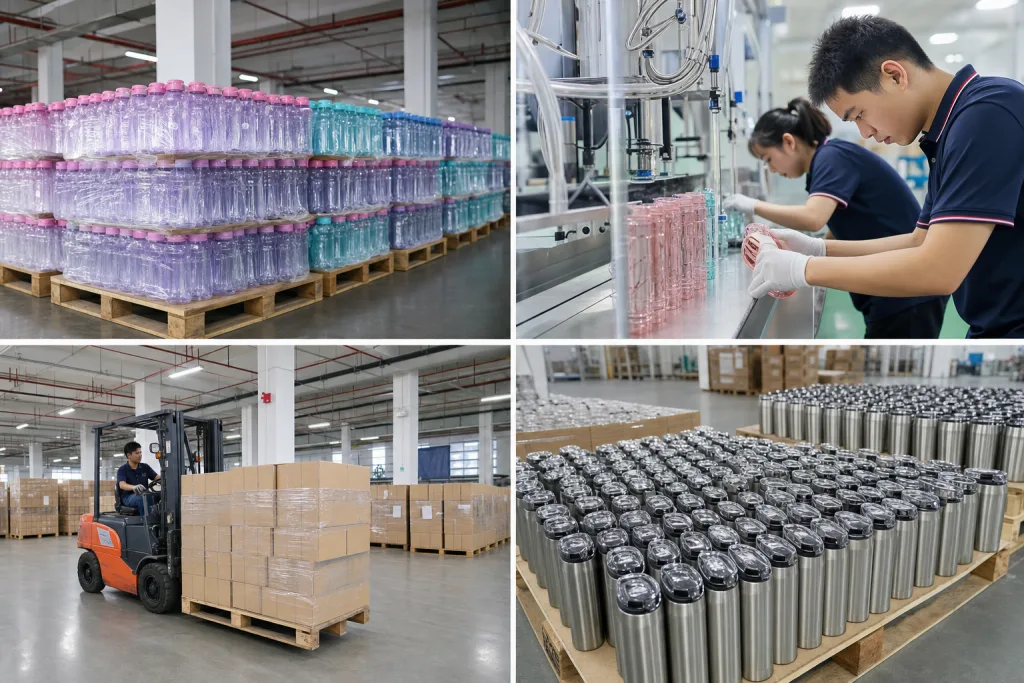
Key Takeaways
- A realistic FOB China price for basic wholesale drinkware often starts around USD 0.70-1.20 for PP/Tritan-style bottles and USD 2.20-4.80 for stainless vacuum bottles
- MOQ is usually 1,000-3,000 pieces per model, but custom colors and molded lids can push MOQ to 5,000 pieces
- Always check wall thickness, cap material, gasket fit, odor, AQL level, and carton drop strength before chasing the lowest quote
- Decoration can add USD 0.08-0.65 per unit depending on silkscreen, laser engraving, powder coating, UV print, or gift packaging
Cheapest wholesale water bottles look simple on a quote sheet. Buying them cleanly is harder. A supplier can show USD 0.72 per bottle, then the cost moves after logo setup, 5-layer carton strength, inner box choice, color MOQ, inspection fee, and sea freight. If you source bulk drinkware for retail, promotion, sports clubs, or hospitality, the low unit price only matters if the bottle passes smell, leak, drop, and compliance checks. QC pulled one low-price PP sample last month with a sharp gate mark at the mouth; the buyer saved USD 0.04 and lost 12 days on rework.
We manufacture drinkware in Zhejiang, China, and we see the same buyer mistake every week: comparing one-line prices instead of total sourcing risk. That is the wrong question to ask. Our Hangzhou-linked supply chain can output about 450,000 stainless and plastic units per month, with typical MOQ from 1,000 to 3,000 pieces per SKU. We run pressure checks, carton drop tests, and logo position checks in mm before mass packing, because a cheap bottle with a crooked print still gets rejected at receiving. Use the questions and checklist below before you approve a cheap quote.
What does cheapest actually mean?
Ask a factory for the cheapest wholesale water bottles and we hear different targets: lowest FOB unit price, lowest landed cost, or the lowest cost your sales channel can accept without returns. Those are different jobs. A USD 0.85 plastic bottle looks cheaper than a USD 1.05 bottle on a quote sheet, but we have seen a thin cap and soft gasket fail the upside-down leak test after 8 hours, then the LCL carton corners crushed by 12 mm in transit. The math doesn't work if you save USD 0.20 and spend it back on replacements.
For procurement, “cheap” should mean the lowest cost that still meets your written specification. Write it down. Capacity tolerance in ml, material grade, lid type, leak test method, logo process, packing, compliance requirement, and inspection level all need to be clear before RFQ. If those eight points are missing, three suppliers will quote three different bottles, and the lowest number will usually be the weakest sample. QC pulled the sample, not the price list.
For example, a 650 ml single-wall PP bottle for promotion may pass at 60-75 g body weight if the campaign is short and the lid is simple. A retail Tritan-style bottle may need 110-145 g, cleaner clarity under a light box, and a spring lid that survives 3,000 open-close cycles on the jig. A 500 ml stainless steel vacuum bottle may use 201 stainless outside and 304 inside for a budget program, but European buyers often push back and ask for 304 inside and outside, especially when the hangtag says food-contact safe.
Cheap is not a material. Cheap is a controlled specification with no unnecessary features.
In Zhejiang, China, we usually ask buyers to build two specs: a cost-down version and a retail version. The cost-down version removes the gift box and silicone boot first, then checks whether gradient coating or a molded handle still earns its cost. The retail version keeps the details that stop returns, such as a thicker gasket, a stronger hinge pin, or a carton that passes a 10 kg stacking check. We run both samples on the line because “best price” alone is how bulk production goes sideways.
Which bottle type is lowest cost?
Lowest cost comes down to material, bottle size, and how the logo is applied. For a promo giveaway, we run simple plastic first because the mold cycle is fast and the carton weight stays low. For a retail buyer asking for heat retention, stainless vacuum bottles cost more at PO stage, but they usually carry a better shelf price and generate fewer “doesn’t keep hot” complaints. QC pulled one 500 ml vacuum sample last month at 38 mm mouth opening; the buyer cared more about 6-hour heat loss than saving USD 0.18.
- Basic PP bottle: often USD 0.70-1.10 FOB China at 3,000-5,000 pieces, suitable for events and school programs. Cheap and quick. I would not pitch it for premium retail, because the hand feel and scratch resistance give the game away.
- Tritan-style or copolyester bottle: usually USD 1.20-2.60 depending on lid complexity, capacity, and testing. Buyers ask for it when clear body appearance and BPA-free claims matter; we also check the PO spelling of “Tritan” because one buyer once typed “Titan” and their compliance team flagged the artwork file.
- Single-wall stainless bottle: commonly USD 1.60-3.20. It is lighter than vacuum designs but has no heat retention. Check rim polishing with a cotton swab and inspect the inside under a 6000K lamp; black polishing dust inside the neck is a small finding that becomes a big email chain.
- Vacuum stainless bottle: usually USD 2.20-4.80 for 350-750 ml standard models. Price moves with steel gauge, coating type, and lid design. Copper lining adds cost, so ask if the buyer’s test requirement justifies it before the line quotes.
- Large growler or canteen: a bulk growler, beer growler bulk order, or bulk canteen program can range widely from USD 4.50 to more than USD 12.00 depending on 1 L, 1.9 L, insulation, handle type, and cap structure. The math changes fast once the carton goes over 15 kg gross weight.
For wholesale drinkware, the smallest bottle is not always the cheapest program to run. This is the wrong question to ask if you only compare plastic or steel weight. A 500 ml bottle may use the same lid, gasket, polishing labor, logo setup, and carton handling as a 750 ml bottle. The material saving may be only USD 0.10-0.25, while the buyer sees a lower retail value. We have seen 500 ml and 750 ml share the same 63 mm lid, same laser fixture, and same 24 pcs master carton; freight did not drop the way the buyer expected.
If you source wholesale canteen, canteen bulk, or canteen wholesale lines for outdoor accounts, ask whether the cap thread is standard across sizes. Shared components cut spare-part trouble and help combine MOQ; we ship fewer odd caps when 600 ml and 1 L use the same thread gauge. For wholesale growler or beer growler wholesale bulk programs, ask for pressure guidance if the product will hold carbonated drinks. A lot of low-cost stainless growlers are made for cold liquid storage, not long-term pressurized beer transport, and we have seen this go sideways when a buyer assumed a beer growler worked like a keg.
Where do hidden costs appear?
Most price gaps in drinkware wholesale do not come from supplier greed. They come from blanks in the RFQ. If you send a serious bulk inquiry, spell out decoration, packaging, tests, carton marks, and whether you want spare parts. Otherwise the first quote is bare FOB: plain item, neutral polybag, no inspection, no compliance papers, no special carton mark. QC pulled a sample at the packing table last week and the buyer still asked why the quote moved. That is the wrong question.
Decoration is the first hidden cost. One-color silkscreen may add USD 0.08-0.18 per unit after screen setup. On our 6-color screen press, a clean logo still needs a frame, ink mix, and a test run before the line goes steady. Laser engraving on stainless can add USD 0.15-0.45 depending on logo size. Full wrap UV print, heat transfer, or powder-coated multi-color logos can add USD 0.35-0.90. If you need custom retail packaging, expect USD 0.15-0.60 for a color box, more for thick kraft, inserts, or barcode labeling.
Testing is the second. REACH, LFGB, FDA food-contact documentation, CPSIA for kids products, or ASTM-related checks are not free. A practical budget is USD 180-600 per test set, depending on lab and scope. Our lab file cabinet has stacks for each market, and when the buyer flagged a missing LFGB page, we had to rerun paperwork before sampling. If your distributor requires BSCI, ISO 9001, Sedex, or factory audit documents, tell the supplier before sampling. Some very cheap workshops cannot support those requests, and this is where cheap goes sideways.
Logistics is the third. Carton size affects freight more than buyers expect. A wide-mouth bottle with a bulky handle can reduce container loading by 15-25%. We check this on the pallet jack and on a basic carton drop test, because a 2 mm change in carton width can wreck a load plan. If you ship to Amazon FBA, FNSKU labeling, carton weight limits, suffocation warning bags, and ISTA-style drop resistance may add cost but prevent receiving problems.
Before you approve the best wholesale drink bottle quotation, ask for a costed option sheet: plain item, logo method, packaging, test, inspection, spare parts, and shipping terms. Once these lines are visible, the “cheapest” supplier is often not the one with the cheapest first email. We once saw a PO with “color box” in the notes and “no box” in the drawing, and that typo burned a day on the line. The math does not work unless every line is clear.
What MOQ should you expect?
MOQ is not just a factory rule. It comes from steel sheet purchasing, masterbatch color mixing, powder coating line changeover, logo jig setup, and carton printing plates. For existing bottle shapes in Zhejiang, we usually quote 1,000 pieces for plain stainless models, 2,000-3,000 pieces for custom logo orders, and 3,000-5,000 pieces for custom color plastic bottles. On the line, a color change can burn 2-3 hours while the team cleans the spray booth, checks the RAL card, and runs the first 20 pcs for adhesion testing. Molded lids, unique caps, or exclusive shapes can require 10,000 pieces or a separate tooling fee.
If you buy alcohol flask bulk, alcohol flask in bulk, or alcohol flask wholesale for gift channels, MOQ may be lower because most hip flask bodies are standardized. Custom embossing, leather wrap, funnel set, or gift box printing changes the math fast. We once had a buyer ask for 600 pcs with 4 box designs; the box factory rejected it because each design needed its own printing setup. For alcohol flask wholesale bulk, ask whether the inner welding and polishing meet your market’s food-contact requirements, not just whether the outside looks clean.
Beer tumbler bulk and beer tumbler wholesale programs usually sit in the middle. A 16 oz or 20 oz stainless beer tumbler in bulk can often start at 1,000-2,000 pieces per color if the shape is existing. Beer tumbler wholesale bulk orders with powder coating and laser logo scale better than fully custom plastic lids because we run the same cup body through the coating line and only change the laser file. QC pulled the sample last month for a 0.4 mm lid gap, and that kind of issue is harder to fix when the lid mold is new.
MOQ checklist before you negotiate
- Can the supplier mix 2 colors within one 3,000-piece MOQ?
- Is the MOQ per model, per color, or per logo?
- Does the quoted price include spare lids or silicone gaskets?
- What happens if final production is 3% over or under order quantity?
- Can the first order use neutral cartons and the reorder use printed retail cartons?
A good China factory may accept a trial MOQ, but it will protect itself with a higher unit price. Fair enough. Pushing a 500-piece custom color order to match a 5,000-piece price is the wrong question to ask; the setup cost has not disappeared, it just gets hidden in thinner coating, cheaper cartons, or a rushed inspection. We have seen this go sideways when a PO even had the Pantone code typed wrong by one digit.
How should samples be judged?
Samples are not souvenirs. They are engineering evidence. When samples arrive for wholesale drinkware, we put them on a 0.1 g scale, check height and mouth ID with a digital caliper, smell them, fill them, shake them, and leave them overnight. Do not judge them under office lighting with the sales team saying, “looks fine.” That is how bad stock gets approved.
For plastic bottles, check odor after 24 hours closed. Fill with warm water at about 60°C if the material claims to tolerate it, then inspect deformation, cap fit, and taste transfer. For transparent materials, hold the bottle against a white A4 sheet and look for flow marks, black dots, bubbles, and wall thickness changes near the shoulder. For stainless bottles, check inside polishing, welding line, mouth smoothness, and whether a magnet sticks strongly to parts that were claimed as 304 stainless. A magnet test is not a full material test, but QC has caught obvious substitution this way before.
Vacuum bottles need a simple heat test. Fill with 95°C water, close for 6 hours, and measure temperature drop with the same probe each time. A budget bottle will not perform like a premium bottle, but your supplier should give a target, such as above 55°C after 6 hours for a 500 ml model under room temperature. Touch the outside wall after filling; strong heat on the outer body usually means vacuum failure. We have seen buyers skip this and argue later over a 12°C gap.
For growler wholesale, beer growler in bulk, or beer growler wholesale orders, check handle welding and cap seal carefully. A large bottle creates more leverage when dropped. We run a simple pull check on the handle and look for pinholes around the weld under a bright inspection lamp. For canteen wholesale, inspect strap rivets, cap tether, and coating adhesion around edges, because coating chips usually start at the rim or bottom seam.
Ask for a pre-production sample after artwork and packaging are confirmed. The approval sample should match bulk production in material, color, logo size, lid, gasket, and carton. If the factory says the sample is “similar,” write down exactly what will change, including Pantone code, logo position in mm, carton mark, and polybag warning text. Similar is not a QC standard. We have seen this go sideways over one missing comma on a PO.
What belongs in your QC plan?
For cheap bulk drinkware, inspection is not optional. Low unit value will not save you from claim cost. A USD 1.20 bottle can turn into a USD 8.00 service ticket after domestic freight, replacement handling, and retailer penalties. We have seen one 5,000 pcs order get held because the carton mark missed a single digit from the PO. Put the QC plan on one page, with pass/fail numbers, and send it before deposit.
Use AQL for visual and functional defects. Around 7 out of 10 buyers we work with use AQL 2.5 for major defects and 4.0 for minor defects, with critical defects set to zero tolerance. Critical defects mean no debate: sharp edges, contamination, broken glass, leakage, unsafe smell, wrong material, or wrong logo. Major defects include failed leak test, poor lid fit, severe scratch, wrong capacity, or carton damage. Minor defects cover small color drift against the approved Pantone chip or tiny cosmetic marks inside the signed limit sample. QC pulled one sample last month with a 0.6 mm burr on the spout; that belongs in critical, not “minor.”
For water bottles, set functional tests by inspection lot. Run leak test on at least 32 pieces, cap open-close test on sample pieces, coating adhesion cross-hatch test for painted stainless, barcode scan test, carton drop test, and capacity check. For glass bottles, add thermal shock guidance and check whether the protective sleeve fits after washing. For kids bottles, ask for CPSIA or relevant market documents before production starts, not after the container is closed. This is where the math goes bad: a USD 60 lab document question can become a USD 6,000 hold at destination.
Factory timing matters. A normal China schedule is 7-10 days for existing sample, 25-35 days for mass production after deposit and artwork approval, and 3-7 days for inspection and shipment booking. Peak season before summer or Q4 can add 10-20 days, especially when powder coating lines are full. Our Zhejiang planning team prefers inspection when goods are 80-100% packed, because carton, label, quantity, and mixed-SKU problems show up then. At 50% packed, the line can still hide trouble.
If your supplier refuses third-party inspection, treat it as a warning sign. Cheap should still be inspectable. We ship low-cost bottles every month, and the good factories can handle AQL sheets, calipers, barcode scanners, and a buyer’s inspector on the floor.
How to compare final quotes
Build one quote sheet before you pick a supplier. Put FOB port, Incoterms, material, capacity, weight, MOQ, logo process, packing, carton quantity, carton size, production lead time, test documents, inspection allowance, payment terms, and sample cost in separate columns. Boring? Yes. But last month QC pulled a 500 ml bottle sample that was quoted at 285 g, while the sealed PP sample weighed 248 g on our bench scale. That difference changes feel, dent resistance, and carton gross weight.
For China export orders, Zhejiang factories often quote FOB Ningbo or FOB Shanghai. EXW looks cheaper on line one, then local trucking, customs handling, and export documents land on you or your forwarder. New importers usually do better with FOB. We ship from Hangzhou to Ningbo in about 3.5 hours when traffic is normal, and a missed SI cut-off can push sailing by 7 days, not “a little later.” For North America and Europe, ask your forwarder for duty, ocean freight, port charges, warehouse handling, and final delivery before you lock the retail price.
Do not over-customize the first order. If the target is cheapest wholesale water bottles, use an existing mold and lid, then stay with a standard coating color and one-color logo. Custom packaging should wait until the sales channel pays for it. We have seen this go sideways: a buyer wanted 6 bottle colors, 4 lid colors, and 3 box versions on a 1,000 pcs trial order, then flagged a PO typo where “matte black” became “matt back.” If you need a family line, such as wholesale canteen, wholesale growler, beer tumbler wholesale, and alcohol flask wholesale under one brand, use the same finish spec, logo size rule, and carton marking system. Repeat orders move faster when the line is not guessing.
Our rule for new buyers is simple: choose the complete quote, not the loud quote. A complete quote names the steel grade or plastic grade, body weight, decoration cost, packing, MOQ, lead time, payment term, and inspection standard. If two suppliers differ by less than 5%, pick the one that answers technical questions without dodging. The math doesn't work when you save USD 0.06 per piece and lose 18 days fixing wrong cartons, barcode placement, or a logo film that was 2 mm off center.
Send your target price and bottle specification
We will check material, MOQ, decoration, packing, and FOB cost, then tell you where the quote can be safely reduced.
Frequently asked questions
What is a realistic price for the cheapest wholesale water bottles?
For simple plastic promotional bottles, a realistic FOB China range is about USD 0.70-1.20 at 3,000-5,000 pieces. Tritan-style bottles often run USD 1.20-2.60. Basic single-wall stainless bottles are commonly USD 1.60-3.20, while vacuum insulated bottles usually start around USD 2.20-4.80 depending on capacity, steel grade, lid, and coating. If a quote is 20-30% below these ranges, check body weight, gasket quality, carton strength, and whether logo, packaging, and inspection are excluded. Very low prices can be real for stock clearance, but they are rarely stable for repeat wholesale drinkware programs.
Can I mix water bottles, canteens, growlers, and flasks in one order?
Yes, but MOQ is usually counted per model, color, and decoration method. You might place 1,000 pieces of a water bottle, 1,000 pieces of a wholesale canteen, 1,000 pieces of a wholesale growler, and 1,000 pieces of alcohol flask wholesale in one shipment, but each item still has its own setup cost and production schedule. Mixing helps logistics because the goods can ship in one container or LCL booking. It does not always reduce factory MOQ. Ask whether cartons can share the same marks, whether the same logo file works across curved surfaces, and whether all items can finish within a 30-40 day window.
Is stainless steel or plastic better for the lowest landed cost?
Plastic usually wins on unit price and freight weight, especially for event giveaways and short-term promotions. A 650 ml PP bottle may cost under USD 1.20 FOB, while a comparable stainless vacuum bottle may be three or four times higher. But stainless can win on perceived value, retail margin, and durability. If you sell through retail or corporate gifting, a USD 3.50 insulated bottle may be easier to sell profitably than a USD 0.95 plastic bottle. For strict cheapest wholesale water bottles, choose plastic. For better brand impression and fewer low-quality complaints, consider stainless or Tritan-style materials.
What inspection standard should I use for drinkware bulk orders?
A practical starting point is AQL 2.5 for major defects, AQL 4.0 for minor defects, and zero tolerance for critical safety defects. Your inspection checklist should include leak testing, capacity check, smell check, logo position, coating adhesion, barcode scan, carton drop condition, and quantity verification. For insulated bottles, add a heat retention test using hot water for 6 hours. For kids bottles, glass bottles, or food-contact items in Europe and North America, confirm REACH, LFGB, FDA, CPSIA, or ASTM-related requirements before production. Inspection should happen when 80-100% of goods are packed, not after the container leaves.
How long does production take after I approve the sample?
For existing models with a standard logo, plan on 25-35 days after deposit, artwork approval, and pre-production sample approval. Add 7-10 days for sampling if you need a physical logo sample. Custom colors, molded lids, retail gift boxes, or large growler bulk programs can push production to 40-55 days. Ocean freight to North America or Europe may add 25-45 days depending on port and season. If you need goods for a fixed event date, work backward and leave at least 10 extra days for inspection, rework, customs, or vessel delay.