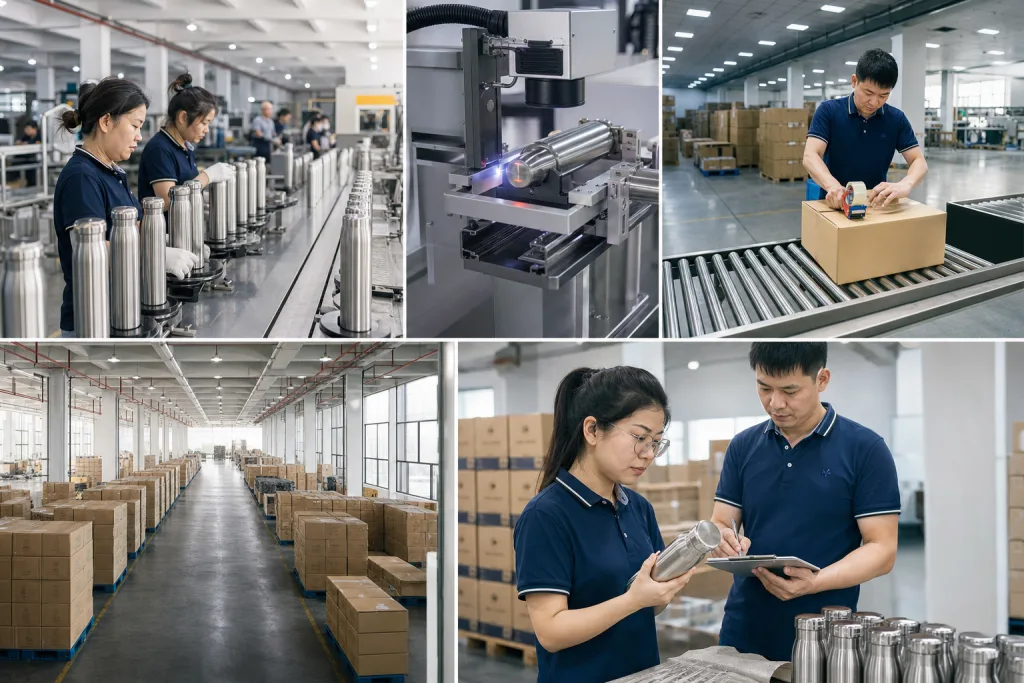
Key Takeaways
- A 500 ml stainless vacuum bottle can often be quoted from USD 2.35-4.20 FOB China depending on steel, lid, coating, and carton specification
- For a custom thermos, realistic MOQ is usually 1,000 pcs per color for screen print and 3,000 pcs for full custom color coating
- 304 inner steel is the safe baseline for Europe and North America; 316 costs about 8-15% more and is not always needed
- Use AQL 2.5/4.0 inspection, 100% leak testing, and 24-hour heat retention sampling before balance payment
If you sell outdoor gear or run promotional campaigns, the cheapest wholesale vacuum bottle is not the one with the lowest line price. It is the bottle that reaches your warehouse without a failed 24-hour leak test, powder coating scratches over 0.5 mm, crushed K=K cartons, or a logo your client refuses after QC pulled the sample.
From Zhejiang, China, we see buyers overpay in 2 common ways: they add specifications the shelf price cannot recover, or they squeeze the thermos factory until the line swaps out the parts that protect quality. Wrong question. Start with capacity and steel grade, then check decoration, packaging, compliance, and inspection against the target price; if the math does not work at 3,000 pcs MOQ, it will not magically work after the PO arrives with one typo in the lid color code.
Start With Four Buying Decisions
The fastest way to buy the cheapest wholesale vacuum bottle is to stop asking “what is your best price?” before the bottle is defined. This is the wrong question to ask. A factory thermos quote only means something after four items are locked: capacity in ml, inner and outer steel grade, lid construction, and logo process. Last month we had two POs with “750ml thermos” in the item line but no lid drawing; our costing sheet showed a USD 0.46 gap before the buyer even picked the cap.
For outdoor retailers, we usually run 500 ml, 750 ml, and 1,000 ml. The 500 ml bottle ships cheaper because a 48 pcs carton stays near 15-17 kg, which keeps warehouse teams happier. The 750 ml bottle looks stronger on a hiking shelf, but material cost moves up by roughly USD 0.35-0.70 per unit once the body height and vacuum shell are adjusted. The 1,000 ml version sells well for camping, but it needs a stronger base, a larger carton, and often a thicker cup-style cap. QC pulled one 1,000 ml sample with a 0.6 mm base dent after the drop test, so we do not treat this size like a stretched 500 ml bottle.
The second decision is steel. A common manufacturer thermos uses 304 stainless steel inside and 201 or 304 outside. If you sell into the EU, UK, Canada, or the United States, we advise 304 inner wall as the baseline. No debate there. Moving to 316 inner steel sounds premium, but for plain water, tea, and coffee the math often does not work unless your retail price can carry an 8-15% higher metal cost. On the line, the difference starts at incoming material inspection, where our QC checks coil markings and wall thickness with a digital caliper before deep drawing.
The lid system is where cheap quotes hide trouble. A simple screw cap is low cost and stable. A flip lid, straw lid, or push-button lid can add USD 0.20-0.80, and leakage risk rises if the silicone ring is too soft, the hinge pin is loose, or the spring loses tension after cycling. We have seen this go sideways: one buyer flagged a 2% leak rate after air shipment because the sample lid used a 52 Shore A silicone ring while mass production came in softer. For promotional thermos programs, simple lids cut complaints.
The fourth decision is decoration. A thermos custom logo by one-color screen print is usually the safest low-cost route, especially for a 1,000 pcs MOQ. Laser engraving looks clean and lasts longer in daily use, but it slows the line because each body sits under the laser head for seconds, not strokes through a screen. Powder coating with several logo positions makes a better retail item, but MOQ and rejection rate rise when dust, pinholes, or color drift show up under the light box. Decide these four points first; then supplier thermos pricing becomes comparable.
Where The Low Price Really Comes From
A cheapest wholesale vacuum bottle quote starts with steel grade, forming scrap, vacuum work, lid components, coating, labor, QC, packing, and export handling. Cut the wrong line item and the math doesn't work: one buyer saved USD 0.18 per bottle, then QC pulled the sample carton and found 6% leaking at the lid after a 45-degree shake test.
For a standard 500 ml customized thermos, a practical FOB China range is USD 2.35-4.20. The low end usually means stock mold, 304 inner and 201 outer, PP basic lid, one-color silk print, white box, and 24 pcs master carton. The higher end often means 304/304 steel, powder coating, laser logo, retail gift box, barcode label, and a stronger K=K carton. If one thermos manufacturer comes in 20-30% below the other quotes, ask what was removed. We once saw a PO typo list “201 inner” instead of “304 inner”; the buyer flagged it only after the pre-production sample arrived.
Wall thickness matters. We see 0.4-0.5 mm stainless sheet on many 500 ml bottles, depending on the body shape and stretch depth. Too thin, and the bottle dents when the carton takes a corner hit. Too thick, and freight goes up fast. Vacuum performance comes from stable welding, copper lining if used, and a clean vacuum sealing process; the line still needs time for leak testing and heat retention checks. In our Zhejiang facility network, a normal production line may run 80,000-150,000 stainless bottles per month, but the good lines slow down when the helium leak tester or hot-water retention rack shows drift.
Separate product cost from landed cost. A 500 ml bottle may look cheap at FOB Ningbo or FOB Shanghai, but carton size can move the landed price by USD 0.10-0.35 per unit by ocean freight, and by more if the order ships by air. Ask for carton dimensions, gross weight, and units per carton before approving the sample. We ship plenty of 500 ml bottles in 24 pcs cartons; changing from 49x33x27 cm to 55x38x31 cm can wipe out the “cheap” quote.
Cheap is acceptable. Blind cheap is not. Your target is the lowest specification that still passes the market, not the lowest number on a spreadsheet.
Choose MOQ Around Market Risk
MOQ is not just a factory rule; it is how the buyer and factory split risk. For a customizable thermos using an existing bottle shape and one-color logo, 1,000 pcs per design is often workable in China. We run that on standard laser or silk-screen fixtures without stopping the line for half a day. For a custom powder color, 3,000 pcs per color is more realistic because the coating line needs cleaning, color matching, and batch control; last month QC pulled the first 30 pcs because the Pantone chip looked fine indoors but shifted under the D65 light box. For a private mold, expect 10,000-30,000 pcs depending on body complexity and lid tooling.
Outdoor retailers should not start with 24 SKUs. The math doesn't work. A better first run is usually two capacities and two colors, not six colors and four lids. If you buy thermos bulk for a spring outdoor launch, 500 ml and 750 ml cover most shelf needs, and both sizes normally pass shelf-display checks without changing the tray depth by more than 5 mm. If you are a promotional brand serving corporate gifts, 500 ml and 600 ml are easier because they fit more logo sizes and ship efficiently for office or event programs; we have seen buyers flag 750 ml samples because the logo looked too small on the curve.
Distributors thermos buyers often ask for mixed cartons to support smaller dealers. Factories can do this, but it slows packing and increases labeling mistakes. We’ve seen this go sideways when a PO said “blue/black 1:1” but the carton mark file said 2:1. If you need mixed colors, define the inner box label, carton mark, and SKU ratio clearly. A warehouse-friendly carton might be 24 pcs per carton for 500 ml, with a gross weight near 10-13 kg. Heavier cartons cut carton cost by a few cents, but our drop-test table and the loading guys both tell the same story: crushed corners, scuffed powder coat, and claims photos from the buyer.
Lead time also affects MOQ decisions. A normal custom thermos lead time is 25-35 days after deposit and artwork approval for stock body orders. Add 7-12 days for custom color approval, and 20-35 days for new mold or complicated lid development. Small MOQ is the wrong question to ask if the vessel date is fixed. Before you chase a lower MOQ from a thermos vendor, ask whether your shipment date, carton marks, and compliance documents still fit the plan; one missing FDA line on the invoice can cost 2 days at document checking before we ship.
Decoration Choices That Save Money
Logo method is one of the easiest places to burn budget. A thermos promotional order does not always need full-wrap artwork, metallic coating, or debossed packaging. From 42 buyer comments we logged last quarter, the first complaints were logo position, color match, and whether the bottle felt light in the hand. Simple wins. On the line, QC checks the logo with a 0.5 mm steel ruler before packing, not with a design mood board.
Screen printing is the budget workhorse. One-color screen print on a cylindrical stainless body is economical, fast, and suitable for campaign quantities. It works best when the logo is not too tiny and the print area avoids strong body curvature. For 1,000-5,000 pcs, it is often the best choice for a promotional thermos. We run this setup with a curved screen jig, and the buyer usually saves more here than by arguing over 304 stainless thickness.
Laser engraving costs more per unit than basic print, but it will not peel. It is a good option when you use powder coating and want a permanent mark. It also avoids some ink compliance questions, though the coating itself still needs to meet the market requirement. For an outdoor retail bottle, laser can justify a slightly higher shelf price. QC pulled the sample after a 3M tape test last month; the print lifted, the laser mark stayed clean.
Heat transfer and full-wrap printing create strong visual impact, but they require tighter setup control. If your order is a low-margin distributor thermos program, full-wrap artwork can create avoidable rejects from alignment issues, scratches, or color variation. Keep full-wrap for retail packaging where the price supports it. We have seen this go sideways: one PO said “seam hidden,” but the artwork had a 6 mm mismatch at the back, and 312 pcs were sorted out before AQL 2.5 inspection.
Color is another cost lever. Stock colors are cheaper because the coating line already runs them often: black, white, navy, army green, and stainless steel finish. A Pantone-matched custom color can be worth it for brand consistency, but expect MOQ around 3,000 pcs and accept a tolerance. On coated stainless, a ΔE below 2.0 is difficult to promise at low price; 8 out of 10 factories we know control around ΔE 3.0-4.0 for practical production. The math doesn't work if the buyer wants 800 pcs, a private Pantone, and the same price as stock black.
Compliance For Europe And North America
If you are buying from a thermos manufacturer in Zhejiang or another part of China, confirm compliance before you pay the deposit. A cheap bottle that fails food-contact testing is not cheap. It is dead stock. We have seen a buyer save USD 0.18 per piece on coating, then lose 3,000 pcs because QC pulled the sample and the report did not match the shipped color.
For the EU, ask for LFGB or EU food-contact migration testing, plus REACH when coatings, inks, or silicone parts are used. For the United States, FDA food-contact expectations apply, and some retailers ask for California Proposition 65 screening. For children’s drinkware, ASTM or CPSIA-related requirements may apply based on age grading and lid design. For Canada, retailer documentation is not always the same, but food-contact safety still matters. Get the exact SKU, material, and color on the report; one PO typo like “PP lid black” instead of “PP lid grey” can delay booking by 5 days.
Factory audits are also buyer protection. BSCI, Sedex, or ISO 9001 does not prove the bottle is perfect, but it shows the manufacturer thermos line has process control. If your client is a national outdoor chain, ask early whether they require BSCI, social audit reports, or restricted substance declarations. Asking after production starts is the wrong question to ask. We run audit document checks before mass production because pulling files from an old subcontracted coating shop can take 12 days vs 2 days from our own archive.
Do not assume one report covers every component. Stainless body, PP lid, silicone gasket, coating, ink, and adhesive labels may need separate material declarations. If you change lid color or coating after sample approval, the original report may no longer match. Good thermos suppliers keep material records by batch and can provide steel grade declarations, coating information, and test report references. On our line, the incoming inspector checks 304 stainless coil tags, gasket batch codes, and coating lot numbers before the first 500 pcs go to assembly.
For Amazon or marketplace shipments, add FNSKU labeling, suffocation warning for polybags if used, carton weight limits, and drop-test packing. Lab pass is not enough. A bottle that passes testing but arrives with crushed gift boxes still creates chargebacks and returns; we ship marketplace cartons under 15 kg when requested and test gift boxes with a 76 cm drop before final packing.
Sampling And Quality Control Plan
For a custom thermos, sampling is not a souvenir stage. It is where we freeze the order. QC pulled the first sample with a 0.02 mm caliper, then checked body shape, lid fit, silicone color, coating finish, logo size, logo position, packaging, and barcode or FNSKU if applicable. If any item is marked “for reference only,” write the missing point down in plain language. No guesswork.
Sampling usually takes 5-10 days for an existing shape with basic logo, and 10-18 days for custom coating or more complex decoration. New mold samples take longer; a first-off mold piece can sit 20 days if the cavity needs rework. We keep one sealed golden sample in the office cabinet and one with the factory. Photos help, and measurement notes help more, but a phone screen will not tell you coating texture, lid torque, or print adhesion. The buyer flagged that once on a 0.3 mm logo shift. Fair pushback.
During production, insist on 100% leak testing. On the line, we flip each bottle, hold it for 30 seconds, and check the seam again before packing. Vacuum bottles also need heat retention sampling, so fill with 95°C water and check temperature after 6, 12, or 24 hours based on your spec. A typical retail claim might be 6 hours hot and 12 hours cold, while better stainless thermos designs may claim more. Claims must match test data, not sales talk.
Final inspection should use AQL, commonly 2.5 for major defects and 4.0 for minor defects, with critical defects at 0. Our inspection desk uses a 1500 lux light box and a 0.1 mm feeler gauge for lid gaps. Critical defects include leakage, sharp edges, foreign material inside the bottle, unsafe lid failure, and wrong material. Major defects include serious dents, wrong logo, poor coating adhesion, and non-working lid. Minor defects include small cosmetic marks within agreed limits.
Ask for adhesion testing on printed or coated parts, carton drop testing for retail packs, and random capacity checks. We run a 1.2 m drop test on corner and face, because thin cartons fail there first. If a thermos factory objects to inspection on a low-price order, that is the wrong question to ask. The math does not work, and we have seen that go sideways.
Build A Quote You Can Compare
To compare thermos manufacturers fairly, send every supplier the same RFQ sheet. Put capacity, fixed dimensions, steel grade, lid type, color, logo method, packaging, compliance target, order quantity, delivery term, and destination port in one table. We use a 12-column RFQ template because missing one line, such as carton size or logo position in mm, changes the price. Ask five thermos suppliers for a 500 ml bottle with no details, and you will get five different wall thicknesses, five lids, and no price you can compare.
A clean RFQ might say: 500 ml double-wall vacuum bottle, 304 inner and 201 outer stainless steel, powder coated black, one-color screen print logo on front, screw lid with silicone gasket, individual white box, 24 pcs master carton, EU food-contact compliant, AQL 2.5/4.0 final inspection, FOB Ningbo, quantity 3,000 pcs. Now the supplier thermos quote has boundaries. QC pulled a sample last month where the buyer wrote “black finish” on the PO, and the line used glossy spray paint instead of matte powder coating. Same color. Different cost.
Payment terms change the quote. Standard terms are often 30% deposit and 70% before shipment after inspection. For repeat distributors thermos orders, some factories may discuss better terms after 2 or 3 shipped orders, but first orders rarely get credit. If you want a lower unit price, moving from 1,000 to 3,000 pcs usually saves more than spending five hours fighting over USD 0.03. The math doesn't work when the mold setup, logo screen, and carton printing are spread over only 1,000 pcs.
Be careful with EXW quotes. They look cheaper on paper, but you still pay local trucking, export declaration, port handling, and forwarder coordination in China. FOB Ningbo or FOB Shanghai is cleaner for most overseas buyers. Zhejiang factories commonly ship through Ningbo because stainless drinkware can move from Hangzhou to the port in about 3 hours by truck, and our forwarder can book the container space directly after carton CBM is confirmed.
The cheapest wholesale vacuum bottle you can safely buy is the one where specification, sample, testing, packing, and trade term are visible before production. Lock those first. Then push price hard. We have seen this go sideways when a buyer approved a sample with a 0.5 mm thinner outer wall than the bulk spec, then flagged dents during final inspection.
Send Your Thermos Specification For A Factory Quote
Share capacity, quantity, logo method, packaging, and destination. We will return practical FOB pricing, MOQ, lead time, and risk notes.
Frequently asked questions
What is a realistic MOQ for a custom stainless thermos?
For an existing stainless thermos shape, 1,000 pcs per logo design is a realistic starting MOQ for one-color screen printing. If you need a custom powder-coated Pantone color, plan for 3,000 pcs per color because the coating line has setup loss and cleaning time. Laser engraving can sometimes run at 500-1,000 pcs if the bottle is in stock, but the unit price will be higher. For a new mold, most manufacturers thermos projects need 10,000-30,000 pcs to spread tooling cost. If a supplier promises 200 pcs with custom color and very low price, check whether it is actually stock color with a logo.
How cheap can a wholesale vacuum bottle be without becoming risky?
For a 500 ml double-wall stainless vacuum bottle, a normal FOB China price is often USD 2.35-4.20 depending on steel grade, lid, coating, logo, and packaging. Below that range can be possible for very simple stock goods, but you should check wall thickness, 304 inner steel, lid gasket quality, vacuum failure rate, and carton strength. A price that is USD 0.30 lower may cost more later if 3-5% of units leak or arrive dented. For outdoor retail or corporate campaigns, the safer target is lowest acceptable specification, not the lowest possible construction.
Should I choose 304/201 or 304/304 stainless steel?
For most promotional and retail bottles, 304 inner with 201 outer can be acceptable if the outer coating is good and the market does not require a full 304 claim. It saves cost versus 304/304. For outdoor retailers, coastal markets, or premium positioning, 304 inner and 304 outer is stronger from a marketing and corrosion-resistance standpoint. The price difference varies, but 304/304 may add roughly USD 0.20-0.60 per 500-750 ml bottle depending on steel prices. Never accept 201 inner steel for food-contact vacuum bottles sold in Europe or North America.
Which logo method is best for a promotional thermos?
One-color screen printing is usually best for a promotional thermos when cost and speed matter. It works well for 1,000-10,000 pcs campaigns and keeps setup simple. Laser engraving is better when the bottle has powder coating and the buyer wants a permanent, premium-looking logo. It costs more but avoids peeling. Full-wrap heat transfer is useful for retail designs, but it adds alignment risk and higher rejection rates. For most corporate gift orders, keep the logo under 60 x 80 mm, avoid tiny text, and approve a real pre-production sample before mass production.
How long does production and shipping usually take?
For an existing factory thermos model with custom logo, production usually takes 25-35 days after deposit and artwork approval. Custom coating can add 7-12 days, and new mold work can add 20-35 days before production even begins. Ocean freight to Europe or North America commonly adds 25-45 days port to port, depending on route and season. Air freight is faster but can destroy the price advantage of a bulk thermos order. If your launch date is fixed, work backward from delivery date and allow at least 10 days for sampling, inspection, and export paperwork.