Key Takeaways
- For stainless bulk drinkware, a realistic low-cost MOQ is usually 1,000 units per SKU and 3,000 units per color for custom powder coating
- A USD 0.18 cheaper lid can create a 3-5% leak rate if gasket fit and thread tolerance are not controlled
- Standard production lead time in Zhejiang is 25-35 days after approved sample and deposit
- Use AQL 2.5 for major defects and AQL 4.0 for minor defects on drinkware wholesale orders
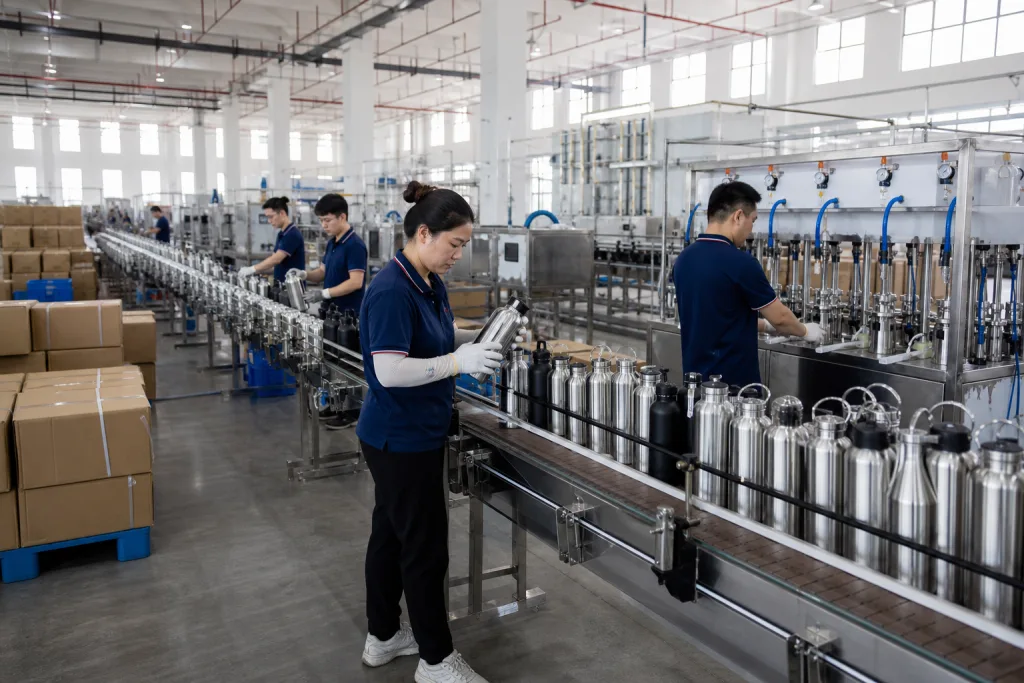
You asked for the cheapest wholesale drinkware, but the lowest FOB quote is the wrong question to ask. The real job is getting stock that ships clean: lids do not leak, coating does not scuff, and the carton size matches the booking so your freight bill does not jump. On our line, we check lid torque with a small gauge and spot carton measurements before the first 200 pcs move to packing, because a 2 mm mistake on a box can change the pallet count fast.
Take a buyer who needs 8,000 units split across travel tumblers, canteens, and beer growlers for a spring promotion. We run that order with a China supplier, a price that still leaves room for QC, and sample approval tight enough for retail or Amazon FBA. The math does not work if the PO says one thing and the carton art says another, and we have seen that go sideways on a typo in the outer case size. From our Zhejiang factory floor, this is how we would spec it, cost it, sample it, inspect it, and ship it.
Start with the order you actually need
Cheap sourcing goes wrong when the RFQ says only “send your best wholesale drinkware price.” That line tells us nothing. We can't price air. For this buyer setup, we run a mixed order: 3,000 stainless travel tumblers, 2,000 sports canteens, 2,000 beer tumblers, and 1,000 beer growlers. That is 8,000 units, but the line still has four molds, four lid sets, four carton specs, and four inspection checks. Last month QC pulled a growler sample with a loose cap; the buyer had typed the lid code wrong on the PO.
If you want the cheapest wholesale drinkware, split must-haves from nice-to-haves before you ask for FOB China pricing. A 20 oz double-wall tumbler in 304 stainless steel, 0.5 mm inner wall and 0.4 mm outer wall, is a different build from a 0.6 mm/0.5 mm version with ceramic lining. Same shelf look. Different cost. Different dent resistance in transit. Our drop test rack is set at 60 cm, and the thinner wall shows scuffs first, so this is the wrong question to ask if you want the low number to hold.
For canteen wholesale, say what you need: hiking canteen, military-style canteen, kids bottle, or sports bottle with strap. Buyers search bulk canteen, canteen bulk, wholesale canteen, and drinkware bulk like they mean one item. They don't. A sports canteen with a flip straw lid carries more leak risk than a plain screw cap bottle. A wide-mouth bulk growler also needs tighter thread control because carbonation pressure and repeat opening work the seal hard. On our cap-torque gauge, a 0.3 N·m swing is enough for QC to flag the lot.
At BottleForge Industrial in Hangzhou, Zhejiang, we price by SKU, material grade, capacity, coating, logo method, packaging, and test requirement. Our regular stainless drinkware output is about 450,000 units/month, but a small custom run still needs line time booked in advance. If you want a low price and on-time ship, keep the first order tight: two body shapes, two colors, one logo method, and one carton standard. We had a buyer push back on this last quarter, then the math didn't work when they split 12,000 pieces across six cartons and two print files.
Build the cheapest workable specification
The cheapest workable specification is not the thinnest bottle. It is the lowest-cost spec that survives your sales channel and the carton drop test. For a budget retail promotion, we usually quote 304 stainless steel for food-contact surfaces, 201 stainless only on approved non-contact outer parts, PP lid components, silicone gasket, and powder coating only when the SKU needs color. On our line, a 0.40 mm inner wall can pass where a 0.32 mm wall starts showing dents after vacuum forming and packing compression. If your market is Europe, add LFGB or EU food-contact testing. If your market is North America, add FDA food-contact compliance and, for kids items, CPSIA where applicable.
Here is how we would set the four SKUs. Travel tumbler: 20 oz, double-wall vacuum, 304 inner, 201 or 304 outer depending on target price, sliding lid, one-color silk screen logo with a 45 mm print height limit unless the cup taper is adjusted. Sports canteen: 24 oz, single-wall for gym giveaways or double-wall for outdoor retail, screw cap, carry loop. Beer tumbler bulk: 16 oz, double-wall, clear press lid, matte black or stainless finish. Beer growler wholesale: 64 oz, single-wall for cheapest pricing or double-wall if cold retention matters, screw cap with silicone seal. We run these sizes often, so tooling risk is lower than with a custom 19 oz “almost standard” shape a buyer once asked us to match from a blurry photo.
The buyer also asks about alcohol flask bulk and alcohol flask wholesale bulk for a gift set. Flasks are price-efficient because they are smaller, but the weld seam, mouth polishing, and cap thread need tighter checks. QC pulled a 6 oz alcohol flask sample last month because the lip had a 0.2 mm burr after polishing; that would fail a retail inspection before the buyer even checked the carton label. A 6 oz alcohol flask in bulk can look attractive on price, yet poor polishing around the mouth can kill the order fast. Do not add flask SKUs just because they look cheap on a spreadsheet. We’ve seen this go sideways.
For printing, silk screen is normally the best first-order option below 10,000 units. It is slower than leaving the bottle blank, but the math still works for one-color logos when the artwork is clean and the print area stays flat. Laser engraving looks clean and durable, but it costs more per unit on coated products and can slow production by 2 to 3 days on a 5,000 pcs order because each cup sits under the laser head. Heat transfer and full-wrap printing need stricter artwork control and higher reject allowance; the buyer flagged a 1 mm color shift on a wrap print before, and they were right. If the goal is best wholesale drink bottle value, not a design award, keep decoration simple.
Read FOB prices without fooling yourself
A low FOB quote usually hides one of three cuts: thinner body steel, cheaper lid tooling, or soft packaging. We see this every week on China drinkware wholesale projects. A USD 2.45 tumbler and a USD 2.75 tumbler can both be honest, but they are not the same cup. Ask for wall thickness in mm, stainless grade, lid material, carton size, unit weight, and packing method in writing. Last month QC pulled a 20 oz sample quoted at the low end; the buyer expected 0.50 mm body material, but the caliper read 0.38 mm. If the supplier will not write those specs on the PI, the quote is not ready for comparison.
For this scenario, a realistic FOB Ningbo or Shanghai low-cost range might be: 20 oz travel tumbler USD 2.40-3.20, 24 oz sports canteen USD 1.90-2.80, 16 oz beer tumbler wholesale bulk USD 2.20-3.10, and 64 oz growler wholesale USD 5.80-8.50 depending on insulation and cap structure. Alcohol flask wholesale can be under USD 1.50 for simple 6 oz units, but gift box, funnel, and mirror polishing usually add USD 0.25-0.70. The math gets ugly fast. We had one PO where “gift box” was typed, but the buyer meant color box with insert; that small wording gap added USD 0.18 per unit before shipment.
Be careful with phrases like beer growler bulk, beer growler in bulk, beer growler wholesale, and beer growler wholesale bulk. Search terms do not prove pressure performance or coating durability. They also say nothing about the cap seal. If the growler is for breweries, ask whether the supplier tested sealing after 24 hours with liquid and whether the cap passed repeated opening cycles. On the line, we run a simple leak check with filled samples laid sideways in a tray; it catches problems that nice product photos miss. For beer tumbler in bulk, spend less time arguing vacuum hours and more time checking rim finish, lid fit, and carton rub marks after a drop test.
MOQ changes price more than buyers expect. At 500 units per SKU, setup and line changeover eat the order. At 1,000 units, the job becomes workable. At 3,000 units per color, powder coating and logo setup cost less per piece. At 10,000 units, you can push harder on lids, cartons, and inner packing. The cheapest unit price usually appears when the factory can run one body shape for several shifts without stopping the line. We run into this on powder coating: changing from matte black to white can cost 2 to 3 hours for cleaning, and that time still lands in somebody’s FOB price.
Sample before you negotiate too hard
Too many buyers try to close the price before they see samples. Wrong order. You can agree on a target range first, but the final price should sit on the approved sample, not a PDF quote. For our 8,000-unit order, we would issue pre-production samples for each SKU: one plain sample to check structure, one logo sample with the real print method, and one packed sample with carton size and drop-test assumptions. Sampling usually takes 7-10 days for existing molds and 15-25 days if a new lid or special color is involved. Last month QC pulled a 600ml bottle sample where the PO said matte black, but the artwork file said PMS 426C gloss. Small typo. Big argument.
During sample review, do not stop at “the logo looks nice.” Fill each bottle with water, invert it for 30 minutes, shake it for 60 seconds, and leave it on white paper overnight. No shortcuts. Check coating thickness and adhesion with a cross-hatch tape test if powder coating is used; our line uses 3M 600 tape for that check. Measure capacity to the fill line, not just the brim, because buyers complain when a “500ml” bottle only holds 455ml at the safe fill mark. We use calipers for mouth diameter, lid thread height, gasket seating, and wall thickness spot checks.
If you are buying canteen bulk for outdoor retail, test the cap strap and handle like the customer will abuse it. A strap that survives 20 pulls in the office may still fail after 200 pulls in real use. We have seen this go sideways on a 12,000-piece promo order when the buyer approved the desk sample and skipped pull testing. If you are buying growler bulk for brewery merchandise, test the cap after hot water washing because gasket deformation can show up after heat exposure. For beer tumbler wholesale, confirm that lids from batch A fit cups from batch B, not just the hand-matched sample on the sales desk. The buyer flagged this once at final inspection, and the line had to re-sort lids by cavity number.
Once the sample is approved, freeze the specification. Lock it. That means material grade, weight tolerance, color range, logo position, packing, barcode, carton mark, and inspection criteria. If you change from kraft box to color box after deposit, you add cost and risk; the math doesn't work if the carton supplier already cut 320gsm kraft board. Cheap sourcing depends on boring discipline, signed sample tags, and a spec sheet the merchandiser can hand to QC without guessing.
Control QC like a retailer
For cheapest wholesale drinkware, QC cannot be casual. Low price leaves less margin for returns, replacements, and angry retail buyers. We run an initial production check around 10-20% completion, then a final random inspection when at least 80% is packed. Use ANSI/ASQ Z1.4 sampling with AQL 2.5 for major defects and AQL 4.0 for minor defects. For premium retail, tighten major defects to AQL 1.5. On one 30,000 pcs tumbler order, QC pulled the sample at 12% production and caught a lid gasket mismatch before the line packed 300 cartons.
Major defects include leakage, sharp edges, wrong material, poor vacuum performance, incorrect logo, broken lid, severe dent, rust spot, and wrong barcode. Minor defects include small coating dust, slight print offset within tolerance, light polishing marks, or carton scuffing. Define numbers. Do not write “acceptable finish” on the PO; the buyer flagged that wording for being useless. Use logo position tolerance plus or minus 2 mm, color difference within agreed Pantone visual range, and treat any dent larger than 2 mm on a visible surface as major. The caliper does not argue.
Vacuum products need insulation testing. A practical factory test is hot water at 95°C, measured after 6 hours, with a defined minimum temperature drop range based on bottle structure. Not every low-cost order needs laboratory testing, but every order needs leak testing. Our Zhejiang production line uses 100% leak checks for vacuum bottles and random destructive checks for weld integrity; the line operator records failed pieces on a whiteboard beside the pressure tester. Chasing the absolute lowest quote in China is the wrong question to ask when one leaking bottle can cost more than the saved USD 0.03.
Packaging QC matters just as much. A cheap cup becomes expensive fast if 8% arrive scratched because the inner polybag is too thin or dividers were removed to save USD 0.05. For export cartons, specify 5-ply corrugated for heavier growlers, carton gross weight under 15 kg where possible, and clear drop-test expectations. We ship plenty of Amazon FBA orders, and FNSKU labeling plus carton size limits must be locked before mass packing, not fixed at the warehouse. We have seen this go sideways: 620 cartons ready, one FNSKU digit wrong on the PO, two workers relabeling by hand until midnight.
Plan freight, duties, and cash timing
The landed cost decides whether you bought cheap or just got a low FOB line. FOB price is one row on the cost sheet. Add inland pickup if the quote excludes it, export documents, ocean freight or air freight, duty, customs clearance, warehouse handling, labeling, and damage allowance. We had one USD 2.60 tumbler land at USD 3.45 for Los Angeles, then USD 4.10 for Hamburg after the buyer changed the carton from 24 pcs to 12 pcs and destination charges moved. QC pulled the packed carton and measured 58 × 39 × 46 cm. That carton size mattered more than the 6.8 kg gross weight.
For our mixed 8,000-unit order, the growlers eat the most cubic meters. Simple as that. If the buyer insists on beer growler in bulk with individual color boxes, freight cost jumps because the line loses empty-space control inside the master carton. If they accept plain kraft boxes for wholesale channels, carton utilization improves and the packing team can run tighter stacks on the pallet. For beer tumbler in bulk, nesting is usually not possible when lids ship in the same carton, so cup taper, handle shape, and lid bag position affect container loading. Drinkware bulk freight is a geometry problem, not just a weight problem, and we have seen this go sideways when a buyer approved the cup but forgot to approve the inner tray.
Payment terms for a first order are commonly 30% deposit and 70% balance before shipment after inspection. Large repeat buyers may push for better terms after 2 or 3 clean shipments, but new buyers should not expect open account. If a supplier offers relaxed terms and the lowest price, the math does not work; check their factory status, export record, and quality system before sending the PO. BSCI, ISO 9001, REACH documentation, LFGB reports, and material test reports are useful, but verify that certificates match the factory name and product category. We once saw a PO typo list 201 stainless while the approved sample was 304 stainless, and the buyer flagged it only after the balance payment notice.
Zhejiang is a strong region for stainless drinkware because polishing, welding, coating, and packaging suppliers sit within 1–2 hours of Hangzhou and Yongkang. That helps with cost control. Still, your purchase contract should state Incoterms, lead time, approved sample reference, penalty or remedy for failed inspection, spare lid percentage, and document requirements. Put the sample code and carton mark artwork in the contract, not just in a chat screenshot. Cheap without contract clarity is delayed trouble, and we ship smoother when the line has one signed spec sheet to follow.
Choose the supplier that explains tradeoffs
The right China supplier for cheapest wholesale drinkware will not say yes to every target price. That is the wrong question to ask. Good factories show you where cost can come out and where it will hurt the order. On the line, QC pulled 20 lids from a 500-piece sample run before we approved a thinner carton. Thinner color box paper from 350 gsm to 300 gsm? Fine. Remove the silicone gasket? No. Switch from laser engraving to one-color silk screen? Often smart. Cut carton strength on 64 oz wholesale growler shipments? We have seen that go sideways fast.
When you compare suppliers, ask three plain questions. What is your monthly capacity for this exact SKU, not the whole plant? What defect rate did you see on similar bulk drinkware orders in the last 90 days? Which parts are made in-house, and which parts are outsourced? If the answer is vague, they are selling from a catalog, not running the production. The buyer flagged a PO typo on lid color once, and that small miss turned into a 3-day delay. We ship enough to know the math does not work when a supplier cannot name the process.
For brand owners, ask about spare parts. A 1% spare lid allowance can save a promotion if cartons get crushed in transit. For distributors, ask whether the factory can hold the same mold and lid for repeat orders over 12 months. A 0.4 mm change at the thread can create complaints even when the bottle body looks the same. Our tool room keeps the mold cavity number on the rack and the lid code on the traveler. Buyers often think one lid is one lid. It is not.
At BottleForge Industrial, we quote a clean, inspectable spec instead of chasing the lowest number on the page. If your target is canteen wholesale, alcohol flask wholesale, beer tumbler wholesale, or a mixed wholesale drinkware program, send the capacity, material, logo, packaging, target market, and annual volume. We will tell you where the real savings sit, and where 8 cents protects the whole order. If the master carton is set above 15 kg, we change the pack plan before the line starts.
Send your target spec and landed cost goal
We will review material, MOQ, packaging, QC, and FOB options before you commit to a wholesale drinkware order.
Frequently asked questions
What MOQ should I expect for the cheapest wholesale drinkware order?
For existing molds, expect 1,000 units per SKU as a workable MOQ. For custom powder coating, 3,000 units per color is more realistic because the coating line needs setup time and color cleaning. A mixed first order of 5,000-10,000 units usually gets better pricing than scattered 300-unit tests. If you need custom tooling, MOQ can move to 5,000-10,000 units, plus tooling cost. For simple alcohol flask wholesale or single-wall canteen bulk, MOQ may be lower, but the unit price will not be as sharp.
Is 201 stainless steel acceptable for wholesale drinkware?
It depends where it is used. For food-contact surfaces, we recommend 304 stainless steel because it has better corrosion resistance and is widely accepted for export drinkware. Some budget items use 201 stainless on the outer wall of a double-wall bottle to reduce cost, while keeping 304 inside. That can be acceptable if declared clearly and tested properly. For Europe, confirm REACH and food-contact requirements. For North America, check FDA food-contact expectations and your retailer’s own standard. Do not accept vague wording like “stainless steel material” on the purchase order.
How long does a China drinkware wholesale order take?
For existing molds, plan 7-10 days for samples and 25-35 days for mass production after sample approval and deposit. Add 3-7 days for final inspection, booking, and export handling. Ocean freight then depends on destination: often 25-40 days to North America or Europe port-to-port, plus customs and inland trucking. If you need custom color matching, new packaging, or lab testing, add 7-15 days. Rush orders are possible, but they usually cost more and create higher QC risk.
Can I mix tumblers, canteens, growlers, and flasks in one order?
Yes, but each SKU still has its own MOQ, tooling, packaging, and QC points. A mixed wholesale drinkware order can improve total shipment efficiency, especially if cartons load well together. However, it does not automatically give you the same price as 8,000 units of one tumbler. For example, 2,000 beer tumbler bulk, 2,000 wholesale canteen, 1,000 bulk growler, and 3,000 travel tumblers require separate production scheduling. Keep colors and logo methods consistent if you want the best cost.
What inspection standard should I use before paying the balance?
Use ANSI/ASQ Z1.4 with AQL 2.5 for major defects and AQL 4.0 for minor defects as a practical baseline. Major defects should include leakage, wrong logo, rust, sharp edges, broken lids, failed vacuum performance, and incorrect barcode or FNSKU. Inspect when at least 80% of goods are packed and 100% are produced. For a 8,000-unit order, the sample size will usually be a few hundred units depending on inspection level. Put the standard in the purchase order before deposit, not after production.