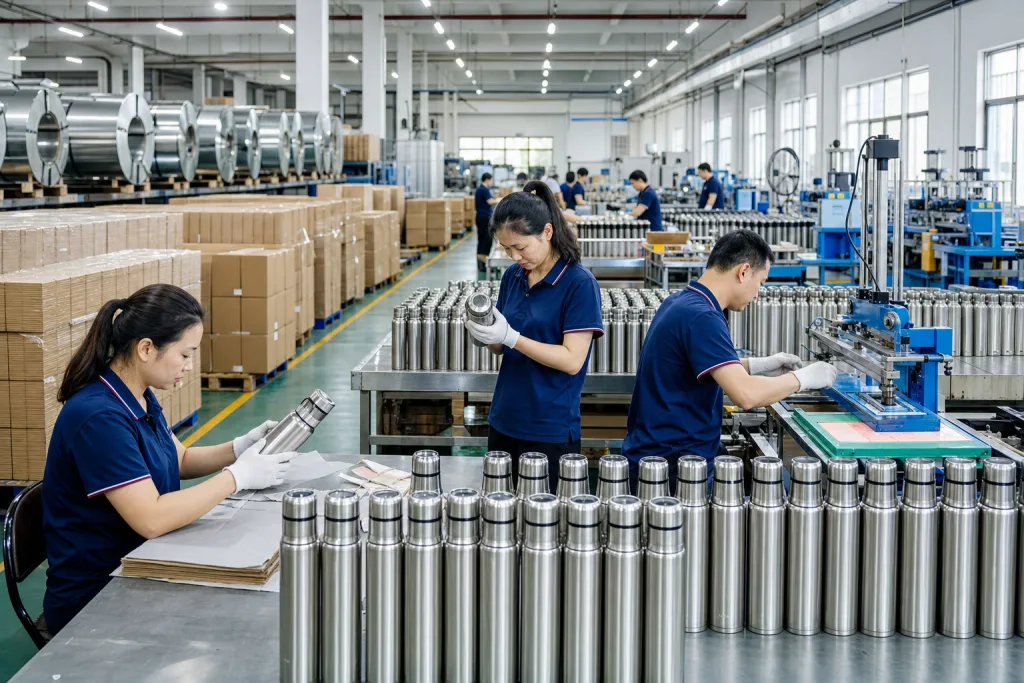
Key Takeaways
- A realistic cheapest promotional vacuum bottle starts around USD 2.10-3.80 FOB China for 350-500 ml standard stainless models
- For most bulk thermos orders, 201 stainless lowers cost while 304 stainless improves food-contact confidence
- Sample approval should check leakage, coating adhesion, logo position, carton drop resistance, and 6-hour heat retention
- A clean PO should list capacity, steel grade, wall thickness, lid material, logo process, packing, AQL, lead time, and Incoterm
The cheapest promotional vacuum bottle is not always the lowest FOB quote in your inbox. For outdoor retailers and promo brands, the real cost usually appears after the PO: 42°C heat retention after 6 hours instead of the promised 55°C, powder coating under 35μm, crushed K=A export cartons, artwork approval sitting for 3 days, or a flip lid that leaks right on the trade show table. Bad samples are cheap. Bad bulk is not.
If you are buying a custom thermos from China for the first time, vague supplier promises need to become clear PO lines: 304 stainless, capacity tolerance, coating spec, logo position in mm, packing method, AQL 2.5 inspection, and the exact approved sample date. Our Zhejiang factory ships roughly 650,000 stainless drinkware units per month, with typical MOQ from 1,000 pieces per color for standard models. That scale helps, but the math does not work if the RFQ says “good quality” and the buyer later flags a 2mm logo shift during pre-shipment QC.
Start with a usable RFQ
A cheap RFQ says “send price for 500 ml thermos.” A usable RFQ tells the thermos manufacturer what you will actually buy. If you want the cheapest promotional vacuum bottle, don’t make the supplier guess. Guessing adds risk money, or the line quietly drops material thickness from 0.5 mm to 0.4 mm. We see this on 7 out of 10 first RFQs.
For a promotional thermos program, send one RFQ table with these fields: capacity, target FOB price, stainless grade, finish, logo method, packing, order quantity, delivery window, destination port, compliance market, and sample deadline. A China thermos supplier can quote within 24-48 hours if those details are clear. Send only a photo and most thermos suppliers will quote their closest mold, not your best commercial option. Last month QC pulled a 500 ml sample that looked right in the photo, but the actual body diameter was 68 mm, which failed the buyer’s cup-holder test.
RFQ line items to include:
- Model: 350 ml, 500 ml, or 750 ml vacuum bottle; state straight-wall for lowest tooling risk, or tapered body if shelf look matters.
- Material: inner 304 stainless steel, outer 201 or 304 stainless steel; request thickness, commonly 0.4-0.5 mm per wall for entry promotional bottles.
- Lid: PP with food-grade silicone gasket; add carry loop or cup lid only if the campaign budget allows the extra USD cost and mold match.
- Finish: powder coating for better grip, spray paint for low price, mirror polish for no paint claim, or brushed steel for scratch hiding.
- Logo: 1-color silkscreen for simple giveaways, laser engraving for a cleaner retail look, heat transfer for gradients, or full-wrap print when artwork covers the bottle.
- Packing: white box, kraft box, color box, or bulk carton; include barcode or FNSKU if needed, and confirm carton drop-test requirement before mass packing.
- Inspection: AQL 2.5 for major defects, 4.0 for minor defects, or your own standard; tell the supplier if leakage, coating adhesion, or logo position is a reject point.
For outdoor retailers, I usually quote two routes: a basic factory thermos with standard mold, then a better customized thermos with 304/304 steel and stronger coating. The first gives you the floor price. The second shows the real cost of better hand feel and fewer coating complaints. Saving USD 0.20-0.40 per unit sounds good on a spreadsheet, but we’ve seen this go sideways when the buyer flagged chipped paint after a 3M tape test on the first pre-shipment sample.
Choose the cost floor honestly
The cost floor starts with material, capacity, lid build, decoration, and packing. We run that math against the line every day. A manufacturer thermos is not expensive because someone “wants margin”; 0.4 mm steel, vacuum yield, coating loss, labor, and carton volume set the number first. On one 350 ml sample run, QC pulled the cup after a 24-hour vacuum hold test and the leak rate was fine, but the lid parts still decided the final cost.
For common thermos bulk orders shipped FOB Ningbo or Shanghai, a 350 ml basic stainless vacuum bottle may quote around USD 2.10-2.70 at 3,000 pieces. A 500 ml promotional model often sits around USD 2.60-3.80 depending on steel grade and lid. A 750 ml outdoor bottle with handle lid, thicker coating, and color box may reach USD 4.50-6.20. These are working ranges, not promises, and they track what we see from Zhejiang and nearby China supply chains when raw material prices stay normal. Last month the buyer flagged a PO typo on “500ml” versus “500 ml”; that single space did not change the cup, but it did force a carton check.
If you ask for the cheapest promotional vacuum bottle, the supplier thermos quote usually cuts cost in one or more of these places:
- 201 stainless steel outer wall instead of full 304 construction.
- Standard mold with no tooling charge.
- Single-color logo instead of full-wrap artwork.
- White box instead of printed color box.
- Standard black, white, silver, or navy coating instead of matched Pantone coating.
- One lid style already stocked by the thermos factory.
This is fine for a 5,000-piece giveaway tied to a 12-day campaign. It is the wrong spec for retail. Retail buyers expect better dent resistance, steadier color, and packaging that survives a 1.2 m drop test in the warehouse. We have seen this go sideways when a cheap lid passed sample stage but failed after the first 200 cartons hit the line. A straight supplier should tell you where the low-cost version works and where it will create claims.
My rule: cut mold, carton, and logo complexity first. Do not cut gasket quality or vacuum performance just to shave a few cents; we rejected a run for a soft gasket at 55 Shore A, and the math did not work.
Lock the sample before artwork
Sampling is where 6 out of 20 promotional bottle projects burn 14 days for no good reason. The team approves a bottle shape, bumps the logo from 45 mm to 60 mm, changes the powder coat, then QC pulls the sample and finds the print running over the shoulder radius. Treat sampling as a locked sequence, not a mood board.
First, ask your thermos manufacturers for stock samples in 2-3 candidate models. We ship these by express courier from China in 5-8 days, often packed in a 38 x 38 x 45 cm sample carton. Do not pay for custom coating at this stage unless the shape, lid, drinking feel, and packing size already pass your buyer's shelf check. For a bulk thermos program, the first sample answers one question: will this model sell to your target user? Anything else is the wrong question to ask.
Second, approve the decoration area. A custom thermos with a straight body may take a 50 x 70 mm silkscreen logo cleanly; our print master checks this with a flexible ruler before film output. A tapered body often needs a smaller mark or laser engraving because the squeegee pressure changes near the curve. Full-wrap print looks good on a sales deck, but the math doesn't work for cheap promo orders unless you accept higher MOQ and tighter artwork control, with 3-5% extra scrap. For the cheapest promotional vacuum bottle, one-color silkscreen or laser engraving is the safer decision.
Sample PO line items:
- 2 pieces for each selected model and capacity combination, with the lid style written by code.
- 1 decorated pre-production sample after artwork approval, pulled from the line before bulk printing.
- Declared sample charge, often USD 50-150 for logo setup, refunded after bulk PO by some suppliers.
- Courier cost by DHL, FedEx, UPS, or your own account number; one typo on the PO can delay pickup by 1 day.
- Required tests: leak test at horizontal position, logo rub test with 3M tape, coating cross-hatch, and heat retention check.
For heat retention, run a practical test: fill with 95°C water, close for 6 hours, then measure with a probe thermometer. A cheap promotional bottle will not match a high-end retail flask, but it must not behave like a single-wall bottle. Reject any sample that leaks after being laid horizontally for 30 minutes; we've seen this go sideways when a buyer skipped that test and found wet cartons during incoming inspection.
Write the bulk PO like engineering
The bulk PO is not just a buying document. It is the work order the line will follow. If your purchase order says “customizable thermos, black, logo as sample,” the factory has to guess. Bad start. A thermos production team needs measurable instructions that the polishing room, coating line, QC table, packing crew, and export desk can all read the same way.
For a 3,000-piece thermos customized order, the PO should spell out the model number, capacity tolerance, stainless grade, agreed wall thickness, lid material, gasket material, coating color, logo file reference, logo position, packing method, barcode rules, carton marks, AQL, lead time, payment terms, and Incoterm. We have seen this go sideways over small gaps: one buyer wrote “500 ml” but approved a 520 ml mold, then their retailer flagged the shelf label at receiving. If selling into Europe, add REACH and LFGB-related expectations where applicable. If selling into the US, add FDA food-contact expectations and any retailer-specific requirements. For kids or youth outdoor lines, discuss ASTM or CPSIA relevance before production, not after shipment, because the math does not work once 125 cartons are already on the water.
Bulk PO line example:
- Item: 500 ml double-wall stainless vacuum bottle, standard mold BF-500S.
- Material: inner 304 stainless steel, outer 201 stainless steel, PP lid, silicone gasket.
- Finish: matte black powder coating, coating adhesion 3B or better by cross-hatch method.
- Logo: 1-color white silkscreen, front center, 45 x 60 mm, AI file dated 2026-06-01.
- Quantity: 3,000 pieces, MOQ 1,000 pieces per color.
- Packing: 1 piece/white box, 24 pieces/export carton, carton drop test from 76 cm.
- QC: AQL 2.5 major, 4.0 minor; 100% leak test during production.
- Lead time: 30-35 days after deposit and artwork approval.
- Price: USD 2.95 FOB Ningbo, excluding destination duties and inland freight.
This is how you turn a supplier thermos offer into something we can build, inspect, and ship without arguing later. QC pulled the sample, checked the 45 x 60 mm screen print with a steel ruler, and packed it against the same PO line. That is the point. It also lets thermos distributors, agents, and import teams compare quotes without hidden assumptions such as thinner outer steel, a cheaper gasket, or 18 days of lead time quietly becoming 30-35 days after artwork approval.
Check quality while production runs
Waiting until final inspection is risky on a cheapest promotional vacuum bottle order. At that point, powder coating, logo printing, lid fitting, and carton packing are already done on the line. If QC pulls a leaking sample then, rework eats 3-5 days and the shipping date gets squeezed. For first orders with new thermos suppliers, ask for production photos and a mid-production check at 20-30% completion, with clear shots of the vacuum test bench, logo jig, and packed cartons.
The main quality risks are predictable. Vacuum failure means poor temperature retention; we run a hot-water test at 95°C and check the drop after 6 hours. Weak silicone gaskets cause leakage. Thin coating chips around the bottom rim, often after the drop test from 80 cm. Logo registration moves by 2-5 mm between batches if the screen frame is not locked properly. Cartons collapse when the paper strength is too low; one buyer flagged this after 11 cartons crushed on a pallet during inland trucking. These are not special problems. They are normal factory control points.
A practical inspection plan for a distributor thermos order should include:
- Incoming material check for stainless grade certificates and lid/gasket material declarations, including supplier lot numbers on the material sheet.
- In-process vacuum performance sampling before coating, because fixing a failed inner bottle after paint is the wrong question to ask.
- 100% leak test after assembly, usually by inversion or pressure method depending on model, with the lid tightened by hand rather than over-tightened by a wrench.
- Logo check against approved sample under normal light, not only factory floor lighting, because a white logo can look fine under LED lamps and yellow near a window.
- Carton measurement, gross weight, and shipping mark confirmation, including PO number spelling; we once saw one digit typed wrong on 86 cartons.
For most promotional thermos orders, a third-party final inspection costs around USD 200-350 per man-day in China. That is small compared with a container of wrong logos. If the order is 1,000 pieces for a local giveaway, photo inspection and retained samples may be enough, plus 2 sealed samples kept in the sample room. If the order is 20,000 pieces for retail distribution, use a formal AQL report and require defect photos by category, not just a pass stamp on page one.
Do not ask the thermos factory for impossible zero defects at bargain pricing. The math does not work. Ask for visible standards: no leaking, no sharp edges, no serious dents, no wrong logo, no dirty inner wall, and no color mix beyond agreed tolerance. We ship smoother when the buyer signs off on these points before mass production, and QC has a 1-page checklist at the packing table.
Plan freight, cartons, and reorder
The lowest unit price can turn into a freight problem fast. Stainless vacuum bottles take up space for the value, especially once the buyer asks for a color box, egg-crate divider, and outer carton. A 500 ml bottle packed 24 pieces per carton may have a carton size near 48 x 32 x 28 cm, depending on design. We measured one 500 ml straight-body model at 47.5 x 31.8 x 28.6 cm on the carton table, and the CBM surprised the buyer more than the bottle price. Air freight for a late promotional campaign can wipe out the margin.
For 1,000-3,000 pieces, buyers usually choose LCL sea freight, or air freight when the event date is already too close. For 10,000 pieces and above, FCL usually makes more sense. Ask your thermos supplier to quote carton dimensions, gross weight, CBM, HS code suggestion, and loading quantity before you approve the PO. A 20-foot container may hold tens of thousands of units depending on bottle size and packaging, but this is the wrong place to guess. Last month a buyer budgeted from the old carton size, then QC pulled the packed sample and found the new gift box added 3 mm on each side. The math did not work.
If you are a thermos distributor selling repeat campaigns, set the reorder rules before the first shipment leaves Zhejiang. Keep the same model, lid, coating code, and logo position in your item master. Store the approved artwork, Pantone reference, barcode, carton mark, and inspection report in one folder, not across 6 email threads. We have seen this go sideways when a repeat PO says “same as last time” but the last file has a typo in the carton mark. The second PO should not restart from zero.
Reorder PO line items to save time:
- Repeat the previous approved sample dated and sealed by both sides, with one retained sample in the factory sample room.
- Confirm whether raw material price adjustment applies after 30 days, especially for 304 stainless sheet and PP lid parts.
- Keep the same carton pack unless the warehouse changed pallet height, carton weight limit, or barcode rules.
- Request production lead time, usually 25-30 days for repeat standard orders, and ask whether the line already has the same coating color scheduled.
- Confirm seasonal capacity pressure before Chinese New Year or Q4 export peaks, because polishing and powder coating slots get booked first.
China can produce a competitive manufacturers thermos program, but the buyer still controls the brief. If you want the cheapest promotional vacuum bottle that does not embarrass your brand, buy a standard mold, approve one decoration method, write the PO tightly, and inspect against the same sample you signed. Simple works. We ship cleaner orders when the carton mark, barcode, and AQL 2.5 checklist match before production starts.
Send your thermos RFQ and target price
We will review capacity, logo, packing, MOQ, and FOB options, then suggest a practical spec for your promotional or outdoor retail order.
Frequently asked questions
What is the MOQ for the cheapest promotional vacuum bottle?
For standard stainless vacuum bottle molds, a practical MOQ is usually 1,000 pieces per color and 3,000 pieces per order for better FOB pricing. Some stock-color models can start at 500 pieces, but logo setup, carton handling, and export paperwork make very small orders less efficient. If you need Pantone coating, full-wrap printing, or a special lid color, expect MOQ to rise to 3,000-5,000 pieces. At our Zhejiang factory, standard custom thermos lead time is typically 30-35 days after deposit and artwork approval.
Is 201 stainless steel acceptable for a promotional thermos?
Yes, if the use case is short-term promotional distribution and the inner wall is food-contact safe 304 stainless steel. A common cost-saving structure is 304 inner wall with 201 outer wall. It can reduce cost by roughly USD 0.10-0.35 per unit depending on size and market steel prices. For outdoor retail, premium gift sets, or long warranty programs, I would push you toward 304 inner and 304 outer construction. The PO should clearly state the steel grade, not just say “stainless steel,” because different thermos manufacturers may interpret that differently.
Which logo method is cheapest for thermos custom orders?
One-color silkscreen is usually the cheapest logo method for a simple promotional thermos, especially on powder-coated bottles with flat or gently curved bodies. Laser engraving costs a little more in some cases but gives a durable, clean result and avoids ink adhesion problems. Heat transfer and full-wrap printing are better for complex designs but need higher setup control and usually larger MOQ. For a 3,000-piece thermos customizable order, you should quote silkscreen and laser side by side. The cheapest method is not useful if the logo scratches off during handling.
How do I compare quotes from different thermos suppliers?
Put every thermos vendor into the same quote sheet. Compare capacity, steel grade, net weight, lid type, coating, logo process, packing, MOQ, lead time, Incoterm, and AQL terms. A USD 2.70 quote may not beat a USD 2.95 quote if it uses thinner walls, no individual box, weaker lid material, or excludes logo setup. Ask for carton size and CBM too, because freight can change landed cost by 5-20%. For distributors thermos programs, request a signed specification sheet before deposit so purchasing and QC are aligned.
Can I sell a cheap bulk thermos in Europe or North America?
Yes, but cheap cannot mean undocumented. For Europe, ask your thermos supplier for food-contact material declarations and discuss LFGB or REACH expectations based on your market and retailer. For North America, FDA food-contact expectations and retailer-specific testing may apply. If the bottle is for children, requirements become stricter and you should review CPSIA or ASTM relevance. Testing can cost a few hundred to over USD 1,000 depending on scope. Build that into the campaign budget instead of trying to fix compliance after the bulk thermos order arrives.