Key Takeaways
- A realistic cheapest promotional thermos starts around USD 3.10-4.80 FOB China at 3,000-5,000 pcs
- 304 stainless steel inner walls and 201 outer walls can cut cost without touching drink-contact safety
- Logo method can change unit cost by USD 0.08-0.45 depending on silkscreen, laser, or full-wrap print
- Use AQL 2.5/4.0 inspection and approve 2-3 pre-production samples before bulk thermos production
The cheapest promotional thermos is rarely the lowest number on the first quote sheet. A USD 3.20 bottle can turn into USD 4.10 after logo film, carton upgrades, rejected pad printing, and late air freight. We saw this last May on a 5,000 pcs outdoor promo order: QC pulled 32 printed samples, the buyer flagged a 1.5 mm logo shift, and the rework killed 6 days. If you sell outdoor gear or run promo programs, your real job is simple: buy a thermos that looks acceptable, passes basic compliance, and arrives before the campaign date.
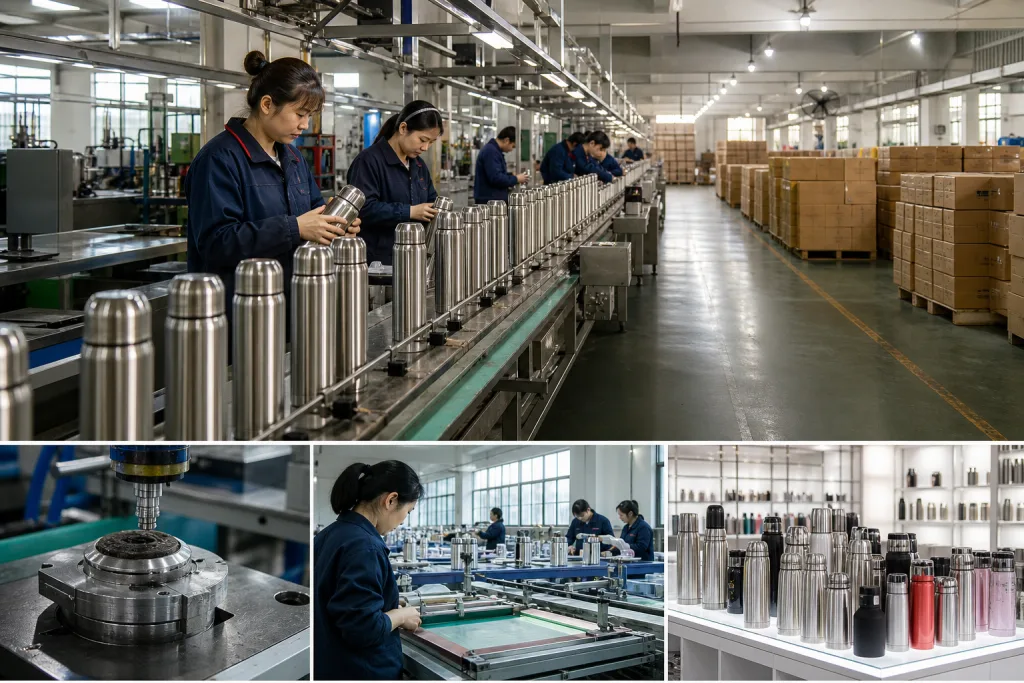
From our Zhejiang factory floor, the safest low-cost route is a controlled sourcing process: clear RFQ with ml capacity and 304 stainless noted, paid sample, locked PO, inline checks, then bulk shipment. Simple, not casual. China has plenty of thermos suppliers, but cheap pricing only works when you define vacuum hold time, carton drop test, packing method, and defect limits before the deposit moves. We run this on the line with calipers, a vacuum tester, and AQL 2.5 tables; without that, the math doesn't work.
Start with a brutal RFQ
A cheap custom thermos quote only means something when every supplier thermos factory prices the same bottle. Do not send, “500 ml bottle, logo, best price.” We see this RFQ every week. You will get 12 prices for 12 builds: thinner outer wall, no vacuum test, cheaper lid resin, loose color tolerance, or a white box missing from the cost sheet.
Put the commercial target on the first line: promotional thermos for outdoor retailers, cost target USD 3.50-4.20 FOB Ningbo or Shanghai, estimated order 5,000 pcs, repeat possibility 20,000 pcs per year. Zhejiang factories like ours can run around 450,000 stainless drinkware units per month, but the low-cost line still needs slotting 25-35 days before ship date. Last April, one buyer pushed for 18 days; the math didn’t work because the vacuum oven and powder coating booth were already booked.
For the product, specify capacity, body shape, steel grade, lid type, insulation target, and packaging with no blanks. A normal cheapest promotional thermos build is 500 ml, double-wall vacuum, 304 stainless steel inner, 201 stainless steel outer, PP lid, silicone seal, powder coating or spray paint, individual white box. If you need food-contact documents for Europe or North America, state REACH, LFGB, FDA, or California Prop 65 based on the sales channel. QC pulled a sample last month where the PO said “SS304” but the approved spec was 304 inner / 201 outer; that one typo changed the quote by USD 0.18.
RFQ line items to request:
- FOB unit price at 1,000, 3,000, 5,000, and 10,000 pcs, with the same lid, coating, and box
- MOQ for blank stock, one-color logo, and custom color matched by Pantone code
- Tooling, mold, logo screen, and sample charges, including refund rules after bulk order
- Production lead time after deposit and artwork approval, stated as calendar days, not “soon”
- Carton size, gross weight, and units per master carton, because freight can kill a cheap quote
- Available audit documents such as BSCI, ISO 9001, or Sedex, with expiry dates
This is where you separate a real thermos manufacturer from a trading desk guessing from a spreadsheet. A thermos vendor that answers all line items in one pass is usually easier to manage than one offering only “cheap price friend.” We’ve seen this go sideways: the buyer flagged carton weight at final inspection, and the supplier admitted they never calculated the 12 kg master carton limit.
Strip cost without breaking function
The cheapest promotional thermos should still survive the first trail weekend without the body looking like scrap. Cut cost on purpose. On the factory side, we price the steel grade first, then the inner and outer wall thickness, lid parts, surface finish, logo process, and packing spec. A 500 ml stainless thermos with 0.35-0.40 mm inner wall and 0.45-0.50 mm outer wall is common for promotional use. Go thinner and you might save USD 0.10-0.18, but QC pulled samples at 0.32 mm last year and the dent rate failed our drop check from 80 cm.
For 7 out of 10 promo orders we quote, 304 inner plus 201 outer is the sensible compromise. The drink-contact surface stays 304 stainless steel, while the outer shell uses lower-cost material. If your outdoor retailer customer demands full 304 stainless steel, expect a price increase of roughly USD 0.20-0.45 per unit depending on weight and finish. “Food grade stainless” is too loose. Ask for material test reports by part: inner wall, outer wall, lid plastic, gasket. We had one buyer flag this after their PO only said “SS bottle,” and the lab report could not match the gasket material to the final sample.
Logo method changes the landed cost faster than buyers expect. One-color silkscreen on a straight body is usually the cheapest, often USD 0.08-0.15 per unit after a USD 30-60 screen charge. Laser engraving looks cleaner and resists abrasion, but adds USD 0.15-0.30. Full-wrap heat transfer or 360-degree UV print can add USD 0.35-0.80, so the math doesn't work for the cheapest promotional thermos unless the design needs retail shelf impact. On the line, a curved body plus big logo also means more rejects; our operator checks alignment with a 1 mm guide mark before curing.
Practical PO options: choose existing mold, existing lid, standard capacity, one-color logo, and white box. Better: use our current 500 ml mold, PP flip lid already in stock, 1C black logo, and 350 gsm white tuck box. Use custom color only above 3,000 pcs because paint line setup and color matching waste are real costs. If you need a customizable thermos program with 4 outdoor club logos, keep bottle color the same and split the imprint by design; we run the same powder coat batch, then change only the screen.
Check the supplier math
When quotes arrive, build a comparison table before you chase the lowest unit price. A manufacturer thermos quote at USD 3.55 can beat a supplier thermos quote at USD 3.30 if the cheap line leaves out logo setup, sample freight, 5-layer export cartons, or time for SGS inspection. We see this every March before Canton Fair. For thermos bulk orders, the buying cost is landed cost plus the cost of fixing trouble after QC pulled the sample.
Ask each thermos factory to write whether pricing is FOB, EXW, CIF, or DDP. For first-time bulk thermos projects, FOB Ningbo or Shanghai is cleaner because your forwarder controls freight and documents. In Zhejiang and broader China, roughly 7 out of 10 trading suppliers we meet can quote DDP to Amazon or a distributor warehouse, but promotional buyers should still pin down the base FOB cost before accepting a door-to-door number. One buyer flagged a DDP quote last year because the PO said “Los Angels warehouse” and the supplier had priced Long Beach only. Small typo. Big bill.
MOQ is another trap. A factory thermos MOQ might be 1,000 pcs for stock color with silkscreen, 3,000 pcs for custom Pantone, and 5,000 pcs for modified lid color. If a thermos supplier says MOQ 500 pcs with custom powder coating at a low price, confirm whether they are using leftover paint, hand spraying, or combining your run with another order. That can work. The color still drifts if the line switches from black matte to Pantone 186C on the same spraying booth without a full cleanout.
Quote comparison PO fields:
- Item number and exact capacity, such as 500 ml / 17 oz, matched to the carton mark
- Steel grade and net product weight, for example 245 g ± 8 g, checked on a 0.1 g bench scale
- Logo process, print size, and number of positions, with artwork in mm instead of “same as sample”
- Unit price by quantity tier and currency, including 1,000 pcs and 3,000 pcs if both are possible
- Payment term, normally 30% deposit and 70% before shipment, tied to inspection release
- Inspection standard, usually AQL 2.5 major and 4.0 minor, written before the cartons reach the warehouse
A good thermos manufacturers quote does not hide behind “same as sample.” It states the measurable version of the sample. If the math depends on guessing wall thickness, carton strength, or logo area, the math doesn't work.
Buy the right sample
Do not skip samples to save USD 80. That math does not work. For a new customized thermos, we ask for at least two rounds: one stock reference pulled from the warehouse rack, then one pre-production sample with your logo, body color, and gift box. If the schedule allows, approve three pieces: one for your office, one for the distributor thermos customer, and one sealed at the factory as the production control sample with a QC signature sticker.
Stock samples from China usually take 3-5 days to prepare and 4-7 days by courier to Europe or North America. Expect USD 30-80 per sample plus freight. Custom logo samples usually need 7-12 days after artwork approval, not “next day” unless the logo is a simple 1-color print already set up on the pad-printing plate. If a supplier thermos vendor refuses a logo sample and says “bulk will be fine,” be careful. We have seen this go sideways: rough edges, wrong Pantone, logo sitting 4 mm too close to the curve, weak adhesion on matte coating after the 3M tape test.
Run simple checks when the sample arrives. Weigh it on a kitchen scale and compare with the quote. Fill with 95°C water, close the lid, and measure temperature after 6 hours. A cheap promotional unit does not need premium 24-hour performance, but if it drops from 95°C to below 55°C in 6 hours, the vacuum is suspect. Check lid leakage by inverting for 10 minutes, then shaking over A4 paper. No excuses here. QC pulled a 500 ml sample last month where the silicone ring looked fine, but the paper showed two wet spots after 6 minutes.
Sample approval PO line items: sample fee, courier cost, logo artwork file name, Pantone color, approved insulation target, packing photo, and deadline for pre-production sample approval. Add the exact carton mark if your buyer needs it; one PO typo like “sliver” instead of “silver” can waste 12 days on revised artwork and re-approval. This is where a customizable thermos becomes a controlled product, not a hope.
Lock the bulk purchase order
After the sample is approved, the bulk PO has one job: kill guesswork. A promotional brand sometimes assumes the factory will copy every detail from the sample. The factory team may read “cheapest promotional thermos” and swap a 0.4 mm liner for 0.38 mm, or change the lid gasket supplier, unless the PO blocks it. Put the approved details into the PO and attach artwork, sample photos, carton marks, and inspection checklist. We run this check at the merchandiser’s desk before deposit booking; one buyer once sent a PO with “matt black” while the signed sample was glossy black, and QC pulled the sample before the line opened.
For a typical 5,000 pcs thermos promotional order, a practical timeline is 2 days for deposit confirmation, 3-5 days for material and accessory preparation, 7-10 days for body forming and welding, 3-5 days for vacuuming and testing, 4-6 days for coating and printing, then 3-5 days for packing and final inspection. Total lead time is normally 25-35 days after deposit and sample approval. Rush orders are possible. The math gets ugly if you cut vacuum testing from 3 days to 1 day; we’ve seen this go sideways with 18 leaking pcs pulled from a 200 pcs inline check. Do not rush coating cure or vacuum test to save a week.
Your PO should state acceptable tolerances. For example: capacity 500 ml ± 5%, product weight 245 g ± 8 g, logo position tolerance ± 2 mm, color tolerance close to approved sample under D65 light, carton drop test from 60 cm if the goods will move through distributor warehouses. If your outdoor retailer needs barcode labels or FNSKU labels, state the label size, placement, scan grade, and whether the label goes on the gift box or master carton. Small labels cause big arguments; the buyer flagged one 38 mm × 25 mm FNSKU because our worker placed it 12 mm off the lower-right corner on the white box.
Bulk PO line items:
- Product: stainless vacuum thermos, item code, capacity, approved sample date, and signed sample photo from the sample room
- Quantity: 5,000 pcs, over/under shipment tolerance 0% unless agreed
- Price: USD 3.78 FOB Ningbo including one-color logo and white box
- Payment: 30% deposit, 70% after passed inspection before shipment
- Quality: AQL 2.5 major / 4.0 minor, critical defects not accepted, with vacuum failure and logo peeling listed as major defects
- Documents: commercial invoice, packing list, test reports, bill of lading, with carton marks matching the buyer’s shipping instruction
This detail is not paperwork for paperwork’s sake. It protects both you and the thermos manufacturer when the line is full and the buyer asks why the carton mark says “THERMO CUP” instead of the PO wording “VACUUM THERMOS.”
Inspect before cartons leave
The cheapest thermos distributors buy successfully get checked before cartons leave China. Once cartons land in your warehouse, every defect costs more: sorting labor, repacking tape, replacement lids, customer chargebacks. A third-party inspection in Zhejiang, Guangdong, or elsewhere in China often costs USD 180-300 per man-day. On a 5,000 pcs order, that is about USD 0.04-0.06 per unit. Skipping it is false economy. We had one buyer refuse this on a 350 ml promo flask order; QC later found 3.8% lid seepage after the cartons were already strapped on pallets.
Use an inspection plan that matches the product risk. Critical defects include sharp edges, leaking lid, failed vacuum, rust on inner wall, wrong material, broken cap, strong odor, and unsafe packaging staples. Major defects include bad logo placement, visible dents, serious paint scratches, wrong color, missing instruction sheet, or unscannable barcode. Minor defects include small dust marks, slight carton printing variation, or tiny coating specks outside the logo area. Ask the inspector to use calipers on mouth diameter, a barcode scanner on the retail label, and a white cloth rub test on printed logos; “looks okay” is not a finding.
For insulation, inspectors cannot test every piece for 6 hours, but they can sample a practical number. A factory thermos line should already run 100% vacuum testing during production, often by heat detection or temperature decay. Ask for the factory record and let the inspector verify a sample set. We run the hot-water spot check at 95°C, then compare shell temperature after filling; one bad batch usually shows itself fast. For appearance, use approved golden samples and clear photos. Words like “good quality” are useless during a dispute.
Pre-shipment inspection PO clause: shipment can be released only after buyer-approved inspection report, with rework at supplier cost for failed critical or major defects. If re-inspection is required because of factory-caused failure, the thermos suppliers side should pay. That clause motivates the production team to check properly before the inspector arrives. Put it on the PO, not only in an email thread; we have seen this go sideways when a buyer’s PO had the delivery date wrong by one digit and no inspection hold line.
Low-cost does not mean unmanaged. It means every paid feature is necessary, visible, and checked. The line respects what the buyer measures.
Send your thermos RFQ for factory pricing
Share capacity, quantity, logo method, target price, and delivery country. We will return a practical FOB quote and sample plan.
Frequently asked questions
What is the realistic MOQ for the cheapest promotional thermos?
For a stainless promotional thermos, realistic MOQ is 1,000 pcs for stock color with a simple one-color logo, 3,000 pcs for custom Pantone coating, and 5,000 pcs if you want better FOB pricing and stable paint-line setup. Below 1,000 pcs, many China thermos suppliers will still quote, but the unit price often jumps by USD 0.40-1.20 because logo setup, packing labor, and line changeover are spread across fewer units. If your campaign needs only 500 pcs, choose an existing color, silkscreen logo, and standard white box.
How cheap can a custom thermos be without becoming risky?
For outdoor promotional use, a safer low-end target is usually USD 3.10-4.80 FOB China for 500 ml at 3,000-5,000 pcs, depending on steel weight, lid, finish, and logo. You may see quotes below USD 3.00, but check whether the inner wall is true 304 stainless steel, whether vacuum testing is included, and whether the lid gasket is food-contact silicone. A very thin body may pass a showroom check but dent badly in distributor handling. Saving USD 0.20 is not worth a 5% complaint rate.
Which logo method is best for a cheap customized thermos?
One-color silkscreen is usually the best low-cost logo method, especially on straight-sided bottles. Expect about USD 0.08-0.15 per unit plus a screen charge around USD 30-60. Laser engraving is more durable and gives a cleaner retail feel, but it often adds USD 0.15-0.30 per unit. Full-wrap UV or heat transfer can look impressive, yet it is rarely the cheapest option. For promotional brands managing many distributor thermos orders, keep the bottle color fixed and change only the screen print artwork.
What quality tests should I require before bulk shipment?
Use AQL inspection, commonly 2.5 for major defects and 4.0 for minor defects, with zero tolerance for critical safety issues. The checklist should include leakage, sharp edges, coating scratches, logo position, carton strength, barcode scanning, odor, rust, and lid fit. For insulation, ask the thermos factory for 100% vacuum test records and have the inspector test sample units with hot water. A practical test is checking temperature drop over 4-6 hours. Also confirm material reports for 304 stainless inner wall, PP lid, and silicone gasket.
Should I buy from a factory thermos maker or a trading supplier?
If the project is repeatable, buy from a thermos manufacturer or a supplier with direct factory control. You will get clearer answers on steel thickness, vacuum testing, painting capacity, and rework timing. A trading thermos vendor can be useful for very small mixed orders, but for 3,000-10,000 pcs of one customized thermos, factory communication saves time. Ask for production photos, audit documents, monthly capacity, and a named QC contact. The best choice is not always the lowest quote; it is the lowest controlled landed cost.