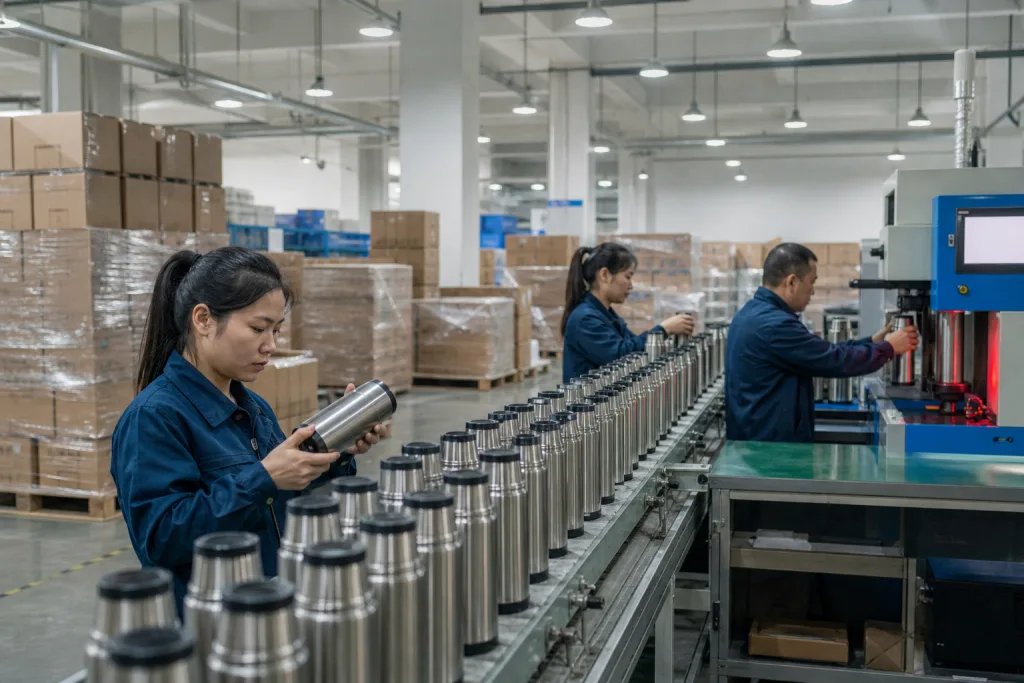
Key Takeaways
- A workable cheapest promotional thermal bottle usually lands at USD 2.20-3.80 FOB Ningbo for 500 ml bulk orders
- 304 inner steel is worth keeping even when you reduce outer shell, lid, or coating costs
- MOQ is normally 3,000 pieces per color for standard models and 5,000-10,000 pieces for private mold changes
- AQL 2.5/4.0 inspection and 12-24 hour vacuum testing prevent cheap bottles from becoming expensive claims
The cheapest promotional thermal bottle is not always the lowest FOB quote. We’ve watched buyers cut USD 0.30 per unit by thinning the steel, then lose USD 1.20 per unit after QC pulled dented samples, weak vacuum bottles, and logos with ink rub-off after 3M tape testing. Bad math. For B2B custom drinkware, the cheap bottle still has to survive a 12 kg export carton, a fixed campaign date, and your customer’s first hot-water test.
At our Zhejiang factory, the same question lands on my desk almost every week: which spec is cheap enough but still safe to put your name on? The wrong question is “what is your lowest price?” A better one is “which cost cuts will not come back as claims?” Below is a head-to-head buyer guide based on choices we run on the line: 201 vs 304 stainless steel, 350 ml vs 500 ml with real carton CBM impact, powder coating vs silkscreen after logo adhesion checks, plus carton packing that can take export handling from China without crushed corners.
The real cheap bottle comparison
Buyers asking for the cheapest promotional thermal bottle often compare finished bottles from a catalog photo. Bad habit. Two bottles can look the same on a PDF, but one runs 0.30 mm outer steel, a light PP lid, and basic spray paint; the other runs 0.40 mm steel, a tighter sealing ring, and powder coating. The price gap may be only USD 0.45, but QC sees the difference after the first carton drop test from 80 cm.
For a normal 500 ml double-wall vacuum bottle from a canteen factory in Zhejiang, realistic FOB Ningbo pricing is roughly:
- Entry promotional spec: USD 2.20-2.80, 201 outer / 304 inner, basic lid, one-color silkscreen, white box.
- Balanced distributor spec: USD 2.90-3.80, 304 inner, thicker outer shell, better coating, laser logo or cleaner screen print with tighter artwork control.
- Retail-ready spec: USD 4.20-6.50, custom lid, gift box, higher AQL, stronger insulation target, more finishing steps on the line.
The entry spec is not automatically bad. We ship it for event giveaways, membership campaigns, and travel bundle programs where the target retail value is low and the buyer only needs 3,000-10,000 pcs to pass a short promotion window. The problem starts when a buyer expects a USD 2.40 item to behave like a premium retail bottle. The math doesn't work, and we have seen this go sideways when the PO says “premium vacuum flask” but the approved sample was the cheapest shell.
A canteen supplier should give you a spec table, not just a beauty photo. Ask for steel grade, wall thickness range, capacity tolerance, lid material, coating type, logo method, carton drop-test condition, and vacuum test duration. If a canteen vendor cannot provide those details, the quote is not comparable; last month QC pulled the sample and found the quoted lid was PP while the buyer’s test request needed a stronger sealing structure.
Spec table: where money disappears
Use this table when you compare canteen makers in China. It is not a perfect fit for every shape, but on our line it shows where the quote rises or drops. QC pulled a 12-piece sample last week, and the cost gap was easy to see.
| Spec choice | Cheapest fit | Better fit | Buyer risk |
|---|---|---|---|
| Inner wall | 304 stainless, 0.30-0.35 mm | 304 stainless, 0.38-0.45 mm | Do not cut the inner contact steel on drinkware that holds water, tea, or juice. We reject that move at QC. |
| Outer wall | 201 stainless, 0.30-0.35 mm | 304 stainless or thicker 201 | Thin outer shells dent more in courier bags and on pallet corners. The buyer sees that before the bottle is even opened. |
| Capacity | 350 ml or 500 ml | 600 ml to 750 ml | A bigger bottle adds steel weight and carton cube, so the freight bill climbs too, not just the material line. |
| Finish | Spray paint or matte powder | Durable powder coating | Cheap paint scratches fast, and dark colors show the marks first. We see that on the packing bench in the first box check. |
| Logo | One-color silkscreen | Laser engraving or multi-color print | Low-cost printing needs artwork set for curved walls and coating texture. A small font can blur on the sample cup. |
| Packing | Egg-crate carton, white box | Color box, kraft box, mailer | Gift packaging often adds USD 0.20-0.80 before freight. |
The lean build we ship most often is 304 stainless steel inside, 201 stainless steel outside, a standard screw lid, one logo position, and a plain white box. That keeps the bottle cheap without touching the drink-contact side. On a 5,000-piece order, the lid change alone moved the quote by USD 0.12 each.
If you buy for schools, gyms, or corporate accounts, this spec is easy to put in front of a buyer. If you are building a retail custom growler or customized growler line, start higher than the lowest promo build. We ran a 1 m drop test on one sample, and the cap problem showed up fast. A growler needs more body weight to resist dents, tighter leak testing at the cap seam, and a cap system that stays tight after handling.
Use-case fit before unit price
Pick a cheap thermal bottle by use case, not by wishful thinking. Procurement teams often send one RFQ to five canteen suppliers and award the lowest line; we see this go sideways when the buyer compares a 0.35 mm inner wall sample against a 0.42 mm production-ready bottle. That method is fine for simple plastic items. It is the wrong question to ask for vacuum drinkware.
Event giveaway
For a conference, bank promotion, insurance campaign, or trade show, a 350 ml or 500 ml cheapest promotional thermal bottle is usually enough. We run one body color, one logo position, and bulk cartons or white boxes; a normal packing spec is 50 pieces per master carton, around 12-14 kg gross weight. MOQ can be 3,000 pieces per color, with 25-35 days production after sample approval. What matters is logo clarity, no leaking after the line does the inverted water test, and insulation that still feels acceptable after 4-6 hours.
Distributor catalog item
A distributor canteen needs fewer complaints across repeat small orders. Choose a model the canteen manufacturer keeps as a stable mold for at least 12 months, because one cap thread change of 0.3 mm can make old replacement lids useless. Keep two safe colors, such as black and stainless, or add navy if the catalog has enough volume. A canteen customized with laser engraving usually gives cleaner repeat orders than low-cost multicolor printing; QC pulled one sample last month where the printed logo shifted 2 mm after the tape test, and the buyer flagged it fast.
Retail or online bundle
If you are doing customized drinkware for retail, do not chase the bottom spec. You need better coating, cleaner welding, stronger caps, barcode labels, carton marks, and maybe FNSKU labels if the goods go to fulfillment centers. The bottle may cost USD 0.70-1.50 more, but return rates beat the first FOB quote; the math does not work when 3% of customers complain about cap leakage. For Amazon-style cartons, we ship with scannable labels facing out and check them with a handheld scanner before sealing.
The same thinking applies to a customizable growler or distributor growler. A 1,000 ml or 1,900 ml vacuum growler uses much more steel, takes more carton space, and gets tougher leak checks because a full unit is heavy on the cap seal. Treat it as a different product, not a larger promotional bottle; our line sets a separate torque check for these caps, usually 8-10 kgf·cm before packing.
Decoration choices that stay cheap
Logo method is where buyers blow up a cheap bottle cost. We see it every week. A standard one-color silkscreen logo on a straight body can stay low cost, often USD 0.05-0.15 per unit depending on logo size and ink coverage. If the artwork moves onto a curved shoulder or orange-peel powder coating, the print master will ask for pad printing, laser engraving, or a smaller imprint window after the first film check.
For the cheapest promotional thermal bottle, keep the design simple. Use one logo position, one ink color, under 60 mm wide, with no fine lines below 0.3 mm. That 0.3 mm line matters; QC pulled a sample last month where the buyer’s tiny slogan filled in after 200 prints. Avoid wrap artwork unless the order size pays for the jig and the slower line speed. Wrap prints need tighter bottle positioning and more rejection allowance, and the math does not work on small promo runs.
Laser engraving costs more than basic screen printing per piece, but it can be cheaper over repeat canteen distributor orders. No PMS ink matching. No peeling complaint after dishwashing. On powder-coated bottles, laser removes the coating and leaves a stainless or silver mark, so the result looks more permanent. The buyer flagged this once on a black bottle because they expected white engraving; we now confirm the laser mark color on the approval sheet before bulk production.
For a canteen customizable program with 20 or 30 customer logos, we usually recommend fixing the bottle model and body colors, then changing only the logo file. The line runs cleaner that way. The factory can hold shared lids, bodies, inserts, and cartons, which cuts changeover loss at printing and packing. In our Zhejiang production line, standard stainless thermos models can run about 450,000 units per month across bottle sizes, but small scattered logo orders still slow packing and inspection when every carton needs a different PO sticker.
Cheap customization is not about doing everything. It is about controlling variables: same body, same lid, same carton, different logo.
Quality checks you should not remove
Some cost cuts are acceptable. Cutting inspection is not. Thermal bottles fail in repeatable places: vacuum loss, lid leaking, coating scratches, dirty inner wall, poor welding, wrong logo position, or carton damage. We see these on the line with a torque tester, a 0.5 mm feeler gauge, and a plain white cloth inside the bottle mouth. A canteen supplier with real QC catches them before packing.
For promotional custom drinkware, use AQL Level II with critical 0, major 2.5, minor 4.0 as a normal baseline. Critical defects include unsafe contamination, sharp edges, broken glass if applicable, or serious leakage. Major defects include vacuum failure, wrong logo, deep dents, or lids that do not close correctly. Minor defects include small surface marks within the agreed limit, for example one 3 mm scratch outside the main logo area if the signed sample allows it. QC pulled the sample last month because the PO said “mat black” instead of “matte black”; small typo, big argument.
Vacuum testing matters. Do not remove it. A basic factory process should include hot water testing or temperature retention checks, often 12-24 hours depending on the model. Not every unit will receive a full 24-hour lab-style test, but the factory should have inline vacuum detection and sampled retention testing. Ask how many pieces are tested per batch and what temperature drop is accepted; for a 3,000 pcs order, we normally expect a written sampling count, test start temperature, room temperature, and final reading after 12 hours. If the answer is “we just know,” the math does not work.
For Europe, ask about LFGB or EU food-contact compliance where needed, plus REACH for coatings if your importer requires it. For North America, FDA food-contact expectations and Prop 65 screening may be relevant depending on market. For kids items, ASTM or CPSIA rules can apply, especially if the cap has paint, small parts, or silicone accessories. The buyer flagged this on a 500 ml kids bottle because the silicone straw was approved, but the painted cap was not covered in the report.
A cheap canteen vendor that cannot discuss these requirements is not cheap; it is just transferring risk to you. We have seen this go sideways: 48 cartons looked fine outside, then the first retail carton had lid seepage after a simple upside-down test.
MOQ, lead time, and freight math
MOQ is where buyers and canteen vendors often talk past each other. We run 3,000 pcs per color on an existing mold because the coating line, silk-screen setup, and export carton work all need to be spread across enough units. A factory may quote 1,000 pcs, but the unit price jumps fast once setup is carried by too few bottles. For a cheapest promotional thermal bottle, 3,000 pcs is the number that makes sense. Below that, the math does not work.
For a standard canteen customized order from China, a practical schedule is:
- Sample with logo: 5-10 days after artwork confirmation. QC pulls one sample off the line, prints the logo, and checks the ink edge before we ship it by courier.
- Bulk production: 25-35 days after sample approval and deposit. A 3,000 pcs order usually runs one molding slot, one coating batch, and one packing shift.
- Inspection and booking: 3-7 days depending on forwarder and carton volume. If the buyer flags a carton typo or barcode mismatch, we stop the booking until the pack list is fixed.
- Sea freight: about 25-40 days to Europe or North America ports, depending on route. A 20GP and a 40HQ do not price the same when carton size changes the loading plan.
Air freight can save a campaign deadline, but it breaks the cost model. A 500 ml vacuum bottle may weigh 230-320 g before packing, and the cartons are bulky. We have seen a 3,000 pcs air shipment cost more than the bottles themselves. If the launch date is fixed, lock artwork early and approve the pre-production sample within 48 hours. One typo on the PO can burn a full day at the line.
FOB Ningbo or FOB Shanghai is common for Zhejiang drinkware factories. EXW looks lower on paper, but then you handle inland trucking, customs documents, and export booking from the plant gate. For a first order, FOB is the cleaner move. If you compare canteen manufacturers, keep the same Incoterm, carton quantity, packing method, and logo process on every quote. Otherwise the numbers do not match.
Payment is commonly 30 percent deposit and 70 percent before shipment for custom drinkware. On a 3,000 pcs order, we do not release the truck until the balance lands. If you ask for credit terms, expect the canteen manufacturer to price that risk into the order.
How to brief the factory
A clear RFQ usually saves USD 0.12 to 0.35 per bottle, which beats arguing after the quote is messy. Send the same brief to each canteen supplier so you compare one product, not 6 different guesses from 6 salespeople. Include capacity, target FOB price, destination market, order quantity, body color, logo file, logo size, packaging, compliance needs, and delivery deadline. We run quotes from a cost sheet, not from a mood board.
Use a brief like this: “500 ml double-wall vacuum bottle, 304 inner, 201 outer acceptable, matte black, one-color white logo 50 mm wide, white box, 5,000 pieces, FOB Ningbo, EU market, AQL inspection required, delivery ready in 35 days.” That gives the canteen factory enough information to quote properly. Last month QC pulled a 500 ml sample from the line and found the buyer’s PO said 50 mm logo, but the artwork file was 65 mm wide. That small typo changed the print fixture and cost us one extra day.
Tell the supplier where the bottle will be sold or used. A canteen promotional order for a bank giveaway is not the same as a customized canteen sold in outdoor retail, and treating them the same is the wrong question to ask. A distributor drinkware program may need neutral cartons and repeatable stock colors, while a canteen distributor may need mixed logos in one container. A customizable drinkware brand may need lifestyle packaging and tighter color matching, such as Delta E under 1.5 on the powder coating panel.
If you are sourcing from China for the first time, ask for photos of current production, a 20-second factory video, BSCI or ISO 9001 documents if available, and a signed golden sample before mass production. Do not approve from a render only. A real sample shows weight, cap feel, coating texture, print sharpness, and whether the bottle looks cheap in the bad way or cheap in the smart way. We have seen this go sideways when a buyer approved a glossy render, then flagged the actual matte coating after 10,000 pieces were packed in white boxes.
Send us your cheapest thermal bottle brief
Share quantity, logo, market, and deadline. We will quote a practical Zhejiang factory spec, not a risky race-to-the-bottom bottle.
Frequently asked questions
What is the lowest realistic price for a promotional thermal bottle?
For a standard 500 ml double-wall stainless thermal bottle from China, the lowest realistic FOB Ningbo range is usually USD 2.20-2.80 at 3,000-5,000 pieces. That assumes 304 stainless inner wall, 201 stainless outer wall, standard screw lid, one-color logo, and white box packing. Quotes below USD 2.00 may be possible for smaller capacity, thinner steel, very basic lids, or huge orders, but you should check vacuum performance and dent rate carefully. Always compare weight, steel grade, logo method, and carton packing before accepting the cheapest line.
Should I choose 201 or 304 stainless steel for the cheapest bottle?
Keep 304 stainless steel for the inner wall because it touches the drink and is expected in most B2B custom drinkware programs. To reduce cost, many buyers accept 201 stainless steel for the outer wall. This is common for canteen promotional orders where the bottle is mainly used for water, tea, or office gifts. A full 304 body looks better on a spec sheet, but it can add USD 0.20-0.60 per unit depending on thickness and market steel price. Do not downgrade the inner wall just to win a few cents.
What MOQ should a canteen distributor expect?
For existing molds, most Zhejiang canteen manufacturers prefer 3,000 pieces per color as a workable MOQ. Some canteen vendors accept 1,000 pieces, but the unit price is higher because coating, logo setup, packing, and export paperwork do not shrink proportionally. If you need a private lid, special shape, or dedicated color match, expect 5,000-10,000 pieces or a mold charge. For distributor canteen programs, it is often smarter to standardize two bottle colors and change only the logo for each customer.
Is laser engraving cheaper than silkscreen printing?
For a single large order with a simple one-color logo, silkscreen is usually cheaper, often around USD 0.05-0.15 per unit. Laser engraving may cost more per piece, but it avoids ink matching, drying time, and peeling complaints. For repeat distributor drinkware orders with many logos, laser can reduce mistakes and speed approvals. It also works well on powder-coated bottles because the mark is permanent and clean. If your logo has gradients or many colors, neither basic silkscreen nor laser is ideal; you may need heat transfer or UV printing.
How do I prevent cheap thermal bottles from leaking or losing insulation?
Set inspection terms before production. Use AQL Level II, with critical 0, major 2.5, and minor 4.0 as a starting point. Ask the canteen manufacturer for lid leak testing, vacuum detection, and sampled temperature retention testing for 12-24 hours. Approve a golden sample and require the factory to match it for weight, cap fit, coating, and logo position. For a 5,000 piece order, also consider a third-party inspection before the 70 percent balance payment. It is much cheaper than handling claims after the goods arrive.