Key Takeaways
- A basic PP promotional bottle can land at about USD 0.45-0.90 FOB at 10,000 pcs depending on cap, logo, and weight
- PP is best for cold beverage giveaways, school events, festivals, charity runs, and short-cycle campaigns
- Tritan, aluminum, and stainless cost more but solve different problems around clarity, rigidity, and perceived value
- MOQ for molded-color PP is usually higher than for standard-color custom drinkware because resin color change wastes time and material
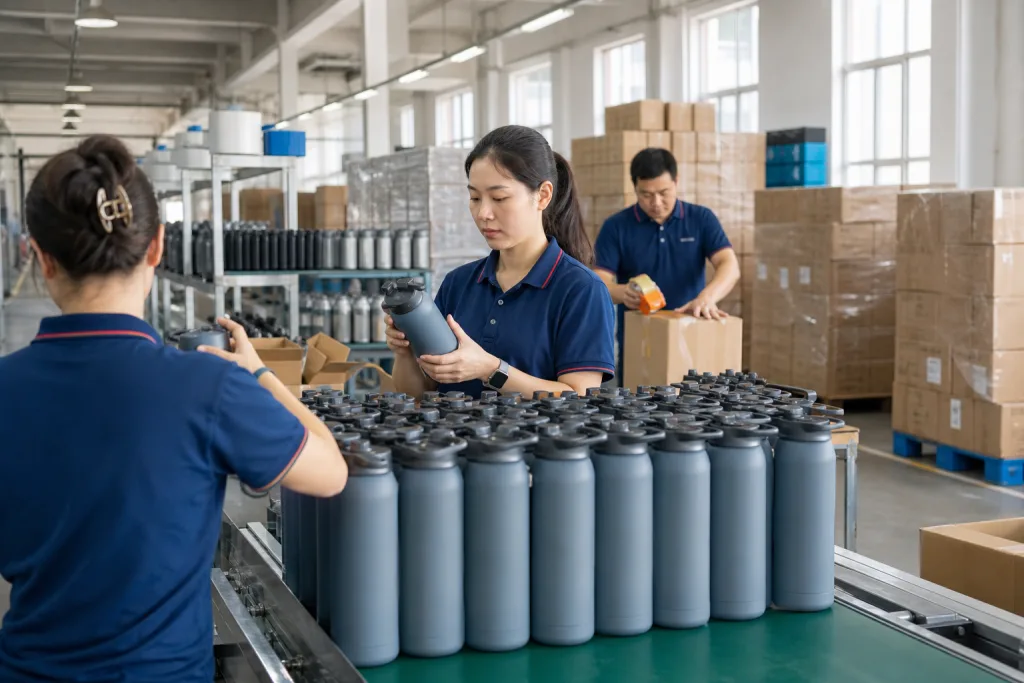
The cheapest promotional polypropylene bottle will not win a design award, but it can be the right SKU when your campaign needs 10,000 pieces and the unit price has a hard ceiling. You are buying reach, not heirloom drinkware. On our Hangzhou line, a 500 ml PP bottle often gets checked with a simple go/no-go thread gauge and a 0.01 g scale before we talk about color matching or logo position. The wrong question is “Which bottle is cheapest?” The better question is “Will this plastic, cap, print, and carton spec survive the way the giveaway is used?” Buyers get into trouble when they compare PP, PET, Tritan, aluminum, and stainless as if only the price changed.
From our factory work in Zhejiang, China, the same mistakes show up again and again: choosing PP for hot-fill use above its comfort zone, asking for a premium wrap logo on a throwaway bottle, or ignoring carton volume until freight wipes out the savings. We have seen a buyer save USD 0.03 per piece on the bottle, then lose more than USD 0.08 per piece because the carton jumped from 0.052 cbm to 0.071 cbm. QC pulled the sample, the cap fit was fine, but the master carton was the problem. A low-cost canteen customized correctly can work well. A cheap bottle specified badly just creates complaints.
The real head-to-head comparison
Ask a canteen supplier for the cheapest bottle and 8 out of 10 quotes will be a light PP body at the minimum gram weight the mold can run without sink marks or short shots. That is fine for a one-day event. It is the wrong question for a retail promo, employee kit, or distributor drinkware program. We compare material by landed usable value: which one passes the buyer’s handling test, print test, and carton drop test at the lowest total cost?
This is the benchmark we use on calls with canteen distributors and brand buyers. Last month QC pulled the sample set from line 3 and the buyer flagged the PP bottle as “too toy-like” beside Tritan, even though the PP quote was USD 0.38 lower.
| Option | Typical FOB range | Best use | Weak point |
|---|---|---|---|
| Polypropylene PP | USD 0.45-0.90 | Mass promotional giveaway where low piece price matters more than shelf feel | Softer look, lower perceived value |
| PET | USD 0.55-1.05 | Clear cold-water bottle for sports days and school campaigns | Not for hot liquid |
| Tritan | USD 1.45-2.80 | Retail-style reusable bottle when the buyer wants a cleaner transparent body | Higher resin cost |
| Aluminum | USD 1.20-2.40 | Outdoor canteen promotional programs with lightweight metal feel | Dents, liner quality matters |
| Stainless steel | USD 2.80-6.50 | Premium gift or custom growler where weight and freight are accepted | Heavier, higher freight |
These are normal China export ranges for simple designs at meaningful volume, not luxury packaging. Add the extras before you compare quotes: unusual lids, printed sleeves, individual boxes, hang tags, barcode labels. A USD 0.62 bottle can become USD 0.88 fast after two-color print, PE bag, color box, and tighter carton packing. We have seen this go sideways when a PO says “bulk pack” but the artwork file shows a retail barcode sticker, and the buyer expects both at the same price.
For BottleForge Industrial in Hangzhou, Zhejiang, typical PP promotional orders start around 5,000 pcs for standard colors and 10,000-20,000 pcs for molded custom colors. Normal production lead time is 18-25 days after artwork approval for simple screen print, with monthly drinkware output capacity around 600,000 units across plastic and metal lines. We run standard color PP faster because the resin is already on the floor; custom Pantone resin usually adds color matching and a first-shot check with calipers on the lid fit before mass production.
Where polypropylene actually wins
PP wins when the bottle is a giveaway, not a keepsake. Think marathon registration packs, gym trial memberships, school open days, summer camps, trade-show handouts, or 50,000-piece insurance and telecom campaigns. The job is simple: hold water, carry the logo, pass basic food-contact checks, and land at a unit price where nobody gets nervous if 20% stay in the carton. We see this every April when buyers push for event bottles under USD 0.60, and QC still has to check cap fit with a thread gauge before the line can pack.
Polypropylene is lighter and more flexible than Tritan. It handles normal cold drinks well and takes moderate warmth better than PET, but we do not sell a basic PP promotional bottle as a hot-drink item. Keep the user instruction to cold or room-temperature beverages for safety and deformation control. If the campaign involves boiling water, tea, coffee, dishwasher use, or retail shelf life past one season, the cheapest promotional polypropylene bottle is the wrong question to ask; move the buyer to stainless or a higher-grade plastic. We have watched PP bodies oval out after a buyer tested them with 90°C water from a kettle, then asked why the cap leaked.
A simple 600 ml PP sports-style bottle usually weighs 45-70 g depending on wall thickness, cap structure, and whether the body is straight or shaped. A thinner wall can save USD 0.03-0.06 per unit, but the math does not work if the bottle feels soft in hand. For distributor canteen programs of 10,000-30,000 pcs, we usually stop the cost-down discussion once the sidewall drops below about 0.55 mm, because the body starts to collapse under thumb pressure. Your client will not inspect resin invoices. They squeeze the bottle. Two seconds later, they decide whether it feels cheap.
For logo decoration, one-color silkscreen is the sensible choice. Cheap. Fast. Readable. Multi-color prints need registration tolerance, and low-cost curved bottles are a poor surface for photographic artwork or small legal copy. If the brand guide asks for tight Pantone matching and 4 mm text, run a print area test before mass production; we have had buyers flag a 0.8 mm shift on a curved 600 ml bottle even though the AQL cartons were clean.
When PET, Tritan, or metal beats PP
PP is not automatically the best value. “Cheapest bottle” is often the wrong question to ask. A canteen manufacturer should push back when the material does not match the selling channel, even if the inquiry starts with “cheapest.” For a transparent bottle, PET and Tritan usually look cleaner on the shelf; our QC pulled a PP sample last month with a visible flow mark near the shoulder at 1.2 mm wall thickness, and the buyer flagged it before price came up. PET stays low-cost but has a tighter use range. Tritan costs more, but it gives better clarity and a stiffer hand feel, closer to retail goods than giveaway plastic. If you are building a customizable drinkware line for gyms, campus stores, or corporate wellness shops, Tritan protects your brand better than PP.
Aluminum sits in the middle. It looks tougher than plastic and works well for outdoor promotional campaigns, especially when the artwork is a 1-color logo on a 500 ml bottle. The risk is the internal liner. Cheap aluminum bottles with weak coating can fail taste, odor, or adhesion checks; we have seen a cross-hatch tape test pull coating from the neck area after curing. Bad sign. If a canteen vendor quotes a low aluminum price, ask what coating is used and whether it meets LFGB or FDA food-contact requirements. For Europe, REACH and specific food-contact declarations matter. For North America, FDA food-contact compliance and Prop 65 review may be part of your due diligence.
Stainless steel is the correct choice when the product is meant to be kept. A customized growler, distributor growler, or vacuum tumbler does not compete with PP on price; it competes on perceived value and repeated use. If your buyer expects retail packaging, laser engraving, powder coating, or double-wall insulation, do not compare it with a USD 0.60 PP bottle. The math does not work. On the line, a 304 stainless vacuum tumbler needs leak testing, vacuum testing, and carton drop checks, and the MOQ is often 1,000 pcs per color instead of a small trial run with loose bulk packing. The sourcing logic is different.
Use PP when the bottle is a message carrier. Use Tritan when the bottle is part of a reusable lifestyle range. Use aluminum when the outdoor look matters more than transparency. Use stainless when retention and premium feel justify the freight and MOQ. Make the cut before sampling. A good canteen factory in China should catch this early, before you pay for molds, artwork, and a revised PO because someone typed “PP clear” when the buyer actually wanted glass-like clarity.
Spec choices that change the price
The headline price of the cheapest promotional polypropylene bottle moves with small spec choices. Capacity comes first. A 500 ml body usually costs less than 750 ml because it takes less PP resin and fits tighter in the carton. The carton math is not 1:1. On one 750 ml quote we ran last month, the bottle height cut the master carton from 100 pcs to 60 pcs and pushed CBM up by 28%. That freight wiped out the resin saving the buyer expected. For North American campaigns, carton strength matters too; our QC team checks the 5-ply export carton after a 1.2 m drop test because parcel handling there is not gentle.
Cap design is the second cost driver. A basic screw cap is the low-cost choice. A flip-top lid, carabiner, straw, silicone seal, or carry loop adds extra molds, assembly steps, and more spots for leakage. Simple wins here. For promotional use, fewer parts usually means fewer after-sale claims, and we have seen this go sideways when a buyer chose a cheap flip lid with a loose hinge pin. QC pulled the sample after 20 open-close cycles on the line. If the product is for children, request testing against applicable standards such as ASTM F963 where relevant, and avoid small detachable components that create choking concerns.
Color changes cost more than buyers expect. Standard factory colors use stock resin and masterbatch, so white, translucent, blue, and black move fastest. A custom Pantone body often needs 10,000 pcs or more, plus 1-2 rounds of color adjustment at the injection machine. For a canteen customized with a molded color, expect a pre-production sample or color chip approval under D65 light. The buyer flagged a PP bottle once because the approved chip was 293C, but the PO typed 2935C. Small typo, big delay. If you only need brand color on the logo, keep the body in a stock color and put the money into cleaner printing.
Packaging is where 4 out of 10 bottle quotes get messy. Bulk pack keeps cost down: for example, 100 pcs per export carton with each bottle in a simple polybag, or no bag if your market allows it. Individual white boxes, color boxes, instruction sheets, FNSKU labels, and retail hang tags add USD 0.05-0.25 per unit. We ship Amazon FBA orders with carton labels checked against the packing list because one wrong FNSKU can freeze inventory at the warehouse. That packaging cost is valid for FBA or retail distribution, but hiding it inside a “bottle price” comparison is the wrong way to buy.
Logo methods for low-cost promotions
For PP bottles, silkscreen printing is the workhorse we run most often. One-color print on one side keeps the cost clean. At 5,000-10,000 pcs, the screen setup fee is usually small once spread across the order, but complicated artwork still raises rejection risk on the line. Fine lines below 0.25 mm, tiny QR codes, and full-wrap artwork are a bad match for cheap curved PP bodies; QC pulled samples last month where the 6 mm QR code filled in after 300 pcs.
Pad printing works for smaller logo areas, especially near curved shoulders or on caps where the screen frame cannot sit flat. Heat transfer gives more color, but the math often does not work for a bottle made for one campaign season. In-mold labeling sounds attractive on a buyer call, but for the cheapest promotional polypropylene bottle it usually only makes sense at high volume because the mold insert, film setup, and trial loss are hard to absorb. We have seen buyers push back on a USD 0.03 print increase, then ask for photo-grade artwork on a 600 ml PP bottle. That goes sideways fast.
Laser engraving is not relevant for PP the way it is for stainless steel. Wrong material. If you ask canteen manufacturers for laser on plastic, they may offer a printed or embossed alternative, but the result will not look like engraving on a powder-coated metal tumbler. Match the logo method to the bottle material, not to a photo from another product category.
Artwork approval should be treated as a production control step, not a formality. Ask your canteen supplier for a digital proof showing logo size, print position, Pantone number, and maximum print area; we mark these in mm on the PDF so the merchandiser and print master read the same file. For larger orders, approve a physical pre-production sample. A realistic timeline is 3-5 days for artwork proof, 5-7 days for printed sample if needed, and 18-25 days for mass production after approval. Rushing print approval often creates the most expensive “cheap” bottle problem: 20,000 pcs with a logo placed 12 mm too low because someone approved a PO with the old layout code.
Quality checks buyers should not skip
A cheap PP bottle does not need luxury inspection, but it still needs basic controls. For B2B custom drinkware, we run AQL inspection before shipment on orders above 10,000 pcs, and we push for it even at 5,000 pcs if the print area is large. Check capacity, bottle weight in grams, lid fit, leakage, odor, print adhesion, carton drop condition, barcode accuracy if used, and color consistency between the approved sample and bulk goods. QC should use the signed sample, a digital scale, and a filled bottle on the same table. No guessing.
Leak testing must match the bottle structure. A simple screw-cap bottle should be filled to nominal capacity, tightened by hand, then inverted for 30-60 seconds; for sports lids, we also shake 10 times because that is how end users treat them. If the cap uses a silicone gasket, check gasket placement during inspection. One missing gasket in a carton of 100 pcs can turn into a visible complaint rate fast. For print adhesion, a 3M tape pull is basic but still catches weak ink curing. For odor, QC opens random cartons after production and checks whether the resin, packaging, or ink smell is strong. Low-cost plastic can fail buyer acceptance even when the caliper shows the dimensions are correct.
Compliance paperwork depends on destination. For EU buyers, ask about food-contact declarations, LFGB where applicable, REACH/SVHC status, and packaging requirements. For the US, FDA food-contact suitability and state-level chemical warnings may matter. If your buyer is a retailer, they may request BSCI, ISO 9001, or social audit documents from the canteen factory. Do not wait until the goods are finished to ask for these files; we have seen a 20,000 pcs order sit 12 days in the warehouse because the buyer flagged a missing declaration after packing.
At our Zhejiang facility and partner lines in China, we prefer to lock the inspection standard before deposit: acceptable scratch length in mm, print tolerance, color deviation, carton markings, and spare parts quantity. It sounds boring. Good. Boring specifications prevent angry email chains. The cheapest unit price is the wrong question to ask if your distributor canteen order gets stuck because cartons lack PO numbers, retail labels, or the PO has one typo in the barcode digits.
Best-fit buying decision by campaign
If the job is a one-time event with 5,000-30,000 attendees, go with PP, one-color print, a standard cap, and bulk export cartons. That is where the cheapest promotional polypropylene bottle belongs. We run that setup all the time. On the line, QC pulled the sample in under 15 minutes, and the math stays clean: low FOB, short lead time, fewer chances for a PO typo to slow the ship date.
If the bottle is going to a sports club, school store, or wellness program and people will keep it for months, put PP next to Tritan before you sign off. The extra USD 0.60-1.50 per unit can pay back when clarity, stiffness, and shelf feel drive reorder chance. We had one buyer flag a cloudy PP sample as “cheap-looking” after the first pull. That was the wrong question to ask from the start. For a canteen distributor building a repeat catalog, the cheapest first order is not always the best SKU on the sheet.
If the buyer asks for outdoor, camping, or “canteen” positioning, aluminum and stainless deserve a hard look. A custom canteen or customizable canteen in metal photographs better and supports a higher retail tag. For a custom growler or customizable growler, go stainless and accept the higher MOQ, heavier carton, and longer production window. We have seen PP try to stand in for metal on a camping pitch, and it goes sideways fast. The buyer notices the feel in the hand before the first inspection report lands.
The practical rule is simple: match the bottle to the expected life of the promotion. One day to one month: PP is usually the right call. Three months to one year: Tritan or a better PP build is safer. Multi-year brand gift: stainless. If you send your target price, quantity, logo method, destination port, and compliance market, a serious canteen vendor can send a usable FOB comparison in 24-48 hours. We do that every week, and a clean spec sheet beats a vague catalog dump every time.
Send your target price and bottle quantity
We will compare PP, PET, Tritan, aluminum, and stainless options with realistic MOQ, FOB pricing, packing, and lead time.
Frequently asked questions
What is a realistic MOQ for the cheapest promotional polypropylene bottle?
For standard factory colors, 5,000 pcs is usually a practical MOQ for a simple PP promotional bottle with one-color print. For molded Pantone body color, expect 10,000-20,000 pcs because the resin color change, machine cleaning, and color matching waste are harder to absorb. If you need a custom cap, special mold, or in-mold label, the MOQ can move much higher. For many China factories, quoting below 3,000 pcs is possible only if you accept stock shapes, stock colors, and a higher unit price.
How cheap can a PP promotional bottle be without becoming junk?
At real B2B volume, a basic 500-600 ml PP bottle can often sit around USD 0.45-0.90 FOB China, depending on weight, cap, print, packing, and order quantity. Below that range, you should check wall thickness, cap seal, odor, and carton strength very carefully. A bottle that saves USD 0.04 but feels collapsible may damage the campaign. Ask for unit weight in grams, not just capacity in milliliters, because two 600 ml bottles can feel very different.
Is polypropylene safe for food-contact promotional drinkware?
Polypropylene is widely used for food-contact products, but safety depends on the resin grade, additives, colorants, and manufacturing control. For EU orders, ask your canteen supplier for food-contact documentation and REACH/SVHC information. For US programs, request FDA food-contact suitability information and check whether your retailer requires Prop 65 review. Do not assume every cheap bottle has the same paperwork. If the goods are for children, add the relevant children’s product testing discussion early, before artwork and deposit.
Should I choose PP or PET for a clear promotional water bottle?
Choose PET if clear appearance is more important than heat resistance and long-term reuse. PET can look cleaner than PP at a similar low price, but it is generally for cold beverages only and can deform under heat. Choose PP if you accept a more translucent or softer appearance and want a tough, low-cost giveaway bottle. If the buyer wants a clear reusable retail-style bottle, Tritan is normally the better option, though the FOB price may be USD 1.45-2.80 instead of under USD 1.
What information should I send to get an accurate quote?
Send capacity, target FOB or delivered budget, quantity, logo colors, destination country, packing method, deadline, and compliance requirements. If you are a distributor drinkware buyer, also mention whether you need FNSKU labels, individual boxes, carton marks, or retailer documents. A good canteen manufacturer can quote faster when the use case is clear: event giveaway, retail resale, school program, outdoor promotion, or corporate kit. With complete details, a useful quote and material recommendation should normally be possible within 24-48 hours.