Key Takeaways
- A realistic MOQ for a customized thermos is 1,000-3,000 pcs per model/color for stable pricing
- 304 stainless steel, 0.45-0.55 mm wall thickness, and 100% vacuum testing matter more than the lowest FOB line
- Laser engraving is safer for small logos; screen printing usually needs 500-1,000 pcs per color to control cost
- Use AQL 2.5/4.0 inspection, 24-hour heat retention sampling, and 80 cm drop tests before shipment
The cheapest custom vacuum flask is rarely the lowest FOB line on the quotation sheet. For outdoor retailers and promo brands, the real bill comes later: 37 lids leaking during carton drop test, powder coating chipped before the launch date, logo Pantone mixed wrong, or customers complaining the bottle is warm by lunch. We’ve seen this go sideways.
From our factory in Zhejiang, China, we run into this almost every month. A buyer asks for a custom thermos at USD 2.80, then finds out the steel grade, vacuum rate, carton strength, and logo method were never written clearly on the PO. QC pulled one 500ml sample last season with 0.38mm body thickness instead of the agreed 0.45mm. The math doesn’t work if the spec is loose. A low-price supplier thermos order can work, but only when the failure points are locked before the line starts.
The cheap quote hides material risk
If a thermos factory quotes 8-15% below the normal market level, check the steel first. Most outdoor and promotional thermos programs should use 304 stainless steel for the inner wall. Some low-cost thermos manufacturers use 201 stainless for the outer wall, and that can pass for dry markets, but 201 inside the bottle is the wrong corner to cut. We have seen inner liners fail the 24-hour salt-water spot check after tea and sports-drink filling tests, with rust marks showing near the weld seam.
Ask for the steel grade by part: inner liner, outer shell, lid insert, and tea filter. A clear spec might read: inner wall 304 stainless steel, outer wall 201 or 304, wall thickness 0.45-0.55 mm, food contact parts BPA-free PP or Tritan. If the PO only says “stainless steel vacuum flask,” the factory still has room to swap material. QC pulled one sample last year where the liner was marked 304 on the carton, but the XRF gun read 201 on the rim.
For the cheapest custom vacuum flask that still survives retail use, do not chase the thinnest body. This is the wrong question to ask. A light 500 ml flask may save USD 0.10-0.18 per unit, but it dents faster during inland trucking and warehouse handling; we usually see the first dents on the shoulder and bottom edge after a 1.2 m carton drop test. Promotional brands can accept lighter gauges for a 30-day giveaway campaign, while outdoor retailers usually need a shell that does not come back with claims.
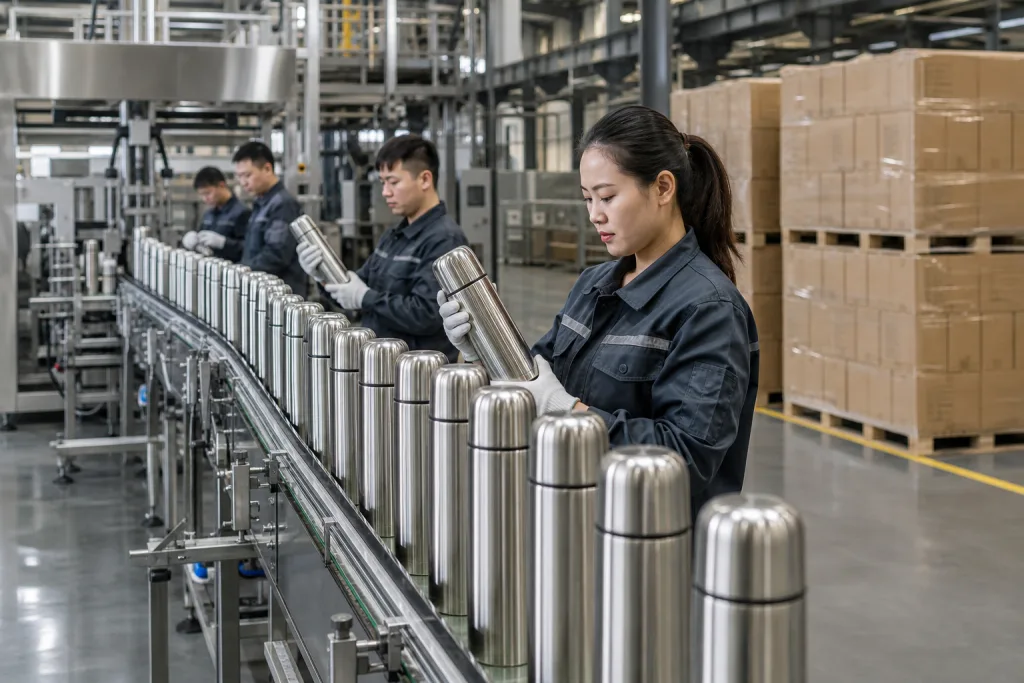
At BottleForge in Zhejiang, China, our normal stainless thermos capacity is about 450,000 units per month, with MOQ starting around 1,000 pcs for existing molds and 3,000 pcs when you need a special coating color. Those numbers are not decoration. Under that range, supplier thermos costs rise because coating setup, logo plates, and carton printing get spread over too few units. We run the powder-coating line with fixed cleaning time between colors, so a 600 pcs custom Pantone order can cost more per piece than a 1,200 pcs reorder in stock black.
Vacuum failure is not always visible
A vacuum flask can look perfect and still fail. The insulation comes from the vacuum gap between the inner and outer stainless walls, often less than 1 mm after drawing and welding. If the vacuum is weak, the outside body warms up after hot water filling, or the drink drops temperature too fast. We see this most often in low-price custom thermos orders where the buyer pushed for a USD 0.08 saving and the factory skipped proper body screening.
Do not accept a loose claim like “keeps hot 12 hours.” Define the test. For a 500 ml custom thermos, we usually write it this way on the PO: fill with water at 95°C, close lid, test at room temperature 20°C ± 2°C, then record temperature after 6 hours and 12 hours. A decent flask may stay above 65°C after 6 hours and above 45°C after 12 hours, depending on body shape and lid design. Wide-mouth models lose heat faster than narrow-mouth models. Simple physics. If a buyer asks us to match a narrow-mouth result on a 75 mm wide-mouth soup flask, we push back because the math does not work.
The factory thermos line should run a vacuum test on 100% of bodies before assembly. We run hot water screening and infrared checks before lids, paint, and cartons enter the line; QC pulled the sample faster when the IR gun showed one body at 38°C while the batch average sat near 28°C. Common methods include temperature sensing and hot water screening. For your pre-shipment inspection, add random heat retention testing to the AQL plan. It takes time, so tell the inspection company at least 2 days before inspection. If you ask on inspection day, they cannot complete a 12-hour test properly.
For thermos bulk orders, vacuum failure rates above 1% are already painful. On 10,000 pcs, that means 100 bad units reaching customers if the supplier does not screen correctly. Your purchase order should state that vacuum failure is a critical defect, not a minor cosmetic issue; one buyer once wrote “minor” by mistake on the PO, and the claim became a week-long argument. A supplier thermos partner who argues with that point is not ready for your retail or distributor thermos business.
Leaking lids destroy promotion schedules
Lids sink more cheap thermos custom jobs than the stainless body ever does. We ship a sample, the bottle looks fine, then the buyer flags a leak in a backpack after the first field test. That is how a promo run misses a launch date. On our line, QC pulled one unit with a loose snap ring and the whole lot got held.
Spec the lid like a real part, not a decoration. Check the gasket material, thread pitch, lid torque, spout shape, and whether spare silicone rings are packed in the carton. Food-grade silicone is standard, but 0.2 mm matters. We saw one gasket come in at 1.8 mm against a drawing callout of 2.0 mm; it passed dry assembly and failed once hot water built pressure inside the flask. The math does not work if you guess.
For a customized thermos with flip lid, push button, straw lid, or cup lid, test leak performance in three positions: upright, inverted, and horizontal after shaking. Our factory check is simple: fill to 90% capacity, close the lid, invert for 30 minutes, then shake 10 times. For sports and outdoor channels, add an 80 cm drop test on a filled unit, then check for seepage at the hinge and vent. One drop is not a durability claim. It just shows weak pins and brittle caps before the buyer does.
The cheapest custom vacuum flask usually starts with an existing lid mold. Good. That cuts tooling risk and saves 20-35 days versus new cap development. The wrong question is whether the catalog photo matches. It is whether the threads match, the sealing face stays flat, and the cap still passes torque after coating and logo work are done. We had a PO last season with a typo on the cap code, and the buyer nearly got a 304 stainless body with the wrong closure. Small mistake. Big headache.
For distributors thermos programs, we take a plain lid that passes leak and torque checks over a fancy one that looks good in a rendering every time.
Logo defects come from wrong decoration choices
A customizable thermos only sells if the logo looks sharp. About 7 out of 10 logo complaints we see are not artwork problems; they start when the buyer picks the wrong decoration for the cup surface, coating, and target price. Cheap is not always cheap. A quote with one-color screen printing may look good on the PI, then QC pulls the sample under a 3M tape test and the edge lifts.
Laser engraving is the safer choice for stainless steel or powder-coated bodies when the logo is small, detailed, or ordered in 1,000-3,000 pcs. No ink. No adhesion risk. We run it on a fiber laser, often with a 0.05 mm engraving line, so small text stays cleaner than screen print on a curved wall. It suits corporate gifts, outdoor clubs, and premium promotional thermos orders. The trade-off is color: the mark is exposed metal or tonal contrast, not Pantone-matched artwork. Some buyers ask for “red laser logo”; the math doesn't work.
Silkscreen printing fits simple logos and larger flat-ish areas, but cylindrical bottles need proper fixtures, not a loose V-block made in a hurry. Multi-color printing needs registration control, and each color adds screen cost plus setup time. Heat transfer can handle gradients and full-color designs, but we test adhesion on powder coating with cross-cut tape before mass production. UV printing works for short runs, yet we have seen it go sideways on rough outdoor orders when the bottle rubs against carabiners, backpacks, or carton dividers during a 12-day sea shipment.
For thermos promotional projects, fix the logo size in millimeters, Pantone code, position from the base, and acceptable color tolerance before sampling. A normal visual tolerance might allow 1-2 mm position deviation, but a logo printed over a seam or curve can look worse than the caliper reading says. Approve a pre-production sample. Photos help, but physical samples are better when coating texture and logo contrast matter; one buyer flagged a matte black cup because the gray logo looked fine in our light box and dull in their office at 500 lux.
If you are buying from a thermos vendor in China for the first time, send vector files in AI, EPS, or PDF format. Low-resolution PNG files create fuzzy edges and slow down sampling by 2-3 days. We had one PO spell the logo file as “final-final-new.png”; the line waited while design redrew it, and the sample ship date moved from Friday to Tuesday.
Coating shortcuts show up in cartons
Powder coating makes a stainless thermos look shelf-ready, but it is one of the first places cheap production gets exposed. We see chips on the drinking rim, sleeve scratches from packing, and shade drift between two powder lots. Matte black looks easy on a quote sheet. It is not. If the pretreatment tank is weak or the curing oven runs 165°C when the powder supplier asked for 180°C, QC pulled the sample will usually find edge peeling after tape test, not after the buyer has already launched the item.
For outdoor retailers, ask for coating adhesion and abrasion checks before you approve mass production. A cross-hatch tape test is a basic requirement; we cut 1 mm grids with a cutter, press 3M tape, and check how much coating lifts. For higher expectations, request a rubbing test, dishwasher warning validation if applicable, and a drop test on a coated, filled bottle. Most vacuum flasks are not truly dishwasher safe after powder coating and logo printing. Print “dishwasher safe” without test data, and the complaint belongs to you.
Pantone matching on powder coating is not the same as printing on paper. Textured finishes shift under factory lights, and the same black can look warmer after a second spray pass. For large thermos bulk orders, approve a color chip or coated metal sample before mass production; one buyer once flagged a 1.5 Delta E difference on a charcoal grey flask because their retail display had mixed batches. If your order is 20,000 pcs split across three shipments, state whether all batches must use the same powder lot.
Packing also affects coating defects. A low-price thermos supplier may quote thin polybags and light export cartons to save USD 0.05-0.12 per unit. The math does not work if bottles rub for 28 days on the water and arrive with silver marks on the shoulder. For distributor thermos programs, we normally recommend individual polybag or tissue wrap, egg-crate divider or snug white box, 5-layer export carton, plus carton drop testing at 76 cm for common export packs. If you ship to Amazon FBA, carton weight, FNSKU labeling, and master carton size must be agreed before packing materials are ordered.
Compliance cannot be fixed after production
Compliance is not a certificate hunt after the cartons are packed. It starts at the BOM table. For Europe, buyers usually ask for LFGB, REACH, and food-contact documents, then they check whether the stainless steel, PP lid, silicone ring, and coating match the report. For the United States, FDA food-contact expectations and state rules need to be checked before we open the color drum. Children’s drinkware is a different job: CPSIA or ASTM-related checks can apply based on the straw, handle, paint, and small-parts design. A kids-style stainless bottle is not the same compliance job as an adult hiking flask. QC once pulled a 350 ml kids bottle because the spare straw was not listed on the test report.
Ask your thermos manufacturer for recent test reports, then read the small fields: product description, material, model, date, and tested components. Boring work. Still necessary. A report for another lid or coating does not protect your shipment. If you change the plastic cap from PP to Tritan, swap the silicone gasket hardness, revise the paint, or add an inner coating, the old report can fall out of scope. We have seen a buyer flag this at final inspection because the PO said “matte black powder coating” while the lab report showed “spray paint.” The math does not work after production.
Factory audits are separate from product compliance. BSCI, ISO 9001, and social audit documents support your sourcing file, but they do not prove the flask is food safe. For a new suppliers thermos relationship, we run a practical approval path: review factory documents, confirm the bill of materials line by line, make pre-production samples, run lab testing when the market requires it, then release mass production. One missed gasket material can delay shipment 7-10 days. The line will not care that the sales contract looked tidy.
Lead time also needs honesty. For an existing stainless thermos mold with standard powder color and laser logo, 25-35 days after sample approval is realistic in Zhejiang. Custom Pantone coating, special packaging, or new lid tooling can push production to 45-60 days. If a thermos factory promises 15 days for a complicated 10,000 pcs customized thermos order during peak season in China, ask what step they plan to skip. We ship from Hangzhou and Ningbo lanes every week; coating alone can take 6-8 days when the oven is full and the buyer asks for 2% spare lids packed by color.
A low price needs a written control plan
The cheapest custom vacuum flask is not the one you get by pushing 8 suppliers until one cuts the quote by USD 0.12. That usually comes back later as thin coating, loose lids, or a carton drop-test problem. Write the risk split into the PO. Outdoor retailers usually need insulation data, tougher powder coating, and lids that survive a 1.2 m drop test. Promotional brands care more about Pantone logo match, event delivery date, and unit price. Same product name. Different spec.
Your RFQ should include capacity, body shape, steel grade, wall thickness target, lid type, coating, logo method, packing, compliance market, MOQ, and inspection standard. We run into trouble when a buyer sends “500 ml bottle, black, logo” and expects 3 factories to quote the same item. They will not. Use Incoterms clearly: FOB Ningbo or FOB Shanghai is common for Zhejiang production; EXW can look cheaper but puts local trucking, warehouse handling, and export paperwork back on your side. If you compare FOB against DDP without separating duty and freight, the math doesn't work, and you are not comparing suppliers thermos pricing correctly.
For QC, set AQL levels before production. A common approach is critical defects not allowed, major defects AQL 2.5, minor defects AQL 4.0. Define critical defects as leakage, failed vacuum, unsafe sharp edges, wrong material, severe contamination, and incorrect logo. Major defects can include visible dents, coating chips, misaligned print, or wrong packaging. Minor defects include small scratches within agreed limits, such as 1 scratch under 5 mm on the back side only. QC pulled the sample on one 3,000 pcs order last year and found the laser logo 2 mm too low; the buyer flagged it because the approved artwork showed center alignment.
A good thermos supplier will not object to clear standards. Clear standards protect the factory too, because the line, the packing team, and the final inspector all know what will pass. At BottleForge Industrial in Zhejiang, China, we would rather reject a vague RFQ than win an order that becomes an argument at inspection. We ship cheap flasks, but not mystery flasks. Cheap only works when the flask still performs after your customer fills it, drops it, packs it, and uses it again.
Send your flask spec before chasing quotes
Share capacity, logo, market, MOQ, and target price. We will tell you what can be safely reduced and what should not be touched.
Frequently asked questions
What is the real MOQ for the cheapest custom vacuum flask?
For existing molds, a realistic MOQ is usually 1,000 pcs per model and color with laser engraving. If you need custom powder coating, Pantone matching, screen printing, or retail packaging, 3,000 pcs is a safer planning number. Some suppliers quote 500 pcs, but unit price may rise by USD 0.30-0.80 because coating setup, logo fixtures, and carton printing are spread over fewer units. For promotional thermos orders with a tight event date, it is often better to choose a stock color and existing lid than force a low MOQ custom build.
How cheap can a custom stainless thermos be without being risky?
For a basic 500 ml stainless vacuum flask from China, a workable FOB range is often around USD 2.80-4.50 depending on steel grade, lid, coating, logo, and packing. Below that, check whether the inner wall is really 304 stainless steel, whether the factory runs 100% vacuum testing, and whether the carton is strong enough for export. A USD 0.20 saving is not useful if 2% of the shipment leaks or fails heat retention. Ask for a full spec sheet before comparing prices.
Which logo method is best for a bulk thermos order?
For 1,000-3,000 pcs, laser engraving is usually the most stable method because it has no ink adhesion problem and handles small details well. For larger thermos bulk orders, one-color silkscreen printing can be cheaper if the logo is simple and the bottle surface is suitable. Heat transfer or UV printing works for colorful promotional designs, but you should test adhesion on the exact coating. Always approve a pre-production sample, not only a digital mockup, especially for matte, textured, or dark surfaces.
What inspection standard should I use for a custom thermos?
Use AQL inspection with critical defects not allowed, major defects at AQL 2.5, and minor defects at AQL 4.0. Critical defects should include leakage, failed vacuum, wrong material, unsafe sharp edge, contamination, and wrong logo. Add functional tests: 30-minute inverted leak test, 80 cm carton or product drop test depending on packing, coating adhesion test, and heat retention sampling. For a 10,000 pcs order, do not rely only on factory photos. Use third-party inspection or your own QC checklist before paying the balance.
How long does a customized thermos order take from China?
For an existing mold, standard color, and laser logo, plan 25-35 days after sample approval, plus shipping time. A custom Pantone powder coating, printed gift box, or new lid can push the schedule to 45-60 days. Lab testing may add 5-10 working days if required for LFGB, REACH, FDA-related documentation, or other market checks. During peak seasons before summer campaigns or Q4 gifting, confirm capacity early. A thermos manufacturer promising very short lead time may be skipping sampling or proper QC.