Key Takeaways
- For the cheapest custom drink bottle, a 1,000-3,000 unit MOQ is usually more realistic than 300 units
- Logo method can change cost by USD 0.05-0.45 per unit depending on color count and surface
- AQL 2.5/4.0 inspection is cheap compared with replacing one leaking 20-foot container
- FOB Ningbo or Shanghai gives cleaner cost control than unclear all-in shipping quotes
The cheapest custom drink bottle is not always the lowest quoted unit price. A USD 1.18 bottle can turn into a USD 2.40 landed headache when the cap leaks at the 24-hour inverted test, the logo fails a 3M tape pull, or the carton collapses after a 1.2 m drop. You are buying a spec, not a photo.
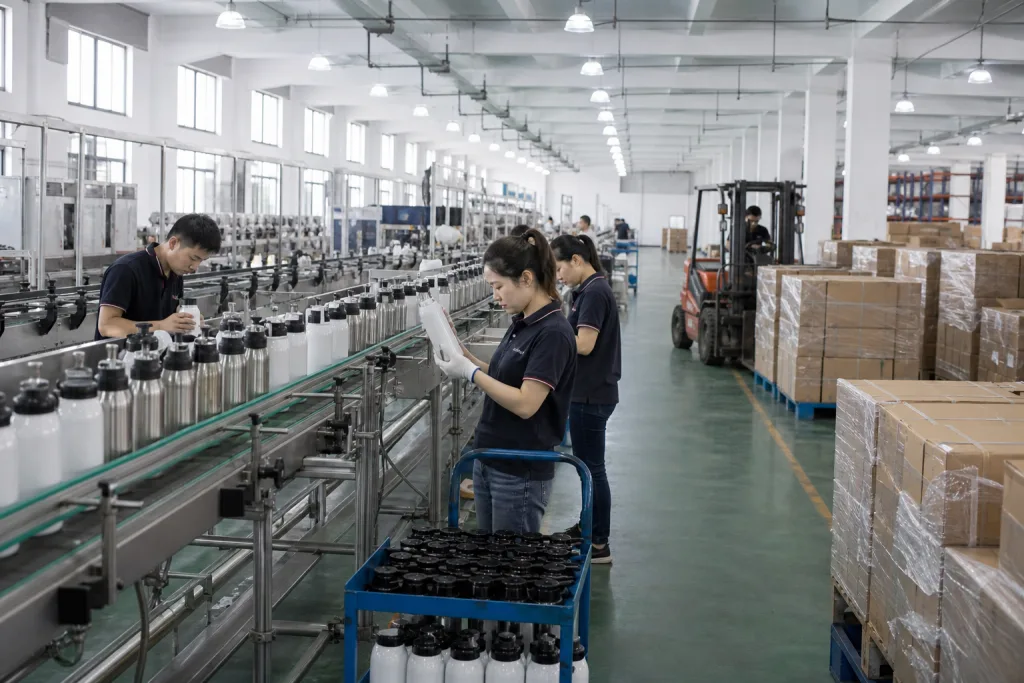
On our Zhejiang factory floor, we see the same mistake at least 8 times a month: buyers ask for “your cheapest bottle” before they fix capacity, material, wall thickness, decoration, packing, and inspection level. Wrong question. BottleForge Industrial runs drinkware production in Hangzhou with typical custom MOQ from 1,000 units and monthly capacity around 600,000 units across stainless, plastic, glass, canteen custom, and tumbler lines. Last week QC pulled a 650 ml sample where the PO said matte black, but the artwork file named it “gloss BK”; that one typo would have cost 12 days to rework instead of 3 minutes to confirm before the line started.
Start with the bottle body
The first line on your spec sheet should be body material, because it sets the real floor price. For the cheapest custom drink bottle, single-wall plastic usually wins on unit cost. We run PP, PE, Tritan-style copolyester, and PETG on different molds, but they do not quote the same. PP is the cheap, light option, often used for canteen promotional programs at 3,000-5,000 pcs. Tritan-style material costs more because the resin price and polishing standard are higher, but it looks clearer on the shelf. Stainless steel pushes the price up, though it makes more sense for long-term retail and outdoor channels. The buyer flagged this last month: same 750 ml shape, PP was fine for giveaway, Tritan was the better fit for a gym-chain retail SKU.
If you are comparing a custom canteen, ask whether the quotation is for single-wall aluminum, single-wall stainless, or double-wall vacuum stainless. Those are not close cousins. A 600 ml single-wall aluminum canteen customized with one-color silkscreen may sit near the low end. A 32 oz double-wall customized growler with powder coating and laser logo is not in the same purchasing bracket. Different line. Different math. On our floor, the aluminum body goes through a lighter forming process, while the vacuum growler needs welding, vacuum pumping, powder coating at about 180-200°C, then laser alignment. If a supplier puts both under one “custom metal bottle” price, we’ve seen this go sideways.
For stainless drinkware, check the grade. 304 stainless steel is the common food-contact choice for the inner wall. Some low-cost offers use 201 stainless on parts where buyers expected 304. That may be acceptable for a dry outer shell, but not for the liquid-contact surface. QC pulled the sample once after a PO typo changed “304 inner” to “stainless inner”; that one word would have opened the door to a cheaper inner wall. For plastic, ask for food-contact test capability under FDA, LFGB, or EU 10/2011 depending on your market. Ask before the deposit, not after the cargo is ready.
Wall thickness matters. A cheap plastic bottle at 0.7 mm wall may dent, deform, or feel flimsy. A 0.9-1.1 mm wall feels better in hand but adds resin cost, so this is the wrong question to ask if the buyer only says “cheapest.” Cheapest for a one-day event is not cheapest for a retailer handling returns. For stainless, common body thickness is 0.4-0.5 mm. Going thinner saves cents but increases dent claims; our caliper check often finds the problem before packing, especially around the shoulder radius. A serious canteen factory in China should state the material and thickness clearly, not just send a glossy photo.
Capacity changes more than volume
Capacity looks simple on a buyer brief: 500 ml, 600 ml, 750 ml, 1 L, 32 oz. On the line, it changes the mold set, carton CBM, loading quantity, logo print window, and defect rate after polishing. A 500 ml bottle usually gives the cleanest balance for promotional custom drinkware: compact body, lower unit weight, better carton count, fewer dents in transit. We run 500 ml single-wall bottles in 48 pcs/carton more often than 750 ml in 36 pcs/carton, and that difference shows up on the freight sheet fast. A 750 ml or 1 L bottle looks stronger for outdoor or gym use, but the math does not work if the buyer is chasing the cheapest custom drink bottle.
For distributor drinkware programs, do not pick capacity because a competitor’s catalog is pushing it. Check the channel first. Retail shelves usually sit better with 500-650 ml because the bottle height still fits common display racks around 230-260 mm. Outdoor distributors ask for 750 ml, 1 L, or a custom growler at 64 oz because the end user expects more volume. School or kids programs need 350-450 ml, plus cap pull-force and small-parts checks; QC pulled one sample last season because the silicone straw tip came loose after a bite test. If you sell canteen items to clubs, camps, or outdoor events, a 600 ml or 750 ml canteen promotional item is often easier to quote sharply than a larger insulated bottle.
Capacity also affects MOQ. If a canteen manufacturer already has stock molds for 500 ml and 750 ml, MOQ can be 1,000-3,000 units for standard colors with custom logo. Stock mold means we already have the cavity, trimming fixture, and carton spec on file. If you request a new bottle shape, new cap, or an odd volume like 680 ml, tooling may cost USD 1,500-8,000 depending on complexity, and MOQ can move to 5,000-10,000 units. We have seen this go sideways when a PO says 680 ml but the artwork says 700 ml; the buyer flagged it during pre-shipment photos, not during sample approval.
Ask for measured full capacity and practical fill capacity. Some suppliers quote brim-full volume, which is not how anyone fills a bottle before screwing on the cap. A 750 ml bottle may have a comfortable use capacity of 700-720 ml. That gap matters if your packaging, online listing, or compliance label makes a specific claim. In our QC room, we check it with a digital scale and water at room temperature: 1 g is treated as about 1 ml, then we record both brim-full and usable fill in the inspection note.
Cap, seal, and leak claims
The cap is where 7 out of 10 “cheap” bottle complaints start. The bottle body can pass gauge check, then one loose silicone ring creates cartons of returns. Your spec sheet should name the cap: screw cap with gasket, flip cap with hinge pin, straw lid with dust cover, sport push-pull cap, bamboo-look cap, or carabiner cap. Each one changes the mold cost, assembly time, and failure risk. The lowest-cost choice is usually a simple screw cap with one silicone gasket. Boring, yes. Reliable, if the thread is clean and the line controls closing torque with a 0.6-0.8 N·m torque tester.
For a canteen customizable project, buyers often ask for a clip, strap, compass, or wide-mouth cap after the first quote. That is where the math starts to move. Each extra part adds hand assembly and another QC point; last month QC pulled the sample because a strap rivet sat 1.5 mm off-center. A customized canteen with a strap may cost USD 0.08-0.25 more than the same bottle without it. A straw lid can add USD 0.20-0.60 depending on the number of parts and whether the straw is PP, PE, or silicone.
Leak testing needs to be written on the PO, not assumed from a nice sample photo. For standard water bottles, we run 100% upside-down leak testing on the production line for screw caps and sampling-based functional testing for flip or straw lids. For export orders from Zhejiang, we normally combine line checks with final AQL inspection. A typical setting is AQL 2.5 for major defects and 4.0 for minor defects. Leaking is a major defect, sometimes critical if the product is marketed for bags or children. The buyer flagged this once after a PO typo said “leak proof” while the approved lid was only splash resistant; we have seen this go sideways.
Ask about gasket material before you approve the cheapest cap. Food-grade silicone is common. Low-cost rubber substitutes can smell, stain, or fail a 70°C hot-water soak test in our lab cup. If your product goes to Europe, ask your canteen supplier for food-contact declarations and REACH-related material control where applicable. If your product goes to North America, ask about FDA food-contact and, for children’s items, CPSIA or ASTM considerations.
Decoration is not just branding
Your logo method can kill the cheapest custom drink bottle target. One-color silkscreen is the low-cost choice for simple logos on plastic and 304 stainless bodies, as long as the print area is straight. On our line, a one-position one-color print on a cylindrical bottle may add roughly USD 0.05-0.12 per unit at 3,000 pieces; the screen room still has to set the jig, check the 300-mesh screen, and run ink adhesion tape tests. Two to four colors cost more because each color needs screen setup, alignment, and waste allowance. The buyer often asks for a four-color gradient on a giveaway bottle. The math doesn't work.
Laser engraving works well on stainless steel and some coated bottles. It is durable and clean, but not always the cheapest. A small laser logo may add USD 0.10-0.25 per unit. Large wraparound laser work is slower; we run it piece by piece, and QC pulled samples before where the mark looked lighter near the shoulder. Heat transfer and UV printing handle more colors and gradients, but they add cost and need cleaner surface preparation, especially after powder coating. If you are building customized drinkware for retail, the extra cost can make sense. If you are buying a canteen promotional giveaway, keep the logo simple.
Powder coating, spray painting, and color matching also affect the quote. A stock color bottle with your logo is cheaper than a custom Pantone body. Custom color coating often needs MOQ around 3,000-5,000 units per color, depending on the canteen factory line schedule. Small orders with custom body color are possible, but you pay through a higher unit price or lead time moving from 12 days to 18 days. We have seen this go sideways when a PO says “navy blue” but the buyer expects Pantone 296C.
Send vector artwork, not a low-resolution JPG. Give the logo size in millimeters and location from a physical reference point, such as 45 mm wide centered on the front, 70 mm from bottle base. For a customizable growler or distributor growler program, confirm whether the decoration area is flat enough; a 2 mm shoulder curve can bend small text more than buyers expect. Curved shoulders, embossed panels, and textured coating can distort print. A pre-production sample is worth the 5-7 days it takes.
MOQ and price ladder reality
Most buyers ask for the lowest MOQ and the lowest unit price in the same email. That is the wrong question to ask. For standard custom drinkware from China, a practical MOQ is often 1,000 units for stock color plus logo, 3,000 units for better pricing, and 5,000 units or more for custom color or special packing. We run stock-color jobs faster because the line does not stop for color change, and our pad-print jig is already set. Some canteen vendors will quote 300 units, but the price may include manual handling, higher decoration cost, and domestic consolidation fees. We have seen buyers flag this later when 6 cartons arrive with mixed inner packing.
A realistic price ladder for a basic 600 ml plastic bottle might look like this: 1,000 units at USD 1.35-1.80 FOB, 3,000 units at USD 1.05-1.45 FOB, and 10,000 units at USD 0.85-1.20 FOB, depending on material, cap, logo, and packing. The math changes fast. One cap switch from a normal flip lid to a straw lid can add USD 0.12-0.22, and a thicker 0.45 mm body wall uses more resin than the sample on the shelf. A basic single-wall aluminum custom canteen may be similar or slightly higher. A stainless insulated bottle will not honestly fit that price range unless the spec is stripped down and the order volume is high.
When comparing canteen suppliers, keep the Incoterm identical. FOB Ningbo and FOB Shanghai are common for Zhejiang exporters. EXW may look cheaper but leaves you paying local trucking, export handling, and customs paperwork through your forwarder. DDP is simple on paper, but it hides the cost structure. For experienced importers, FOB is usually cleaner. Last month a buyer compared our FOB Ningbo quote with another factory’s EXW Yongkang quote and missed about USD 260 in truck and document charges.
Ask each canteen vendor to quote by line item: bottle, logo, packing, inner carton, master carton, testing, sample charge, tooling if any, and freight separately if requested. This makes negotiations more honest. If one canteen manufacturer is USD 0.18 lower but excludes individual polybag, barcode sticker, and export carton upgrade, it may not be cheaper at all. QC pulled the sample and measured the carton at 52 x 38 x 34 cm, then the buyer’s forwarder rejected the packing because the PO required a 5-ply export carton, not 3-ply. Small line items bite.
Packing, cartons, and channel rules
Packing looks boring until it turns into chargebacks. The cheapest custom drink bottle can ship bulk-packed, one unit in a polybag, 50-100 units per master carton. That setup works for about 70% of distributor canteen orders and one-day event giveaways we run. Retail and e-commerce buyers need tighter control: individual white box with barcode placement, color box with scan test, hang tag hole size, FNSKU label, suffocation warning, carton drop strength, and carton weight limit. QC pulled a sample last month because the barcode sat 4 mm too close to the box edge. The scanner missed it.
Individual white boxes may add USD 0.08-0.20 per unit depending on size and paper grade. Color boxes can add USD 0.15-0.45 or more after plate and printing setup. If your sales channel does not need retail packaging, do not buy it. The math doesn't work on a cheap giveaway bottle. If retail packaging is required, get it into the first quote and the PI; do not let a supplier quote bulk packing and then add box cost after you issue the PO. We have seen POs say “white box” while the artwork file says “color sleeve.” That typo stops the line.
Master carton strength should match the route. For sea freight, 5-ply export cartons are common. For courier or e-commerce handling, we ship smaller carton quantities, use stronger board, or add dividers so the bottle shoulders do not rub through the polybag. A carton over 18-20 kg can be rejected or mishandled in some distribution networks. For glass or large customized growler orders, dividers and drop testing are not optional. We use a 76 cm drop test for risky cartons; if the corner crushes, the carton spec changes before packing starts.
Labeling also belongs on the spec sheet. State UPC/EAN, FNSKU, country of origin, recycling marks, material marks, warning text, and carton shipping marks. For goods made in Zhejiang, China, the country-of-origin label should be planned before mass production. Relabeling 5,000 units after packing is slow and expensive; two workers with label guns usually need 12-18 hours, and the cartons get opened twice. We have seen simple label mistakes delay containers by 3-5 days at the warehouse. The buyer flagged it after the pallets were wrapped.
Quality paperwork before deposit
Before you pay the 30% deposit, write down the proof your buyer will ask for, not the proof the supplier feels like sending. For low-risk promotional bottles, we usually see buyers accept a material declaration, signed production sample approval, and final inspection report with photos from AQL 2.5 checks. For retail custom drinkware in Europe or North America, ask before deposit for food-contact test reports, REACH-related documentation, LFGB, FDA food-contact confirmation, CPSIA for children’s drinkware, or ASTM-related checks based on the bottle material and sales market. QC pulled one sample last month because the PO said “PP lid” but the drawing showed Tritan; that small typo held the deposit file for 2 days.
Factory audits also matter if you sell to corporate clients. BSCI, Sedex, ISO 9001, or similar audit records do not guarantee a clean shipment, but they show whether the canteen manufacturer has basic process discipline: incoming material records, calibration stickers on torque testers, and batch traceability on the line. A small canteen supplier without audits may still be capable. Inspect harder. We have seen this go sideways when a corporate buyer asked for a Sedex record after mass production had already started.
A normal timeline for a straightforward order from our Hangzhou, Zhejiang facility is 5-7 days for logo sample after artwork approval, 25-35 days for mass production after deposit and sample sign-off, and 7-10 days for final inspection, booking, and loading coordination depending on vessel space. Peak season can add 10-15 days. If a canteen vendor promises 10 days for 10,000 customized canteen units with custom color, be careful; the math does not work if the color powder needs approval, cartons need a 5-layer drop test, and the UV logo line is already booked.
Use a golden sample. Sign and photograph the approved sample, then define acceptable tolerances: logo position ±2 mm, color tolerance against Pantone within reasonable visual range, capacity tolerance, carton dimensions, and defect classification. We run a 3M tape pull on printed logos and a simple cap leak test before packing; cheap quotes often skip both. The cheapest order is the one that arrives sellable. A USD 0.06 saving per unit is meaningless if 8% of caps leak or the logo fails a basic tape test.
Send your cheapest bottle target spec
Share capacity, material, logo, packing, MOQ, and destination. We will return a practical FOB quote and point out cost traps.
Frequently asked questions
What is the cheapest custom drink bottle for a B2B promotion?
For most B2B promotions, the cheapest workable option is a 500-600 ml single-wall PP or PE bottle with a simple screw cap and one-color silkscreen logo. At 3,000 units, a realistic FOB China range is often USD 1.05-1.45 depending on resin, cap, packing, and artwork. PETG or Tritan-style clear bottles cost more but look better. Single-wall aluminum canteen customized products can also be competitive, especially for outdoor events. Avoid unusual shapes, custom Pantone body color, retail boxes, and multi-color logos if your only goal is lowest landed cost.
Can I order 300 pieces from a canteen manufacturer in China?
Sometimes, but 300 pieces is not factory-efficient for most custom drinkware. The supplier may use stock bottles, outsource logo printing, and charge a higher unit price. You might see USD 2.50-4.00 per unit for something that would cost USD 1.20-1.60 at 3,000 units. For a serious canteen factory, 1,000 units is a more practical starting point for stock color plus logo. If you need only 300 pieces, ask whether the order is handled as sample production, stock customization, or normal mass production.
Which logo method is cheapest for customizable drinkware?
One-color silkscreen is usually the cheapest logo method on a straight bottle body. At 3,000 pieces, it may add around USD 0.05-0.12 per unit. Laser engraving is more durable on stainless but often adds USD 0.10-0.25 for a small logo. UV print and heat transfer support full-color artwork but cost more and need tighter process control. For canteen promotional orders, simplify the artwork to one color, avoid wraparound printing, and keep the logo on a smooth cylindrical area.
How do I compare quotes from different canteen suppliers?
Force every canteen supplier to quote the same spec: material grade, capacity, wall thickness, cap type, logo size, logo method, packing, carton quantity, test standard, MOQ, lead time, and Incoterm. Compare FOB Ningbo with FOB Ningbo, not FOB against EXW or DDP. Ask for separate costs for tooling, sample, logo setup, retail box, barcode label, and inspection. A quote that is USD 0.15 cheaper but excludes individual box, 5-ply carton, or food-contact testing is not a real saving.
What lead time should I expect for customized canteen orders?
For a standard customized canteen using an existing mold and stock color, expect 5-7 days for a logo sample and 25-35 days for mass production after approval and deposit. Custom body color, new mold, complex decoration, or retail packaging can push production to 40-60 days. Sea freight to Europe or North America adds several weeks depending on port and season. If you need goods for a fixed event date, build in at least 10 extra days for inspection, rework, booking, or customs delays.