Key Takeaways
- A practical MOQ for a stainless canteen with custom logo is usually 1,000-3,000 pcs per color
- Laser engraving is stable for 7-12 day sampling, while full custom molding can add 20-35 days
- FOB China pricing can vary 25-40% when steel gauge, finish, cap, and packaging change
- AQL 2.5/4.0 inspection and REACH/LFGB planning should be built into the timeline, not added at the end
A canteen with custom logo looks simple on a quote sheet, but the landed cost can move 25-40% depending on steel grade, cap design, finish, logo method, carton pack, and inspection level. Unit price alone is the wrong question to ask. We have seen QC pull a sample with a 1.6 mm silicone gasket instead of 2.0 mm; the FOB price looked clean, but the cap leaked after the drop test, and the buyer flagged it before shipment.
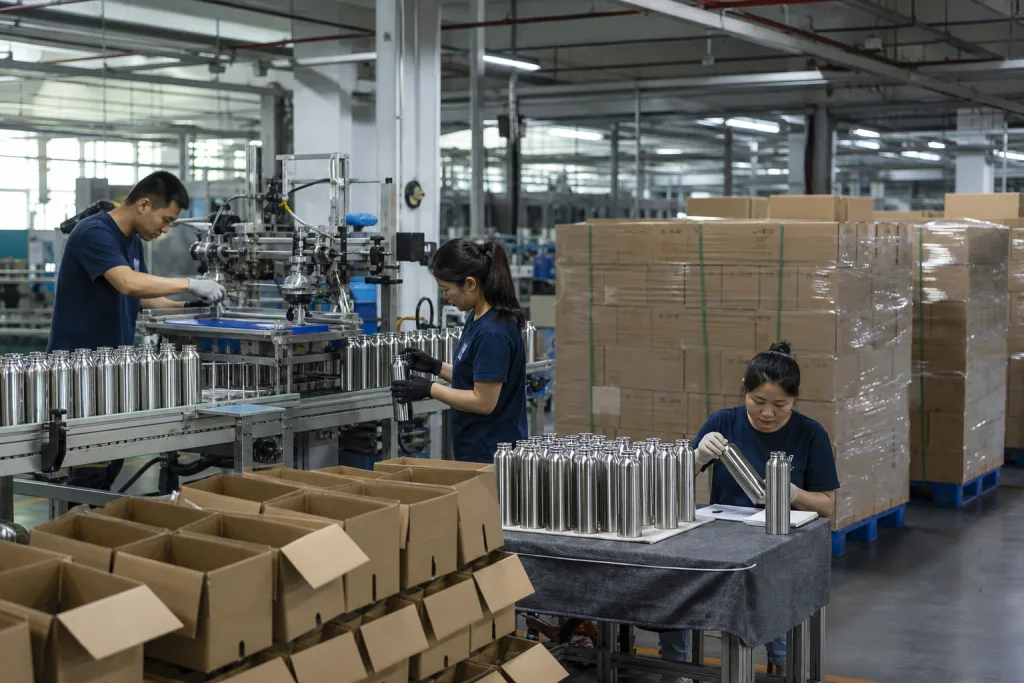
We manufacture drinkware in Zhejiang, China, and we run into the same issue every season: buyers ask for a custom canteen price before the real specification is fixed. For procurement teams, canteen distributors, and brand owners, ask what drives cost, MOQ, and lead time before the PO is placed. A laser logo on 1,000 pcs is one calculation; powder coating plus color box at 3,000 pcs is another, and the line may need 12 days vs 18 days depending on drying time and packing speed.
Start With The Real Specification
Before you ask any canteen supplier for a quote, lock the basic product architecture. A 750 ml single-wall stainless custom canteen is not the same job as a 1.2 L vacuum insulated canteen with powder coating, silicone boot, and retail box. Same shelf name, different build. We had one buyer send an RFQ for “custom drinkware,” then the PO showed a welded carry handle and color box insert; the quote was off by USD 0.42 because the line needed extra welding and packing labor.
The core specification should state capacity, insulation type, steel grade, lid material, mouth diameter, body finish, logo position, packing method, and compliance market. For Europe, we usually check REACH, LFGB food contact, and packaging requirements. For North America, buyers often ask for FDA food contact documentation, ASTM-related packaging checks, and Prop 65 review when required. If you are a canteen distributor selling across both markets, state both regions at the RFQ stage. QC will measure the mouth with a digital caliper in mm, and a 2 mm mismatch can turn into leakage complaints after the cap gasket is fitted.
Material is the first cost fork. Common stainless options are 201, 304, and 316. For outdoor and promotional canteen projects, 304 stainless steel is the normal export choice. Wall thickness often sits around 0.4-0.6 mm for single-wall bodies, with more steps on vacuum items. Thinner steel saves cost, but the math does not work if your retail customer rejects dented cartons after ocean freight. We have seen QC pulled the sample after a 60 cm drop test because the shoulder dented near the logo area.
At our Zhejiang factory, a standard custom canteen program normally runs at 80,000-120,000 units per month across mixed bottle and canteen lines. That capacity helps, but it does not fix a loose spec. A canteen customizable by logo only can move fast, often using existing molds and a normal MOQ. A canteen customized with new tooling, special cap geometry, and exclusive color needs a different schedule. We run those through tooling review first, because one small cap-angle change can add 12 days to sampling before mass production starts.
Where The Unit Cost Moves
The first FOB price you receive is rarely the final landed cost. For a canteen with custom logo, the price moves mainly on material, body forming, surface finish, logo process, cap system, and packaging. A basic 600-750 ml single-wall stainless canteen custom order usually prices below a vacuum insulated model with a handle lid and textured coating. Shape changes the line setup too. Flat military-style bodies need different tooling from round sports canteens, while wide-mouth growler-style items use bigger necking dies and heavier trimming control. Last month QC pulled a flat-body sample with a 1.8 mm dent near the shoulder; that small forming issue became a price and yield discussion, not just a cosmetic note.
As a practical FOB China reference, a simple stainless customized canteen can often land around USD 2.20-4.20 at 3,000 pcs, depending on finish and logo. A more robust insulated model may be USD 5.80-10.50. A custom growler or customized growler with 1.5-2.0 L capacity, heavier gauge steel, and leakproof screw cap can move higher, especially if the lid has 4-6 parts instead of a basic screw plug. The math does not work if a buyer asks for 1,000 pcs, custom mold, gift box, and three-color logo at the 3,000 pcs reference price. We see that pushback often. MOQ is not decoration; it decides how the tooling and line changeover cost gets spread.
Surface finish is another common surprise. A plain brushed body is cheaper than powder coating. Powder coating holds up better for outdoor distributor drinkware, but it adds curing time, color matching work, and sometimes higher rejection if the shape has tight shoulders. We run coated bodies through a thickness gauge and a cross-hatch tape test before packing; a weak edge near the bottom radius will fail fast in a carton rub test. Pantone-matched coating is possible, but repeatable color needs a tolerance, not paper-print accuracy on curved metal. This is the wrong question to ask: “Can you match it 100%?” Ask for a signed color chip and an approved delta range.
Logo cost depends on method. One-position laser engraving is usually predictable and clean for premium canteen promotional orders, especially on brushed 304 stainless bodies. Silk screen is cost-effective for one or two colors on smooth areas, but the artwork needs enough flat printing space; a 42 mm tall logo on a curved shoulder will go sideways. Heat transfer or full-wrap printing raises setup cost and gives stronger retail shelf impact. For a canteen manufacturer, the lowest-risk quote is a simple logo on existing body stock. The highest-risk quote is full-body artwork on a new coated color with tight brand color control; we once had a PO typo calling for matte black artwork on a matte black body, and the buyer flagged it only after the pre-production sample photo.
MOQ Tiers That Actually Work
MOQ is not just a sales rule. It is tied to 304 stainless purchasing, coating batch size, logo setup, packing speed, and QC cost. For a canteen with custom logo, we often see China canteen factories quote 500 pcs when the body is already in stock and the logo is a simple laser or one-color silk screen. That works for a test order. The catch is the unit price: the logo setup charge gets spread over only 500 pcs, and the buyer usually gets 2-3 stock colors instead of a full Pantone match.
A cleaner MOQ for export B2B orders is 1,000 pcs per design for laser engraving or silk screen on standard colors. At 3,000 pcs, the math starts to work: FOB pricing improves, the line gets a more stable slot, and the canteen factory is more willing to handle color matching or packaging changes. At 5,000-10,000 pcs, you can discuss exclusive finishes, retail-ready packaging, and carton optimization. We once had QC pulled the sample because the buyer’s PO said “matte sand” while the approved color board read “matte beige”; that kind of small typo is cheaper to catch before 3,000 pcs go into coating.
- 500 pcs: feasible for sample market runs using existing inventory; expect limited colors, higher logo cost per unit, and fewer packing choices.
- 1,000 pcs: workable for distributor canteen trials, corporate programs, and simple custom canteen orders using standard bodies and 1 logo position.
- 3,000 pcs: better balance for customized drinkware with custom color, logo, and standard retail box; this is where the coating line runs more cleanly.
- 10,000 pcs+: suitable for national promotions, seasonal retail, or distributor growler and canteen programs with tighter price targets and stricter carton loading plans.
For a canteen distributor, the smarter move is often one body model and two colors, not six colors at low quantities. We’ve seen this go sideways. Splitting 3,000 pcs into six coating batches means 500 pcs per color, more gun cleaning, more shade variation, and more rejected pieces at final inspection. If you need a canteen customizable for several end clients, keep the body color standard and change only the logo and box sticker; the packing table can handle sticker changes much faster than the coating room can chase six colors.
Logo And Packaging Cost Timing
Decoration and packaging look like small quote lines, but they can take over the schedule. For a canteen with custom logo, laser engraving samples usually run 7-12 days after artwork approval; our laser table needs one setup plate and a 1:1 position check before QC signs off. Silk screen samples usually need 10-15 days, mostly when the artwork wraps a curved body and the line has to adjust the jig twice. Full-color heat transfer, water transfer, or UV print may need 12-20 days because film output, curing, and 3M tape adhesion tests cannot be skipped.
Send artwork as AI, PDF, or EPS vector files. A low-resolution PNG will not give sharp edges on steel. We see this go sideways often: the buyer sends a 600 px logo pulled from a website, then flags the engraving as “not crisp” after sampling. For logo placement, we usually recommend at least 15-20 mm clearance from weld lines, shoulder curves, and bottom radius; our QC team checks this with a caliper on the first sample. On powder coating, fine text below 5 pt can fill in or lose edge clarity. If your custom canteen includes front logo and back compliance text, quote them as two decoration positions.
Packaging changes both cost and lead time. Bulk pack with polybag and export carton is the lowest-cost choice for promotional canteen orders. A white box adds cost but reduces scratches during handling; last month QC pulled 18 scratched samples from a loose bulk-pack trial after carton vibration. A printed retail box needs dieline approval, color proofing, and carton drop-test planning. If you sell through online channels, specify FNSKU labels, suffocation warnings on bags, or 5-ply mailer cartons before mass production starts.
A canteen vendor that says packaging can be decided later is risking your schedule. Printed box lead time is often 10-15 days after artwork approval, and the paper mill will not hold a slot because a PO has one typo in the Pantone code. If the factory starts bottle production while box artwork is still changing, finished goods may sit in the warehouse waiting for cartons. The math does not work, especially near China holiday periods when 6 days of carton delay can turn into 2 weeks.
Lead Time From RFQ To Shipment
A realistic timeline beats a sales promise that the line cannot keep. For a standard canteen with custom logo from Zhejiang, China, plan 35-55 days from confirmed artwork and deposit to FOB shipment for normal production. This does not include 6-person approval loops on the buyer side; we lost 9 days once because the logo color was approved by marketing but rejected by compliance. If you need new mold work, custom cap tooling, or a new body shape, add 20-35 days before the normal production clock starts, because the CNC shop and cap-fit test cannot run on hope.
The sequence is simple. RFQ and specification check take 1-3 working days if your information is complete: capacity, material, logo size in mm, Pantone code, packaging, and target quantity. Sampling takes 7-20 days depending on logo method and packaging proof; QC pulled one sample last month because the laser logo sat 2 mm too low against the handle radius. Sample shipping to Europe or North America by express takes 4-7 days. After sample approval and deposit, raw material and component preparation take 7-12 days. Mass production usually takes 20-30 days for 3,000-10,000 pcs on a standard model. Inspection, carton marking, booking, and loading add 3-7 days.
Peak season changes the math. Before summer outdoor campaigns, back-to-school programs, and Q4 gift orders, canteen suppliers get booked fast, and coating lines fill first. We run powder coating by color batch, so a 5,000 pcs matte black order may wait behind three larger retail jobs even if the steel bodies are ready. Chinese New Year can remove 3-5 effective production weeks when you include worker return time and subcontractor delays. If your retail delivery date is fixed, place the PO at least 90 days before you need goods in your warehouse. Anything tighter is possible, but the math does not work without paying somewhere.
Air freight can rescue a missed date, but it is expensive for stainless drinkware. Ocean freight is the normal route for distributor drinkware and distributor canteen programs. For dense cartons, even a 3 mm change in insert thickness can affect pallet count, container loading, and landed unit cost. We have seen this go sideways when a buyer approved a gift box after pricing, then flagged the freight increase after cartons were packed. Ask your canteen manufacturer for carton dimensions before you finalize the commercial offer.
Quality Checks Buyers Should Budget
Quality cost is not optional. A canteen with custom logo can pass a PDF review and still fail on the shelf: lid seepage after 200 shakes, powder coating chips at the shoulder, logo ink rubs off under 3M tape, or a 5-ply export carton crushes under a 18 kg stack. We run a written QC checklist before production, not after the line is packed: capacity tolerance in ml, body weight in grams, wall thickness target in mm, vacuum performance if insulated, leak test method, coating adhesion cut test, logo position tolerance from center line, barcode scan rate, and carton drop standard. Skip this step and the math doesn't work.
Common inspection settings are AQL 2.5 for major defects and 4.0 for minor defects, with critical defects at 0. For drinkware, critical issues include sharp edges at the mouth, oil or dust contamination inside the body, severe leakage, wrong material, and unsafe packaging such as loose polybags near children’s items. Last month QC pulled the sample tray and found 3 burrs on 80 lids before packing started. A basic third-party final random inspection in China can cost USD 250-350 per man-day. For larger canteen customized orders, that is cheap insurance compared with sorting 6,000 pcs in a European or North American warehouse.
Leak testing needs a written method. A simple shake test is not the same as an inverted water test for 30 minutes, and buyers flag this difference fast when one carton arrives wet. For vacuum canteens and customizable growler items, thermal retention testing should use a fixed starting water temperature, room temperature, fill level, and test duration. We usually record it with a probe thermometer and a timer at the inspection table. If you are comparing canteen vendors, ask for the test method, not just the words “leakproof” or “keeps hot.”
Compliance paperwork also needs time. Food contact test reports must match the material and coating system used in your order, down to 304 stainless, inner liner, lid plastic, gasket, and outside finish. If you change from bare stainless to powder coating, old reports are not enough; we have seen this go sideways after a buyer changed Pantone color on the PO but forgot to update the test plan. For a professional canteen supplier, material declarations and updated lab testing are normal work, but lab testing can add 7-12 working days. Build that into your cost and lead-time plan.
How To Negotiate Without Damage
Price negotiation is normal, but pushing only on the FOB number can hurt the order. A canteen factory can cut USD 0.08 by thinning the shell from 0.50 mm to 0.45 mm, switching the lid insert, using a lower-grade powder, skipping one leak-test pass, or removing the top pad from the export carton. Sometimes that is acceptable. Often the math does not work. We have seen QC pull 32 pcs from a pre-shipment lot and find dented bodies because the buyer approved cheaper packing to win a bid.
Negotiate with controlled options. Ask for a quote at 1,000, 3,000, and 10,000 pcs, with the same spec sheet attached each time. Ask for brushed stainless versus powder coating, and ask the line to price both finishes with the same 304 stainless body. Ask for laser engraving versus one-color silk screen, including logo size in mm so the printing room is not guessing. Ask for bulk pack versus printed retail box. This shows which cost lever matters. For 5,000 pcs canteen promotional projects, packaging and decoration choices often save USD 0.15 to USD 0.35 per unit, while arguing over USD 0.08 on the bottle body usually creates trouble.
If you are a distributor canteen buyer, discuss repeat-order protection before the first PO is signed. Can the canteen manufacturer hold the same Pantone powder for 6 months, or will the next batch be matched by eye under a D65 light box? Can they keep the same lid mold and gasket hardness, not just a “similar lid” from another workshop? Can they maintain barcode and carton marks for your warehouse, including the same carton size and gross weight? We ship repeat orders for retail shelves, and the buyer flagged it once when the second run looked half a shade darker beside the first run.
The best RFQ is not long, but it is precise: model photo or drawing, capacity, material, finish, logo file, logo size, packaging, destination country, target MOQ, delivery deadline, compliance needs, and inspection requirement. Add the practical details too: carton drop-test need, barcode position, lid color, and whether AQL 2.5 is required before shipment. With that, canteen suppliers in China can quote honestly. Without it, you will receive low placeholders that change after sampling. We have seen one PO typo list 750 ml while the approved sample was 1,000 ml. That wastes more time than asking the hard questions on day one.
Send your canteen specification for a real quote
Share capacity, logo file, MOQ, packaging, destination, and deadline. We will return practical FOB pricing and lead-time options.
Frequently asked questions
What is a normal MOQ for a canteen with custom logo?
For a standard stainless canteen with custom logo, 1,000 pcs is a realistic starting MOQ when you use existing body colors and laser engraving or simple silk screen. At 500 pcs, some canteen vendors can support the order, but the unit cost is higher and color options are limited. For custom powder coating, printed retail box, or multiple logo positions, 3,000 pcs per color is a more stable MOQ. If you need a fully customized canteen with new cap tooling or exclusive body shape, expect 5,000-10,000 pcs because tooling, trial production, and component purchasing must be amortized.
How long does production take after sample approval?
For a standard canteen customized with logo only, mass production normally takes 20-30 days after sample approval and deposit. Add 7-12 days for material and component preparation if the color or lid is not in stock. Inspection, carton marking, booking, and loading usually add another 3-7 days before FOB shipment from China. A safe planning range is 35-55 days from confirmed artwork to FOB for 3,000-10,000 pcs. If you need new mold development, special cap engineering, or lab testing for a new coating system, add 20-35 days before mass production begins.
Which logo method is best for outdoor or promotional canteens?
Laser engraving is the safest choice for long-term outdoor use because it does not peel and works well on stainless steel and many powder-coated surfaces. It is best for one-color logos, names, and premium custom drinkware. Silk screen is cheaper for larger, simple graphics, but adhesion depends on the coating and curing process. Heat transfer or UV printing is better for full-color canteen promotional artwork, but it costs more and needs extra rubbing or adhesion checks. For most B2B programs, we suggest laser engraving for 1,000-3,000 pcs trials and full-color printing only when the artwork truly needs it.
Can one canteen supplier handle both Europe and North America compliance?
Yes, but you should state both markets before quotation. For Europe, buyers commonly request LFGB or EU food contact testing, REACH declarations, and packaging compliance information. For North America, FDA food contact documentation and Prop 65 review may be needed depending on material, coating, and selling state. If you change coating, plastic lid material, gasket, or printed decoration, older test reports may not cover the new order. A responsible canteen supplier in Zhejiang or elsewhere in China should confirm which reports already exist and which tests need 7-12 working days at a third-party lab.
How can canteen distributors reduce cost without lowering quality?
The cleanest savings usually come from order structure, not weaker materials. Combine demand into 3,000 pcs or 5,000 pcs runs instead of many 500 pcs batches. Use one standard body color and change logos for different end customers. Choose laser engraving or one-color silk screen before moving to full-wrap decoration. Use a white box with label instead of a fully printed box for early distributor canteen programs. Keep the same lid, gasket, and carton specification for repeat orders. These choices can reduce setup waste, coating changeover, and packaging cost while keeping the actual canteen quality stable.