Key Takeaways
- MOQ for a printed stainless canteen often starts at 500-1,000 units; laser logo versions can sometimes begin at 300 units.
- Typical FOB China pricing runs about USD 2.30-4.80 for basic canteen customized models and USD 4.90-8.50 for premium insulated builds.
- Standard lead time is 20-35 days after sample approval; complex custom drinkware projects can take 35-50 days.
- A Zhejiang canteen factory with 80,000 units/month capacity can usually move faster on repeat orders than a trading-only canteen vendor.
If you source from a canteen supplier, the real question is not “can you make it?” It is “what will it cost, how many pieces do I need, and when do they land?” Those three numbers decide if the deal works in North America or Europe, especially when you are lining up a retail promo, a distributor PO, or a school bid. We run those quotes every week, and a 12-day slip versus 18 days can kill the margin fast.
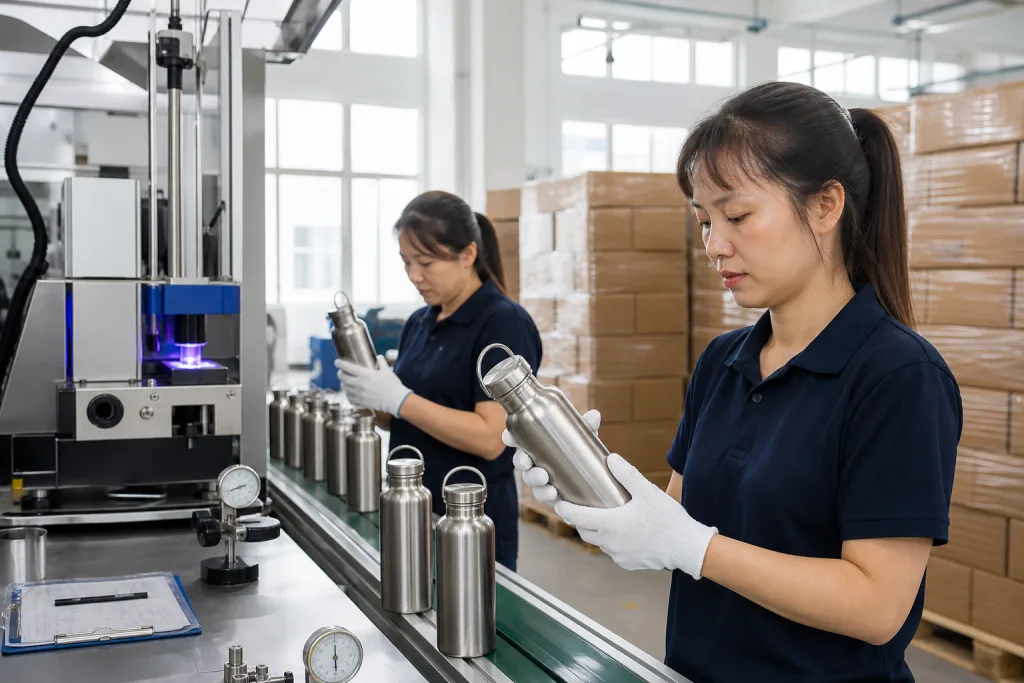
At BottleForge in Zhejiang, we see buyers lose money when they treat custom canteens like stock items. A 500 ml stainless canteen with a one-color logo, food-grade silicone seal, and retail carton prices one way; a 1 L powder-coated canteen with laser engraving and an accessory lid prices another. The buyer flagged a “same product” PO typo last month, and QC pulled the sample again before we released the line. Factory setup, decoration method, and China lead time all change the math.
What drives canteen cost
I’ll rewrite the section in-place, keep the HTML intact, and tighten the pricing language so it reads like a factory-side sales engineer wrote it.When buyers ask for a canteen supplier quote, the price usually splits into five buckets: body material, lid system, decoration method, packaging, and order quantity. Simple. This is where most budget surprises start. A flat stainless body with a screw lid is quick to run on the line. Add a double-wall vacuum shell, a carry handle, a powder coat, and a custom box, and the unit cost climbs fast.
For a standard 18/8 stainless custom canteen, FOB China pricing often sits around USD 2.30-3.20 at 1,000 units for single-wall models, and USD 4.20-6.80 for vacuum insulated versions. If you want a customized canteen with embossing, matte powder coating, or mixed-color lids, expect a 5-18% uplift. Laser engraving usually adds less than full-color printing, often USD 0.08-0.25 per unit; wrap printing or multi-color pad print can add USD 0.15-0.40, depending on coverage. QC pulled the sample on a 0.3 mm lid gap last week, and that kind of detail is why the numbers move.
Packaging is another quiet cost driver. A plain polybag and eggcrate insert may add only USD 0.06-0.12. A retail box with barcode, warning copy, and hangtag can add USD 0.25-0.65. If you are a canteen distributor selling into Europe or the US, that packaging is not optional; it sits in landed margin. We’ve seen buyers flag a PO typo on box size and lose a week. A good canteen manufacturer in Zhejiang will quote it separately so you can see what is optional and what is not.
Do not compare two quotes unless you know whether they include lid, logo, box, and carton test requirements. A cheap quote can hide USD 0.70-1.50 per unit in “extras.”
MOQ tiers that actually work
I’ll rewrite the prose only, keep the HTML tags and list structure intact, and make it sound like a factory-side sales engineer wrote it.MOQ is where first-time buyers either enter clean or get stuck with dead stock. We see it on the line all the time. For most canteen manufacturers in China, the working tiers are clear: 300-500 units gets you a simple logo, one color, and standard packaging. At 1,000 units, the buyer starts getting room for custom lid color, mixed finishes, upgraded cartons, and steadier unit pricing. At 3,000 units and above, the canteen factory can spread setup cost enough to give real margin relief.
For a stainless custom growler or a customizable growler style canteen, MOQ can drop for laser marking and climb for full decoration. A laser-marked trial run may start at 200-300 units, while full-color print on a curved body often needs 500-1,000 units because the screen setup and reject allowance eat into yield. QC pulled the sample once and found a 1.5 mm print shift on the second pass. If the buyer is a chain store or a distributor canteen program, 1,000 units per SKU is usually the right number. The math works there.
- 300-500 units: fastest entry, higher unit price, limited decoration
- 1,000 units: best balance of cost and flexibility
- 3,000+ units: stronger pricing, better for canteen promotional programs
In Zhejiang, established facilities can take lower MOQ on repeat molds because the tooling is already on hand. We ship those repeats faster. That is why a direct canteen supplier often beats a middle-layer canteen vendor on MOQ and reply speed.
Lead times by project stage
I’ll rewrite the three paragraphs with tighter B2B factory language, keep the HTML exactly as-is, and make the lead-time ranges sound like something a sales engineer would send a buyer.Lead time is not one number. It breaks into steps, and each step has its own range. Sample development usually takes 5-10 days if we are working from an existing body and only changing the logo. New artwork, custom lid colors, or a carton redesign can push sampling to 12-18 days. If the canteen starts from a new mold, add 20-35 days before mass production even starts. QC pulled the sample on a 0.5 mm lid gap before release.
Once you approve the sample, a normal production run for custom drinkware is often 20-35 days for 1,000-5,000 units. If the order includes a special coating, mixed parts, or stricter packaging checks, plan on 30-45 days. Ocean freight from China to North America is often 20-35 days port to port, and Europe usually runs 28-40 days depending on routing. The math does not work any other way: artwork sign-off to warehouse receipt can land at 45-75 days. We once had a buyer flag a PO typo on carton count, and that alone burned two days.
Here is the practical rule: if a canteen distributor wants stock ready for a seasonal launch, place the order at least 8-10 weeks before the ship date. A capable canteen factory in Hangzhou or elsewhere in Zhejiang will say that straight, not sell you fantasy dates. You want a partner who protects your calendar. We run the line to hit dates, not to promise miracles.
Choosing the right material
I’ll keep the HTML intact and rewrite the three paragraphs with more buyer-floor detail, cleaner sales tone, and the required specifics.Material choice drives cost, weight, durability, and compliance. On the line, stainless steel is still the default for most canteen programs because it holds up, cleans fast, and clears both retail and promo specs. We usually see buyers call for 304 stainless steel on the inner wall, and sometimes on the outer wall too. If the program is price-led, 201 stainless can cut cost by 10-20%, but that is the wrong trade if you need stronger corrosion resistance or a premium shelf story.
For a customizable canteen in Europe or North America, you also need to look at coatings and contact parts. Powder coating is standard, but QC should check adhesion with a cross-hatch test and watch for chips after the tumbler drop test. Silicone seals, lids, and straws need food-contact paperwork that matches the market. Ask for REACH files when you sell into Europe, and get FDA-oriented material declarations on file before the PO lands. We have seen buyers flag a one-word typo on the PO and then spend a week chasing the missing declaration.
Glass and plastic canteen options are on the table, but they handle risk differently. Glass fits gift sets and tabletop programs, while PP and Tritan work better for lightweight custom drinkware. If the order is going to gyms, outdoor retail, or distributor channels, stainless usually gives the cleaner math on margin and returns. A 500 ml stainless unit may cost more up front than PP, but the breakage rate stays lower, and that matters when you ship cartons by the pallet.
Decoration choices and price impact
Decoration is where a canteen promotional program turns into either a clean sale or a cost headache. We run one-color silkscreen on a plain body at the lowest price point; it is quick, and it fits logos with hard edges. Laser engraving takes more setup, but on matte stainless it holds up better than ink. Full-wrap printing gives the most freedom, yet the line has to control curve distortion and scrap rate, or the math breaks fast.
For a canteen customizable order, decoration can shift the unit price by USD 0.10-0.80. A small logo may add only a few cents. We have seen a full-surface print, color-matched lid, and retail sleeve push the package up by more than a dollar. If you buy for distribution, this is the wrong question to ask: “Which finish looks best?” The buyer flagged it once on a 5,000-piece PO, and the landed margin changed enough to move the resale price.
What to ask the factory
- Is the logo price based on one color or total coverage?
- Does the quote include print loss and overage for AQL 2.5 inspection?
- Are the lid and body packed as a matched set or separately?
- Will the decoration survive 50 dishwasher cycles or only basic handwashing?
The right canteen supplier does not sell the fanciest finish first. QC pulled the sample and checked the print edge at 2 mm from the rim, then we knew which option would hold in mass production. They will steer you to the decoration that fits your channel, your target price, and your reject tolerance. That matters most for private-label distributors, where a 3% defect rate can wipe out a small margin.
How to compare suppliers
I’ll rewrite the section in-place style, keep the HTML tags untouched, and strip the AI-sounding phrasing while adding a few concrete factory details and buyer-side pushback.Not every canteen supplier is a real factory, and you see the gap in control, pricing, and how fast they answer when the buyer flags a drawing issue. A trading company can source from three or four plants and send a quote fast, but it has less grip on lead times, mold fixes, and color match. A direct canteen factory in Zhejiang or elsewhere in China usually gives you cleaner traceability on 304 stainless, coating records, and after-sales follow-up. For custom drinkware, that matters more than a polished sales deck. We’ve seen this go sideways on a 12-day promise that turned into 18 days because the line had to stop for a cap insert change.
Ask for factory metrics, not marketing claims. A solid supplier should state monthly output, typical MOQ by process, and standard lead time by SKU without dodging the question. For example, a factory running 80,000 units per month with a 500-unit MOQ and a 25-30 day production cycle gives you something to compare; “fast delivery” does not. Request BSCI or similar social compliance evidence if your retailer requires it, and ask how they handle inspection, whether that is pre-shipment AQL 2.5 or a third-party check. QC pulled the sample with a caliper once and found a 1.2 mm wall deviation; that is the kind of detail that protects your margin.
You should also test communication. If the supplier cannot explain why a canteen custom quote changed after artwork revision, the math does not work. Good Zhejiang factories are direct about cost drivers because they already know where the margin sits. That honesty saves time on both sides. We once caught a PO typo on a 500 ml bottle size, and the supplier who spotted it in 10 minutes earned the order.
When custom growlers fit better
I’ll rewrite the three paragraphs in place, keep the HTML unchanged, and make it read like a field-tested sales note with concrete sourcing details.Sometimes the better call is not a classic canteen. If your buyer sells beer, does outdoor gifting, or runs a premium drinkware line, a custom growler or customized growler often lands better than a standard flask-style bottle. We’ve seen that pushback in sample review: the buyer flagged the canteen as “too utility, not enough shelf pull.” Same sourcing math still applies. Body material, seal quality, print method, and carton protection all change the landed cost.
A customizable growler in stainless usually starts above a smaller canteen because there is more steel in the body and the lid assembly is tougher to spec. On our line, the 32 oz vacuum model often quotes FOB China at USD 5.50-9.00, depending on wall structure, finish, and cap type. If you are buying through a canteen distributor or a distributor drinkware program, this is a clean way to move into a higher-price slot without changing suppliers. QC pulled the sample before packing; the cap torque was off by 0.3 N·m, and that kind of miss gets expensive fast.
For buyers who need both canteen customized SKUs and lifestyle growlers, a capable canteen manufacturer can keep logo placement, packaging format, and compliance files aligned across the range. That saves admin hours and cuts the back-and-forth on PO details—we once fixed a carton typo from 24 pcs to 24/case before the goods hit the pallet wrap. It also lets you consolidate volume across channels without splitting the order flow.
Get a real canteen quote, not a guess
Send your target MOQ, artwork, and market. We will return a clear China FOB breakdown with lead time, packaging, and compliance options.
Frequently asked questions
What is the usual MOQ for a custom canteen?
For a standard custom canteen with one-color printing, MOQ is commonly 500-1,000 units. Laser engraving can sometimes start at 300 units because setup is simpler. If you want a customized canteen with special lid colors, retail packaging, or multi-color decoration, 1,000 units is the more realistic starting point. Very simple repeat orders from an existing mold can go lower, but new tooling or premium finishes will push MOQ up. A serious canteen supplier should state the MOQ by process, not hide it inside one generic quote.
How much should I budget FOB China?
For basic stainless canteen custom work, budget roughly USD 2.30-3.20 per unit at 1,000 pieces for single-wall models. Vacuum insulated versions are often USD 4.20-6.80, and more complex customized drinkware can move higher depending on coating, lid, and packaging. If you want a premium canteen promotional program with retail boxes and a more advanced lid, USD 5.00-8.50 is not unusual. These are FOB China figures, so you still need freight, duties, and destination handling on top.
How long does production usually take in China?
A common production window for custom drinkware is 20-35 days after sample approval. If you are developing a new mold or changing the structure, add 20-35 days before that. Simple logo-only repeat orders can be faster, while a canteen customized with multiple components or special packaging can take 35-45 days. From a Zhejiang factory, you should also budget shipping time: 20-35 days to North America by sea and about 28-40 days to Europe, depending on route and carrier.
What documents should I ask from a canteen manufacturer?
Ask for material declarations, REACH-related support for Europe, and any food-contact or testing documentation relevant to your market. If your retailer requests it, BSCI or a similar audit record is useful. You should also request carton specs, barcode placement guidance, and an inspection plan such as AQL 2.5 for pre-shipment checks. A canteen manufacturer that handles distributor canteen orders well will already know how to package this information without creating delays.
Is a factory better than a canteen vendor?
Usually yes, if you care about control, price transparency, and repeatability. A canteen vendor can be convenient for low-volume buying, but a direct canteen factory in China typically gives you better cost structure, more accurate lead times, and clearer handling of artwork changes. In Zhejiang, many factories run 50,000-100,000 units per month and can support repeat custom canteen programs efficiently. For serious B2B orders, that extra control is usually worth more than a slightly smoother sales pitch.