Key Takeaways
- For most custom canteen projects, practical MOQ starts at 1,000-3,000 pcs per color and capacity
- A useful canteen supplier list should compare material grade, AQL level, logo method, packing, and FOB terms
- 304 stainless steel, PP lid components, silicone seals, and REACH/LFGB test reports should be checked before deposit
- Normal production lead time is 30-45 days after sample approval, depending on decoration and order quantity
A canteen supplier list looks simple until the first RFQ leaves your inbox. Then 18 replies come back with mixed steel grades, PP or Tritan cap claims, logo size limits, carton CBM, MOQ rules, and price terms. Some canteen suppliers quote FOB Ningbo, some quote EXW, and a few “forget” to say whether the bottle is 201 or 304 stainless steel. We saw one PO last month with “304 inside, 201 outside” typed into the remark column; QC pulled the sample with a magnet before we even opened the salt spray report.
If you buy custom drinkware for retail, promotions, outdoor programs, corporate gifting, or distributor drinkware catalogs, the wrong question is “who is cheapest?” Build a shortlist that removes risk before price negotiation. From our factory base in Zhejiang, China, we see the same pattern on the line: buyers who lock capacity, material, decoration, testing, and packing upfront usually cut sampling time by 7-10 days and avoid rework on laser logo position, shrink wrap, or export carton marks. A 1 mm logo shift sounds small. It still gets flagged.
What belongs on your supplier list
A useful canteen supplier list is not company names copied from Alibaba or Global Sources. For B2B buying, each line should tell you whether that supplier can form the body, run the leak test, print the logo, pack to your carton spec, then ship without a late surprise. We usually build the sheet with 18 fields, because one missing item like carton drop-test status can cost more than the whole sample fee.
Track supplier type, location, factory status, main material, MOQ, daily output, export markets, certifications, decoration options, sample cost, lead time, and payment terms. If you are buying from China, mark the contact as a canteen factory, trading company, or hybrid exporter. None is automatically bad. They just carry different risks. We have seen a PO typed as “304 stainless” while the supplier quote said “201 stainless”; QC caught it with a handheld XRF gun before sample approval.
For example, a canteen manufacturer in Zhejiang may control seam welding, mouth polishing, powder coating, and vacuum testing on its own line. A trading company may show a wider catalog, then place your customized canteen with 2 or 3 workshops. That matters when you need Pantone 186C to match across 5,000 pcs, when the lid thread must stay within 0.2 mm, or when the buyer asks for the same item again six months later.
- Factory identity: business license name; audit status; production address; export experience by market, such as EU or North America.
- Product scope: stainless canteen, plastic sports bottle, aluminum bottle, custom growler, or travel tumbler, with the main sizes they run on the line.
- Commercial fit: MOQ, FOB port, sample time, bulk lead time, and payment terms, plus whether they accept a 500 pcs trial order before 3,000 pcs bulk.
- Quality fit: AQL standard, inspection records, material test reports, and complaint handling, including who signs off when QC pulls a leaking sample.
Do not rank canteen vendors by unit price only. This is the wrong question to ask. A USD 0.18 saving disappears fast if caps leak at 2% or if a 5-layer export carton crushes during pallet handling. Your shortlist should answer one harder question: which canteen suppliers can repeat the approved specification at bulk scale, carton after carton?
Questions before requesting a quote
Before you ask any canteen vendor for pricing, lock the buying brief. In our Hangzhou sample room, 6 out of 10 slow RFQs come from missing specs, not from a sales rep dragging his feet. “Please quote a custom canteen” is the wrong question to ask. A 500 ml single-wall stainless canteen, a 750 ml insulated canteen, and a 1.9 L customized growler need different molds, welding steps, lids, and carton sizes.
Your RFQ should state capacity in ml or oz, body material grade, single-wall or vacuum construction, lid type with strap or no strap, Pantone color, logo size in mm, packing method, test requirement, and destination market. If you sell in the EU, ask about LFGB, REACH, and food-contact declarations. If you sell in North America, ask about FDA food-contact compliance and ASTM-related packaging requirements where relevant. If the item is for children, tighten the small-parts pull test, 3M tape coating adhesion check, and Pb/Cd chemical limits; QC pulled one kid’s cap sample last year because the silicone plug came loose at 62 N.
For stainless steel custom drinkware, ask whether the body is 304, 316, or 201 stainless steel. For most canteen custom projects, 304 is the practical standard for food-contact durability. Wall thickness often sits around 0.4-0.6 mm for many stainless bodies, but the number changes with capacity and forming process. We check it with a digital micrometer at the mouth, shoulder, and base after stretching. Thinner saves cost, but the math does not work if the product goes into outdoor retail or school channels where dent returns hit fast.
Ask every canteen manufacturer the same 12 questions. If one answer is vague, mark it as a risk instead of filling the gap with hope.
Define the commercial target before the quote sheet goes out. A canteen promotional order with a one-color logo and polybag packing cannot be judged against a retail-ready canteen customized with powder coating, laser engraving, color box, barcode, and drop-tested master carton. We ship both types, and buyers still flag a $0.18 price gap when the PO forgot to say “color box.” Clean specs make quotations comparable and stop the line from guessing later.
How to compare factory capability
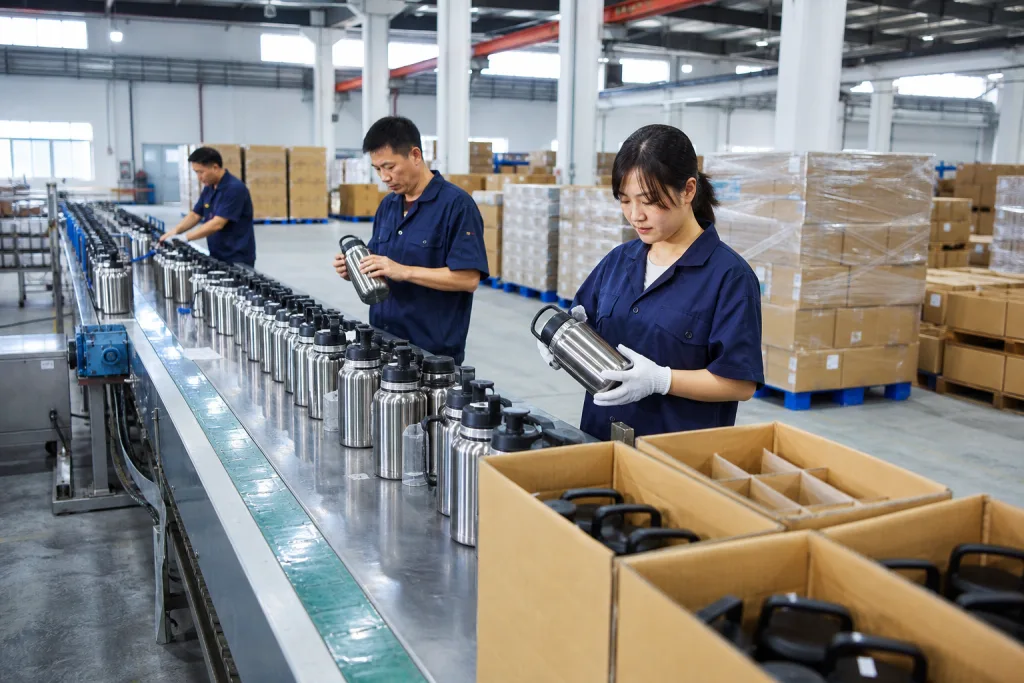
Factory capability is the point where your canteen supplier list starts earning its space in the spreadsheet. A brochure can say “professional canteen manufacturer”; the line tells the truth. Ask for photos or videos of forming, welding, polishing, coating, assembly, leak testing, and packing, with the machine nameplate visible where possible. We usually ask for a 10-minute live walk-through during China working hours, because a TIG welding station, a rotary polishing wheel, and a carton drop-test corner are harder to fake than a PDF.
For reference, a mid-sized Zhejiang drinkware factory may produce 300,000-600,000 units per month, split across stainless bottles and canteens depending on season and product mix. Peak season changes the answer. BottleForge Industrial works with MOQ starting from 1,000 pcs for selected stock-shape logo orders and 3,000-5,000 pcs for custom color or more complex canteen customizable projects. New mold development usually needs higher volume because tooling, jigs, and trial runs must be paid back across the order; if the buyer wants a new cap mold for 800 pcs, the math doesn't work. On our floor, QC pulled a first-shot cap sample last month because the gasket groove was 0.35 mm shallow.
Check whether decoration is done in-house or sent to a subcontractor two towns away. Silkscreen printing, laser engraving, heat transfer, UV printing, and powder coating do not solve the same problem. Laser engraving lasts, but it gives you no Pantone logo color. Silkscreen is the better choice for a one-color school crest or a simple distributor mark. Full-wrap artwork on curved bottles needs tighter fixture control, usually with a custom aluminum jig, and more pre-production proofing before we run 3,000 pcs and find the logo drifting 2 mm at the seam.
Capability checklist
- Can the canteen factory provide pre-production samples before mass production?
- Does it run 100% leak testing on vacuum or screw-cap products?
- Can it match Pantone colors with a tolerance sample?
- Does it understand retail packaging, FNSKU labels, and distributor carton marks?
- Can it support repeat orders with the same cap, gasket, and color finish?
If you are a canteen distributor or distributor growler buyer, repeatability matters more than novelty. Ask the dull questions. Your customers reorder the item they know, not the version the factory switched to because another cap was 0.08 USD cheaper. We have seen this go sideways: the buyer flagged a repeat PO where “matte black” came back with a rougher powder coat texture, and the warehouse rejected 42 cartons before the shipment even hit retail.
Pricing traps in custom canteen orders
Custom canteen pricing has a lot of small screws behind it. Body material is only one line on the cost sheet. Lid structure, gasket hardness, coating type, logo process, packaging spec, testing, scrap rate, inland freight, and exchange rate all hit the final FOB price. On our line, a 0.45 mm body wall and a 0.50 mm body wall do not behave the same during polishing, and QC pulled samples last month for small dents near the shoulder after the rolling station.
For a basic 600-750 ml stainless custom canteen, a promotional-grade FOB China price might sit around USD 2.20-4.50 depending on steel grade, coating, lid, order quantity, and logo method. Insulated models, larger capacities, or retail packaging can move much higher. A custom growler or customizable growler with double-wall vacuum insulation, handle lid, and color box sits in another price band, because vacuum testing, leak testing, and carton drop-test failure all add cost. We run vacuum checks before packing; one failed seal can hold up 48 pieces on the table.
Be careful when one canteen supplier is 15-25% lower than the rest. The math may work, but ask where the saving comes from. Common reasons include 201 stainless instead of 304, thinner body wall, cheaper silicone seal, outsourced coating, lower carton strength, no testing cost included, or EXW terms quoted instead of FOB Ningbo or FOB Shanghai. We have seen this go sideways: the buyer approved 304 stainless, then the pre-shipment inspector found 201 material on the inner cap plate with an XRF gun.
Ask for a costed quotation format. It does not need to show every factory margin, but it should separate product unit price, logo charge, sample fee, mold or tooling fee, packaging upgrade, inspection fee if any, and shipping term. For distributor canteen and distributor drinkware programs, ask whether the price is stable for 30, 60, or 90 days. Stainless steel and packaging paper prices can move around Chinese New Year and peak export months. Last January, a buyer flagged a PO typo that said FOB Shanghai while the quote said FOB Ningbo; that small port change added USD 180 inland freight on one 20 ft shipment.
Payment terms also affect risk. A normal arrangement in China is 30% deposit and 70% balance before shipment, often after inspection. For established buyers with repeat volume, terms can improve after 2 or 3 clean orders. For a first order, do not push payment terms harder than quality controls. We ship better when the deposit is clear, the artwork is locked, and the AQL 2.5 inspection date is booked before the cartons reach the warehouse.
Quality checks buyers should require
A canteen with your brand on it should be checked like a product, not a giveaway. We run it that way on the line. Even promotional orders need pass/fail rules on paper. If you skip that, the factory’s idea of “acceptable” and your customer’s idea will not match. QC pulls one cap every 50 pcs, and that catches more trouble than a pretty sample ever will.
Use AQL inspection for bulk shipments. A common general inspection level is AQL 2.5 for major defects and 4.0 for minor defects, although critical food-contact or safety issues should be treated with zero tolerance. Write the critical list straight on the inspection sheet in red ink: leaking cap, sharp edge, cracked lid, loose handle, wrong material, wrong logo, heavy dent, odor, or a barcode that fails the scanner.
For stainless and plastic contact parts, ask for material declarations and test reports based on your market. EU buyers often ask for LFGB or EU food-contact documentation plus REACH screening for coatings or accessories. North American buyers usually request FDA food-contact compliance. If the canteen is for children, ask about applicable CPSIA-related requirements and coating safety. This is not the place to guess. We have seen a buyer lose a week because the carton file was ready, but the coating test was still missing from the folder.
Physical tests should match the sales channel. Outdoor retailers may expect drop testing, coating adhesion checks, salt spray reference checks for metal accessories, lid torque checks, and dishwasher claims only if validated. We usually run a 1.2 m drop on concrete and a torque check with a wrench set to 0.8 N·m. If you print “dishwasher safe” without test support, the complaint comes back to you, and that is the wrong question to ask.
- Before production: approve the gold sample, artwork proof, color chip, and packing layout. On one job, the buyer flagged a PO typo on “matte black,” and that saved a reprint before the line started.
- During production: check the first finished units for logo position, coating, and lid fit. We pull those units at the first station, not after the whole batch is done.
- Before shipment: run final random inspection, carton drop check, quantity count, and barcode scan. A missing barcode scan on one 2,000 pcs order turned into a full repack, so we do not skip it.
At BottleForge Industrial in Zhejiang, China, we prefer buyers to sign off a pre-production sample before bulk coating begins. It adds 2 to 3 days, but it prevents 5,000 pcs of the wrong matte black finish. We have seen that go sideways more than once.
How distributors should shortlist vendors
Canteen distributors need a sharper filter than one-time promo buyers. You are not buying 3,000 pieces for a single event; you are setting up a repeat program that may run six POs across 18 months. Your canteen supplier list should split “safe for one project” from “safe for catalog supply.” QC pulled a sample last month where the lid fit was fine, but the replacement gasket was 0.4 mm thinner than the approved part. That is how repeat orders start to drift.
First, check product continuity. Will the canteen manufacturer keep the mold, lid, gasket, and color finish available for at least 12-24 months? If not, your catalog image becomes a liability. Second, check mixed-container flexibility. We often ship canteens, tumblers, sports bottles, and customized drinkware in one 40HQ, with 8-15 SKUs under one booking. A supplier who can consolidate multiple SKUs under one export process cuts receiving work and avoids three sets of carton marks, packing lists, and customs questions. Ask this directly. Some factories say yes, then push back when the PO shows four lid types and two powder-coat colors.
Third, look at data support. For Amazon FBA, retail DCs, or regional distributors, you may need FNSKU labels, carton labels, master carton dimensions, gross weight, HS code guidance, product images, and compliance files. This is not hard work, but it must be exact. We check carton size with a tape measure at packing, not from a sales sheet copied from last season. Wrong carton marks can delay receiving even when the product is perfect; one buyer flagged a 60 cm master carton listed as 56 cm on the ASN, and the DC held the pallet for 12 days.
For distributor growler or customizable drinkware programs, ask about spare parts. Extra lids, seals, straws, and handles are cheap insurance. A 1-2% spare parts allocation can stop a replacement claim from turning into a full product return. The math does not work if you save USD 0.03 on a seal and then air-ship 200 lids after complaints. Ask whether the factory can hold approved artwork and repeat Pantone references for future purchase orders; we keep signed color chips and laser-marking files with the job folder because one typo on a PO can send the line in the wrong direction.
The best canteen vendors for distributors are usually not the cheapest factories. They answer technical questions clearly, record changes, and tell you when your idea will cause problems. We have seen this go sideways when a buyer approved a narrow mouth to improve the look, then complained that ice cubes would not fit. That honesty matters when your customers expect stable supply, not excuses from Zhejiang, China, after the vessel has already sailed.
Sample and ordering workflow
A tight workflow keeps custom drinkware projects on schedule. For a stock-shape customizable canteen, we can usually issue the first quote within 24-48 hours if the RFQ includes capacity, finish, logo method, carton packing, and target quantity. Miss one line, and the quote sits. Logo mockups usually need another 1-2 working days after we receive AI, PDF, or EPS files. A physical sample using an existing mold and simple logo decoration often takes 7-12 days; our sample room checks print position with a 0.5 mm steel ruler before packing. New color coating, special lid development, or a customized growler structure can push sampling to 15-25 days.
After sample approval and deposit, normal production is 30-45 days for about 80% of orders under 20,000 pcs. Peak season, complex packaging, or external lab testing can add time, and the math does not work if a buyer asks for 18 days on a powder-coated gift-box order that still needs LFGB testing. Ocean freight to North America or Europe is separate, so book it early if delivery is tied to a retail launch or trade show. Last October, QC pulled the sample because the carton mark on the PO said “canteen bottle” while the artwork proof said “camping flask.” Small typo, big delay.
Use this ordering checklist before deposit:
- Confirmed final specification sheet with capacity, dimensions, weight, material, and finish.
- Approved logo file in AI, PDF, or EPS format with print size and placement.
- Confirmed packaging: polybag, white box, color box, insert card, carton marks, pallet needs.
- Agreed MOQ, unit price, tooling fee, sample fee, FOB port, and payment schedule.
- Defined inspection standard, AQL level, compliance documents, and shipment deadline.
When comparing canteen manufacturers, check how they handle revisions. A professional canteen vendor updates the quotation, artwork proof, and specification sheet after each change, including small items like lid gasket color or carton size in cm. If updates are buried across 37 chat messages, we have seen this go sideways. For serious B2B orders, the final proforma invoice should match the approved specification, not just the product name “custom canteen.”
Send your canteen RFQ for a practical factory review
Share capacity, material, logo, packaging, MOQ, and destination market. We will flag cost drivers and production risks before sampling.
Frequently asked questions
What MOQ should I expect from a canteen manufacturer in China?
For stock-shape custom canteen orders, MOQ is often 1,000-3,000 pcs per color and capacity. If you need a custom color coating, retail color box, or special lid, 3,000-5,000 pcs is more realistic. New mold development for a canteen customized from scratch can require 10,000 pcs or more, depending on tooling cost and complexity. Some canteen suppliers will accept lower MOQ, but the unit price may rise by 10-30% because setup, printing, coating, and export handling are spread over fewer units.
How do I know if a canteen supplier is a real factory?
Ask for the Chinese business license, production address, audit documents, workshop video, and photos of key processes such as welding, polishing, coating, assembly, and leak testing. A real canteen factory should explain its monthly capacity, main equipment, QC steps, and in-house versus outsourced processes. You can also request a live video call during China working hours. If the supplier refuses to show the production site or gives only catalog images, treat it as a trading company until proven otherwise.
Which logo method is best for customized drinkware?
It depends on the finish, order quantity, and durability target. Laser engraving is very durable on stainless steel and good for premium custom drinkware, but it cannot print full-color graphics. Silkscreen printing is economical for 1-2 color logos and common for canteen promotional orders. UV printing supports more color detail but needs proper adhesion testing on coated surfaces. For powder-coated canteens, always approve a production-like sample and run tape adhesion checks before bulk production.
What should I check in a pre-shipment inspection?
Use AQL sampling, commonly 2.5 for major defects and 4.0 for minor defects, unless your customer requires stricter rules. Check quantity, appearance, coating color, logo position, lid fit, leaking, odor, sharp edges, dents, barcode readability, carton strength, and packing accuracy. For a 5,000 pcs order, a third-party inspector may inspect a few hundred units depending on the sampling plan. Critical defects such as leaks, wrong material, or unsafe edges should have zero tolerance.
Can one supplier handle canteens, growlers, and other drinkware?
Yes, if the supplier has a broad drinkware production base or stable partner workshops under one QC system. Many buyers prefer one canteen supplier for custom canteen, custom growler, sports bottle, and travel tumbler projects because documentation and shipping are easier. The risk is that the supplier may be strong in one category and weak in another. Ask for category-specific samples, test reports, and recent export cases before combining SKUs in one purchase order.