Key Takeaways
- 304 stainless steel with 0.45-0.55 mm inner wall is the normal starting point for private-label canteens
- Typical MOQ is 1,000 units per color for stock shapes and 3,000-5,000 units for custom tooling
- Laser logo samples usually take 5-7 days; full production after approval is commonly 30-45 days
- AQL 2.5/4.0 inspection, REACH review, and carton drop testing should be written into the PO
Canteen private labeling looks easy on a quote sheet. Then QC pulls the sample and the lid torque is off by 0.8 N·m, the paint film reads thin under the gauge, or the carton fails a 1.2 m drop test. One bad bottle is not the problem. The problem is 5,000 units that look fine in photos and then trigger returns, retailer claims, or distributor complaints the week they hit shelf.
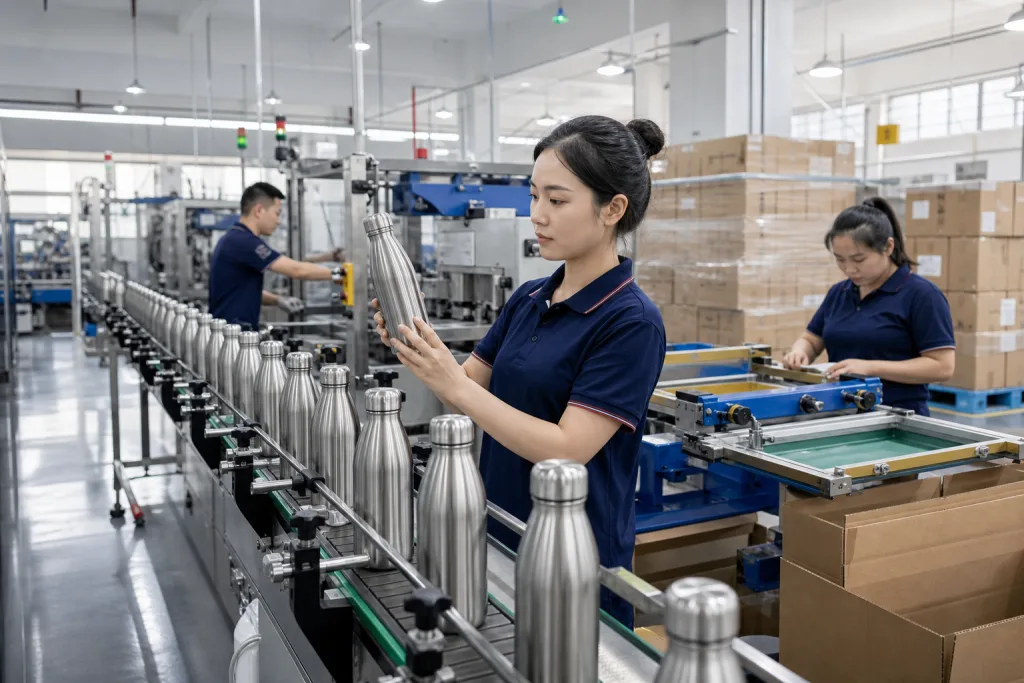
At our Zhejiang drinkware factory, we run a custom canteen like a spec-controlled production job, not a souvenir order. The line checks logo position with a steel ruler, the buyer flags a typo on the PO, and we fix it before packing starts. If you source from China for outdoor retail, campus supply, promo programs, or distributor channels, every line on the quote sheet changes cost, lead time, compliance, and how the bottle feels in the hand. The buyer who says “just print the logo” is asking the wrong question.
Capacity Is A Retail Decision
The first spec line most buyers write is capacity: 18 oz, 24 oz, 32 oz, 40 oz, or 64 oz. That number is a retail decision. It sets shelf price, shipping cube, handle clearance, lid opening, and the customer your canteen private labeling project can serve without fighting returns. On our line, a 40 oz body needs a different necking tool than a 24 oz body, and that tooling change is where buyers often miss 3-5 days.
For outdoor retail and campus channels, 24 oz and 32 oz are the safer custom canteen sizes. A 24 oz stainless canteen usually lands around 270-340 g before packaging, depending on wall thickness and insulation. A 32 oz version feels more premium on the shelf, but it pushes carton weight up fast; one buyer flagged this after seeing a 12.8 kg master carton on the packing spec. Freight kills cheap promos. For distributor canteen programs, the math does not work if the landed cost jumps just to make the bottle look bigger.
Growler-style products are different. A custom growler or customized growler normally starts at 64 oz, with a wider mouth and stronger cap seal. Do not treat a distributor growler like a scaled-up sports bottle. Once liquid weight exceeds 1.8 kg, the handle, weld strength, and lid thread design become failure points; QC pulled one sample last year where the spot weld showed a 0.6 mm gap after a loaded drop test.
Ask your canteen supplier to quote the actual brimful capacity and practical fill capacity. A bottle marked 1,000 ml may hold 1,060 ml to the brim but only 980-1,000 ml in normal use. We run this with a digital scale and water at room temperature, then record the number on the pre-production sample report. If you sell through regulated retail packaging in Europe or North America, check that distinction before artwork is printed, because a 1,000 ml claim on the color box is not something you want to fix after mass production.
Buyer impact: capacity changes FOB price, carton size, perceived value, and claim risk. Do not approve the shape until you know the packed weight and master carton dimensions.
Steel Grade And Wall Thickness
For stainless canteen custom projects, the standard food-contact build is 304 stainless steel on the inner wall and 201 or 304 on the outer wall. If the program sits in outdoor premium, children’s retail, or corporate gifting with 18-24 months of brand exposure, specify 304 inner and 304 outer. It costs more, often USD 0.25-0.60 extra per unit depending on size, but it cuts rust claims on exposed rims, base edges, and thread areas. QC sees this first. Last month the line pulled 12 samples with light staining around the bottom seam after a 5% salt spray check; all were 201 outer bodies from a low-price quote.
Wall thickness is where quotes get slippery. A canteen manufacturer can make the same 32 oz shape with a 0.35 mm outer wall or a 0.50 mm outer wall. Both look fine in a catalog photo. The thinner one dents faster, feels cheap in hand, and can deform during vacuum handling, polishing, or carton drop testing. For most customized drinkware, we run 0.45-0.55 mm inner wall and 0.40-0.50 mm outer wall. Heavy-duty custom growler programs may need 0.55-0.65 mm depending on handle design. The buyer often asks, “Can you match the cheaper quote?” Wrong question. Ask whether the supplier measured the sheet with a Mitutoyo micrometer before forming, because 0.08 mm missing from the wall is easy to hide until the first pallet arrives.
If the canteen is single-wall aluminum rather than stainless steel, ask for alloy grade, internal coating, and coating migration test data. Aluminum canteens are lighter and cheaper, but coatings need tight control, especially around the shoulder radius where spray thickness can drop below 12 μm. For European buyers, request REACH-related documentation and food-contact declarations. For the U.S. market, ask whether the supplier can support FDA food-contact expectations and, for children’s items, relevant CPSIA or ASTM review. We have seen this go sideways when a PO only said “silver aluminum bottle” and the supplier treated the inside coating as optional.
China has 200+ canteen manufacturers selling export orders, but not every canteen factory controls material thickness lot by lot. At our Zhejiang production site, incoming stainless coil is checked by micrometer, and production lots are separated by batch number. Simple habit. It prevents big distributor drinkware problems later, like mixed 0.35 mm and 0.45 mm bodies in the same SKU or a carton of replacement lids matched to the wrong thread batch.
Insulation Performance Needs A Number
“Keeps drinks cold all day” is not a production spec. We ask buyers to write the target in numbers: 95°C water stays above 55°C after 6 hours at 20°C room temperature, or 4°C water stays below 10°C after 12 hours. QC pulled the sample on our bench and compared it against the same record. Give us a number, not a slogan.
Vacuum insulation comes down to weld quality, vacuum level, wall gap, copper plating, and cap design. On the line, a 0.1 mm weld issue or a weak vacuum pull shows up fast in the thermal curve. A wide-mouth cap loses more heat than a narrow screw cap. A straw lid is convenient, but it will not perform like a sealed stainless cap. This is the wrong question to ask if your target is under USD 5 FOB; at that price, you may need single-wall construction or a shorter insulation window. If you are buying retail-grade customizable drinkware at USD 8-12 FOB, batch testing for thermal retention is the right call.
Leak resistance also belongs on the spec sheet. We run a simple test: fill to rated capacity, close the lid at defined torque with a torque wrench, invert for 30 minutes, then shake and inspect. For sports and outdoor packs, the lid should also survive a 1.0 m drop test on packed samples and basic thread fatigue testing. A cap that saves USD 0.12 can turn into a return pile fast. We've seen that go sideways.
If you sell to canteen distributors, keep mixed lid options under control. Straw lid, loop cap, chug cap, and bamboo-look lid may all fit the same body, but they do not give the same leak result, dishwasher expectation, or spare-part setup. Put each lid into the quotation and the test plan on its own line. One PO typo can send the wrong cap style to the wrong body size, and the buyer will flag it before the cartons leave the warehouse.
Surface Finish Drives Brand Perception
Powder coating, spray painting, electro-polishing, brushed stainless, matte UV print, and rubberized touch coating do not sell the same bottle. On a canteen customized order, the finish often decides whether retail buyers call it “promo stock” or “shelf-ready.” We had a German buyer put two 750 ml bottles side by side last month, both 304 stainless, and he picked the one with the smoother powder feel before checking the spec sheet.
Powder coating is still the safer choice for outdoor custom drinkware. We run standard coating thickness at 60-90 microns, checked with a coating thickness gauge before packing. For rough handling or distributor growler programs, ask for cross-hatch adhesion testing and abrasion testing, not just a nice sample photo. Spray paint gives clean gradients and gloss, but scratches show faster around the base ring. Rubberized coating feels premium in the hand, but black and navy can pick up oil marks after 10 minutes on the line. The math does not work if the buyer expects a soft-touch finish to survive like powder coat.
Color matching should use Pantone or physical color chips, with an agreed tolerance from the start. Metal curvature, coating thickness, and curing temperature shift the final color; we have seen the same Pantone look 1 shade warmer after a 180°C curing pass. For canteen private labeling, approve a physical color sample under D65 light, not a phone photo sent from the workshop. Phone photos lie. If the order has multiple SKUs, agree whether slight shade variation between production batches is acceptable before we split production across 2 coating days.
Logo method matters too. Laser engraving is clean and permanent, and it fits MOQ 1,000-unit programs where buyers want low complaint risk. One-color silkscreen costs less for simple graphics, often USD 0.08-0.18 per position, but thin letters under 0.3 mm can fill in during printing. Heat-transfer printing or UV printing handles full-color artwork, but the AI file needs clean vector lines and the QC team should pull the sample before mass printing. For a canteen promotional campaign, screen print may be enough. For a retail custom canteen priced above USD 15, laser or high-resolution UV looks more credible on the shelf.
Do not approve decoration without a rub test. Use a practical standard: 3M tape adhesion after curing, 50 dry rubs, and 20 alcohol rubs on printed areas. We have seen this go sideways when a PO said “matte logo” but the artwork file had a glossy UV layer hidden inside. Your customers will not describe the coating failure politely if the logo comes off during the first week.
MOQ, Tooling, And Lead Time
MOQ is not a punishment from the canteen supplier. It is the break-even point where 304 stainless coil ordering, coating booth setup, silk-screen plate setup, AQL 2.5 inspection, and carton packing labor stop fighting the line. For stock molds from our China factory, a realistic MOQ is 1,000 units per color for laser logo or one-color print. For custom color coating, most canteen vendors will ask for 2,000 units because 6-8 kg of paint loss, spray gun cleaning, and one trial rack are real costs.
For a new body shape, new cap, special handle, or fully customized growler, expect tooling. Simple lid mold changes may start around USD 800-1,500. Full bottle body tooling can run from USD 3,000 to over USD 10,000 depending on shape, vacuum construction, and mold count. T1 is not mass production. Lead time for new tooling is commonly 25-35 days before first T1 samples, then QC pulled the sample for lid fit, thread bite, and vacuum hold before we talk about bulk. Production lead time after sample approval is usually 30-45 days for 3,000-10,000 units.
Our Zhejiang line capacity for stainless bottles and canteens is about 450,000 units per month across standard models, but capacity is not the same as empty production slots. Peak season before summer retail and Q4 promotional programs can add 7-15 days. If you are a canteen distributor serving multiple accounts, reserve capacity before artwork is final, especially when you need four or more colors. We have seen this go sideways: the buyer waited for a Pantone change, the PO came 12 days late, and the black coating line was already booked.
Ask for quote validity and raw material assumptions. Stainless steel, cartons, and coatings can move within a quarter; 0.5 mm carton board and powder coating are not fixed forever. A professional canteen manufacturer should state FOB port, packaging method, MOQ, sample cost, sample days, production days, and payment terms in one quote sheet. If those items are vague, your landed cost forecast is not reliable. The math doesn't work when a quote says “about 35 days” but the sample approval, deposit date, and artwork cut-off are missing.
Packaging And Compliance Lines
Private label does not stop at the bottle. Packaging decides whether your receiving report passes or the retailer issues a chargeback. For retail canteen private labeling, we usually quote 6 packaging routes: plain white box for club promos, printed color box for shelf sales, kraft box for outdoor brands, belly band for low-cost branding, hang tag for feature callouts, and barcode sticker for warehouse scanning. Add an instruction sheet when the lid has a straw, spout, or gasket set. For Amazon or marketplace programs, add FNSKU labeling, suffocation warning for polybags if used, and carton label formatting. QC pulled one sample last month where the FNSKU was 2 mm too close to the box edge; the scanner still read it, but the buyer flagged it.
A typical 32 oz vacuum canteen may pack 24 units per master carton, but that depends on box style and handle shape. Carton weight should usually stay below 15-18 kg for easier warehouse handling. Heavy cartons get dropped. Specify 5-ply export carton for heavier custom growler orders, and ask the factory to confirm gross weight before bulk packing, not after the line is taped shut. For North America, 7 out of 10 buyers ask for ISTA-style transit thinking even when they do not run a full ISTA test. At minimum, run a carton drop test on packed goods from 76 cm or according to buyer protocol. We use a 76 cm drop table in the packing area; if the corner crushes and the color box dents, the math does not work for retail.
Compliance should match your destination market. For Europe, ask for LFGB or EU food-contact testing where applicable, REACH SVHC screening for coatings and plastic parts, and packaging recycling marks if your retailer requires them. For the U.S., review FDA food-contact expectations, California Proposition 65 risk, and ASTM considerations for children’s drinkware. If the item is for kids, do not let a canteen vendor treat it like adult promotional drinkware. This is the wrong question to ask: “Do you have a certificate?” Ask which exact material was tested, such as 304 stainless body, PP lid, silicone gasket, powder coating, and the printed ink on the carton.
Quality inspection should be written into the purchase order. A normal pre-shipment inspection plan is AQL 2.5 for major defects and 4.0 for minor defects, with critical defects at 0. Check capacity, leakage, vacuum performance, coating, logo position, barcode scan, carton marks, and accessory count. Make it measurable: 32 oz capacity within agreed tolerance, no water leakage after 30 minutes upside down, logo position checked by caliper in mm, barcode scanned with a handheld scanner, and accessories counted against the packing list. Good China canteen suppliers are used to this. If a factory resists inspection language, that is useful information before you send a deposit. We have seen this go sideways when a PO says “standard inspection” and nobody defines whether a loose lid gasket is major or minor.
FOB Pricing Without Guesswork
A clean quote for customized canteen programs should break out the base unit, decoration, packaging, testing, and tooling. If everything sits inside one number, your team cannot tune the spec without guessing. For example, a 32 oz stainless vacuum canteen may quote at USD 5.20 FOB Ningbo with plain stainless finish, USD 5.85 with powder coating, USD 6.05 with laser logo, and USD 6.45 with color box and hang tag. We run this costing from the BOM sheet and the powder-coating line ticket, down to the extra 0.18 kg carton weight on some gift-box packs. Cheapest is not always better. On distributor programs, the lowest quote often becomes the problem order.
FOB Ningbo or FOB Shanghai is common for Zhejiang factories because both ports work for our trucks. Ningbo is usually faster from Hangzhou; our normal warehouse-to-port move is 1 day to Ningbo versus 2 days to Shanghai when the booking is clean. If you buy from China and compare EXW, FOB, CIF, and DDP quotes from different canteen suppliers, check the responsibility line item by line item. FOB includes export clearance and delivery to port. EXW does not. DDP may include duties and last-mile delivery, but the math depends on the forwarder, and we have seen this go sideways when a buyer compared our FOB Ningbo price against a DDP quote with unclear duty treatment.
For distributor drinkware, landed cost discipline matters. Add ocean freight, duty, customs brokerage, inland trucking, warehouse handling, inspection, and defect allowance. A USD 0.30 saving at factory level means little if the carton cube increases freight by USD 0.45 per unit. Ask your canteen factory for carton dimensions before approving the final shape; QC pulled one 32 oz sample where the revised lid made the master carton 42 mm taller, and that killed the pallet plan. This is the wrong question to ask: “Can you cut the unit price?” Ask what changed in weight, cube, packing ratio, and defect risk.
Separate reorder economics from first-order economics. Your first order may include sample fees, artwork setup, tooling, compliance testing, and photography samples. Reorders should be cleaner. If you expect repeat business, negotiate mold ownership, color standard retention, spare lid pricing, and lead time priority before the first PO is signed. We once had a PO with “Pantone Black C” typed as the color note, and the buyer flagged it only after the pre-production sample; one missing code cost 6 days. Lock the standard early.
Send Your Canteen Spec Sheet For Review
BottleForge will check capacity, material, logo method, packaging, MOQ, and FOB assumptions before you commit to production.
Frequently asked questions
What is the normal MOQ for canteen private labeling?
For stock stainless canteen models, 1,000 units per color is a practical MOQ for laser engraving or simple one-color silkscreen. If you need custom powder coating, expect 2,000 units per color because the coating line has setup loss and cleaning time. For a new body, cap, or handle, 3,000-5,000 units is more realistic. Some canteen vendors may quote 500 units, but the unit price usually rises sharply and color consistency may be harder to control.
How long does sampling and production take?
A logo sample on an existing canteen shape usually takes 5-7 days after artwork approval. A custom color sample normally takes 10-14 days because coating and curing must be scheduled. New tooling can add 25-35 days before the first trial sample. After you approve the pre-production sample, mass production is commonly 30-45 days for 3,000-10,000 units. During peak China export periods, add 7-15 days as a safety buffer.
Which logo method is best for a private-label canteen?
Laser engraving is the safest choice for stainless and powder-coated canteens because it is permanent, clean, and works well at 1,000 units. Silkscreen is cheaper, often USD 0.08-0.18 per position for one color, but it needs adhesion testing. UV print is better for full-color logos or retail artwork, but it costs more and requires careful curing. For rugged outdoor custom drinkware, we usually recommend laser unless the brand requires full-color decoration.
Can one canteen factory handle both retail and promotional orders?
Yes, but the specifications should not be the same. A canteen promotional order may prioritize low FOB price, simple packaging, and a 30-day delivery window. A retail customized canteen needs stronger coating, barcode control, better carton testing, compliance files, and tighter AQL inspection. If your canteen manufacturer can support both, ask them to quote two spec levels instead of forcing one product to fit every channel.
What documents should I request before paying the deposit?
Ask for a formal quote sheet, product drawing or spec sheet, material declaration, packaging layout, sample timeline, production lead time, payment terms, and inspection standard. For Europe, request REACH and food-contact testing direction before production. For North America, ask about FDA food-contact suitability and Prop 65 risk review. If the supplier has BSCI, ISO 9001, or factory audit reports, review the date and scope. Do this before the 30% deposit, not after production starts.