Key Takeaways
- A realistic custom canteen MOQ starts around 1,000-3,000 units per color for factory-direct production
- 304 stainless steel is standard for food-contact canteens; 316 is usually only needed for specific premium or coastal-use briefs
- Plan 35-55 days for bulk production after sample approval, plus 3-7 days for pre-shipment inspection
- Use AQL 2.5/4.0, REACH/LFGB or FDA paperwork, and carton drop tests before releasing balance payment
You are not buying a bottle with a cap. You are buying a part that has to survive freight, retail handling, dishwasher claims, logo wear, and the customer dropping it on concrete. Good canteen manufacturers ask the awkward questions before they quote, because the wrong body gauge, lid seal, coating, or carton spec can turn a cheap PO into a pile of complaints. We have seen that go sideways on the line after QC pulled the sample at 500 cycles.
From Hangzhou, Zhejiang, we see buyers in Europe and North America make the same mistake: they ask for a “custom canteen” price before they pin down capacity tolerance, steel grade, finish, testing, and packing. A serious canteen factory in China can quote fast, but the math only works when the buyer gives clear limits. One PO came in with “500ml” typed as “50ml”; the sample room caught it before we ran the tooling.
What Should You Ask First?
I’ll rewrite the section in place, keep the HTML structure untouched, and sharpen it to sound like a factory-side sales engineer.The first buyer question should not be “what is your cheapest canteen?” Ask this first: “What customized canteen program can your line run at my volume without drift?” That answer tells you more than a catalog ever will. A 3,000-piece quarterly program behaves differently from a 600-piece promo drop, and we’ve seen that gap break pricing fast.
Start with the use case. Is this for outdoor retail, school merch, military-style branding, corporate gifting, or a private-label drinkware line? A 600 ml single-wall aluminum canteen for an event carries a different risk than a 1,000 ml vacuum-insulated stainless steel model with powder coating and laser logo. For a custom growler or customized growler, the neck thread, lid seal, and carbonation-use claim need separate sign-off. QC pulled the sample on a 38 mm cap mismatch last month; that kind of issue starts here.
Then set the commercial frame. A canteen manufacturer in Zhejiang may accept stock-color logo orders from 500-1,000 units, but true canteen custom work usually starts at 1,000-3,000 units per color. New mold work can need 5,000-10,000 units depending on body shape and tooling cost. FOB Ningbo or Shanghai pricing for stainless steel canteens often moves from about USD 3.20 to USD 8.80, depending on capacity, insulation, lid design, coating, and packaging. The math does not work any other way.
Practical rule: if the quote comes before the supplier asks about lid material, coating, logo method, and test standard, the quote is probably not production-ready.
For procurement, the best early request is a tight RFQ sheet: capacity, material, finish, logo size, packaging, certification market, target price, annual volume, and delivery port. Good canteen suppliers in China can work from rough ideas, but a clean RFQ saves three rounds of bad pricing. We once shipped a PO with “silver matte” typed as “silve mate”; the buyer flagged it, and the line had already printed the cartons.
Which Canteen Specs Actually Matter?
I’ll rewrite the section in place, keep the HTML intact, and tighten the copy so it sounds like a factory sales engineer wrote it. Then I’ll do a quick pass for the banned phrases and keep the specs/numbers unchanged.Most canteen vendors show polished renders. That is the easy part. You need the build sheet behind them. For stainless steel custom drinkware, ask for inner and outer grades, wall thickness, vacuum performance, lid build, gasket material, coating type, and capacity tolerance. We run into claims issues fast when those fields are vague, and the buyer usually flags it after the first carton lands.
For a vacuum canteen, the common setup is 304 stainless steel for the inner wall with 304 or 201 on the outer wall. For higher-end retail or EU-focused customized drinkware, 304/304 is cleaner to explain to customers. Wall thickness usually sits at 0.4 mm to 0.6 mm before forming. Thinner stock cuts cost and weight, but it dents faster. We’ve seen 0.35 mm samples come back with panel marks after a 1.2 m drop test, so this is the wrong place to chase the lowest number unless your warranty is built for it.
Capacity trips up a lot of buyers. A 1,000 ml bottle may have a brimful capacity around 1,030-1,080 ml, while usable capacity is lower. Ask if the stated capacity is nominal, usable, or brimful. One PO typo we saw listed 1000ml on the artwork and 960 ml on the carton, and QC pulled the sample before packing. For canteen customizable programs, that mismatch can mess with label claims, retail listings, and customs paperwork.
- Body: single-wall, double-wall vacuum, or aluminum construction.
- Lid: PP, Tritan, stainless cap, silicone gasket, carry loop, or straw lid.
- Finish: powder coat, spray paint, raw brushed steel, or electro-polish.
- Logo: laser engraving, silk screen, pad print, heat transfer, or full-wrap decal.
- Testing: leak test, vacuum test, adhesion test, drop test, and dishwasher claim review.
If you are a canteen distributor, lock these specs before sampling. Change the coating or lid after sample approval, and lead time can move by 7-15 days while the line runs a new color match and the buyer waits on fresh samples.
How Do You Check Factory Reality?
I’ll rewrite the section in-place, keeping the HTML structure intact and tightening the prose so it sounds like a factory-side sales engineer.A canteen supplier can be a trading company, an assembly shop, or a real factory with forming, polishing, coating, and packing under one roof. The label alone means nothing. What matters is whether they control the risks in your order. For repeat distributor drinkware programs, factory control beats a cheap first quote every time.
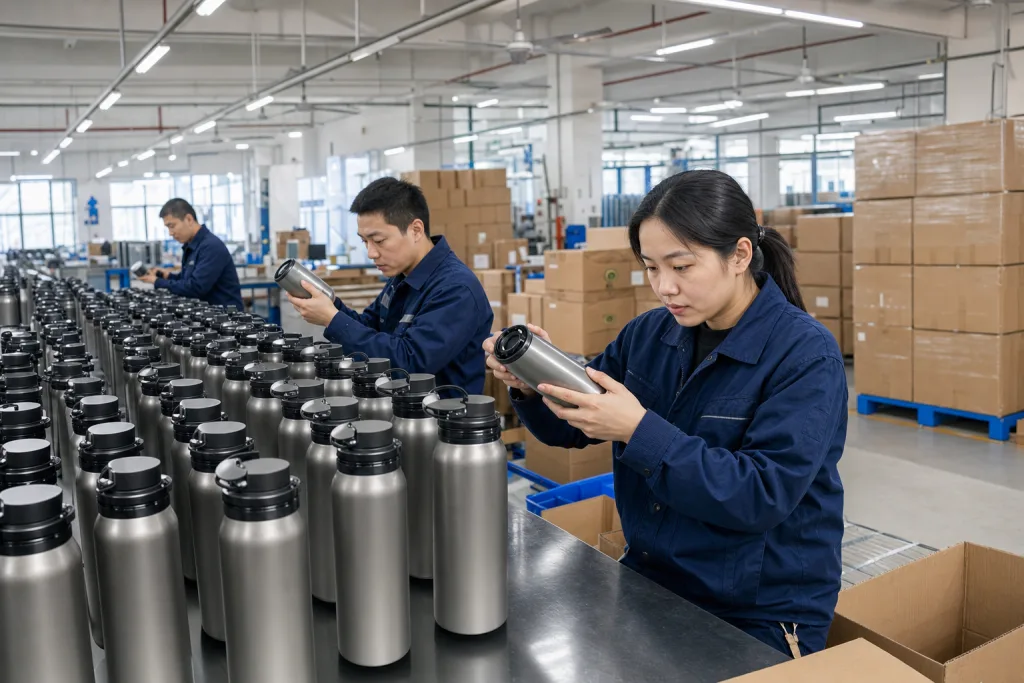
Ask for production numbers, not slogans. At BottleForge Industrial in Hangzhou, Zhejiang, the line runs about 450,000-600,000 stainless units per month across tumblers, thermos bottles, canteens, and growlers, depending on season and coating mix. We have seen a buyer flag a 20,000-unit custom canteen PO because it landed before Q4 retail, and that job still had to fight for coating, logo, and packing slots. A plant that can make samples is not the same as one that can ship clean bulk, week after week.
For a canteen manufacturer audit, ask for the business license, BSCI or Sedex status if your retailer requires it, ISO 9001 where available, recent inspection reports, and dated production photos. If you sell into Europe, ask for REACH, LFGB, and the food-contact declaration that matches the coating and print ink. For North America, FDA food-contact compliance and California Proposition 65 review may apply. QC pulled the sample once and found a PO typo on the carton mark; that sort of miss tells you how the file room is run.
Quick factory check
- Can they show forming, welding, polishing, coating, and packing workflow?
- Do they run 100% leak testing for sealed models?
- Can they provide AQL inspection photos from previous orders?
- Do they separate food-contact silicone, plastic, and metal component records?
- Can they hold golden samples in both the factory and buyer file?
Good canteen vendors answer these questions straight. If a supplier keeps talking price and dodges process details, that is the wrong question to ask. The risk is not hidden; it is waiting on the line.
What Custom Options Are Worth Paying For?
I’ll rewrite the prose only, keep the HTML structure intact, and tune the voice toward a factory-side sales engineer.Custom drinkware gets expensive fast. The line sees that every week. A procurement manager should split shelf value from factory pain. A custom canteen with the right coating, logo, and retail box can look premium without opening a new mold. A new body shape, a new cap tool, and a multi-color print are only worth it when repeat volume is already there.
For branding, laser engraving is the most durable choice on powder-coated stainless steel because it cuts through the top layer and exposes the metal underneath. Clean result. Color choices are limited. Silk screen printing fits simple one- or two-color logos and usually runs well from 1,000 units upward. Heat transfer or full-wrap graphics can work for canteen promo campaigns, but the buyer should ask for adhesion tests and scratch tests, especially if the claim says outdoor use. QC pulled the sample on a scuff test at 500 rubs, and that saved one buyer from a messy claim later.
For a canteen customized program, color is where schedules slip. Pantone matching on powder coat needs a tolerance talk because the metal substrate, surface texture, and batch curing all shift the finish. A realistic color sample cycle is 5-10 days for standard powder and 10-18 days for custom powder. If you approve color from a phone photo only, the math does not work when the retail shelf lights the product differently. We’ve seen that go sideways on a 3000-unit PO with one wrong shade note.
Packaging is another customization that changes cost and damage rate. A plain white box might add USD 0.12-0.25 per unit. A printed kraft box can add USD 0.25-0.55. A rigid gift box can add more than USD 1.00 and push carton volume up, which changes sea freight math. For distributor growler and distributor canteen programs, the carton cube can matter as much as unit price. One buyer flagged a PO typo on carton size last month, and the freight quote jumped on the spot.
Spend money on customization that protects margin: durable logo, steady color, scannable barcode, protective inserts, and clear retail claims. Skip cosmetic complexity that creates inspection fights and no real buyer value. That is the wrong question to ask.
How Should Pricing Be Compared?
I’ll rewrite the section in place, keep the HTML structure intact, and tighten the pricing language so it sounds like a factory-side sales engineer wrote it.Comparing canteen manufacturers by unit price alone is a bad sourcing move. You have to line up the same spec, the same Incoterm, the same packing, the same inspection duty, and the same payment term. A USD 0.35 gap can vanish once carton size, defect rate, remake policy, and late shipment costs hit the file.
Ask each canteen vendor to quote in a fixed format: product cost, logo cost, packaging cost, sample cost, mold or setup cost, inspection support, and FOB port. For China exports, FOB Ningbo and FOB Shanghai are common for Zhejiang production. If you ask for EXW, inland handling, export declaration, and trucking move to your side. If you ask for DDP, get duties, VAT, and anti-dumping exposure written out line by line. We’ve seen cheap DDP quotes go sideways at customs. QC pulled the sample, and the buyer flagged the missing tax note.
For a 1,000 ml double-wall stainless customized canteen, a realistic FOB range is USD 4.50-7.50 at 3,000 units, depending on lid, coating, logo, and box. A 1.9 L custom growler or customizable growler may run USD 8.00-14.00 FOB depending on handle, cap, and insulation performance. Aluminum single-wall canteens can land lower, but the food-contact coating and dent resistance need a hard check. The math does not work if the wall thickness is off by 0.2 mm and the buyer still expects the same finish.
Quote comparison checklist
- Is the material grade written as 304, 316, 201, aluminum 6061, or vague “stainless”?
- Is the capacity claim nominal or actual?
- Is the logo cost included for one position and one color?
- Is the box plain, printed, retail-ready, or mailer-safe?
- Is the quote valid for 15, 30, or 60 days?
- Are spare parts, replacement lids, or overrun units priced?
For canteen distributors, ask suppliers to quote reorder pricing separately. First orders often carry extra setup handling; repeat orders should be cleaner if specs stay the same. We run this check on every PO, because one typo on carton count can shift the whole margin.
What Quality Plan Protects You?
I’ll rewrite the section in-place, keeping the HTML tags and the original technical numbers intact while making the prose sound like a factory-side sales engineer wrote it.Quality control has to be signed off before the deposit lands, not after defects start showing up. For a custom drinkware order, we lock one golden sample, one written spec sheet, one production color standard, one packing layout, and one inspection plan. If a supplier says “we check everything” but cannot name the check points, the plan is still missing. We’ve seen that go sideways on the line, usually at MOQ 3000 when the buyer flags a typo on the PO and the spec gets muddy.
Use AQL for final inspection. For most custom drinkware, buyers use AQL 2.5 for major defects and AQL 4.0 for minor defects. Critical defects stay at zero tolerance: sharp edges, serious leakage, unsafe odor, contaminated food-contact surface, or wrong material. For vacuum canteens, add hot-water temperature retention testing on a sample set. A plain lab check may use 95°C water, read at 6 hours or 12 hours, with the pass line written into the PO. QC pulled a 24-piece sample last week and one cap failed the 12-hour hold by 8°C; that is the kind of miss you want to catch before shipment.
Functional tests must match the claim. If your listing says leakproof, test filled units upside down and side-laid for a fixed time, usually 30-60 minutes. If you call it dishwasher safe, do not hand-wave it. Many powder-coated bottles survive household washing, but repeated high-heat cycles can shorten coating life. If you need dishwasher-safe claims for Europe or North America, put the cycle count and test method in writing. Otherwise the math does not work, and the buyer will push back the first time a sample comes back scratched after 20 cycles.
For canteen promotional orders, logo wear is where complaints start. Ask for a 3M tape adhesion test on printing, a cross-hatch test for coating where it fits, and a rub test for artwork. For retail distributor drinkware, run carton drop testing: 1 corner, 3 edges, and 6 faces from around 76 cm is a common ISTA-style reference, though the final setup should follow carton weight and channel. We run this with a simple drop tester, not guesswork, because a 4.2 kg shipper behaves differently from a 1.8 kg one.
The buyer keeps one approved sample, the factory keeps one, and the inspector checks against the same piece. Simple. That habit cuts arguments fast. In our shop, we tag the sample bag with the PO number and date, and that one label has saved more than a few orders when the buyer later says the color looks off.
When Is A Supplier Ready?
I’ll rewrite the section in-place, keeping the HTML structure intact and tightening the sales-engineer tone. I’m also going to replace the generic phrasing with concrete factory-floor details and cleaner timeline language.A canteen supplier is ready only after the loose ends are closed. You need a signed PI, confirmed artwork, an approved sample, a written spec sheet, packaging dieline, testing requirements, inspection standard, and shipping marks. Miss one item, and sales, engineering, production, and packing end up working off memory. That is not a process.
Use a real timeline. A digital mockup usually takes 1-2 days. An existing mold sample with logo takes 7-12 days. New color sampling can add 5-10 days. New mold or cap tooling adds 25-45 days before production sampling starts. Bulk production often takes 35-55 days after sample approval for custom canteen orders in China, and we see that stretch in August-October peak season or before Chinese New Year. Ocean freight to Europe or North America adds 25-45 days depending on port and routing. The math does not work if you promise faster than that.
If you sell on marketplaces or to large retailers, lock the label spec early. FNSKU labels, carton barcodes, suffocation warnings, country of origin marking, recycling symbols, and multilingual instruction sheets all change the packing flow. For Amazon FBA drinkware, we keep carton weight under 22.5 kg where possible, check scannable labels on the line, and confirm polybag rules before mass packing starts. QC pulled a sample once and found a label placed 8 mm off center; the buyer flagged it, and we reworked the whole pack plan.
Use this final release checklist before paying deposit:
- Approved physical sample with signed date and version number.
- Final artwork in AI, PDF, or vector format with logo size in mm.
- Material declaration and target compliance market confirmed.
- Carton dimensions, gross weight, and shipping marks approved.
- AQL level, inspection date, and defect definitions agreed.
- Payment terms, lead time, FOB port, and late-change policy written.
A good canteen manufacturer will accept this checklist fast. It helps the factory too. Clear files cut rework, cut disputes, and speed up the next reorder. We ship faster when the paperwork is clean, and we've seen the wrong PO typo on a carton mark turn into a 2-day delay.
Send Your Canteen RFQ For A Factory Review
Share capacity, logo, target price, market, and delivery date. We will return practical specs, MOQ, and FOB options from Zhejiang, China.
Frequently asked questions
What MOQ should I expect from canteen manufacturers?
For factory-direct canteen custom orders, expect 1,000-3,000 units per color for existing molds with logo printing or laser engraving. Stock color logo orders may start around 500 units if the supplier has inventory. Custom powder coating usually starts closer to 1,000 units per color, while new mold projects often need 5,000-10,000 units to make tooling sensible. If a canteen vendor offers 100 units with full customization, it is likely using stock goods, digital print, or trading inventory rather than true production.
How long does a customized canteen order take?
For an existing stainless steel model, plan 7-12 days for logo sample and 35-55 days for bulk production after approval. Add 5-10 days for custom color sampling and 3-7 days for final inspection, booking, and export handling. New mold projects can add 25-45 days before a production-ready sample is approved. In Zhejiang and wider China, lead times stretch before Chinese New Year and during Q4 retail season, so place repeat distributor canteen orders earlier.
Is 304 stainless steel enough for custom drinkware?
Yes, 304 stainless steel is the normal choice for food-contact custom drinkware, including canteens, tumblers, and many growlers. It balances corrosion resistance, cost, forming performance, and availability. 316 stainless steel is more expensive and usually only needed for special premium positioning, salt-air environments, or buyer-specific requirements. If a canteen supplier only says “stainless steel” without listing 304, 316, or 201, ask for a material declaration and consider third-party material testing on bulk goods.
Which logo method is best for canteen promotional orders?
For durability, laser engraving on powder-coated stainless steel is usually the safest choice because it will not peel like ink. For low-cost canteen promotional campaigns with simple artwork, silk screen printing can work well at 1,000 units or more, but you should approve print position and run tape adhesion testing. Heat transfer or wrap printing is better for colorful artwork, though it adds setup cost and more inspection risk. Always request a physical pre-production sample before bulk production.
How do I choose between several canteen suppliers?
Compare more than price. Ask each canteen supplier for the same RFQ: material grade, wall thickness, capacity, lid material, coating, logo method, packaging, FOB port, MOQ, sample time, production lead time, and inspection terms. Then check whether they can provide AQL inspection support, food-contact documents, and dated production photos. A supplier that is USD 0.20 higher but gives clear specs, stable color control, and realistic lead time is often cheaper than a low-price quote with vague production control.