Key Takeaways
- A 500-600 ml stainless canteen often lands at USD 1.45-3.20 FOB, depending on steel grade, lid, and finish.
- Most practical MOQ for a custom canteen is 500-3,000 units; laser logo and one-color print usually keep setup costs lower than full-wrap decoration.
- For export, ask for AQL 2.5 major / 4.0 minor, REACH documentation, and 18/8 stainless or verified BPA-free plastic.
- A Zhejiang canteen factory with 200,000 units/month capacity and 25-35 day lead time can usually support repeat programs better than one-off spot buying.
If you buy custom drinkware for a brand, program, or distribution channel, the hard part is not finding a canteen factory. The hard part is telling a real canteen manufacturer from a polished trading desk, then deciding what matters most: price, compliance, decoration quality, or lead time. Those calls can move unit cost by 15% to 40%, and we have seen a buyer argue over $0.18 while ignoring a lid spec that later failed on the line.
At BottleForge in Zhejiang, we see the same mistake every week: buyers start with artwork and end up fixing leaks, bad lids, or a missed REACH requirement after the PO is already out. We had one PO with a simple typo on the capacity, 750ml vs 850ml, and QC pulled the sample before production started; that saved a 12-day delay. A better way is to make four decisions first: material, capacity, branding method, and supply model. Get those right, and a canteen supplier can quote cleanly, while your canteen distributors or retail customers see fewer surprises later.
Start With the Use Case
I’ll rewrite the section in-place, keeping the HTML tags and structure unchanged while tightening the sales-engineer voice and removing the AI-ish phrasing.Before you compare canteen manufacturers, lock down where the product will sell. A gym program, a school store, a distributor catalog, and a promo giveaway need different specs. A canteen promotional item can live with a basic lid and simple print. A retail custom drinkware line needs tighter tolerances, cleaner packaging, and stronger carton protection. If the canteen goes into outdoor, military-style, or travel channels, ask for impact resistance, dishwasher tolerance, and finish wear after 30-50 wash cycles.
Do not let style drive the decision. We’ve seen a custom canteen look good in a rendering and then fail in distribution because the mouth opening is too narrow for filling, or the lid thread strips after repeated use. That is the wrong question to ask. For a canteen distributor, those practical details beat a clever silhouette every time. Ask for sample photos, drop-test data, and the packed weight. A 180 g body and a 240 g body are not the same thing; freight and shelf feel change fast. QC pulled one sample at 2 mm off spec on the cap lip, and the buyer flagged it on the first round.
When buyers in Europe or North America talk to a canteen vendor, I tell them to start with three numbers: pieces per SKU, sales channel, and target retail or landed cost. That forces the factory to quote a real structure instead of guessing. In Zhejiang, plenty of factories run both customizable drinkware and promotional items, but the right one is the one that matches your channel. One PO typo on MOQ can shift the whole quote by a week.
Choose the Right Material First
I’ll rewrite the prose in-place, keep the HTML tags and list structure unchanged, and tune the voice to sound like a real factory-side sales engineer.Material sets the price, compliance burden, and service life. For a canteen factory quote, stainless steel is usually the safest starting point because it holds flavor better and gets accepted in more export markets than most plastics. Ask straight away whether the body is 304/18-8 or 201. On our line, that difference is usually USD 0.20-0.55 per unit, and the buyer feels it later in rust resistance. If the order is meant to last, 304 is the better call.
Plastic has a place too, especially for a lightweight custom drinkware line or a low-cost canteen custom promo. Tritan-style copolyester and PP both work, but QC needs material grade proof and migration paperwork before we ship. A customizable canteen in plastic can land at a lower FOB price, often USD 0.65-1.40, but the math changes fast if the wall is flimsy or the lid leaks. We’ve seen a 1.2 mm shell get rejected in hand feel; 2.0-2.5 mm reads as a better product.
- 304 stainless: best balance of durability and export confidence.
- 201 stainless: lower cost, but weaker corrosion margin.
- Plastic: lighter, cheaper, easier for short promotions.
If you source from China, ask for a material declaration, REACH for EU orders, and FDA migration support when the market needs it. A real canteen supplier should hand those over fast; if they stall, the buyer flagged it for a reason. We run that check before the first sample leaves the table.
Decide Capacity and Form Factor
I’ll rewrite the section in place, keep the HTML exactly as-is, and tighten the prose so it sounds like a factory-side sales engineer wrote it.Capacity is not a slogan. It changes mold size, carton count, shipping density, and how the end buyer actually uses the bottle. A 350-500 ml canteen works for kids, schools, and short commutes. A 750 ml to 1 liter model fits outdoor retail and distributor programs. A custom growler sits in another lane: bigger volume, thicker wall, more premium positioning, and usually a stronger push for insulation or carbonation retention.
When you compare canteen customizable options, check neck diameter and base diameter first. A wider mouth makes washing easier and speeds filling on the packing line. A narrower body gives better pack-out in cartons and cleaner pallet loads. On a 40HQ, a 2 mm change in diameter can shift carton count by 8% to 12%. That is real money if you ship every month from Zhejiang to the U.S. or Europe.
We run sample testing for balance in hand, lid torque, and tip stability when filled. QC pulled one sample last month that looked fine on artwork but sat too high once capped, and the buyer flagged it in five minutes. That is the wrong question to ask if you only look at print design. For canteen distributors, the clean move is to lock in one or two body formats and repeat them across graphics. It keeps the line stable and gives the canteen manufacturer less tooling drift to fight.
Pick Branding Method Carefully
I’ll rewrite the section in-place, keep the HTML structure intact, and tune the tone toward a factory-side sales engineer with concrete production details.Decoration is where a lot of buyers pay too much. A one-color silk screen or pad print is usually the cheapest route for a canteen promo order. Laser engraving costs more on day one, but it holds better on stainless steel and gives a cleaner premium finish. Heat transfer and full-wrap printing fit retail or lifestyle designs, though they add scrap risk and tighter artwork control on the line.
For a custom canteen, ask the factory how many colors are included, what the logo area measures in mm, and whether curved-surface registration will push small text out of spec. If your mark has fine lines, we often bump it 10% to 15% so it does not fill in after curing. QC pulled a 1.2-meter drop sample and the buyer flagged a tiny logo that looked fine on screen but turned muddy after print. This is the wrong question to ask if you start with price alone; the math does not work when the artwork fails.
“If the logo cannot survive a 1.2-meter drop test and 24-hour adhesive cure, it is not a decoration method; it is a future complaint.”
For buyers comparing canteen customized and customized drinkware programs across several SKUs, set one decoration method per channel. We run laser on premium stainless, silk screen on volume promotions, and we avoid mixing three methods on one launch unless the MOQ and artwork count make it worth the extra setup. A PO typo on a 2,000-piece run once sent the wrong logo file to the print table, and that turned into a full rework.
Check Factory Capability, Not Brochure Claims
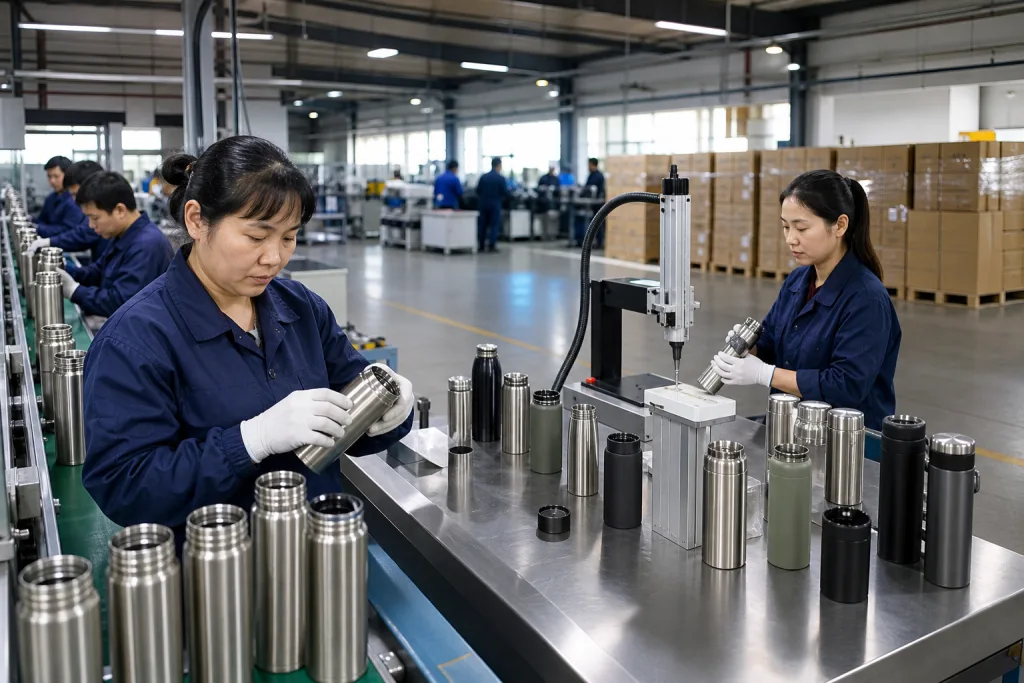
I’ll rewrite the section in place, keep the HTML tags unchanged, and strip the brochure tone while adding more factory-floor specifics.A real canteen factory should give you monthly output, sample lead time, and the split between stamping, polishing, painting, and packing without checking a brochure. At BottleForge in Hangzhou, Zhejiang, we run 200,000 units a month, sample lead time is 7 days, and mass production usually lands at 25-35 days after order confirmation. Those numbers beat a glossy PDF. If a canteen supplier dodges them, you are probably talking to a trader with a nice website.
Ask where the QC gates sit. Good canteen vendors should show incoming material checks, in-process leak testing, and final inspection by AQL. For export runs, AQL 2.5 major and 4.0 minor is a sane baseline. On our line, QC pulled a sample because one 18 oz unit had a 0.3 mm lip dent, and that is the kind of detail buyers should hear. If a factory says “100% inspected,” ask straight: visual only, leak test only, or both. The math does not work otherwise.
Also ask who owns the tooling. If you pay for a custom canteen mold, get it in writing: who owns it, where it sits, and whether spare parts are included. We have seen this go sideways when a buyer later moved half the volume to another canteen supplier and found the mold was parked at the old plant. One PO even came in with a typo on the cavity count, and that cost two days before we caught it. In China, especially Zhejiang, the better factories are clear on tooling because repeat orders pay better than one fast sale.
Build the Order Around MOQ and Price
I’ll keep the HTML exactly as-is and rewrite only the prose, with tighter sales-engineer tone and concrete factory-floor detail in each paragraph.MOQ is where deals usually get tested. We see buyers ask for a custom canteen with three colors, printed gift boxes, and 300 pcs. The math does not work. For a basic stainless model, 500-1,000 units is a normal run. For a canteen customizable program with embossed tooling or special packaging, 2,000-3,000 units is more realistic. Once you add a complex customized growler, the MOQ climbs again because the body, cap, and insulation parts all carry separate setup cost. QC pulled a sample with a 0.3 mm gap on the cap ring last week; that kind of issue shows why tiny lots get expensive fast.
Use price bands, not a race to the bottom. A FOB quote of USD 1.80 and a FOB quote of USD 2.25 can both make sense if the higher one gives thicker steel, cleaner print, and fewer leak claims. After freight and duty, the landed gap may be only 4%. We’ve seen buyers chase the cheaper canteen promotional product, then pay more when the first carton fails a leak test at 20 kPa. That is the wrong question to ask.
For canteen distributors and distributor canteen programs, ask for tiered pricing at 1,000, 3,000, and 5,000 units. It gives you room to set margin and run promos without guessing. A good canteen manufacturer in China should quote with the real specs on the page: material, lid type, packaging, carton spec, and Incoterms such as FOB Ningbo or FOB Shanghai. We once found a PO typo that said “FOB Shanigai”; the buyer flagged it before booking, and that saved a messy freight correction. If those details are missing, you are not comparing real offers.
Protect Compliance and Repeatability
I’ll rewrite the section in-place, keep the HTML tags untouched, and tighten the prose so it sounds like an export sales engineer wrote it.Compliance is not paperwork decoration. It decides whether your custom drinkware clears customs or gets stuck at the port. For EU orders, ask for REACH material support and confirm the inks, coatings, and lids all fit the destination market. For North America, get migration and food-contact documents where the buyer needs them. If you buy from a canteen factory in China, ask for batch records, production photos, and test reports in the same carton set. We ship this way because a missing report burns time fast.
Repeatability is the other half. A canteen made for one promotion should match the next run close enough that the retail buyer does not flag a finish shift or lid color drift. Keep a signed golden sample, a Pantone target, and a short spec sheet with steel grade, wall thickness, decoration method, and carton count. On the line, that sheet beats a 20-email chain every time. The math works.
If you work with canteen distributors, push for a simple post-order flow: pre-production sample approval, midline inspection above 10,000 units, and final packing photo approval. QC pulled the sample, checked the cap torque, and caught problems before the buyer did. That is how Zhejiang export factories protect both sides. You do not need drama; you need repeat orders, stable quality, and a canteen vendor that ships on schedule.
Send your spec for a factory quote
Share your target MOQ, material, artwork, and market. We’ll turn it into a clear canteen supplier quote with real lead time and FOB pricing.
Frequently asked questions
What MOQ should I expect from a canteen factory?
For a standard stainless custom canteen, expect 500-1,000 units if the decoration is simple and the tooling is already available. If you want a special lid, custom packaging, or a new mold, 2,000-3,000 units is more realistic. For a customized growler or insulated build, MOQ can move higher because the body structure and assembly are more complex. A fair factory will quote the MOQ by SKU, not give you a vague “depends” answer. Ask for pricing at 1,000, 3,000, and 5,000 units so you can see where the real breakpoints are.
What is a normal lead time for custom drinkware from China?
For a typical canteen factory in Zhejiang, sample lead time is often around 7 days and mass production 25-35 days after order confirmation. If the order needs new tooling, painted finishes, or special packaging, add another 7-15 days. Shipping time is separate: about 18-28 days by ocean to North America, depending on port and routing. If a canteen supplier promises unusually fast delivery on a fully customized canteen, check whether they are counting only production and not packing, testing, or export booking.
How do I compare stainless and plastic canteen options?
Start with channel, not price. Stainless steel usually wins for durability, odor resistance, and premium perception, and 304/18-8 is the safer export choice. Plastic is lighter and can be cheaper, often by USD 0.30-1.00 per unit, but you need to verify material grade, wall thickness, and compliance. A 2.0-2.5 mm wall on a plastic customizable canteen generally feels more substantial than thin stock. If your buyer is a canteen distributor selling to retail or outdoor channels, stainless is usually the lower-risk SKU.
What quality checks should I ask for?
Ask for incoming material verification, leak testing, and final inspection using AQL 2.5 major and 4.0 minor. For printed or coated canteens, request adhesion or rub testing as well. A proper canteen manufacturer should also provide packed carton photos, drop-test records if required, and batch traceability. If you buy a customized canteen for export, keep the signed golden sample and approve color against Pantone before mass production. Quality is easier to control when the factory documents it instead of describing it verbally.
Can one factory handle both custom canteen and custom growler orders?
Yes, but only if the factory has the right equipment. A canteen factory that handles stamping, welding, polishing, coating, and packing in-house can often make both a custom canteen and a custom growler. The difference is in structure and QC intensity. Growlers usually need thicker walls, tighter seal control, and more premium finishing. If you also need canteen promotional units, ask whether the same line can switch between SKUs without changing your quality baseline. A good Zhejiang supplier will tell you exactly where the line is.