Key Takeaways
- Most canteen customizable projects start at 500 to 1,000 pcs MOQ, with FOB China prices often at USD 1.20 to 4.80 depending on steel grade and lid.
- A reliable canteen factory should quote lead time in 25 to 35 days after sample approval, not vague promises.
- For Europe and North America, ask for REACH, LFGB, FDA or ASTM-related test support, plus AQL 2.5 for critical defects.
- If you need canteen promotional stock, choose one body shape and one lid family first; complexity cuts yield and pushes cost up 8% to 15%.
If you are buying canteen customizable drinkware for retail, promotions, or a private-label program, getting a sample is the easy part. The hard part is pinning down the quote, matching the coating, and making sure the production plan still works at 5,000 units. We have seen this go sideways when a buyer approved a glossy black sample, then QC pulled the bulk pieces and found a 0.4 mm color drift against the signed sample. Margin disappears fast.
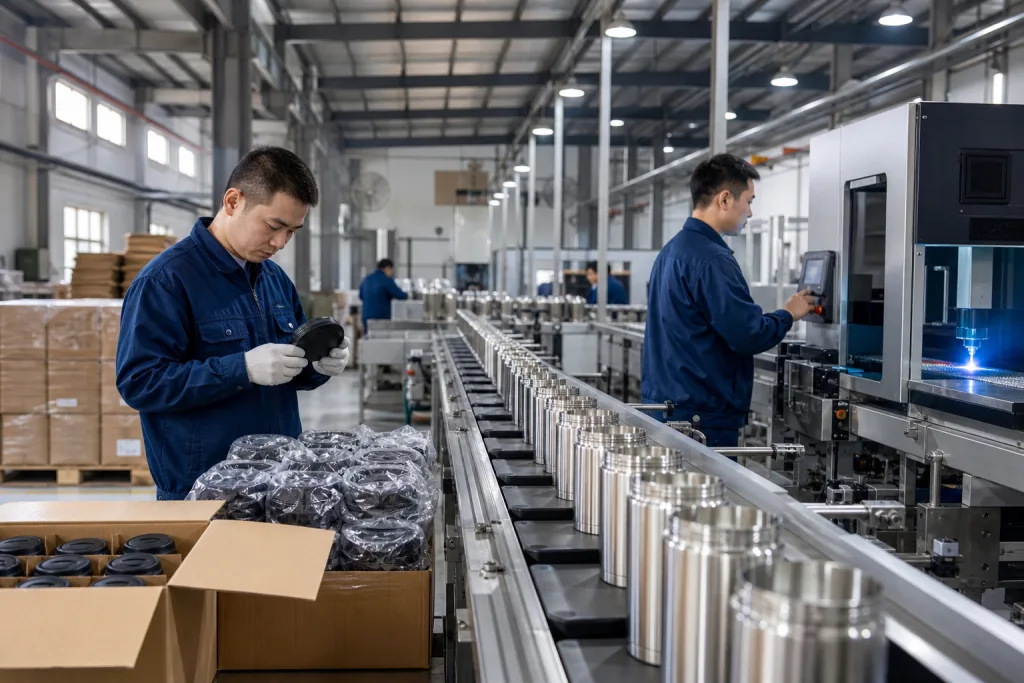
From Zhejiang and the wider China supply chain, we see the same pattern every season: 7 out of 10 new buyers ask first for a canteen custom quote, then find the real questions are capacity, surface finish, lid fit, and compliance. A serious canteen manufacturer should answer those before artwork starts. If they cannot confirm the line schedule, lid mold number, coating spec, and FDA or LFGB test plan, you are not talking to a canteen supplier; you are talking to a middleman with no production control.
What are you really buying?
Buyers often ask us for a customizable canteen. That is too loose. On our quotation sheet, that name can point to a 500 ml vacuum steel bottle, a flat single-wall camping canteen, or a wide-mouth sports bottle with a PP carry handle. The spec beats the product name. A trading office can send a nice 3D rendering; a canteen manufacturer should ask for body volume, wall structure, cap thread, coating code, and target market before quoting. Last month QC pulled a 750 ml sample where the buyer’s PO said “canteen,” but the artwork showed a bottle with a straw lid. That mismatch cost 6 days.
Start with where it will be sold. For hiking retail, we run 18/8 stainless steel, double-wall vacuum, powder coating, and a 45 mm mouth so ice cubes fit. For a canteen promotional order, single-wall aluminum or SS304 can work if the logo area is wide enough and the FOB math stays under the buyer’s target. Premium caps are different. A growler-style cap with a silicone seal can lift the shelf price, but it also means new mold review, leak testing at 0.6 MPa, and sampling closer to 18 days instead of 12 days. In Zhejiang, I would not assume the factory owns every step. Ask if forming, welding, coating, and packing are in-house; we have seen orders go sideways when coating was sent out and the buyer flagged 2 mm color drift against the Pantone chip.
- Define capacity first: 350 ml, 500 ml, 750 ml, or 1,000 ml.
- Choose structure: single-wall or vacuum insulated.
- Lock lid type: screw cap, flip cap, loop cap, or custom closure.
- Ask for material proof: SS304, SS316, aluminum, or BPA-free plastic.
Which specs change your landed cost?
I’ll keep the HTML structure intact and rewrite the prose to sound like a factory-side buyer note, with concrete cost drivers and one real floor detail per paragraph.The price moves fast once you step from a basic custom canteen into a tighter spec. A 0.4 mm wall works for promo orders, but 0.5 mm or 0.6 mm adds stiffness and cuts dent claims. For a vacuum insulated canteen customized program, steel grade, copper coating, and the evacuation step can push FOB up by USD 0.60 to 1.50 per unit. Coating changes the math too. Matte powder, UV print, rubber paint, and laser marking all load the line differently, and we have seen buyers underestimate the cure time by 2 hours per rack.
Ask the canteen supplier for a line-item quote. Mold fee, sample fee, printing fee, packing fee, and carton setup should be split out. If the seller sends one lump sum, you cannot compare canteen suppliers fairly, and that is the wrong question to ask later when the margin is gone. A good canteen factory in China should also give you the monthly output for your model. At BottleForge Industrial in Hangzhou, Zhejiang, the standard line runs 180,000 units per month across multiple drinkware models, but your canteen shape can still hit a hard limit on coating oven space or lid stock. QC pulled the sample on a 24 oz unit last week because the cap logo sat 1.5 mm off center.
- Single-wall steel: lower cost, faster lead time, more print flexibility.
- Vacuum insulated: higher margin, more QC steps, more packaging damage risk.
- Custom lid: new tooling can add 18 to 35 days.
- Special finish: soft-touch and gradient paint usually add 5% to 12%.
How do you screen suppliers?
I’ll rewrite the section in place, keep the HTML structure untouched, and make the prose sound like a factory-side sales engineer.Do not screen a canteen vendor by catalog alone. Ask for a production audit pack: business license, factory photos, test reports, export history, and the actual QC flow. We run into this all the time in Hangzhou—one buyer sent a PO with the wrong lid code, and the whole order had to be held because the line had never seen that spec before. You want a canteen factory, not a trading desk that swaps plants by price. In China, that difference matters because tooling control and coating consistency keep batch two from drifting off the approved sample.
Check whether the supplier can support AQL inspection, pre-shipment photos, and a drop-test packaging review. For Europe and North America, ask for REACH and food-contact compliance by name. If you need retailer compliance, request carton marks, barcode placement, and FNSKU labeling support before mass production. A canteen distributor who knows retail will bring these up on the first call. A weak one will only quote unit price. That is the wrong question to ask.
Good procurement rule: if the supplier cannot explain defect limits, coating thickness, and testing standard in plain English, do not send the PO yet.
- Ask how many canteen manufacturers they work with directly.
- Ask for recent export destinations and matching test documents.
- Confirm if they can do custom logo placement on body, lid, and box.
- Request a sample timeline in writing: 7 to 10 days for standard samples, 12 to 18 days for new tooling samples.
What sample approval should include
A sample is not a beauty shot. For customized drinkware, this is where we lock the tolerances before the line opens: opening diameter in mm, lid thread engagement, coating adhesion, and leak resistance. On a customized growler format, check thermal retention for insulated builds; for single-wall 304 stainless, run the salt-spray or oxidation check instead. We’ve seen this go sideways when a buyer approved the color from photos but skipped the seal test. QC pulled 12 samples from a 300 pcs pilot run, and 3 caps wept at the thread after 24 hours inverted. Good-looking samples do not pay claims.
Use a one-page approval checklist. Confirm pantone, logo location, laser depth or print opacity, cap torque in N·m, carton style, and accessory count against the PO. If your canteen custom project includes a strap, handle, or carabiner, test load-bearing early with a 5 kg hang test, not after bulk cartons are packed. For a distributor drinkware program, packaging matters almost as much as the bottle; one buyer flagged corner crush after a 1 meter drop, and the math did not work once retail damage claims hit. We photograph the signed sample, label it with PO number and revision date, then keep the approved unit in the sample room, especially when we ship from multiple canteen suppliers across China and Zhejiang.
- Seal test: no leakage after 24 hours inverted.
- Drop test: 1 meter, 6 faces, if retail packaging is required.
- Coating test: cross-hatch or tape pull where applicable.
- Artwork check: exact logo size and placement.
MOQ, pricing, and lead times
I’ll rewrite this section in place, keeping the HTML structure and the existing numbers intact while making it sound like a real factory-side sales engineer.Buyers ask for numbers first, so let’s start there. For a basic canteen customizable order, MOQ usually lands at 500 pcs per color or per design. If you need new lids, fresh tooling, or a shaped body, 1,000 to 3,000 pcs is the number we run. One buyer pushed for 100 pcs with full customization; the sample came back as stock goods with a logo print, which is the wrong question to ask if you want real custom work.
For FOB China, a standard stainless custom canteen often sits around USD 1.20 to 2.20 for simple single-wall models and USD 2.80 to 4.80 for insulated builds, depending on finish and pack-out. We check this against the line every week with a simple caliper and a sample carton test, because the math doesn't work if the spec sheet ignores lid cost or inner pack. Lead time is usually 25 to 35 days after sample confirmation for standard projects, and 35 to 50 days if tooling or special coating is involved. In Zhejiang, a plant with stable coating and assembly lines can move faster, but only if artwork is clean and the forecast is real. Give your supplier a 60-day forecast; that lets us reserve lids, cartons, and carton dividers before the buyer flags a delay.
- MOQ: 500 to 1,000 pcs for standard programs.
- FOB price: USD 1.20 to 4.80 depending on spec.
- Lead time: 25 to 35 days standard, 35 to 50 days custom tooling.
- Payment: usually 30% deposit, 70% before shipment.
Checklist before you place order
I’ll rewrite the prose to sound like a seasoned export sales engineer, keep the HTML structure intact, and weave in a few concrete factory details without changing the list structure.Before you sign off on production, run the PO against a real procurement checklist. This is where bad assumptions get expensive. The canteen customized spec sheet should call out body material, wall thickness in mm, capacity tolerance, lid drawing, logo file format, carton count, and outer carton size. We ask the buyer to confirm spare parts too. A missing gasket turns a clean shipment into a support mess fast.
For a canteen promotional campaign, don’t stop at the bottle. Inner pack style, barcode position, and master carton strength matter more once the goods move 12 days by sea instead of 2 days by truck. If the program goes to Amazon or another marketplace, ask for FNSKU labels and polybag options up front. If you are running 3 SKUs, lock one gold sample and one control sample, then sign both. We had one buyer flag a PO typo on the carton count, and the math did not work. When you work with canteen vendors in China, especially in Zhejiang, get every change in writing. Verbal changes turn into disputes.
- Approved sample signed and dated.
- Spec sheet with thickness, coating, and lid type.
- Test requirements: REACH, FDA, LFGB, or buyer-specific standard.
- Packaging spec: carton count, barcode, drop-test target.
- Production tracking: batch number, inspection report, shipment photos.
Send your spec, get a real quote
Share capacity, material, logo file, and target market. We will turn it into a clear FOB quote, sample plan, and production schedule.
Frequently asked questions
What is the usual MOQ for canteen customizable orders?
Most canteen customizable orders start at 500 pcs per color or per artwork. If you add a new lid or new mold, 1,000 to 3,000 pcs is more practical. For very simple stock-body printing, some canteen suppliers may quote 300 pcs, but the unit price is usually 12% to 20% higher.
How much does a custom canteen cost from China?
For FOB China, a simple single-wall custom canteen can land around USD 1.20 to 2.20 per unit. A vacuum insulated version often lands at USD 2.80 to 4.80 depending on material, coating, and packaging. If you want laser engraving, soft-touch paint, or a custom lid, budget an extra USD 0.20 to 1.00.
How do I know if I am dealing with a real canteen factory?
Ask for factory registration, production photos, QC流程, and current monthly output. A real canteen factory should tell you what is in-house and what is outsourced. If they cannot explain welding, coating, inspection, and packing separately, they are probably a trading company or a canteen vendor without direct manufacturing control.
What compliance documents should I request for Europe and North America?
At minimum, ask for food-contact support, REACH-related material confirmation, and buyer-specific test reports. For some retail programs, you may also need LFGB, FDA-related declarations, or ASTM-style packaging tests. A serious canteen manufacturer will know how to arrange third-party testing through labs in China or Hong Kong.
Can I order a canteen customized design with logo and retail packaging?
Yes. A canteen customized program usually includes logo printing or laser marking, color matching, and branded retail packaging. Expect 7 to 10 days for a standard sample and 25 to 35 days for mass production after approval. If you need a custom growler-style lid or new packaging insert, add 10 to 15 days.