Key Takeaways
- A basic canteen custom order usually starts around 3,000 pieces, with practical pricing from USD 2.40-6.80 FOB depending on material and decoration
- New mold or cap tooling can add USD 800-4,500 and 12-25 days before mass production
- Normal production lead time is 25-45 days after deposit and approved sample, plus 25-38 days ocean freight to Europe or North America
- AQL inspection, REACH/LFGB checks, carton drop tests, and color tolerance approval should be agreed before the PO
If you are sourcing canteen custom products for retail, field teams, outdoor promotions, or distributor drinkware programs, the first question is not color. It is price, lead time, and whether the factory answer holds up after QC pulls the sample on the line.
BottleForge Industrial makes custom drinkware in Hangzhou, Zhejiang, and we see this all the time: a buyer compares a 3,000-piece basic customized canteen quote with a 10,000-piece powder-coated, laser-engraved, boxed set quote and says one canteen supplier is too high. That math does not work. We have seen a PO typo turn 18 days into 12 days just because the spec was clear; China can make solid canteens, but only when the RFQ is tight.
Start with the real product brief
I’m rewriting the section to sound like a factory-side sales engineer, keeping the HTML intact and tightening the brief with concrete numbers and shop-floor detail.A canteen custom project gets expensive fast when the brief is loose. “500 ml canteen, black, logo, gift box” is not enough for a canteen factory to quote cleanly. We need the body material, capacity tolerance, cap structure, finish, logo method, packaging, test items, and delivery terms. A 304 stainless steel customized canteen with 0.5 mm wall thickness, powder coating, silicone carry strap, laser logo, and an individual kraft box is a different job from an aluminum promotional canteen with silkscreen print.
For B2B buyers, start with the facts we can price against: capacity in ml or oz, target FOB, first order quantity, annual forecast, market, compliance, and launch date. If you sell into the EU, call out REACH, LFGB where needed, and any packaging recycling marks. For the US, put FDA food-contact expectations on the table, plus ASTM packaging or drop-test requirements if your retailer asks for them. The math does not work any other way.
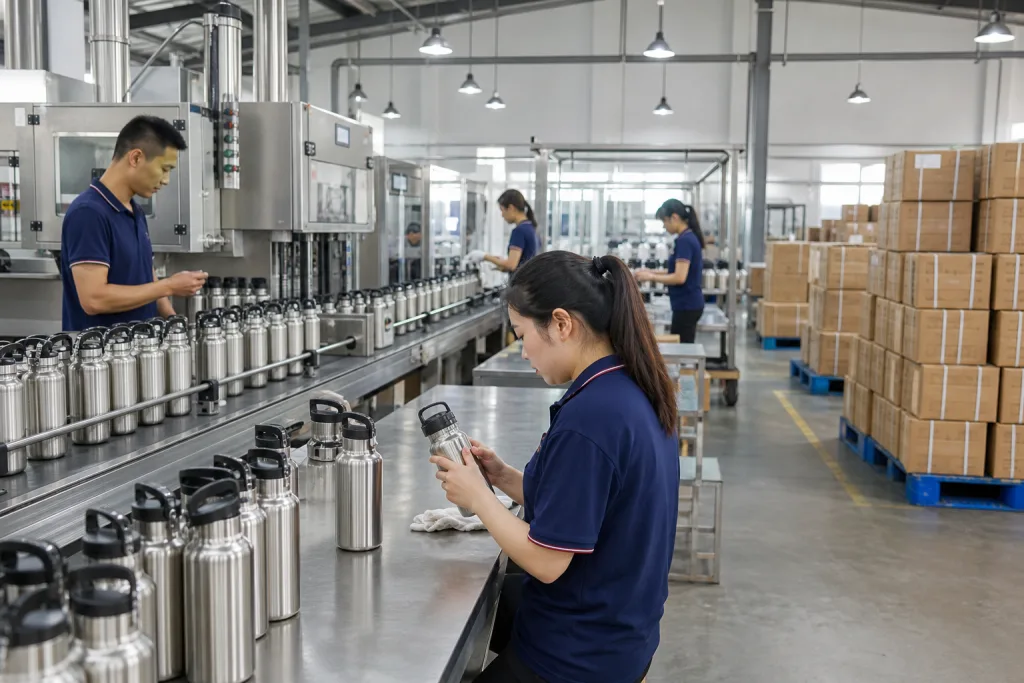
At our Zhejiang facility, the usual MOQ is 3,000 pieces per color for standard canteen customized items and 5,000-10,000 pieces when the cap, body shape, or coating color is non-standard. We run about 600,000 drinkware units a month across canteens, tumblers, bottles, and growlers, but the line still books around finishing, not welding. QC pulled a sample last peak season and the buyer flagged a 1.2 mm logo shift; powder coating and printing were the choke points, not the press shop.
Cost drivers buyers underestimate
I’ll rewrite just the prose inside the existing HTML, keep the tag structure intact, and make it read like a real buyer-facing factory note with concrete cost details.The body is only one line in the quote. We run stainless canteen shells through a deep-draw press, and stainless usually lands above aluminum because the coil costs more, the forming loss is higher, and welding needs tighter control. For a standard single-wall stainless canteen, FOB China usually sits around USD 2.40-4.20 at 5,000 pieces. Double-wall vacuum construction pushes that to USD 4.80-8.50, depending on capacity, cap, and finish. A custom growler or customizable growler in 1.2 L to 1.9 L format can run USD 7.50-15.00 FOB, because the steel weight, vacuum pull, and leak test on the line eat time.
Decoration is the other big driver. One-color silkscreen on a flat or slightly curved area may add USD 0.06-0.15 per piece. Laser engraving often adds USD 0.12-0.35. Full-wrap heat transfer or UV print can add USD 0.45-1.20, and the reject rate climbs if the surface has texture. We had a buyer flag a Pantone mismatch on a powder-coated sample last spring; after that, we set the color chip against the sprayed panel under a D65 light box before mass production. If you ask for PMS-matched powder coating, expect a setup charge around USD 80-180 per color and a real discussion on tolerance before we start.
Packaging changes the quote too. A plain polybag and white box is cheap. A printed retail box, molded pulp tray, instruction sheet, barcode label, and master carton print can add USD 0.30-1.10 per unit. For distributor canteen or distributor growler programs, that cost is often worth it because the cartons land shelf-ready. For a one-time canteen promotional campaign, simple packaging usually makes more sense. One PO typo on a 24-piece sample order once changed the box size from 92 mm to 96 mm, and the buyer paid for new inserts; that is why we check carton spec against the dieline before we cut.
Ask every canteen manufacturer to split body, decoration, packaging, tooling, testing, and freight. A single blended price hides the line item you can still push back on.
MOQ tiers and price movement
I’ll rewrite the section in-place, keep the HTML tags intact, and tune the prose to sound like a real factory sales engineer.MOQ is not a penalty. It is the point where tube buying, line setup, jig changeover, powder loss, and QC time stop wrecking the margin. We have seen a buyer push for 800 pieces on a stock body with one laser logo, and the math does not work; the unit price usually sits 15-35% above a 3,000-piece run. Under 1,000 pieces, you are usually buying decorated stock, not true canteen custom production.
For planning, use these rough FOB tiers from China: 1,000-2,000 pieces for stock-body custom drinkware, USD 3.20-7.80; 3,000-5,000 pieces for standard custom canteen programs, USD 2.40-6.80; 10,000-20,000 pieces, often 6-12% lower if the decoration and packaging stay fixed. At 18 mm wall thickness and the same carton spec, the line gets cleaner pricing; above 30,000 pieces, the saving comes more from steel contracts, carton buying, and fewer color swaps than from labor. One PO typo we saw changed carton count by 1,000, and that killed the quote until the buyer corrected it.
Canteen distributors often ask for mixed colors under one MOQ. That can work, but it needs hard rules. A 6,000-piece order split into 3 colors at 2,000 each is fine if the coating line already runs those shades. Six colors at 1,000 each will cost more and can add 5-8 days because each swap means powder waste, gun cleaning, and a fresh first-piece sign-off. QC pulled the sample twice on one multicolor run because the blue batch drifted; the buyer flagged it, and we had to stop the line.
If your brand is testing demand, start with a standard customizable canteen body and put the money into decoration and packaging. Save the new mold for the second order after sell-through data proves the shape deserves tooling. That is the safer play. We have seen first orders chase a custom shell too early and sit on dead stock for 12 weeks.
Tooling and sample timing
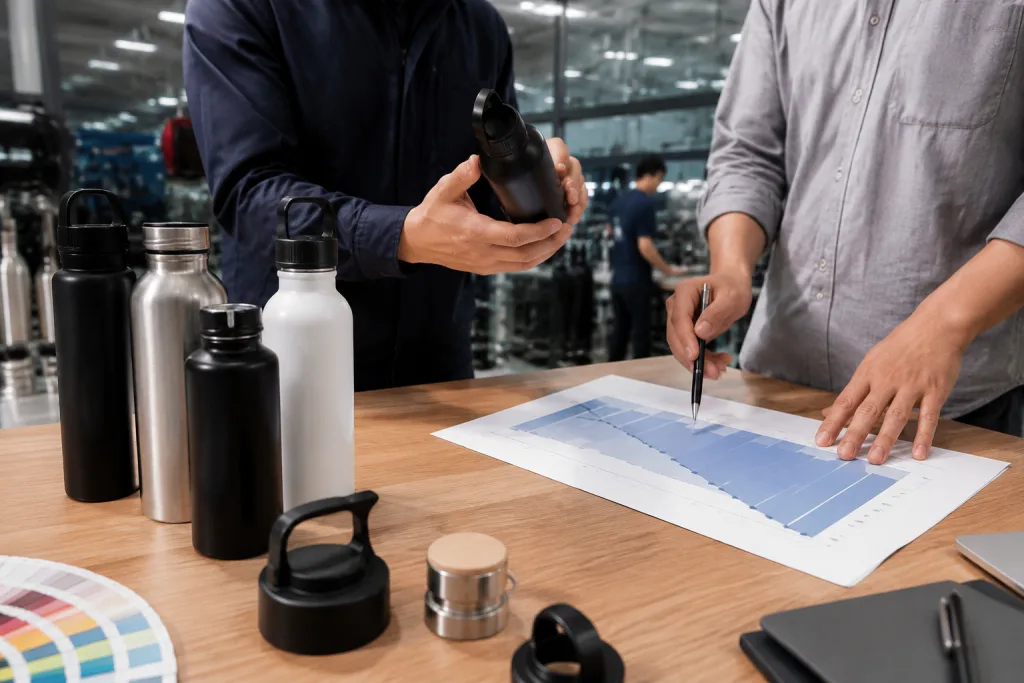
I’ll rewrite the four paragraphs with tighter sales-engineer language, keep every tag unchanged, and preserve the section structure. Then I’ll sanity-check that the timing, tooling numbers, and buyer checkpoints still read cleanly.Tooling is where buyer schedules slip. If we use an existing canteen body, the pre-production sample is usually ready in 7-12 days after artwork approval. If the job needs a new cap, new body embossing, a special handle, or a custom mold, add 12-25 days for tooling and the first samples. Tight curves and a narrow neck slow the line; polishing and cleaning take longer, and we have seen that turn a “simple” shape into a late delivery.
Tooling costs stay fairly clear once the drawing is fixed. A new silicone gasket or small plastic accessory mold is usually USD 300-900. A custom plastic cap mold often lands at USD 1,200-3,500. A new stainless body tool may run USD 2,000-4,500 for a simple canteen, and more for odd geometry. On a customized growler with a swing handle and wide-mouth cap, we quote both the cap tooling and the welding fixture. The math does not work if a buyer wants one number for all three parts.
Sampling should not skip the real checkpoints. Approve capacity, weight, coating color, logo size, cap fit, leak test results, packaging structure, barcode placement, and carton marks. For retail or online drinkware, check the FNSKU or EAN label position before the cartons are printed. If your canteen distributor needs multiple languages on the pack, lock the text at sample stage. QC pulled a sample last month because the barcode sat 8 mm too low. Small mistake. Big delay.
A good canteen manufacturer in Zhejiang will push back when the sample request is not production-friendly. That is not negativity. We do it because changing a strap hole, logo curve, or box insert at sample stage is cheaper than scrapping 5,000 units after mass production. One buyer once sent a PO with the cap code typed as “CP-100O” instead of “CP-1000”; we caught it before tooling, and that saved a round of rework. That is the right place to argue.
Production calendar without wishful thinking
I’ll rewrite the section in place, keep the HTML tags untouched, and tighten the timeline language so it sounds like a factory-side sales engineer wrote it.After sample approval and deposit, a standard canteen custom order usually runs 25-45 days. We see the short end on existing bodies, one decoration method, 1-2 colors, and plain cartons. The long end kicks in with powder coating, mixed SKUs, retail packaging, new accessories, or extra testing. Before major China holidays, especially the weeks around Chinese New Year, add real buffer. A PO signed in early January can still miss March if the materials list and sample are not locked. QC pulled the sample; the buyer flagged a logo shift, and that 3 mm change cost us 4 extra days.
A realistic schedule looks like this: RFQ clarification, 2-4 days; artwork and dieline confirmation, 2-5 days; sample, 7-12 days for standard items or 20-35 days with tooling; production, 25-45 days; final inspection and booking, 3-7 days; ocean freight to North America or Europe, usually 25-38 days port-to-port. Air freight takes 5-9 days, but it rarely makes sense for stainless canteens unless the order is small or the launch date is already slipping. The math does not work on a 1,200-piece run.
For Amazon-style or marketplace programs, distributor drinkware buyers need extra time for carton labels, FNSKU, pallet rules, and delivery appointments. For traditional canteen distributors, the bottleneck is usually mixed SKU allocation. If you order 12 colors across 3 sizes, the slowest SKU controls the ship date unless you accept a split shipment. We had one buyer typo the PO with 3,000 cartons instead of 300; the line caught it before print, which saved a week.
Do not approve mass production before freight terms are clear. FOB Ningbo or Shanghai is standard for Zhejiang factories. DDP looks easy on paper, but someone still owns duties, anti-dumping checks if they apply, customs documents, and appointment fees. If the contract says DDP and nobody names the broker, we have seen that go sideways fast.
Quality checks that protect margin
I’ll rewrite the section in place, keep the HTML exactly intact, and tighten the prose so it reads like a factory-side sales engineer.Quality issues on canteen custom orders are usually plain and expensive: cap leaks, coating scratches, logo offset, color drift, dented bodies, weak cartons, wrong barcodes. We control them with written specs, not luck. Lock the AQL before mass production. A lot of B2B buyers run AQL 2.5 for major defects, 4.0 for minor defects, and 0 for critical defects. If QC finds a leak, odor, unsafe burr, or wrong material, that is a stop-the-line issue.
For stainless custom drinkware, ask the canteen supplier to confirm the grade in writing, usually 304 for the food-contact side. On some low-price outer shells, 201 stainless shows up, and the buyer flagged it for a reason. Wall thickness needs a number on the PO, such as 0.4-0.6 mm based on structure. For powder coating, we run cross-hatch adhesion checks and abrasion targets. On vacuum items, every piece should pass vacuum screening; sampling 20 pcs out of 5,000 does not protect margin.
Compliance changes by market. EU buyers often ask for REACH, LFGB, and packaging declarations. US buyers may want FDA food-contact statements and Prop 65 review, depending on the channel. Children’s canteens need tighter control on small parts, coatings, and bite valves. A kids bottle is not a smaller adult bottle. That is the wrong question to ask.
Third-party inspection in China usually lands around USD 180-350 per man-day. That is cheap next to a rejected retail shipment. If your canteen vendors push back on inspection, ask what they are hiding. A solid canteen manufacturer may argue over the checklist, but they should not resist an AQL check with QC pulled on the line.
Choosing the right factory type
I’ll rewrite the four paragraphs in place, keep the HTML untouched, and tune the wording to sound like a factory-side sales engineer with concrete shop-floor detail.Not every canteen supplier runs the same setup. Some are trading companies with access to three or four canteen makers. Some only do coating or decoration. A real factory has forming, welding, polishing, vacuum testing, assembly, and packing on one line. For repeat orders, that beats a middleman. You get cleaner pricing, faster engineering feedback, and one team owning the result.
When you qualify canteen suppliers in China, ask for capacity by process, not just annual sales. A factory claiming “1 million units per month” may be counting every bottle model plus subcontracted work. Ask how many powder-coated canteens we ship per day, how many laser marking machines are running, what the MOQ per color is, whether AQL 2.5 is the inspection standard, and which port the cartons leave from. QC pulled a sample last week because the 0.3 mm coating edge was thin; that is the kind of detail that matters. The math does not work if you skip it.
For brand owners, direct contact with the production team cuts errors. For a distributor with 40 SKUs, the better partner is usually a factory that can keep tooling on file, hold color chips against the same Pantone code, and block capacity before peak season. For promotional buyers, artwork turnaround and packing speed matter more than a clever lid shape. We’ve seen this go sideways when a buyer flagged a PO typo on the carton count and the whole schedule slipped two days.
BottleForge Industrial is based in Hangzhou, Zhejiang, close to Ningbo and Shanghai ports, so export booking is simpler. We ship from here every week. Still, we tell buyers the hard part straight: if you want a fully customized canteen at 1,000 pieces, six colors, retail packaging, and a 20-day delivery window to Germany or the US, the factory is not the main problem. The plan is. Cut the color count, raise the MOQ, or move the launch date. That is the fix.
Send your canteen custom brief for factory pricing
Share quantity, artwork, market, and delivery date. We will return practical MOQ, FOB cost, sample timing, and production lead-time options.
Frequently asked questions
What is a realistic MOQ for canteen custom orders?
For a true canteen custom order, plan around 3,000 pieces per color for standard factory bodies. If you only need a laser logo on an existing stock body, some canteen vendors may accept 1,000 pieces, but the unit price is usually 15-35% higher. For new coating colors, custom caps, retail packaging, or multiple accessories, 5,000-10,000 pieces is more realistic. If you need a new body shape or customized growler tooling, the canteen manufacturer may ask for 10,000 pieces or an annual forecast before opening tools. Mixed colors can work, but tiny splits create setup waste and longer production time.
How much should I budget for a customized canteen?
For FOB China pricing, a basic single-wall stainless customized canteen often falls around USD 2.40-4.20 at 5,000 pieces. Double-wall vacuum canteens usually sit around USD 4.80-8.50, depending on capacity, cap, finish, and decoration. Aluminum promotional canteens may be lower, but they have different durability and compliance considerations. Add USD 0.06-0.35 for common logo methods, USD 0.30-1.10 for retail packaging, and USD 180-350 for a third-party inspection day. Tooling, if needed, can add USD 800-4,500. Always compare quotes with the same material grade, wall thickness, packaging, and Incoterm.
How long does production take after sample approval?
A normal canteen custom production run takes 25-45 days after deposit and approved sample. Existing bodies with one logo and simple packaging can be close to 25-30 days. Powder coating, multiple colors, custom boxes, new straps, or extra compliance testing can push the timeline toward 40-45 days. Sampling usually takes 7-12 days for standard products and 20-35 days if tooling is involved. Add 3-7 days for final inspection and export booking. Ocean freight from China to Europe or North America commonly takes 25-38 days port-to-port, so a safe total calendar is often 8-12 weeks.
Should I buy through a canteen distributor or direct factory?
A canteen distributor can be useful if you need low quantities, fast local delivery, or many small mixed SKUs. The trade-off is less control over material, tooling, and factory scheduling. A direct canteen factory or manufacturer is better when you need repeat orders, stable color, exact packaging, AQL inspection, and cost transparency. For a first order below 1,000 pieces, local distributor drinkware may be practical. For 3,000-50,000 pieces, direct China sourcing usually gives you better control, provided your brief is clear. Ask whether your canteen supplier owns production or is coordinating subcontractors.
What files and details should I send for quotation?
Send capacity, target material, finish, logo size, artwork in AI or PDF format, packaging style, order quantity by color, destination port or warehouse, and required compliance standard. If the project is for marketplace delivery, include FNSKU or carton label rules. If it is for retail, include box dieline needs, barcode placement, and carton drop-test requirements. Also state your target FOB price and launch date. A canteen manufacturer can quote faster when you define whether the project is a standard customizable drinkware order or a fully custom canteen with new tooling. Good RFQs usually save 2-4 days of back-and-forth.