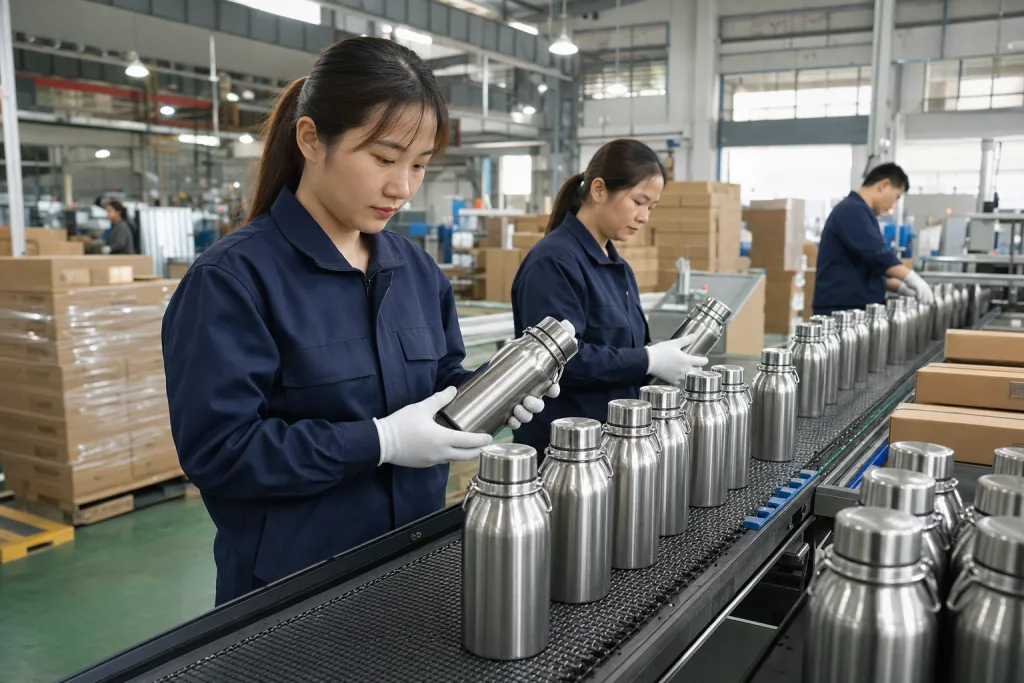
Key Takeaways
- A realistic canteen bulk MOQ is often 1,000-3,000 units, with 30-45 day lead times after sample approval
- For stainless canteen wholesale, 304 material, 0.5-0.8 mm wall thickness, and 18/8 finish are standard buyer checks
- AQL 2.5 major and 4.0 minor is common for drinkware bulk inspection, but the carton test and leak test matter more
- FOB China pricing on a basic wholesale canteen usually starts around USD 2.10-4.80 depending on size, lid, and decoration
You send one RFQ for canteen bulk, and the quotes look the same at first glance: same photo, same price band, same lead time promise. The split shows up in the details. One supplier gives you 1,000 units MOQ and 35 days; another asks for 3,000 units and 50 days. One can build 304 stainless with 0.6 mm wall thickness and pass REACH; another cannot state the coating spec or the AQL they inspect against. If you buy for a brand, that gap matters more than the unit price.
This walkthrough follows one order the way a procurement manager should handle it: spec, sampling, price negotiation, QC, packing, shipping, and post-delivery risk control. The numbers matter because canteen wholesale is not generic drinkware wholesale. If you source from Zhejiang or anywhere else in China, you need a buyer’s checklist, not brochure talk. BottleForge Industrial in Hangzhou runs 120,000 units per month, and we see where orders go off the rails before they ship.
The RFQ Starts With Use Case
I’ll rewrite the three paragraphs in-place, keep the HTML exactly as-is, and tighten the sales-engineer tone with concrete factory details and less filler.The first mistake in canteen bulk buying is asking for price before the product is clear. We run into this all the time in Zhejiang: if the brief says only “stainless bottle,” the quote is shallow and the first sample usually misses the mark. Start with use case first: sports retail bottle, university canteen giveaway, or insulated wholesale drinkware for an outdoor brand. That spec drives the whole RFQ.
For a standard wholesale canteen, lock down capacity first: 500 ml, 750 ml, or 1,000 ml. Then lock down material. If you want fewer complaints and decent drop resistance, 304 stainless is the normal baseline. If you are chasing the lowest number, some factories will push 201 stainless, but that is the wrong place to start a brand launch. Ask for wall thickness in millimeters, not “thick” or “premium.” We quote 0.5 mm for light duty and 0.6-0.8 mm when the buyer wants a better hand feel. QC pulled a sample at 0.42 mm once, and the buyer flagged it on sight. If the supplier cannot answer those three points in one email, the RFQ is too loose.
Tell the factory how the bottle will be sold. An Amazon FBA canteen order needs barcode placement, polybag rules, and carton drop strength; a distributor order may need color sorting and mixed-SKU packing. We had a PO typo on carton count last month, and the packing line had to rework 3,200 pieces. That one detail changes landed cost more than most buyers expect, and the math does not lie.
Sampling Exposes Real Factory Capability
I’ll rewrite the section in-place, keep the HTML structure intact, and tighten the language so it reads like an export-sales engineer wrote it.Once you get a quote, push for samples right away. If a buyer skips sampling, the bill shows up later in rework, missed ship dates, or a warehouse full of lids that fail in the first carton. We see this go sideways all the time. In Zhejiang, sample turnaround tells you more than the unit price. A supplier that can handle a standard canteen bulk sample usually ships it in 5-7 days; custom print or laser engraving often takes 10-12 days, and that gap matters when the line is already booked.
Do not judge the sample by looks alone. Run a quick QC check: fill it with water, shake it, invert it for 10 minutes, then check the cap threads for seepage. Put it on the scale and compare the body weight with the spec sheet. If a 750 ml canteen bulk sample says 0.6 mm wall thickness but comes in 15% lighter than the drawing, the math does not work; ask for a second sample and the process explanation. We had a buyer flag a PO typo on the lid code once, and QC pulled the sample before packing, which saved a bad batch. Ask the factory whether the lid seal is silicone or TPE, whether the gasket is food-contact compliant, and whether the finish can pass abrasion testing. That is the right question to ask.
Buyer note: A factory that sends cut-section photos, gauge data, and leak-test results is usually safer than one that only sends glossy render shots. Ask for the photos with a caliper in frame.
Price Is A Stack Of Small Choices
I’ll rewrite the section in-place, keep the HTML tags unchanged, and make the pricing language sound like a factory-side sales engineer wrote it.Unit price in drinkware bulk is a stack of small choices, not one number. For a basic 500 ml wholesale canteen in 304 stainless with a standard screw lid, FOB China usually sits around USD 2.10-3.20 at 1,000 units. Add powder coating, laser logo, and a premium cap, and the same item moves to USD 3.80-4.80. Want a boxed retail pack? Add another USD 0.18-0.45, depending on insert and print. Cheap quotes are often just missing lines.
Ask for the price split by body, lid, decoration, packaging, and carton setup. We run quotes this way on the line, because a buyer flagged one PO that missed export carton labeling and the “cheap” offer turned into a rework bill. If you are comparing drinkware wholesale offers, keep the Incoterm the same, ideally FOB Ningbo or FOB Shanghai if the supplier is in Zhejiang. An 8% lower quote that leaves out inner bagging or testing is not a better quote. The math does not work.
For niche subcategories, the same rule applies. Alcohol flask bulk and alcohol flask wholesale bulk orders look simple on paper, but the hinge spec, polishing hours, and leak test standard move cost fast. Beer growler bulk and beer tumbler bulk jobs usually need thicker gauge, tighter finish control, and more rejection on the QC table than a standard canteen. QC pulled the sample at 1.0 mm wall thickness when the PO called for 0.8 mm, and that is the kind of mismatch that burns time. If a supplier prices all of them the same, you should push back.
QC Should Match The Real Risk
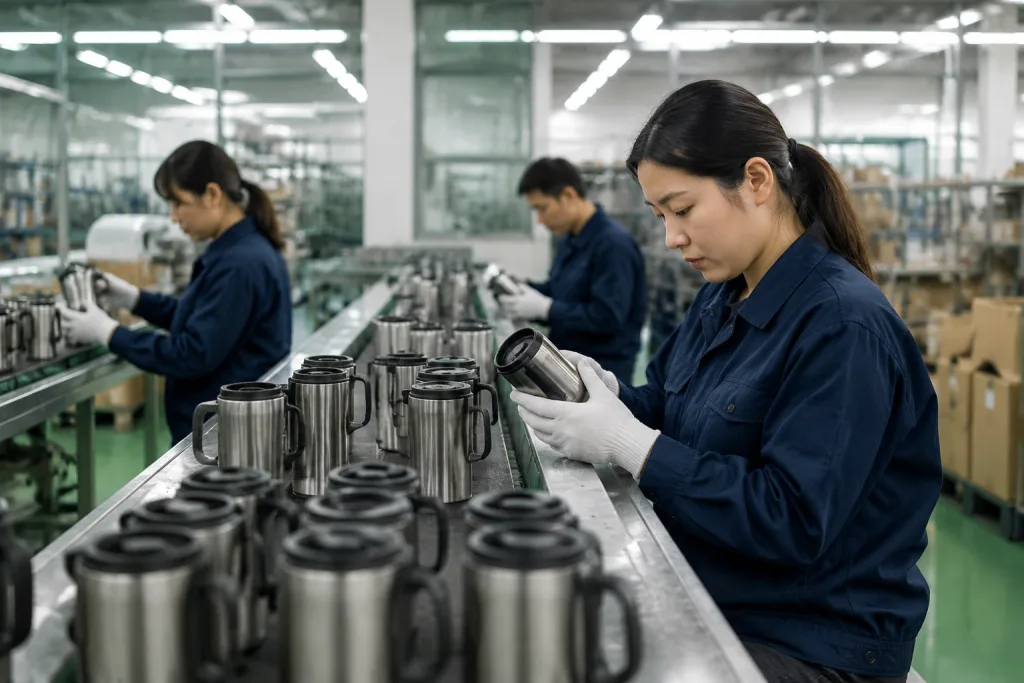
I’ll rewrite the section in place, keep the HTML tags untouched, and make the tone sound like a real factory-side sales engineer.QC for canteen bulk should match the money at risk. We do not run theater on the line. Start with incoming checks: stainless grade, lid resin, coating lot, and the logo process. Then lock the acceptance bar. For most wholesale drinkware orders, AQL 2.5 works for major defects and AQL 4.0 for minor defects. If the buyer is paying for a premium brand, we tighten critical functions like leak resistance and cap torque to AQL 1.5. The math does not lie.
The test list stays short. Check vacuum retention on insulated bottles. Check threaded cap alignment on 30 samples per lot, not 10. Check odor after a warm-water rinse. Run the carton drop test at 60 cm for export cartons and confirm there are no internal dents. If the order has print, we do 50 manual swipes with a standard cloth under light pressure. For laser logos, we check contrast and depth. QC pulled the sample, and that is the point where bad work usually shows up.
For drinkware wholesale from China, ask for photo and video proof from the factory floor before shipment. A Zhejiang supplier should show the packing line, carton count, and seal station. A weak supplier sends one beauty shot and calls it done. We have seen that go sideways on a 3,000-piece order. The buyer flagged a typo on the PO, the cartons were short by 12, and the claim started before the truck left the port.
Packing And Cartons Decide Damage Rate
I’ll rewrite the three paragraphs in the same HTML, keeping tags intact and stripping the AI-ish phrasing. Then I’ll tighten it to sound like a factory-side sales engineer, with concrete packing details and a few grounded numbers.Packing is where a lot of bulk canteen orders bleed cash without anyone seeing it. The bottle passes QC, then shows up with dents because the carton was 3-ply when it should have been 5-ply. For single-wall stainless bottles, we run inner bags plus dividers if the finish is polished or painted. For insulated bottles, molded inserts work best; if the budget is tight, use partitioned cartons so the lids do not hit the body in transit. If you are shipping beer growler wholesale bulk or bulk growler sets, the carton has to be stronger still. Those units are heavier, and the corners take a beating on the line and in the container.
Lock carton count and gross weight before production starts. Once a carton goes over 15-16 kg, handling gets rough and transit damage climbs fast. For Amazon-bound stock, confirm FNSKU placement, suffocation warning rules, and master carton labels before we print the outer box. For distributor orders, check whether mixed-color packing is allowed. We have seen a buyer flag a PO because the carton list said 24 pcs, but the packing spec showed 20 pcs, and that typo turned into a two-day delay. Small stuff. Big cost.
If you are sourcing the best wholesale drink bottle for a brand launch, ask the factory to run a mock packing trial with 50 units. QC pulled the sample, dropped it twice from 1.2 m, and the divider cracked on the second drop. That is the right time to catch it. It is cheaper to scrap one bad insert than to replace 3,000 damaged bottles after sea freight.
Close The Order With Controlled Documents
I’ll rewrite the prose in place, keep the HTML exactly as-is, and make it sound like a factory-side sales engineer wrote it.The order is not done when the line stops. It is done when the papers match the cartons. You need the commercial invoice, packing list, bill of lading draft, and test records lined up with the approved sample. For Europe or North America, ask for REACH paperwork where it applies, food-contact declarations, and any coating or ink statement your market asks for. We’ve had buyers flag a one-line typo on the PO and hold the shipment for 3 days, so if a supplier in China cannot issue clean documents, they are not export-ready.
For recurring canteen wholesale programs, keep a repeat file. Put the approved sample photos, carton dimensions, weight tolerance, AQL results, and logo artwork version in one folder. QC pulled the sample against the master file at 10:20 a.m., and that saved us from a 2 mm carton mismatch on the next run. Then the next order is not a fresh argument; it is a controlled repeat. That is the right way to buy. You protect margin, cut noise, and keep the spec steady across seasons. Whether it is a wholesale canteen, a wholesale growler, or alcohol flask wholesale, the rule is the same: lock the spec, sample hard, inspect hard, and file every handoff.
Send your canteen bulk spec today
We’ll quote with MOQ, material, carton, and lead time spelled out—no vague pricing, no hidden extras, straight from Zhejiang.
Frequently asked questions
What MOQ should I expect for canteen bulk orders?
For a standard canteen bulk program, 1,000 units is a common MOQ for stock-like specs, while 3,000 units is more typical for custom colors, special lids, or complex decoration. If you want mixed sizes or mixed colors, expect the MOQ to move up. In Zhejiang factories, fast-turn sample orders can ship in 5-7 days, but production usually needs 30-45 days after sample approval. For highly customized projects, 50-60 days is more realistic.
What is a fair FOB price for wholesale drinkware?
For a basic 304 stainless wholesale canteen, FOB China pricing often starts around USD 2.10-3.20 at 1,000 units. Add powder coating, laser logo, or premium packaging, and the price can move to USD 3.80-4.80. A thicker 0.8 mm body, better cap, or insulated construction will raise cost further. Always compare the same Incoterm, carton spec, and decoration method, or the quote is not comparable.
How do I check quality before shipment?
Use a simple QC plan that catches real defects. Check leak resistance on at least 30 samples, inspect cap torque, verify logo placement, and confirm carton strength. For most drinkware bulk orders, AQL 2.5 major and 4.0 minor is a practical starting point. If the order is premium or retail-facing, tighten the leak and cosmetic criteria. Ask for photos, videos, and the final inspection report before the balance payment.
Is 304 stainless always the best choice?
For most canteen wholesale orders, 304 stainless is the safest default because it balances cost, corrosion resistance, and buyer confidence. It is usually the right choice for the best wholesale drink bottle positioning. 201 stainless may lower price, but it is a weaker story for a brand and can create more resistance from North American and European buyers. For lids, ask for food-contact compliant materials and a gasket that holds up under repeated opening.
How do growler and flask orders differ from canteen orders?
A bulk growler order usually needs a heavier body, better sealing, and stronger carton protection because the product is larger and more fragile in transit. Beer growler bulk and beer growler wholesale bulk programs also need careful leak testing and packaging control. Alcohol flask bulk or alcohol flask wholesale bulk orders are smaller, but polishing quality, hinge durability, and finish consistency matter more. The spec discipline is the same, but the failure points are different.