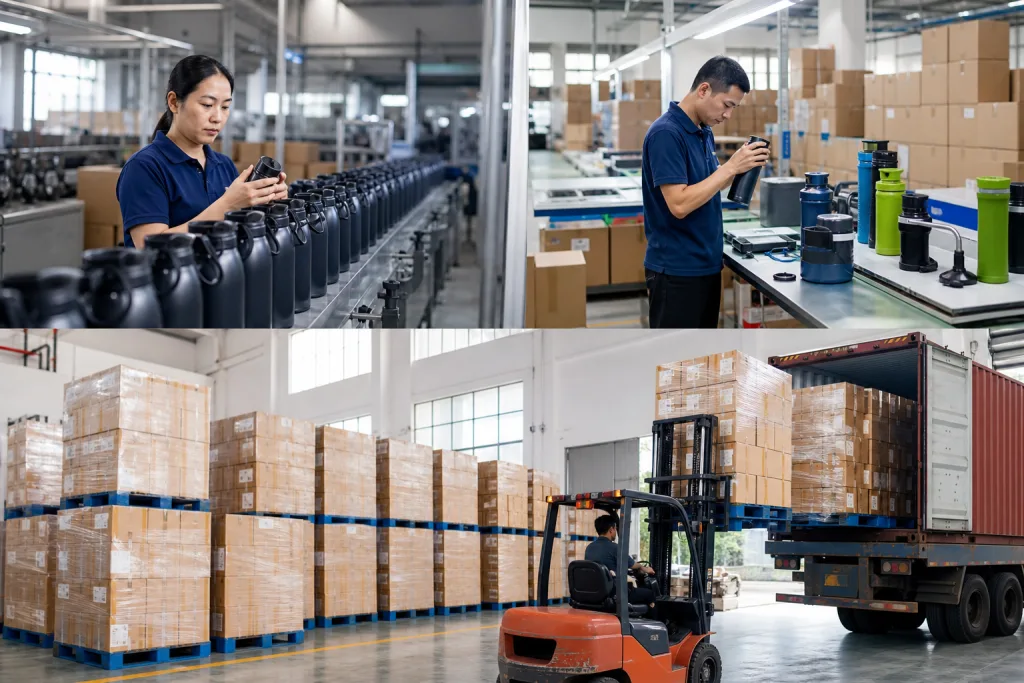
Key Takeaways
- A clean spec sheet usually cuts sampling from 2 rounds to 1 and saves 7-10 days
- Typical MOQ for sport bottles is 500-1,000 pcs, with 20-30 day lead times from Zhejiang
- AQL 2.5 major and 4.0 minor defects is a normal final inspection target for wholesale drinkware
- Logo method changes cost fast: add about USD 0.08-0.60 per unit depending on print or engraving
You do not buy sport bottles wholesale by picking a shape and asking for a quote. You buy a production plan, then check whether the factory can keep it steady from PP sample to mass run. Specs matter. If your launch depends on 5,000 units landing on time, a loose spec sheet with “blue bottle” but no Pantone code, lid torque, or carton drop requirement will cost more than a higher unit price.
Start from the end use: retail shelf, gym promo, Amazon FBA, or distributor stock. A Zhejiang factory should tell you MOQ, lead time, print method, carton count, and test standard before the first sample is approved; on our line, QC pulled a sample last month because the buyer’s PO said 600ml while the artwork showed 650ml. That is the wrong question to ask if you only chase the cheapest quote. If the supplier cannot give those details, you are not sourcing; you are guessing.
Start With the Shipment, Not the Bottle
Here is the mistake we see on RFQs every week: the buyer picks a bottle photo first, then tries to force a commercial order around it. Fine for one sample. Bad for wholesale. Start with the shipment: unit count, destination market, sales channel, and landed cost ceiling. If your forwarder says one 40HQ must stay under 68 CBM, that number matters more than the bottle mood board.
Say you need 8,000 units for a spring promo. If it is a 750 ml Tritan sport bottle with a flip lid, one-color logo, and retail carton, the factory needs that brief before quoting. We can usually price this faster from Zhejiang than a trading desk can, but only when the buyer gives the real inputs: target sale price in USD, color split by SKU, carton style with flute thickness, and whether the file needs REACH, LFGB, or FDA food-contact support. Last month QC pulled a flip-lid sample because the silicone plug sat 0.6 mm off-center. That small detail changes the quote if you want it fixed before mass production.
Do not hide the hard questions at the end of the email. Ask whether the plant can run your volume in one batch, or whether the line will split it across two injection machines. Ask the MOQ per color. For 6 out of 10 sport bottle programs we quote, 500 pcs per color works for plain stock, while 1,000 pcs is the safer floor once you add custom print or special caps. If you are sourcing bulk canteen, bulk drinkware, or a wholesale growler line, use the same discipline and ask for packing data before artwork approval. The category changes. The math does not.
Good sourcing starts with a commercial target, not a product photo.
Lock the Specification Sheet Early
Your spec sheet should be boring. Good. Lock the dull details before tooling, or the sample room will make decisions for you. At minimum, write down capacity, resin or steel grade, wall thickness, lid structure, seal material, print window in mm, packing method, and test requirements. For a 500 ml sport bottle, name the body material clearly: Tritan for higher clarity, PETG for sharper price points, PP for softer squeeze models, or 304 stainless steel for the metal version. If it is stainless, say 0.4 mm or 0.5 mm wall thickness; that one line changes unit weight by around 18-25 g, changes the hand feel, and moves the quote. QC pulled one pre-production sample last month where the PO said “steel bottle” and nothing else. The line chose 0.4 mm. The buyer expected 0.5 mm. That delay was on the paperwork, not the factory.
For a Zhejiang factory running a normal export line, a sensible baseline is 300,000 units per month across mixed drinkware, MOQ 500 pcs for stock colors, and 20-25 days for standard wholesale drink bottle orders after sample approval. FOB Ningbo is common for China export quotes, but compare it with the carton count and CBM, not just the unit price. A bottle at USD 1.20 with loose packing can cost more than a bottle at USD 1.38 that stacks cleanly in a 58 x 38 x 42 cm export carton. The math doesn't work if your forwarder invoices 12.6 CBM instead of 9.8 CBM on the same order quantity. We ship this every week, and the buyer always flags freight after the low unit price has already won internally.
Put the red lines in writing: approved Pantone, acceptable logo size, leak test method, and whether the cap must pass a 90-degree torque check. If you leave those blank, the factory will fill the blanks for you. That is how buyers end up with a product that passes AQL but fails on the shelf. We have seen this go sideways over a 2 mm logo shift and a “close enough” blue cap that was not the approved Pantone. Small line item. Big argument.
- Capacity: 500 ml for gym and school channels, 650 ml for supermarket sets, or 750 ml when the buyer wants higher perceived value
- Seal: silicone for cleaner food-contact positioning, TPE for price-sensitive runs, or integrated gasket when you need fewer loose parts on the line
- Pack: polybag for bulk wholesale, egg-crate tray for lower scratch rates, or retail box when barcodes and shelf display matter
- Standard: REACH, LFGB, FDA, ISO 9001
How Factory QC Actually Works
If you are buying from China, do not write “good quality” on the PO and hope the line understands it. Ask for a QC process you can audit. A proper wholesale drinkware factory should explain incoming inspection, in-process checks, and final inspection in words your merchandiser can repeat back. We run incoming checks on resin, silicone rings, lids, straws, and color chips before mass production; one time QC pulled a gasket that was 0.4 mm undersize, and every lid in that lot failed the leak test. For final loading, the common benchmark is AQL 2.5 for major defects and 4.0 for minor defects, although some buyers tighten critical items to zero tolerance.
What should be checked? Leak test, cap engagement, print alignment, cosmetic finish, odor, color deviation, and carton drop performance all need a line item on the inspection sheet. For a sport bottle, I like to see an inverted water test for at least 3 minutes, a 1.2 m drop test on the packed unit, and a simple thread fit check on every lot using the approved cap, not a loose sample from the showroom. Small thing. Big trouble. If the bottle is meant for repeated washing, ask for dishwasher-cycle evidence or at least a lab report showing the finish does not craze after heat exposure; we have seen matte coating look fine on day 1 and turn cloudy after 8 heat cycles.
For Europe, REACH is the minimum conversation starter; for food-contact plastics, LFGB evidence is often requested by importers in Germany and neighboring markets. For the US, buyers usually ask for FDA food-contact declarations and, where relevant, Prop 65 awareness. BSCI is not a product test, but 7 out of 10 distributors we deal with still want social compliance on file before they open a retailer program. The buyer flagged this last month on a 5,000 pcs sport bottle order because the factory name on the test report did not match the PI by one English spelling. That matters when your retailer starts asking for factory screening.
Do not rely on photos from the line. Photos hide too much. Ask for pre-shipment videos showing carton count, seal inspection, and random sample pulls, with the outer carton marks and PO number visible in the same shot. We ship better when QC opens cartons with a cutter on camera, checks 13 samples across the lot, and shows the sealing tape after inspection. If the factory refuses a third-party inspection from SGS, Intertek, or BV, treat that as a problem, not a negotiation point; the math does not work if you save USD 200 on inspection and receive 80 cartons with leaking caps.
Branding Choices That Change Cost
Logo method is where first-time buyers burn money or spec the order too thin. We see it on 3 out of 10 new sport bottle RFQs. On a sport bottle, the best wholesale drink bottle for your program is usually the one that holds up after rub testing and dishcloth wiping, not the one that looks fancy in a PDF mockup. Screen printing is still the cheapest route for a simple one-color logo. Expect roughly USD 0.08-0.18 per unit for a straightforward print run, depending on size and quantity. Laser engraving on stainless usually adds USD 0.12-0.30 per unit. UV print, wrap print, or multi-color artwork can add USD 0.25-0.60 or more. QC pulled one 750ml sample last month because the logo shifted 2.5 mm off-center after the jig was reset. Small miss. Big complaint.
The catch is the surface. A PP cap prints differently from a powder-coated stainless body. A translucent Tritan bottle can make a pale logo look weak if the ink mix is wrong. If you are buying wholesale drinkware for retail, ask the factory for a digital proof and one physical sample before production. For large programs, I would rather spend USD 30-80 on the right proof than ship 5,000 units with a washed-out logo. We run a 3M tape test and a 50-rub alcohol wipe test on printed samples, and that catches problems a screen photo never shows.
This is also where adjacent categories matter. If you later move into canteen wholesale, wholesale canteen, beer growler wholesale, or even alcohol flask wholesale bulk programs, the same print discipline applies, but the decoration method can change. A growler bulk order with brushed stainless needs different surface prep from a soft-touch drinkware bulk run. Do not let one artwork file drive every SKU. We have seen this go sideways when a buyer used the same 42 mm wide logo on a flask curve and a straight bottle wall, then flagged the flask as “smaller” after mass production.
Practical rule: one logo, one substrate, one approved Pantone. Every extra variable raises your defect risk.
Packaging, Cartons, and Freight
Packaging is not a cosmetic decision. It hits freight cost, damage rate, and retail readiness. A bottle packed loose in a master carton looks cheaper on the PI, then the buyer pays for it later. We saw one 750 ml sport bottle project pass the drop test at 60 cm only after we changed the inner divider from thin white card to 350 gsm corrugated. A retail box adds cost, but if you sell through Amazon or a distributor asking for shelf-ready units, it can still be the better call. For bulk drinkware programs, I often see buyers save USD 0.12 on packaging and lose USD 0.40 in dents, repacking, or warehouse chargebacks. The math does not work.
Start with the carton count. Eight, twelve, or twenty-four units per master carton changes the pallet pattern and the freight density. On a 1,000-unit order, better carton engineering can trim 0.3 to 0.5 CBM. That sounds small until you pay ocean freight from Ningbo or Shanghai, then pay again for domestic warehouse handling in Europe or North America. We run carton mockups with a tape measure and weigh the packed carton on a 30 kg floor scale before mass packing starts. If the order is for Amazon FBA, confirm FNSKU labels, suffocation warnings if needed, and carton barcode placement before production starts. Do it early. One buyer sent the FNSKU file after packing, and the line spent half a day reopening 84 cartons.
Keep an eye on the carton spec: 5-ply is acceptable for many export drinkware shipments, but if the bottle is glass or heavier stainless, 7-ply may be worth the extra cost. QC pulled one glass sample last season with corner crush after the carton sat under 3 layers in the warehouse for 48 hours. That was before sea freight. If you are expanding into beer growler bulk, beer growler in bulk, or beer tumbler bulk, carton strength matters more because the weight per pack rises fast. A 12 pcs carton can jump from 9 kg to 16 kg after the buyer changes from single-wall stainless to glass. The same is true for alcohol flask bulk programs where the unit is small but the metal finish scratches easily. We add PE bags or tissue wrap when the brushed finish shows rub marks under normal shaking.
FOB is only one number. The real number is landed cost per sellable unit after cartons, pallets, ocean freight, and repacking are included. We ship containers every month, and this is where sourcing teams get surprised: a USD 0.08 carton upgrade can save 12 days of claims emails versus 18 damaged cartons sitting at the 3PL. Ask for the packed carton dimensions in mm, gross weight in kg, and the pallet plan before you approve the PO.
Protect the Reorder Before It Starts
Your first order only earns its keep if the reorder matches it. Repeat business is where QC gets tested. Factories can swap a silicone gasket supplier, change a 304 stainless batch, or move the job from cavity 3 to cavity 7 if the controls were never written down. We saw one 5,000 pcs sport bottle reorder go sideways because the golden sample was missing and the approved AI logo file had been replaced by a JPG from the buyer’s email signature.
For a reliable reorder, lock these items in the file: material grade with mill certificate, mold cavity number, lid supplier name, seal hardness in Shore A, logo file version, and carton spec with board thickness. If a factory in Zhejiang says they can match the sample but cannot show the same mold number or cap drawing, ask for a fresh pre-production sample. Short answer: do not trust memory. China factories run fast, and the line leader will choose the workable setup if the PO is vague. Your job is to make sure the approved bottle survives the next run.
If you cross categories, the risk jumps. A buyer handling canteen bulk or wholesale growler orders often assumes the same packing spec works for sport bottles. It doesn’t. A stainless beer growler wholesale bulk program might pass with a small finish shade difference, while a lightweight BPA-free bottle gets complaints if the lid color shifts by 1 mm on the printed band. Keep each SKU on its own control file, because mixing specs is where the math doesn’t work.
If you want stable long-term supply, ask for a supplier document pack: signed sample, test reports, inspection photos, and the last PO reference. We usually include carton drop-test photos, AQL 2.5 findings, and the exact PO line item, because one typo in “matte black” versus “gloss black” can cost 12 days before shipment. That is how you keep a decent price without giving up control.
Send your spec and get a real wholesale quote
Share capacity, material, logo method, and target quantity. We will return MOQ, lead time, and a factory-grade price for China export.
Frequently asked questions
What is a realistic MOQ when I buy sport bottle wholesale?
For standard export sport bottles, 500 pcs is a realistic MOQ for stock colors and simple packing. Once you add custom color matching, special lids, or retail boxes, 1,000 pcs is more common. For a 500 ml Tritan bottle or a 304 stainless model, many Zhejiang factories can quote a small trial order, but the price usually improves only after 1,000 to 3,000 units. If your program needs multiple SKUs, ask whether the factory can split colorways within the same mold. That is often cheaper than opening a second line. If you need a fast sample, expect 5-7 days; mass production usually takes 20-30 days after approval.
Which compliance documents should I ask for in China?
For Europe, ask for REACH support and, where relevant, LFGB food-contact evidence. For the US, ask for FDA food-contact declarations or equivalent supplier statements. If the bottle is stainless, ask for material traceability for 304 or 316 grades. If you are buying from China, also request ISO 9001 evidence for the factory and BSCI if your retail customer screens social compliance. Do not accept a PDF alone without batch reference. A real supplier should be able to tie test reports to your specific SKU, color, and production date. For large wholesale drinkware orders, it is sensible to keep a file with declarations, inspection photos, and the signed sample.
How much does custom logo work add to unit cost?
It depends on the surface and the decoration method. A one-color screen print on a plastic sport bottle may add USD 0.08-0.18 per unit. Laser engraving on stainless usually adds USD 0.12-0.30. UV print, wrap print, or multi-color artwork can run USD 0.25-0.60 or more, especially if the artwork is large or the run is small. The biggest mistake is not the price itself; it is choosing a method that looks fine at sample stage but fails after shipping or washing. For repeat orders, keep the same Pantone, same artwork size, and same cap orientation so the logo appears consistent across cartons.
Can I mix colors or models in one wholesale order?
Usually yes, but you need to separate the rules for each SKU. Many factories in Zhejiang will allow mixed colors within one mold if the total quantity is strong enough, often 500-1,000 pcs per color. Mixing different bottle bodies, lids, and packing styles is more complicated because each combination affects setup time, carton planning, and QC. If you are also sourcing drinkware wholesale items like a bulk canteen, bulk growler, or beer tumbler wholesale bulk program, avoid mixing too many unrelated models in one PO. It lowers your leverage on price and increases the chance of packing mistakes. A cleaner purchase order almost always ships more smoothly.
What lead time should I plan for from PO to shipment?
For standard wholesale sport bottles, plan on 20-25 days after sample approval if the factory already has the raw materials and packaging in stock. If you need special color matching, new tooling, or custom printed cartons, allow 30-35 days. A good supplier in China should tell you whether that schedule is realistic before you confirm the PO. If you are shipping to a tight retail launch, build in extra time for inspection and freight booking. I normally advise buyers to assume 3-5 days for pre-production checks, 1 day for final inspection, and at least 7-20 days for ocean transit depending on destination and sailing schedule.