Key Takeaways
- A practical bulk growler MOQ starts around 1,000 pcs per color for powder coating and 3,000 pcs for custom mold changes
- 304 stainless steel is the safe default; 201 steel can cut cost by 6-12% but increases corrosion risk
- Ask for AQL 2.5/4.0 inspection, leak testing at 100%, and carton drop testing before balance payment
- Normal China production lead time is 30-45 days after deposit and artwork approval, not including sea freight
A bulk growler looks simple on a quote sheet: capacity, material, color, logo, carton quantity. That is where buyers get burned. A 64 oz beer growler in bulk can pass sample review and still come back as warranty claims when the lid gasket is 0.5 mm too loose, the inner polish traps odor, the powder coat is under 60 μm, or the 5-layer carton fails a 1.2 m drop test.
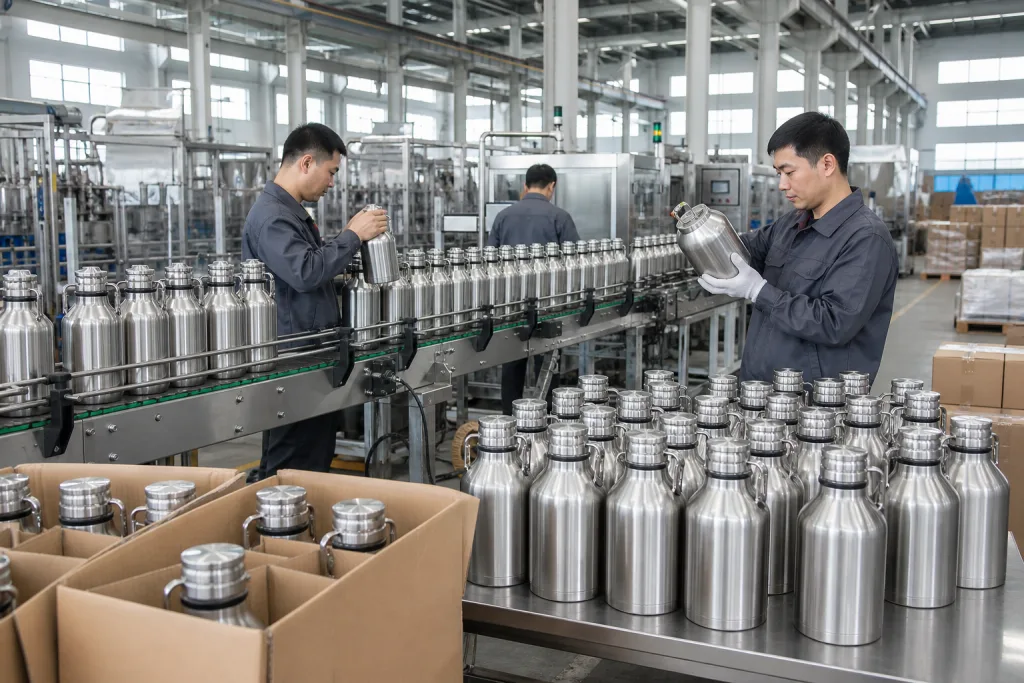
If you plan to buy in bulk growler inventory for retail, breweries, outdoor channels, or promotional programs, read the spec like someone standing beside the line. BottleForge Industrial manufactures drinkware bulk orders in Hangzhou, Zhejiang, and we see the same pattern on 3 out of 10 first-round RFQs: the lowest quote stripped out the details the buyer actually needed. The math doesn't work. Last month QC pulled a sample with a clean logo but a thin silicone ring, and the buyer flagged leakage only after filling it with carbonated beer.
Capacity Is Not Just Volume
When buyers search for buy in bulk growler, they usually start with 32 oz, 40 oz, 64 oz, or 2 L. Capacity is the first spec line, but it drives more than fill volume. It changes tooling, carton size, freight cost, shelf fit, and whether the piece reads like a beer growler or a general outdoor canteen. On the line, a 64 oz body often needs a different forming tool than a 32 oz body. That is the real question to ask.
For beer growler wholesale programs, 64 oz stays the standard because it matches brewery refill habits in North America. A 32 oz size fits gift sets, corporate drinkware wholesale, and e-commerce bundles where parcel weight matters. For outdoor retail, 40 oz and 50 oz formats sit between a bulk canteen and a growler, especially when the cap has a handle or pour spout. We ran a 50 oz sample last month, and QC pulled it because the lid sat 8 mm too high for the shelf carton. If a buyer asks one SKU to cover all three channels, we usually push back.
You should specify both nominal capacity and practical fill line. A 64 oz double-wall stainless growler may physically hold 1,950 ml to the rim, but the usable hot-fill or carbonated beverage level needs headspace. If you sell into beer growler wholesale bulk channels, do not ignore carbonation pressure. Most vacuum growlers are not pressurized vessels. They hold beer for transport, not as mini-kegs. We run burst checks at 2 bar, and the cap seal tells the story fast. Skip this spec and the buyer will flag leaks after the first delivery.
From a sourcing angle, capacity also changes price steps. In Zhejiang, China, a 32 oz stainless single-color growler may start around FOB USD 5.20-6.80 at 1,000 pcs, while a 64 oz powder-coated vacuum growler often lands around USD 8.20-12.50 depending on lid, finish, and logo method. If a supplier quotes both sizes with almost no price gap, ask what wall thickness or insulation structure changed. We have seen that go sideways. When QC pulled the sample, the 64 oz body had a 0.5 mm wall, and the buyer got a dented carton in transit.
Steel Grade Drives Warranty Risk
The material line is where a growler bulk order either stays quiet or turns into warranty emails. We see this on about 7 out of 10 price-driven RFQs. For wholesale drinkware, the inner wall should be food-contact 304 stainless steel. Some suppliers quote 201 stainless steel to shave cost. The sample can still look clean on the desk, and the caliper reading may pass, but 201 has lower nickel content and weaker corrosion resistance. If your customer fills acidic beverages, beer, electrolyte drinks, or uses aggressive cleaning tablets, the small saving can come back as rust complaints within 3 to 6 months.
A responsible spec should state inner wall: SUS304, outer wall: SUS304 or SUS201 by agreement, food contact parts compliant with LFGB or FDA requirements. For Europe, add REACH and LFGB migration testing where needed. For North America, use FDA food-contact expectations. For kids or family-oriented lines, review ASTM-related packaging and labeling even if the growler itself is not a toy. We once had a buyer flag a PO because “SUS304 inside” was written in the email chain but missing from the stamped spec sheet. That is how disputes start.
Wall thickness matters too. Most bulk drinkware items we run sit around 0.4 mm to 0.5 mm stainless sheet before forming. Thinner walls cut cost but dent faster, especially on a large 64 oz body. For beer growler in bulk programs sold through breweries, dents show up because staff handle the product at counters, events, and refill stations. A 0.5 mm outer wall feels better in hand and survives retail handling better than ultra-light builds. QC pulled one 64 oz sample last month after a 1.2 m carton drop test left a flat spot near the shoulder.
Ask for a material declaration, not just a sales promise. For larger orders, we recommend random PMI verification or third-party material checks. BottleForge Industrial can run 300,000 stainless drinkware units per month in Zhejiang, but even with that scale, the purchase order must lock the steel grade. The line follows the approved spec. This is the wrong question to ask: “Can you make it cheaper?” Ask which steel grade, which wall thickness, which test report, and what happens if inspection finds 201 on the inner wall.
Insulation Changes The Use Case
Not every wholesale growler needs vacuum insulation. We say this even when it cuts the quote value. For a 3,000 pcs dry-giveaway order, a single-wall stainless or aluminum bottle may pass the brief if the buyer only needs a logo carrier. For premium beer growler bulk inventory or outdoor retail drinkware with a higher shelf price, double-wall vacuum insulation earns its cost. The wrong question is “which one looks better?” Ask where the user will fill it, how long it sits in a car, and whether the cap will be opened 6 times at a campsite.
For vacuum growlers, ask for performance numbers with test conditions. “Keeps cold all day” is sales copy, not a spec. A useful line reads: cold retention: 0-5°C water, 20°C ambient, measured after 12 hours and 24 hours; hot retention: 95°C water, 20°C ambient, measured after 6 hours. On the line, QC should record the water temperature with a probe thermometer, not guess by hand feel. Large growlers often test well because the volume-to-surface ratio works in their favor, but we have seen a loose PP lid gasket pull the 24-hour result down by 3-4°C.
Vacuum failure is a quality issue you can catch before shipment. The factory should test vacuum integrity during production, either by thermal response testing or vacuum detection equipment. We run this before packing, then QC pulled the sample again after the cartons were sealed. For drinkware bulk orders, require random finished-goods performance tests from sealed cartons, not only production-line samples. This matters. A sample from the bench can pass while 18 pcs from a rushed night shift show weak vacuum after powder coating.
Insulation changes freight math too. Double-wall items take more space and weigh more than single-wall options. A 64 oz vacuum growler may pack 12 pcs per export carton, with a carton weight around 12-16 kg depending on lid and packaging. We measure the master carton with a tape measure after the insert is loaded, because catalog carton sizes are often 10-20 mm short. If you are calculating landed cost for growler wholesale, include cubic meter freight, not only FOB unit price. A low FOB price loses its advantage when the carton design wastes container space.
Lid Design Decides Complaints
The lid causes most after-sales claims in alcohol flask wholesale, beer tumbler wholesale bulk, and growler programs. Buyers stare at the body because the logo is there. End users blame the lid when it leaks in a backpack, smells after two uses, cracks after a drop from the counter, or feels cheap next to the tap. We had one 64 oz growler order where QC pulled 32 leaking samples from a 500 pcs pre-shipment check, and every failure came from gasket seating, not the stainless body.
For a bulk growler, lock down lid material, gasket material, thread design, and leak test method on the PO. PP is common for plastic parts. Tritan may be used for transparent components. Silicone is the usual gasket material, but it should be food-grade and removable for cleaning. If the product will be used for beer, cider, kombucha, or cocktails, skip lid designs with deep hidden cavities that trap odor; we have seen buyers flag this after one weekend of use because the sample smelled sour even after washing with a bottle brush.
A screw cap with stainless exterior and plastic inner structure is the standard choice for 64 oz growlers. It runs clean on the line. Swing-top styles look traditional, but the math does not work unless you control wire tension, ceramic or plastic stopper dimensions, and gasket compression with gauges, not eyeballing. Handle lids fit outdoor bulk canteen lines, but the handle strength must be tested. A simple internal standard is a static hang test at 15-20 kg for 30 minutes, followed by normal leak testing after the load test.
Leak testing should be 100% for filled and inverted units, not just random cartons. For carbonated beverages, be careful with marketing language. A beer growler wholesale product can be suitable for carrying beer, but unless specifically engineered and tested for pressure, do not describe it as pressure-rated. The buyer may push back and ask for stronger wording on the carton; this is the wrong question to ask if the cap has only passed a basic inverted leak test and not a pressure test.
Finish And Logo Need Tolerance
Surface finish is where brand owners often spend on the wrong part and then miss the part buyers touch first. Powder coating costs more than basic spray paint; brushed stainless hides small scratches better; mirror polish shows every fingerprint; electroplating needs tighter bath control. On 2,000-5,000 pcs wholesale drink bottle runs, we push powder coating for retail shelves because the hand feel is better and the return risk is lower. The line will show you fast: QC pulled 12 matte samples last month, and 3 failed because the coating looked fine in photos but felt gritty around the shoulder.
Write the coating type and target thickness on the PO. Powder coating commonly falls around 60-90 microns. Too thin and it scratches easily; too thick and threads, lid fit, or cup holder dimensions can be affected. We check it with a coating thickness gauge, not by eye. For matte black and dark colors, fingerprints and oil marks are more visible. For light colors, factory handling marks and carton abrasion show faster, especially after 18 days in export cartons versus a 12-day domestic move. Approve a pre-production sample under warehouse LED light and daylight, not only a clean studio photo.
Logo method depends on order size and where the logo sits. Laser engraving is clean and durable on stainless or powder-coated surfaces. Silk screen works for larger colorful logos, but weak ink curing will scratch at the first carton rub. Heat transfer gives full-color artwork, though adhesion testing is not optional. For a wholesale canteen or growler wholesale program, ask the factory to run a 3M tape test, alcohol rub test, and dishwasher simulation if you plan to claim dishwasher safety. We have seen this go sideways when a buyer approved artwork on email, then flagged a 1.5 mm logo shift after packing had started.
Color tolerance needs to be written before deposit. Use Pantone references for coated items, but stainless substrate, coating batch, and curing temperature can shift the result. A practical agreement is to approve one golden sample and allow controlled visual tolerance against that sample. This is the wrong question to ask: “Can you match navy blue?” Ask whether batch 1 and batch 2 will pass against the same golden sample under the same light box. If you order canteen bulk inventory over several production batches, keep batch records, or your retail shelf may show three versions of the same “navy blue.”
Packaging Is Part Of The Product
Packaging is not decoration added after the growler passes leak test. For beer tumbler in bulk, alcohol flask in bulk, and large growlers, packaging protects your margin. A 64 oz stainless growler has enough mass to bruise its own powder coating during ocean freight if the insert is thin. We have opened a clean-looking master carton on the QC table and found lid threads rubbed, base rims dented, and black coating marked at the contact points.
Start with the sales channel. For brewery refill programs, a plain white box with barcode is often enough. For retail wholesale drinkware, specify the printed color box, instruction sheet, UPC/EAN label, and compliance icons line by line. For Amazon or 3PL distribution, add FNSKU labeling, master carton labels, suffocation warnings for polybags where relevant, and drop-tested packaging. A packaging spec should include box material, flute type for corrugated cartons, carton dimensions, gross weight limit, and palletization if needed. One buyer once sent a PO saying “retail box” but meant 350 gsm color box with matte lamination; the price gap was USD 0.18 per unit, and the line had already booked plain white boxes.
Our practical recommendation is to keep export cartons under 18 kg when possible. Heavy cartons get dropped. Warehouse staff handle a 22 kg carton differently from a 15 kg carton, especially during container unloading in July. For large growlers, internal dividers and top/bottom pads are cheap insurance compared with a coating claim. ISTA-style drop testing, or at least a 1-corner, 3-edge, 6-face drop sequence from 76 cm, gives you useful evidence before the order leaves China. QC pulled the sample after the edge drop; the carton survived, but the upper lid showed a 3 mm rub mark, so we changed the top pad before mass packing.
Do not let packaging be quoted as “standard export carton” without details. Standard for whom? A factory shipping domestic drinkware in China may use lighter cartons than a buyer shipping from Ningbo or Shanghai to Rotterdam, Hamburg, Los Angeles, or Toronto. This is the wrong place to save USD 0.06. If you want fewer claims, define the packaging before deposit, not after final inspection finds rub marks and everyone argues over whether the carton was “normal.”
Commercial Terms Must Match Specs
The last spec lines are commercial: MOQ, lead time, payment terms, inspection rules, Incoterms. They are not paperwork filler. They decide whether the line can hold your finish, logo position, carton strength, and delivery date. For a custom powder-coated bulk growler with logo and retail box, a realistic MOQ is usually 1,000 pcs per color. We run that number because the coating line needs stable color setup, and one 18 kg powder box does not cover endless small batches. For a new mold, special cap, or unique body shape, expect 3,000-5,000 pcs and tooling charges from USD 1,500 to USD 8,000 depending on complexity.
Normal production lead time in Zhejiang, China is 30-45 days after deposit, artwork approval, and confirmed sample. Count from the approved sample, not from the first WhatsApp quote. Peak season before summer promotions or Q4 gifting can add 10-20 days; we have seen a 38-day plan become 52 days when the powder coating oven was booked by a sports bottle order. If a supplier promises 15 days for a fully custom wholesale growler order, ask what is being cut: existing blank stock, skipped testing, or a subcontract workshop you did not approve.
For payment, most China factories use 30% deposit and 70% before shipment. That is normal, but the balance should be tied to inspection. No inspection, no clean payment. Use AQL 2.5 for major defects and 4.0 for minor defects, with critical defects at 0. Critical defects include leaking, unsafe sharp edges, wrong material, contaminated interior, and missing compliance labels. QC pulled one growler sample last year with a 0.6 mm burr inside the mouth; the buyer called it “small,” but the math does not work when 2,000 pcs reach retail with cut-lip complaints.
FOB Ningbo or FOB Shanghai is common for Hangzhou-area production. EXW may look cheaper, but it puts local trucking, export handling, and document coordination on your desk. If you are new to drinkware wholesale, FOB is usually cleaner. A good purchase order should attach the approved spec sheet, artwork file, packaging layout, inspection criteria, and shipment marks. Check the small lines too. We once had a PO typo showing “matte black” while the approved artwork said “sand black,” and the buyer flagged it only after cartons were packed. That single document prevents more arguments than any friendly email chain.
Send Your Growler Spec Before You Quote
Share capacity, steel grade, lid type, finish, logo, packaging, and target FOB price. We will check what is realistic before sampling.
Frequently asked questions
What MOQ should I expect when I buy in bulk growler products?
For an existing stainless steel growler shape, expect around 1,000 pcs per color for powder coating and logo printing. If you accept stock colors and laser engraving, some factories may support 500 pcs, but unit price is usually higher. For custom body tooling, special lid development, or a unique beer growler wholesale bulk design, plan for 3,000-5,000 pcs. At BottleForge Industrial in Zhejiang, we usually quote standard growler bulk projects from 1,000 pcs because coating setup, logo fixtures, carton printing, and QC time need that volume to make sense.
Is 304 stainless steel always required for wholesale growler orders?
For the inner wall, yes, 304 stainless steel is the safest default for wholesale growler and bulk drinkware programs. It gives better corrosion resistance against beer, acidic drinks, electrolyte mixes, and repeated washing. Some quotes use 201 stainless steel for the outer wall to reduce cost by roughly 6-12%, which can be acceptable if disclosed and tested. Avoid 201 for the inner wall if you sell into Europe or North America under a serious brand. Ask for material declarations and, on larger orders, consider third-party checks during inspection.
Can a beer growler in bulk hold carbonated beer safely?
A standard vacuum beer growler can carry beer, but it should not be marketed as a pressure-rated vessel unless it has specific pressure testing and engineering. Carbonation creates internal pressure, especially if the growler is filled warm or shaken during transport. For beer growler in bulk orders, specify leak testing, gasket quality, and cap thread strength. Also keep your user instructions clear: fill properly, keep cold, do not overfill, and do not use for fermentation. This protects your customers and reduces warranty claims.
Which logo method is best for growler wholesale orders?
Laser engraving is the most durable choice for stainless steel and powder-coated growlers, especially for outdoor, brewery, and corporate wholesale drinkware programs. Silk screen is better when you need a larger one- or two-color logo at lower cost, but ink adhesion must be tested. Heat transfer supports full-color graphics, though it needs stricter rub and tape testing. For orders above 1,000 pcs, ask for a pre-production sample and require a 3M tape test plus alcohol rub test before mass production.
What lead time should procurement managers plan for China production?
For a standard bulk growler with existing mold, custom color, logo, and export packaging, plan on 30-45 days after deposit and sample approval. Add 7-10 days for complex artwork, retail box proofing, or compliance testing. New mold projects can take 60-90 days before first shipment because tooling, sampling, revisions, and pilot production take time. Sea freight from China to Europe or North America adds roughly 25-45 days depending on port pair, routing, and season.