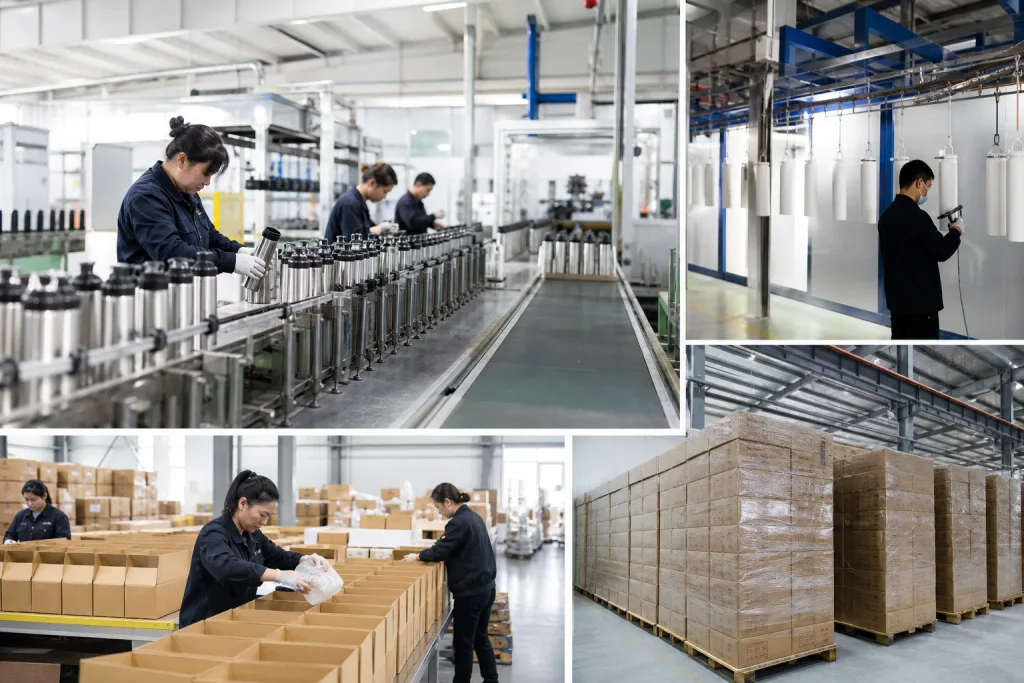
Key Takeaways
- A standard 500 ml bulk vacuum insulated bottle normally lands around USD 3.20–5.80 FOB China depending on steel grade, lid, coating and packaging
- Realistic MOQ is 1,000 units per SKU for existing molds, but custom shape tooling usually needs 3,000–5,000 units
- Plan 7–10 days for samples, 30–45 days for mass production, and 5–7 days for AQL inspection and final release
- Logo method can change cost by USD 0.08–0.65 per unit, with laser engraving slower but more durable than basic silkscreen
A bulk vacuum insulated bottle order looks simple until the quotes land. One supplier sends USD 3.20, another sends USD 5.10, both print “304 stainless steel, 12 hours cold,” and the buyer flags it on the first round. We see this every week. The gap is usually in the liner thickness, lid structure, or coating spec, not the headline material. On our drop tester, a 1.2 m sample can pass once and fail after a weak weld, so the cheap number is often the wrong question.
BottleForge Industrial is based in Hangzhou, Zhejiang, and we run stainless drinkware for B2B buyers, distributors, and private-label brands. Our normal MOQ starts at 1,000 units per SKU, monthly capacity sits at about 450,000 units, and standard production lead time is 30–45 days after artwork approval. On the line, QC checks cap torque with a 0.5 N·m gauge before packing. Here is where cost, MOQ, and schedule usually move.
Where the FOB price starts
For a bulk vacuum insulated bottle, the FOB price starts with stainless steel grade, sheet thickness, welding and vacuum work, lid parts, coating, logo method, carton spec, testing, and factory margin. If a quote lands 25% under the market, ask which line got cut. We see it often: the buyer flagged a low price, then QC pulled the sample and found a lighter cap, thinner carton, or no real vacuum test record.
As a working range, a 500 ml double-wall stainless bottle from Zhejiang, China, using 304 inner and 201 or 304 outer steel, usually prices between USD 3.20 and USD 5.80 FOB Ningbo or Shanghai for 1,000–5,000 units. A 750 ml version often moves to USD 4.20–7.20. A 1,000 ml canteen-style bottle can reach USD 5.80–9.50, especially with powder coating, carry handle, and gift box. On our line, switching from white box to 350 gsm color box can add USD 0.18–0.45 per unit, and buyers sometimes miss that line on the PO.
Wall thickness matters. Most export bottles we run use 0.4 mm to 0.5 mm stainless sheet before forming. Thinner steel can reduce cost by USD 0.15–0.35 per unit, but it dents faster during 1.2 m drop testing and carton compression. Cheap gets expensive. For wholesale drinkware programs, the math doesn't work if your return rate rises above 1.5%, especially when Amazon or retail buyers charge back photos of dented shoulders.
The vacuum process is another quiet cost driver. Proper insulation needs clean laser welding, stable evacuation, copper lining or reflective treatment depending on specification, and leak testing. A bottle that passes a quick hot-water test in a showroom can still fail after 18 days at sea if the weld is weak. Ask for thermal test data using a fixed method, for example starting water temperature at 95°C, room temperature at 20°C, and results after 6 and 12 hours. We ship better when the buyer asks for the test sheet before mass production, not after the container is booked.
MOQ tiers that actually change price
MOQ is not just a supplier rule. It is tied to stainless steel booking, coating line setup, logo fixture setup, carton printing plates, and how we plan workers on the line. For existing shapes, our common MOQ in Hangzhou, Zhejiang is 1,000 units per SKU. A SKU means one size, one color, one lid, and one logo version. If you order 1,000 pieces split across five colors, most factories will treat that as five small runs, because the powder booth still needs cleaning and the laser jig still needs resetting for each version.
At 1,000 units, you are paying for setup waste. Simple as that. At 3,000 units, coating hangers fill better and assembly runs with fewer stops. At 5,000 units, carton printing and accessories start to price down because we can order inserts, polybags, and master cartons in a cleaner batch. For a standard 500 ml bottle, the difference between 1,000 and 5,000 units may be USD 0.25–0.60 per unit, depending on finish and packaging. We have seen five 1,000-piece colors take about 18 coating-line hours, while one 5,000-piece color can finish in around 12 hours because there are fewer color changes.
Custom shape is a different cost bucket. If you want a new body profile for the best wholesale drink bottle in your category, tooling commonly costs USD 1,200–4,500 for bottle molds and fixtures. A custom lid can add USD 2,000–8,000 because of injection mold tooling. Factories usually ask for 3,000–5,000 units for the first run to spread trial loss, welding adjustment, and fixture tuning. If a buyer asks for 500 pieces on a new mold, the math does not work; QC may pull 80–120 samples during trial runs before the mouth roundness and vacuum rate are stable.
Buyers sourcing canteen wholesale, bulk canteen, or wholesale canteen formats should check whether the factory already has the shoulder, mouth diameter, and handle tooling. A “new” canteen bulk design can look minor on a drawing but require new trimming dies, welding clamps, or polishing wheels. We have seen this go sideways when a 2 mm handle-position change looked harmless on the PO, then the buyer flagged uneven polishing near the weld. That adds time, scrap risk, and a harder price discussion after the order is already placed.
Lids, coatings and packaging add up
The lid is often the biggest non-steel cost in drinkware bulk orders. A simple screw cap may cost USD 0.25–0.45. A push-button lid, straw lid, or leakproof flip lid can run USD 0.60–1.40 depending on silicone seals, PP or Tritan material, spring parts, and mold quality. Check the gasket. Last month QC pulled 32 lids from a pilot run and found 3 with flash on the silicone ring, enough to fail a leak test after 6 hours upside down. If your product is for Europe or North America, request LFGB, FDA, BPA-free, and REACH documentation where applicable.
Surface finish changes the quote fast. Basic spray paint is low cost, but it chips on sharp bottom edges if the line does not control curing time and film thickness. Powder coating usually adds USD 0.35–0.90 per unit, and it gives better hand feel and abrasion resistance. We run 70–90 μm coating thickness on most retail bottles; below 60 μm, the buyer usually flags rub marks after a tape test. Electro-polished stainless looks clean for outdoor and hospitality buyers, but fingerprints and scratches show up sooner. For wholesale drinkware, I prefer powder coating for retail and brushed stainless for corporate or industrial programs.
Packaging can move the quote more than buyers expect. A plain white box may cost USD 0.12–0.25. A printed color box can be USD 0.25–0.60. A rigid gift box can exceed USD 1.00. The math does not work if the buyer asks for a premium box on a low-price promo bottle, and we have seen this go sideways after artwork approval. If you sell through e-commerce, add drop-testable mailer packaging, FNSKU label placement, and carton weight control. A 24-piece export carton should usually stay under 15–18 kg for easier warehouse handling; our packing bench uses a 150 kg digital scale, and anything over 18 kg gets complaints from 3PL warehouses.
If you are buying alcohol flask bulk, alcohol flask in bulk, or alcohol flask wholesale for promotional channels, packaging is sometimes more expensive than the small flask itself. For alcohol flask wholesale bulk projects, confirm local compliance on food-contact metal, capacity labeling, and gift-pack claims before artwork is printed. Small mistake, big delay. We once saw a PO typo list 6 oz on the carton while the artwork said 8 oz, and the buyer held 4,800 pieces until we reworked the labels.
Timeline from sample to shipment
A clean sourcing timeline beats a rushed one. For an existing bulk vacuum insulated bottle shape, plan 7–10 days for plain samples or 10–15 days for logo samples. We run laser engraved samples faster than printed samples because the engraving file goes straight to the fiber laser, while silk screen needs a plate, ink test, and a Pantone check under a light box. Last month QC pulled one 500 ml sample because the logo sat 2 mm too low.
After sample approval, mass production normally takes 30–45 days. The first 6–7 days cover 304 stainless steel coil receiving, tube cutting, forming, welding, and vacuum work. Coating and logo application sit in the middle of the schedule. Assembly, leak testing, thermal testing, packing, and carton sealing happen toward the end. Six colors change the math. If your order has six colors, two lids, and three carton artworks, the line cannot move like a one-color corporate bottle; we have seen this go sideways when the PO says “black lid” but the artwork file shows “silver cap.”
Pre-shipment inspection should be booked when at least 80% of goods are packed and 100% are produced. AQL 2.5 for major defects and AQL 4.0 for minor defects is common for bulk drinkware. Inspection normally takes one day, but reserve 3–5 days for rework if the inspector finds coating scratches, logo misalignment, lid leakage, carton damage, or barcode errors. The buyer flagged it more than once: a 1 mm logo shift looks small on the table, then looks bad in a retail shelf photo.
Ocean freight from Ningbo or Shanghai to the US West Coast often takes 15–25 days port to port, while Europe is commonly 28–38 days. Add customs clearance and inland trucking. If your sales launch date is fixed, work backward with a buffer of at least two weeks. We ship from Ningbo most weeks, and a vessel rollover can turn a 15-day sailing into 22 days before the carton even reaches the inland truck.
Growlers, canteens and beer formats
Insulated bottles are not all bought for the same job. A bulk growler is not a commuter bottle with a bigger belly. A 1.9 L or 2 L wholesale growler needs a handle that passes pull testing at filled weight, a wide mouth that stays round after welding, and leak testing that catches slow seepage at the cap liner. On our line, QC weighs the filled sample at about 2.4 kg and checks the handle rivet area with a 0.05 mm feeler gauge after assembly. For growler bulk and growler wholesale orders, chasing the thinnest steel is the wrong question to ask. A dented large bottle looks cheap fast.
Beer growler bulk and beer growler in bulk programs need tighter control than buyers often expect. Capacity tolerance should be checked with a measuring cylinder, closure tightness should be tested after 30 minutes inverted, and the inside wall needs clean polishing so beer residue does not sit in weld shadows. If you sell beer growler wholesale or beer growler wholesale bulk to breweries, ask one question early: is this for carbonated beverage transport or only cold holding? Most vacuum growlers are not pressure vessels. We have seen buyers ask for “keeps beer carbonated for 24 hours” on a PO, and the math does not work unless the design is tested for pressure. The factory should not make unsafe pressure claims.
Beer tumbler bulk and beer tumbler in bulk orders carry less risk than large growlers, but the lid still causes most complaints. A slider lid drinks well at a bar counter; it is not fully leakproof in a backpack. For beer tumbler wholesale and beer tumbler wholesale bulk, print that clearly on the carton and product page, not buried in a spec sheet. Last quarter, the buyer flagged one carton because “spill-resistant” was typed as “leakproof” on the shipping mark, and QC pulled the sample before packing 3,000 pcs. Small wording saves claims.
Canteen bulk and canteen wholesale buyers usually care about outdoor durability more than a glossy photo. Check handle pull strength with a hanging weight, coating adhesion with a cross-cut tape test, and drop testing from 1.0 meter on the bottom edge and shoulder. A good wholesale canteen should survive normal field use. Studio photos do not show whether the powder coating chips when it hits gravel, and we have seen this go sideways on camping promotions with tight delivery dates.
Quality checks before paying balance
Do not treat inspection as paperwork. For bulk vacuum insulated bottle orders, we usually see 10 repeat defects: vacuum failure, lid leakage, silicone odor, uneven powder coating, exposed weld marks, dents, rattling parts, poor logo registration, wrong Pantone color, and crushed color boxes. QC pulled one 750ml sample last month with a 1.8mm logo shift; the buyer flagged it before we packed the master cartons. Fixing that in Hangzhou is annoying. Fixing it after shipment is expensive.
For production approval, ask for a golden sample signed by both sides. The sample should lock color, logo size, lid fit, box artwork, barcode, and surface finish, with photos attached to the PI or approved artwork file. During mass production, a factory in China should be able to send in-line photos and basic QC records, not just a clean table shot from the sample room. At BottleForge Industrial, typical checks include 100% leak testing on assembled bottles, random thermal testing per batch, and visual inspection before packing. We run the leak test with the cap tightened, bottle inverted, and tissue paper under the lid for 30 minutes.
For regulated markets, keep documents organized before the balance invoice arrives. Depending on material and destination, buyers may request FDA, LFGB, REACH, California Proposition 65 screening, and food-contact declarations. Social compliance such as BSCI or Sedex may also be required by retailers. If your distributor asks for ISO 9001, confirm whether it applies to the actual factory, not just a trading office. We have seen this go sideways when the PO says “factory audit required,” but the supplier only sends a certificate from a Shenzhen sales office.
Balance payment is usually due after inspection and before shipment under standard T/T terms, often 30% deposit and 70% balance. If the inspection fails, agree on rework evidence before releasing funds: fresh photos, a short video from the line, and a re-inspection report based on AQL 2.5 if that was written into the order. The wrong question is “can we trust the factory?” The better question is “what proof do we need before we pay the 70%?” Good factories accept this because it protects both sides.
How to compare supplier quotations
Put every quotation into one comparison sheet before you choose a supplier. Match size, capacity tolerance, inner and outer steel grade, wall thickness, lid material, silicone grade, coating type, logo method, box type, carton quantity, test standards, MOQ, lead time, payment terms, and FOB port. Small gaps matter. Last month we checked two “same” 500 ml bottles on the line; one had 0.40 mm outer steel, the other measured 0.32 mm with a digital caliper. Without this check, the lowest price is just the least explained price.
A practical RFQ should show target quantity, delivery market, required certifications, artwork file, Pantone colors, packaging style, inspection standard, and whether you need DDP, FOB, or EXW. If you are planning wholesale drinkware for retail, say so. If it is a corporate gift, say that too. The factory will choose different packaging and defect tolerance. We once saw a PO list PMS 186C while the artwork said PMS 168C; QC pulled the sample before mass printing, but that typo cost 2 days.
For first orders, I recommend keeping the structure simple: one size, one or two colors, one lid, one logo method, and one carton design. Start clean. After the first shipment proves sell-through, expand into drinkware wholesale variations, bulk growler, beer tumbler wholesale, or alcohol flask wholesale lines. The math does not work when a buyer asks for 6 colors at 500 pcs each, then also wants custom color boxes and spare lids. We run the first batch tighter when the SKU count is low, and the complaint data from 3,000 pcs is worth more than guesses from a meeting room.
China has 2,000+ drinkware suppliers, but not all are set up for export documentation, AQL inspection, retailer packaging, or repeat OEM production. A Zhejiang factory with stable coating, welding, and assembly control may not be the cheapest line on your spreadsheet, but it is easier to manage when your delivery window is 35 days instead of 55. We have seen this go sideways: a buyer saved USD 0.18 per bottle, then the inspector found loose lids and uneven powder coating at final AQL inspection. Cheap moved fast. Rework did not.
Send your bottle RFQ for a practical cost check
Share capacity, quantity, logo, packaging and delivery market. We will return a clear FOB quote, MOQ and production timeline.
Frequently asked questions
What is a realistic MOQ for a bulk vacuum insulated bottle order?
For an existing mold, 1,000 units per SKU is realistic for most export factories in China. A SKU means one capacity, one color, one lid, and one logo version. If you want 500 units black and 500 units white, some factories may accept it, but the price will usually rise by USD 0.20–0.50 per unit because coating setup is split. For custom shape, custom lid, or exclusive tooling, expect 3,000–5,000 units for the first production run. Small trial orders below 500 units are usually better handled as stock wholesale drinkware, not full OEM production.
How long does bulk drinkware production take after deposit?
For a standard bulk vacuum insulated bottle with existing mold and approved artwork, production usually takes 30–45 days after deposit and final sample approval. Add 7–10 days for sample preparation, or 10–15 days if you need printed logo samples and color matching. Inspection and shipment release can add another 5–7 days. If you require custom tooling, add 20–35 days for mold development and trial runs before production starts. For holiday retail launches, I suggest placing the purchase order at least 90 days before the required warehouse date.
Why do two factories quote very different FOB prices?
The gap usually comes from steel grade, wall thickness, lid construction, coating durability, packaging, inspection level, and factory overhead. A USD 3.40 bottle and a USD 4.80 bottle may look similar in photos, but the cheaper one could use thinner 201 outer steel, a lighter lid, basic spray paint, and a plain box. The higher quote may include 304 inner steel, powder coating, stronger carton, 100% leak testing, and export documentation. Ask both suppliers to confirm wall thickness, lid material, box specification, AQL standard, and thermal test method before judging price.
Can I mix bottles, canteens, growlers and tumblers in one order?
Yes, but each product type usually has its own MOQ and production setup. A factory may accept 1,000 units of bottles plus 1,000 units of beer tumbler bulk and 1,000 units of wholesale growler, but it will not normally treat them as one 3,000-unit SKU. Different molds, lids, coating racks, cartons, and testing procedures are involved. If your budget is limited, start with the main selling capacity first, then add canteen wholesale, beer growler wholesale, or alcohol flask bulk lines after the first shipment is stable.
What inspection standard should I use for wholesale drinkware?
For most wholesale drinkware, use a third-party pre-shipment inspection with AQL 2.5 for major defects and AQL 4.0 for minor defects. Major defects include leakage, vacuum failure, sharp edges, wrong logo, wrong capacity, missing parts, and unsafe odor. Minor defects include small coating marks, light scratches, or slightly imperfect box printing within agreed limits. Inspection should happen when 100% of goods are produced and at least 80% are packed. For large orders above 10,000 units, add an in-line inspection around 20–30% production to catch coating or logo problems early.