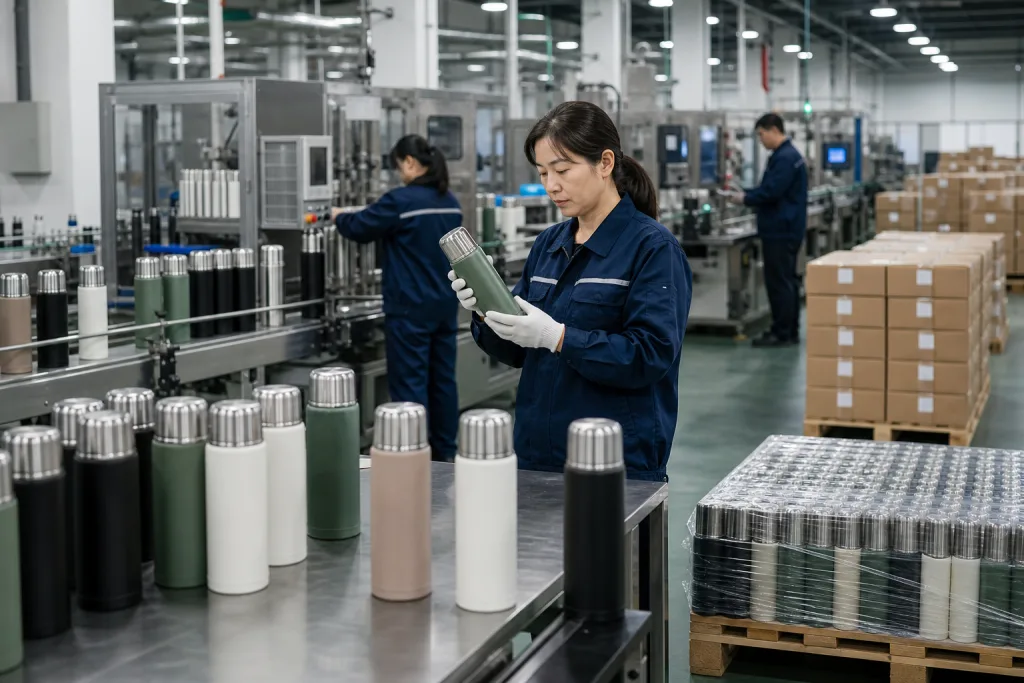
Key Takeaways
- A realistic bulk vacuum flask MOQ is 1,000-3,000 pcs per SKU for custom color and logo
- 304 stainless steel, copper-coated vacuum insulation, and leak testing should be confirmed before deposit
- Normal production lead time is 25-35 days after sample approval and packaging artwork confirmation
- Use AQL 2.5/4.0 inspection plus 100% leak checks for promotional and retail thermos bulk orders
You are not buying a bottle. You are buying 3,000 to 20,000 units that must look identical, hold heat, pass import checks, and land before a retail reset or promo launch. Small misses kill a bulk vacuum flask order: lid leakage at 0.6 MPa air test, powder coating that chips after the tape test, carton marks the warehouse cannot scan, or a logo that looked clean on a PDF but stretched badly on curved steel.
At our Zhejiang factory, we see this pattern with outdoor retailers and promo brands about 40 times a year. The buyer asks for a custom thermos quote. Fair enough. But the real work starts after the first price, because a USD 0.12 cheaper lid is useless if QC pulled the sample for seepage. You need to lock the model, steel grade, decoration, packing, inspection level, and shipping terms before the line opens in China.
Start With The Use Case
A solid bulk vacuum flask spec starts with the user, not the catalog page. For an outdoor retailer, a 750 ml or 1,000 ml flask needs a cup lid, grippy powder coating, and heat retention that still looks good after the line runs 500 pcs and QC checks the first cartons. For a promotional thermos program, the buyer usually focuses on a 500 ml size, a clean logo window, gift box fit, and carton efficiency for event distribution. Price matters, but chasing the lowest unit cost is the wrong question to ask if the flask leaks in a backpack.
For a real buyer scenario, assume you are planning 5,000 pcs of a customized thermos for a winter outdoor campaign. You want a matte forest green body, laser engraved logo, 304 stainless steel inner wall, and a retail gift box. The target FOB Ningbo price is USD 5.20-6.80 depending on cap design, coating, and packaging. That range is normal for a factory thermos order from Zhejiang, China, when you are not cutting corners on steel thickness or leak control. We would usually run pre-production samples first, then check coating color against the approved Pantone chip under a D65 light box before mass production.
The first decision is capacity. A 350 ml flask works for office gifting but feels weak for hiking. A 500 ml model is a safe promotional size. A 750 ml or 1,000 ml manufacturer thermos fits outdoor retail, camping kits, and distributor thermos assortments better. The second decision is lid type. Screw cup lids are reliable and simple to test with a 100°C hot water leak check. Push-button lids feel convenient, but they add springs, silicone seals, and more failure points. We have seen this go sideways when a buyer approved a clever lid, then QC pulled the sample after 3 drops from 1.2 m and the button jammed. If your brand sells through thermos distributors, simple and durable usually beats clever.
Before you ask any thermos supplier for price, prepare a one-page RFQ: capacity, color, logo method, packaging, target quantity, destination country, compliance needs, and target delivery date. This removes 80% of quotation noise. It also prevents the small mistakes we see too often, like a PO saying “mat black” while the artwork file says matte forest green.
Choose The Bottle Construction
Most stainless vacuum flasks look the same in catalog photos. On the line, they are different products. For a bulk thermos order, lock the inner steel grade and outer steel grade first, then check wall thickness, vacuum process, lid resin, gasket spec, and coating process against the PI. If a supplier thermos quote is USD 0.40 cheaper than the other 3 quotes, the saving often sits in 201 outer steel, thinner sheet, or a skipped copper layer. QC has pulled samples that looked fine until the micrometer showed 0.32 mm body sheet instead of the promised 0.4 mm.
For drink-contact surfaces, 304 stainless steel is the standard request for Europe and North America. Some buyers ask for 316 stainless steel, but for normal coffee, tea, and water, 304 does the job and keeps the cost under control. The wrong question is “which steel sounds more premium?” Ask what your retail price can carry. A practical construction is 304 inner wall with 201 outer wall for price-sensitive programs, or 304/304 for premium outdoor products where you want to state it clearly on the product page. Typical body material thickness is around 0.4-0.5 mm before forming, depending on size and shape. Go too thin and dents show up fast; we have seen 750 ml bottles fail carton-drop checks because the shoulder collapsed near the seam.
Vacuum performance comes from welding, evacuation, and sealing quality. Copper coating inside the vacuum layer can improve heat retention, usually adding USD 0.15-0.35 per unit. A serious thermos manufacturer should quote both versions and run the test, not just send a warmer-looking photo. For a 500 ml flask, a reasonable benchmark is hot water at 95°C staying above 60°C after 6-8 hours, tested at room temperature around 20°C. We run this with a calibrated probe and record the start time on the QC sheet. Do not accept “keeps hot all day” unless the supplier gives the water temperature, room temperature, fill volume, and test hours.
Lids cause more complaints than buyers expect. PP food-grade plastic is common, but confirm LFGB or FDA food-contact suitability for your sales market. Silicone gaskets should come out for cleaning without falling off during use; one buyer flagged a 1.2 mm gasket because consumers kept losing it after the first wash. For a customizable thermos with multiple body colors, keep the lid black or stainless unless your MOQ is high enough to cover matched lid components. Small color differences on plastic and powder coating are hard to hide, and we have seen this go sideways on repeat orders.
Price The Order Like A Factory
A thermos factory price starts with steel coil, lid parts, gasket rings, coating, decoration, cartons, labor, scrap allowance, testing, and export handling. On our line, a 0.6 mm wall spec and a 0.8 mm wall spec do not land at the same number. When you compare suppliers thermos quotes, check that each one covers the same scope. FOB Ningbo or FOB Shanghai is standard for Zhejiang manufacturers thermos shipments. EXW can look lower, but then inland trucking and export declaration sit on your side of the table.
For a 5,000 pc bulk vacuum flask order, MOQ is usually not the problem. SKU splitting is. If you want 5 colors at 1,000 pcs each, the factory has to reset the powder coating line and sort QC by color. We have seen the buyer flag a PO because the same model was split into 7 shades and the packing list only showed 3. Many thermos manufacturers accept 1,000 pcs per color for stock shapes, but custom Pantone coating usually needs 2,000-3,000 pcs per color. A new mold for a special cap, shoulder shape, or silicone boot can cost USD 1,200-5,000 and take 20-35 days before sampling. That is the wrong question to ask if you are chasing a tight launch date.
Decoration changes the price more than many promotional brands expect. One-position laser engraving may add USD 0.15-0.35 per unit. One-color silk screen may be USD 0.08-0.18, but large wrap artwork needs curved-surface setup and a higher reject allowance. On a recent sample, QC pulled the cup because the wrap had a 1.5 mm registration shift at the seam. Heat transfer and water transfer can look sharp, but they add scratch-test work and stretch lead time. For a promotional thermos, keep the artwork simple if the event date is fixed.
Packaging also matters. A plain white box may add USD 0.20-0.35. A printed retail box can add USD 0.35-0.70 depending on paper grade, insert, and varnish. Master cartons should be specified by ply, gross weight, drop-test expectation, and shipping mark. We once got a PO with the carton count right and the carton size wrong by 12 mm, and the buyer paid for the extra pallet space. If you sell through online channels, ask early about FNSKU labels, suffocation warnings for polybags, and carton label position. A thermos vendor that knows export packing will save you chargebacks, and the math does not work the other way around.
Approve Samples Before Deposit Risk
Sampling is where a thermos custom project turns into a real order. Do not approve a bulk vacuum flask from renderings alone. You need one physical sample in the right capacity and one pre-production sample with the actual coating, logo, and packaging. On our Zhejiang line, a plain existing-model sample usually ships in 3-5 days. A logo sample normally takes 7-10 days after artwork confirmation. A custom color sample may take 10-14 days because powder coating needs a small batch run. QC pulled the caliper on the cup mouth before we packed the sample.
When the sample lands on your desk, test it like a buyer who expects complaints. Fill it with hot water and weigh it before and after 8 hours to check leakage and evaporation. Turn it upside down for 30 minutes. Put it in a backpack with tissue paper around the lid. Open and close the cap 50 times. Scratch the coating with a fingernail first, then ask for proper factory cross-hatch or tape testing on production samples. A pretty photo says nothing about the thread cut on a real lid. Check whether the mouth is smooth, the cup lid threads correctly, and the logo stays straight when the lid is tightened. We run the tape tester on the line for this.
For laser engraving, ask for logo size in millimeters, not only “centered.” Curved bodies distort wide logos. I have seen a 28 mm mark drift once the body starts to taper. For silk screen, confirm the Pantone code, ink adhesion, and whether the artwork crosses a radius. For a thermos customized with full-color graphics, request a signed golden sample and keep one at your office. The factory keeps another. The line uses that same card when we start production, so both sides compare against one standard. Our laser bench sets depth in 0.1 mm steps, which keeps the buyer from arguing over a fuzzy edge later.
The deposit should follow sample approval, not replace it. A common payment term is 30% deposit and 70% balance before shipment after inspection. If you are working with a new thermos supplier in China, avoid 100% prepayment unless the order is very small or the relationship is already proven. If a seller asks for full payment before a signed sample, the math does not work. We ship after QC signs off against AQL 2.5 and the carton count matches the PO, not before.
Run Production With Checkpoints
Once the deposit lands, the clock starts. For a standard bulk vacuum flask using an existing mold, normal lead time is 25-35 days after final sample and packaging approval. At BottleForge Industrial in Hangzhou, Zhejiang, our stainless drinkware capacity is about 450,000 units per month across thermos, sports bottle, and travel tumbler lines, but capacity means little if the spec keeps moving. We had one buyer change the logo from 42 mm to 46 mm after film output; that added 6 days because the pad-print plate and color card had to be remade. Late logo changes or box revisions can easily add 5-10 days.
A practical production schedule has four checkpoints. First is incoming material inspection: steel coil or tube, lid plastics, silicone gaskets, powder, and cartons. QC checks tube wall thickness with a digital caliper, and a 0.02 mm drift matters on some slim flask bodies. Second is body forming and welding, where a rough seam can kill vacuum performance later. Third is vacuuming and insulation testing. Fourth is surface finishing, logo decoration, assembly, and final packing. If your supplier thermos factory cannot explain these stages, you are probably dealing with a trading layer. That can still work, but visibility is weaker.
Ask for production photos, but do not treat photos as QC. Photos prove the goods exist. They do not prove the goods meet your standard. For a distributor thermos shipment, request a mid-production check when 20-30% of units are completed. We run this before full packing because QC pulled the sample once and found the logo 8 mm too low on 3,000 black bottles. That is still fixable at mid-production; after carton sealing, the math does not work. This check catches color mismatch, wrong logo position, or carton printing errors before all units are packed.
If you have multiple SKUs, separate them clearly on the purchase order. Use item codes, color codes, barcode files, and packaging version numbers, with one approved artwork ZIP instead of five email attachments named “final-new-2.” A common China factory mistake is not making a bad product, but mixing two similar versions because the buyer sent unclear file names or changed “matte navy” to “navy matte” on the PO. We have seen this go sideways. Your PO should be boring, exact, and impossible to misread.
Inspect For Real Failure Modes
Final inspection should target defects that turn into returns. For a bulk vacuum flask, we check leakage, weak heat retention, coating damage, dents, sharp rims, wrong logo, dirty inner wall, odor, soft cartons, and short shipment. AQL inspection has value, but the math doesn't work if nobody runs real-use tests on the line. About 7 of 10 importers we work with set AQL 2.5 for major defects and 4.0 for minor defects. For critical defects, the acceptable number should be 0. Last month QC pulled 200 pcs from a 5,000 pcs lot and found 3 lids with silicone gaskets seated 1 mm off the groove.
Leak testing should happen during production, with 100% testing for assembled flasks whenever the lid structure allows it. For third-party inspection, the inspector can fill the sample with water, close the lid, shake it 10 times, and invert it for 3 minutes on dry kraft paper. Simple test. Heat retention testing needs 12 hours, not a quick 20-minute check, so agree on sample quantity and test duration before inspection day. If your claim says 12 hours hot, the test method must prove that claim with starting water temperature, room temperature, and final reading recorded. Outdoor retailers need to be strict here because consumers use the flask in cold cars, snow trips, and warehouse lunch breaks; we have seen this go sideways when a buyer approved artwork but skipped the thermal log.
Surface inspection needs fixed limits. A tiny dust point near the bottom edge can pass. A scratch cutting through powder coating beside the front logo should fail. Define viewing distance, light condition, and defect size. For example, inspect at 30-40 cm under normal factory lighting, with major coating defects over 1.0 mm rejected in visible areas. This is not being picky; it stops arguments. On the packing table, our QC uses a 1.0 mm defect gauge and white LED bench light, because “small scratch” means different things to a merchandiser and a sprayer.
Compliance belongs inside QC, not after shipment. For Europe, ask about LFGB, REACH, and food-contact documentation. For the United States, FDA food-contact expectations and California Proposition 65 review may apply depending on materials and claims. If the product is for children, ASTM and small-parts or coating checks may be required. A reliable thermos manufacturer will tell you what has already been tested and what needs fresh testing under your brand name. We ship 304 stainless bottles with material reports, but if the PO has a new color coating or a child-use claim typed into the spec sheet, the buyer should budget for fresh lab testing before mass production.
Ship Without Creating New Problems
Shipping is not just booking a vessel. Your thermos bulk order has to be packed, labeled, palletized when the buyer asks for it, declared under the right HS code, and delivered before your sales window closes. Stainless vacuum flasks are usually not dangerous goods, but one wrong HS code or a missing side mark can hold a container at the terminal. We saw a PO last March with “Ningbo” typed as “Nimbo”; small typo, two emails, one amended booking. From Zhejiang, China, most orders run by truck to Ningbo or Shanghai, then go by sea to North America or Europe.
For 5,000 pcs of 500 ml customized thermos units in gift boxes, plan on roughly 10-16 cubic meters depending on bottle shape and carton packing. A tall 500 ml bullet flask packs differently from a squat coffee tumbler; our packing team checks carton size with a tape measure before we confirm CBM. Sea freight is the sensible call when you have 35-50 days before needed delivery. Air freight can eat the full product margin, but it can save 200-500 pcs for a launch event while the balance ships by sea. Decide this on the PO. We have seen split shipments go sideways when the buyer asks after production is already finished and the cartons are sealed.
If you sell through retail distributors, confirm carton labels, item numbers, and pallet rules before production packing begins. If you sell through marketplace fulfillment, FNSKU labels and master carton labels must match the receiving plan exactly. One buyer flagged a 3 mm label shift because their warehouse scanner missed the corner code on the first pass. A thermos distributor may also require inner carton quantities such as 12 pcs or 24 pcs for warehouse picking. These requirements cost little before packing; after cartons are taped, the math does not work.
The best supplier thermos relationship is not the one with the lowest first quote. It is the one where the thermos factory asks annoying questions before production: exact logo file, Pantone code, barcode format, AQL level, port, delivery deadline, and compliance market. QC pulled the sample before mass printing last week because the Pantone chip and artwork file were not the same red. Those questions protect your order. For outdoor retailers and promotional brands, this is how a bulk vacuum flask project stays profitable after it leaves China.
Send Your Bulk Vacuum Flask Spec For Review
Share capacity, quantity, logo method, market, and delivery date. We will check feasibility, MOQ, lead time, and factory pricing.
Frequently asked questions
What is a realistic MOQ for a custom stainless thermos order?
For an existing bulk vacuum flask shape, a realistic MOQ is 1,000 pcs per SKU for simple logo work and 2,000-3,000 pcs per color for custom powder coating. If you need a new lid mold, special silicone boot, or exclusive body shape, expect tooling costs of USD 1,200-5,000 and a higher first order quantity. Promotional thermos projects can sometimes start at 500 pcs using stock colors, but the unit price rises and logo options may be limited. For outdoor retail, 3,000-5,000 pcs gives better control over color, packaging, and FOB cost.
How long does a bulk vacuum flask order take from China?
For a standard manufacturer thermos order from Zhejiang or other China production areas, plan 7-14 days for sampling and 25-35 days for mass production after approval. Sea freight adds about 25-40 days to many North American and European ports, depending on routing and season. If you need printed retail boxes, barcode labels, or multiple color SKUs, add buffer time. A safe retail launch timeline is 70-90 days from approved artwork to warehouse arrival. Air freight can shorten transit, but it often adds USD 2.00-5.00 per unit depending on weight and destination.
Which logo method is best for a promotional thermos?
Laser engraving is the safest choice for a promotional thermos when you want durability and a premium look. It usually adds USD 0.15-0.35 per unit and works well on powder-coated stainless bodies. Silk screen is cheaper for one-color logos, often USD 0.08-0.18, but it needs adhesion testing and may scratch more easily if the bottle is handled outdoors. Heat transfer is useful for full-color artwork, but it adds setup time and more QC risk. For curved flasks, keep the logo width controlled, usually under 60-80 mm unless the supplier confirms distortion limits.
How do I compare quotes from different thermos suppliers?
Compare the same specification line by line: capacity, 304 or 201 steel, inner and outer wall material, copper coating, lid type, coating, logo method, packaging, MOQ, lead time, and FOB port. One thermos supplier may quote FOB Ningbo with a printed box, while another quotes EXW with a plain box. That can hide USD 0.40-0.90 per unit in real cost. Also ask whether 100% leak testing, AQL inspection support, and export cartons are included. The cheapest suppliers thermos quote is not useful if the lid leaks or the cartons fail in transit.
What quality tests should I require before shipment?
Require 100% factory leak testing, sample heat-retention testing, visual inspection under AQL 2.5/4.0, carton drop checks, logo position checks, and packaging verification. For a bulk vacuum flask, critical defects should be 0 accepted: leakage, unsafe sharp edges, wrong material, serious contamination, or missing components. Heat retention should be tested with a defined method, such as 95°C water, room temperature around 20°C, and temperature recorded after 6 or 8 hours. For Europe, request LFGB and REACH-related documentation. For the United States, confirm food-contact materials and any Proposition 65 review if relevant.