Key Takeaways
- A typical MOQ for a stainless bulk thermos starts at 1,000-3,000 units per SKU
- Lead time from artwork approval to bulk shipment is usually 25-35 days
- AQL 2.5 is standard for appearance and AQL 1.0 is common for leaks
- Double-wall 304 stainless with 0.4-0.5 mm inner wall is the safer spec for retail
If you buy bulk thermos for outdoor retail or a promotion, the first mistake is treating it like a color swap. It is not. We have seen the same stainless thermos pass a spec sheet and still leak at the cap, chip at the powder coat, or lose heat after 30 days on the shelf. That is where margin goes, and the buyer flags it fast.
The clean way to source is to run it like a procurement job: RFQ, sample, pilot lot, then full purchase order. On our line in Zhejiang, we check the lid torque with a 2.5 N·m gauge and QC pulled one sample because the artwork file had a typo on the PO. If you lock the details early, you can ship custom thermos programs with fewer headaches, whether the order is 2,000 units for a retail launch or 50,000 units for a distributor run.
Start with the RFQ, not the price
I’ll keep the HTML structure intact and rewrite only the prose to sound like a real export-sales engineer. Next I’m replacing the generic RFQ language with tighter buying-speak, concrete factory details, and cleaner quote fields.When you send an RFQ for bulk thermos, don’t start with “best price.” That question gives you junk data. Ask for a quote sheet you can compare line by line: capacity, steel grade, lid style, surface finish, logo method, carton count, destination port, and whether you need retail boxes or export master cartons. Skip those points and every supplier quote sits on a different base. The low number usually turns into a change order after the sample, and we’ve seen that go sideways on the first PO.
For a stainless thermos, state the body spec first. Our usual retail build is 304 stainless inside and outside, 0.4-0.5 mm wall thickness, double-wall vacuum seal, and a silicone ring checked for both hot and cold leakage on the line. If you want a promotional thermos to hit a lower target, say it directly, but don’t let the factory downgrade the material without writing it down. In Zhejiang, a clean RFQ moves fast; if the sheet is complete, a thermos manufacturer can usually send an initial FOB quote in 24-48 hours. QC pulled one sample at 72°C last week, and that’s the kind of detail buyers remember.
Ask for these PO-ready fields in the quotation:
- Capacity: 350 ml, 500 ml, 750 ml, or 1 L
- Finish: powder coat, spray paint, brushed steel, or matte lacquer
- Logo: laser, silk screen, UV print, or wrap print
- Carton pack: 24 or 48 pcs per master carton
- Sampling fee and sample lead time
Write the sample order like a buyer
I’ll rewrite the three HTML paragraphs in a buyer voice, keep the tags intact, and make the sample PO feel like it came from someone who has run this line before.The sample step tells you fast whether the custom thermos program is real or just nice talk. Pay for a sample that matches the final build, not a showroom piece with a different liner or lid. If you need a customizable thermos with lid engraving, color swatch, and your artwork, put every detail into the sample PO. This is where buyers get lazy and the order goes sideways. A sample is for leakage, finish, and fit. We’ve seen QC pull a cap that looked fine but failed at the gasket seat. One round usually takes 7-12 days from a China factory, and a new coating or mold pushes it out.
For a distributor thermos order, ask for three samples: pre-production blank, decorated sample, and sealed functional sample. Then test them against real use. Fill with 95°C water, close the lid, and check seepage at 10 minutes, 1 hour, and overnight. Run a 24-hour heat retention test if your market expects premium performance. If you sell to outdoor retailers, test glove-friendly opening torque too. The buyer flagged a lid that needed two hands in winter; the math doesn’t work if returns start on week one. A thermos customizable on appearance but awkward to open comes back as a complaint, not a reorder.
Sample PO line items should state:
- Sample quantity: 1-3 pcs per SKU
- Artwork file version and Pantone reference
- Lid color and gasket material
- Logo placement and size in mm
- Testing standard: leak-free, 12-hour heat retention target, drop-check if required
Lock the specification before bulk pricing
I’ll keep the HTML structure intact and rewrite the prose to sound like a factory-side sales engineer, with tighter pricing language and a few concrete shop-floor details.Once the sample passes, move straight into bulk pricing. This is where buyers lose money by approving a sample, then letting the PO drift. A thermos bulk quote has to lock the same spec as the approved sample: steel grade, capacity tolerance, coating thickness, lid build, and packing format. If the order includes an embossed logo or a straw lid, price it into the sheet now. We’ve seen a 0.3 mm lid gasket change turn into a complaint at packing. A factory thermos quote that skips tooling, inserts, or carton crush risk is just a guess.
For stainless insulation products, steel is only part of the cost. Lid structure, decoration method, and packing density also move the number. A plain 500 ml promotional thermos from a Zhejiang line may land around USD 2.60-3.80 FOB at 3,000 pcs, while a powder-coated model with laser logo and gift box can run to USD 4.50-6.20 FOB. The exact figure shifts by market, but the math does not. More parts, more handwork, more cost. If you want a fair comparison between thermos suppliers, make every factory quote the same carton count and the same accessory set. QC pulled one sample last month and found the buyer had mixed 18 mm and 20 mm lids on the same inquiry.
Put the following on the quote sheet before you sign off:
- Incoterm: FOB Ningbo, FOB Shanghai, or EXW
- MOQ by color and by logo version
- Unit price at 1,000 / 3,000 / 5,000 pcs
- Packing method and carton drop test requirement
- Sample approval date and bulk ship date
Treat the PO as the control document
I’ll rewrite the prose to sound like a factory-side sales engineer, keep the HTML structure intact, and preserve all existing tags and list layout.Your purchase order needs to work as the control document, not a loose email thread. For bulk thermos orders, the PO has to match the approved sample and the quote line by line. If the PO says 18 oz and the artwork file says 500 ml, we find out when the line is already running in China. That is a bad day and an avoidable cost.
A clean PO for a thermos manufacturer should list product code, capacity, finish code, logo method, packaging spec, inspection standard, and delivery window. Add the AQLs up front: AQL 2.5 for appearance, AQL 1.0 for leakage and functional checks. If you are placing a manufacturer thermos order with retail packaging, spell out FNSKU, UPC, or country-of-origin marks before we print cartons. We have seen buyers ask for 20,000 relabels after the ETD was confirmed. The math does not work.
Use PO line items like these:
- Item 1: 500 ml stainless thermos, matte black, laser logo
- Item 2: White gift box with insert
- Item 3: Master carton print with SKU and batch code
- Item 4: Inspection fee if third-party QC is required
Check quality at the right points
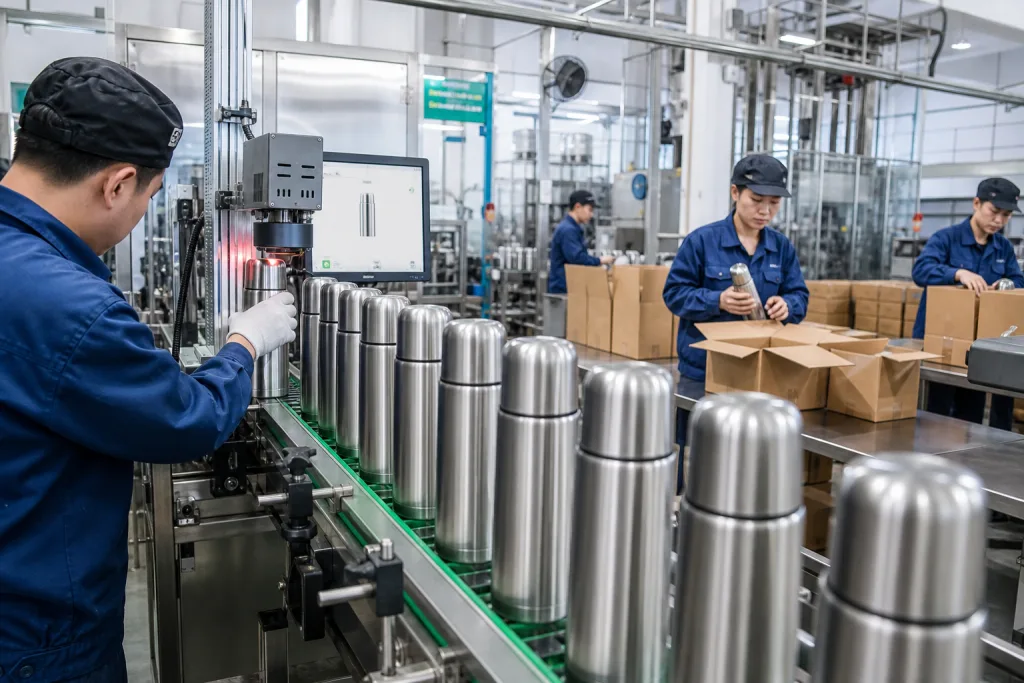
I’ll rewrite the section in place, keep the HTML structure intact, and tighten the sales-engineer tone with more factory-floor detail and fewer AI-style phrases.Quality control works best at three points: incoming materials, in-line production, and pre-shipment. A serious thermos factory in Zhejiang keeps welding, vacuum pumping, and leak testing in separate areas from printing and packing. If a supplier says every check happens at the end, the bad units are already buried in the lot.
For a stainless bulk thermos, we run practical checks: weld seam consistency, vacuum retention, lid torque, sealing ring fit, and coating adhesion. QC pulled the sample on a 0.02 mm weld gap before, and that saved us from a full carton issue. Ask for a stainless steel certificate if your market needs it, and request REACH or food-contact compliance documents where applicable. If you sell into the US, thermal claims need proof, and the carton should not promise 24 hours cold if the line only holds 18. Outdoor buyers care about drop resistance and lid fit, not brochure copy. One dented lid or one leaking cap wipes out the FOB advantage fast.
Use this inspection rhythm:
- Pre-production: confirm raw material lot and decoration sample
- During production: check every 2,000-3,000 units
- Pre-shipment: inspect by AQL and pull leak-test samples from each carton lot
Plan freight before the cartons stack up
I’ll rewrite the prose to sound like a factory-side export note, keep the HTML structure intact, and preserve the list and shipping terms.Shipping sits inside product cost. It is not a side note. For bulk thermos orders, carton size and loading efficiency can move landed cost more than a small unit price gap. We’ve seen a 12% freight swing from a 2 mm carton change. If your thermos distributors need a mixed container, the pack has to survive consolidation. That means master carton compression strength, inner protection around the lid, and no loose accessories rattling in transit.
For FOB shipments out of China, ask the thermos supplier for carton dimensions, gross weight, and palletization suggestions before production wraps. QC pulled the sample on one order because the carton mark was 8 mm too low for the scanner. If you ship to Amazon or a 3PL, you may need FNSKU labeling, suffocation warnings, and case pack consistency. A giveaway thermos can run on simpler packaging; a retail-ready custom thermos for stores cannot. Same factory, different pack-out. The buyer flagged it once, and the math did not work.
Practical freight details to confirm:
- Units per carton and cartons per pallet
- Container load estimate: 20GP, 40GP, or 40HQ
- Barcode position and scannability
- Country-of-origin print on carton and unit
Send your RFQ and lock the spec
We can quote your bulk thermos project with factory-level detail, clear MOQ, and a production plan that fits China sourcing timelines.
Frequently asked questions
What MOQ should I expect for a bulk thermos order?
For a standard stainless bulk thermos, many China suppliers start at 1,000-3,000 units per SKU and color. A simple single-color matte model is easier to open at lower MOQ than a multi-color or multi-lid thermos custom project. If you need separate artwork versions, each version may carry its own MOQ. In Zhejiang, a well-run thermos factory with a 200,000-unit monthly output can usually split production by order size, but you should still plan around one main SKU per PO for the best cost.
How long does sample-to-bulk usually take?
A realistic schedule is 7-12 days for samples, then 18-25 days for bulk production after sample approval, plus 5-12 days for freight depending on route. So a normal custom thermos project can move from RFQ to ship-ready in about 25-35 days if artwork is approved quickly and no new tooling is needed. If the lid is new or the decoration needs special curing, add a week. China suppliers in Zhejiang are usually efficient on lead time, but only when the buyer keeps the spec locked.
What should I test before approving the sample?
Test leakage, heat retention, lid fit, and coating durability. A practical buyer test is 95°C water, then a 10-minute leak check, one-hour upright hold, and an overnight inversion test. For a premium stainless thermos, many buyers also want 12-hour heat retention measured under controlled room conditions. If the thermos promotional order is for outdoor retail, do a glove test on the cap and a light drop test from 80-100 cm. If the sample passes visually but fails functionally, do not release the bulk PO.
What documents should a thermos manufacturer provide?
At minimum, ask for business license, product spec sheet, material declaration, and test reports for food-contact or REACH requirements if your market needs them. For a thermos supplier serving Europe or North America, you may also request BSCI audit status, ISO 9001 process controls, and carton marking confirmation. If the order is going to retail, keep the compliance file with the PO. That saves you time when distributors thermos buyers or customs ask for proof later.
How do I compare FOB quotes from different suppliers?
Compare only when the spec is identical. Check steel grade, wall thickness, lid structure, logo method, packaging, carton count, and inspection standard. A USD 3.10 FOB quote and a USD 3.65 FOB quote may look far apart, but one may include a gift box, sleeve, and AQL inspection while the other does not. Ask each thermos vendor to quote the same Incoterm, the same artwork, and the same packing count. If you do that, the real difference usually narrows fast.