Key Takeaways
- A realistic MOQ for a custom bulk refillable water bottle is usually 1,000 pcs per color, not 100 pcs.
- For custom logo orders, expect 25-35 days lead time after sample approval; special packaging can push it to 45 days.
- Use AQL 0 for critical defects, 2.5 for major, and 4.0 for minor defects when you write QC terms.
- For Europe, ask for REACH or LFGB where relevant; for the US, keep FDA food-contact paperwork and print compliance on file.
You are not buying a bottle. You are buying a repeatable program: fill rate, leak control, print quality, carton survival, and margin after freight. A 750 ml bulk refillable water bottle for a gym chain runs on different tooling and QC points than a 1 L event giveaway or a retail SKU packed in a color box. We see the same mistake in bulk canteen, canteen wholesale, and drinkware wholesale projects: buyers ask for price before they fix the cap type, coating, wall thickness, or test standard. This is the wrong question to ask. Last month, QC pulled 32 samples from a trial run because the flip lid leaked at 0.6 bar after the buyer changed the silicone ring but kept the old PO description.
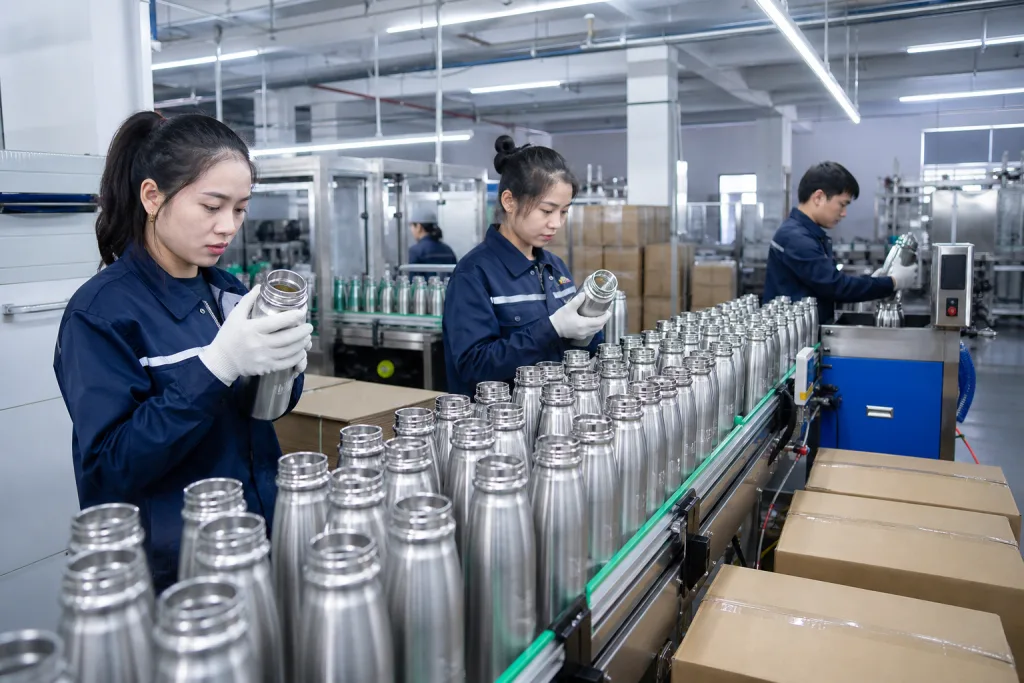
The smart way is to run the order like a production job. In Zhejiang, China, a serious factory should quote from a real spec sheet, show a sample within 7 to 10 days, and build at least 600,000 units per month without resetting the line for every batch. We run vacuum tests, torque checks on the cap, and carton drop tests before the shipment date gets close. Simple work. Easy to skip. That is the level you want when you buy wholesale drinkware for Europe or North America, because a USD 0.08 cheaper bottle does not save money if 3 cartons per pallet arrive crushed or the buyer flags a print shift of 2 mm on arrival.
Start With the Use Case
The first buyer mistake is buying by category, not by use. Wrong question. A refillable bottle for office desks usually needs a one-hand lid and a mouth wide enough for a bottle brush; a hiking bottle needs drop resistance and a cap tether that will not snap after 500 pulls on the line. If your account is asking for a bulk refillable water bottle, confirm the end use before you ask for price. Retail shelf, corporate wellness pack, sports event, or Amazon listing each pushes us toward a different material, decoration process, and carton pack, usually 24 pcs or 36 pcs per master carton. Last month QC pulled a 750 ml sample with a 0.4 mm gap under the silicone gasket; price was fine, but the buyer flagged leakage in the first transit test.
Here is the practical filter I use with buyers:
- Volume: 500 ml, 750 ml, or 1 L are the common SKUs. 500 ml sells faster in retail displays; 1 L works better for gyms and event giveaways where refill stations are 30–50 meters apart.
- Material: Tritan, PP, or 18/8 stainless steel. Stainless takes more abuse, Tritan cuts weight, and PP usually wins when the buyer says the target is under USD 1.20 FOB.
- Closure: Screw cap, flip lid, straw lid, or carry loop. If the cap leaks in transit, the order is dead; we pressure-test random samples upside down for 30 minutes before packing.
- Decoration: Silk screen, laser, heat transfer, or UV print. Match the logo method to the surface and order volume; laser on powder-coated stainless is clean, while UV print on curved Tritan needs a jig or the artwork drifts 1–2 mm.
If you are comparing bulk canteen, wholesale canteen, bulk drinkware, or growler bulk for a hospitality program, do not let the product name hide the actual job: reliable filling and fewer complaints. The best wholesale drink bottle is the one your customer uses daily without calling support. We have seen this go sideways when a PO says “matte black” but the approved sample is gloss black; one typo can hold 3,000 pcs in the packing area for 2 days.
Lock the Spec Sheet Early
Price means nothing until the spec is locked. A supplier can quote a bottle at USD 0.78 or USD 1.46 and both prices can be honest, because one line may run thinner wall stock, a basic PP flip cap, or no powder coating. For a serious bulk refillable water bottle order, the spec sheet should state material grade, wall thickness, tolerance, cap type, coating, logo method, and packing method. We had one buyer flag a USD 0.19 gap after sampling; QC cut the bottle open with a pipe cutter and found 0.38 mm wall where the buyer assumed 0.55 mm. That gap was not “supplier margin.” It was a different bottle.
Use numbers. For stainless steel, ask for 0.5-0.6 mm wall thickness on the body and confirm whether the cap liner is silicone or TPE. For Tritan or PP, ask for the resin grade and the wall thickness in mm, not just “food grade.” State the capacity tolerance, usually ±5%. If the bottle is vacuum insulated, define the thermal retention test with starting water temperature, room temperature, and test hours. If it is a simple refill bottle, define leak testing, drop testing, and dishwasher cycles if that matters to your customer. On our line, a leak test at 0.06 MPa for 30 seconds catches cap-thread problems that a quick hand-shake misses.
Packaging needs the same discipline. Ask for carton quantity, inner box count, carton size, gross weight, and whether the master carton has a 5-ply or 7-ply board. A retailer in North America may want barcodes; an Amazon seller may need FNSKU labeling and a case-pack that fits the warehouse receiving plan. China factories in Zhejiang can do this, but ask before the first sample run. We have seen this go sideways when the PO said “standard export carton” and the buyer expected 24 pcs per carton, while the factory packed 48 pcs in a 15.6 kg carton that the warehouse rejected. Treating the spec as paperwork is the wrong question to ask. The spec is the order.
Run Samples Like a Buyer
Sampling is where weak suppliers show up fast. Do not approve a bottle because the color looks close under office LED light. Ask for one plain sample, one decorated sample, and one pre-production sample after the final artwork is confirmed. For drinkware bulk, we check fit, finish, seal integrity, and print durability with calipers, a torque meter, and a 24-hour leak rack, not just a nice-looking photo from the sales desk.
The sample checklist should be short and ruthless:
- Leak test upside down for 24 hours.
- Open and close the cap at least 30 times to check thread wear.
- Drop test from 1.0 m on concrete for shipping risk.
- Measure weight and capacity against the approved drawing.
- Check logo placement against Pantone or the approved visual standard.
For custom print, send vector artwork and ask for a digital proof before tooling. If the supplier promises a color match, ask how they control it. A delta E target below 2 is good, but 7 out of 10 buyers we meet never request a measurement, then they ask why the second batch looks different under store lighting. QC pulled one sample last month where the logo was 3 mm too low because the PO had “front center” but the approved visual showed “front upper.” Sample freight from China to the US or Europe is usually USD 40 to 120 depending on speed. The bottle sample itself may cost USD 20 to 80, which is cheap compared with fixing a 10,000-piece error later. The math doesn't work if you skip this step.
If you are sourcing canteen bulk, beer growler bulk, or alcohol flask wholesale bulk in parallel, keep the sampling logic separate. A growler can hide issues that a water bottle cannot, especially on closure torque and lining. We run growler caps through a different torque check on the line, and the buyer often flags metallic smell on flask samples before they notice any printing issue.
MOQ, Lead Time, and Capacity
MOQ trips buyers up because they compare unit prices without checking what the factory can actually run. In Zhejiang, a plant running 600,000 units per month prices differently from a 3-line workshop buying bodies from outside. For a standard custom bulk refillable water bottle, we usually see MOQ at 1,000 pcs per color, and 2,000 to 3,000 pcs for a new mold or special coating. QC pulled a sample last month where the “custom 100 pcs” offer was just stock black bottles with a 38 mm logo pad print. If a supplier offers 100 pcs for a custom job, ask whether it is true production or stock goods with a light logo pass.
Lead time depends on the decoration route and the packing bench. Plain stock bottles can ship in 7 to 15 days. Custom logo orders usually need 25 to 35 days after sample approval. Add gift boxes, Pantone color matching, or multilingual manuals, and the schedule moves to 35 to 45 days because artwork, box die-lines, and carton drop-test checks all queue up. One buyer flagged a seller promising one week for a full custom order; the math did not work after we counted coating, curing, laser setup, and final AQL inspection. If the seller claims one week, they are overselling or skipping steps.
Capacity planning matters when you buy wholesale drinkware for multiple channels. A chain store order of 5,000 units should not block your e-commerce reorder of 1,200 units. Ask whether the factory can reserve body stock, cap stock, and print slots separately, because those three bottlenecks do not move at the same speed. We run some bottle bodies ahead, but caps with silicone rings often sit waiting after incoming inspection finds a 0.3 mm fit issue. Better suppliers in China will tell you monthly output by model and whether your order needs one line or two. That answer is worth more than chasing a USD 0.02 price cut.
For related SKUs like wholesale growler, beer growler wholesale, or beer tumbler bulk, the capacity logic is similar, but the packaging and test plan are not. A 64 oz growler may need thicker inner cartons and a different leak test than a 20 oz tumbler, and we have seen mixed PO lines go sideways when the buyer wrote “same packing as bottle” in the remarks. Do not merge them into one vague drinkware wholesale request.
QC That Actually Catches Failures
Write the QC plan before the line starts, not after the complaint email lands. We run it from the signed pre-production sample, with photos of the gasket, neck finish, logo position, and carton mark attached to the file. Use AQL 0 for critical defects, 2.5 for major defects, and 4.0 for minor defects. Critical means leakage after 30 minutes upside down, cracked necks found under the LED inspection lamp, unsafe odors after hot water, or wrong material. Major defects include bad threads that fail the torque check, caps that do not lock, print misalignment over 2 mm, or a body shape that wobbles on the flat glass plate. Minor defects are light scratches, tiny bubbles, or carton rub marks that do not affect use.
For a refillable bottle, focus on seal integrity, decoration durability after 3M tape pull and alcohol rub, plus drop resistance from 1.2 m onto a steel plate. If the bottle is vacuum insulated, add a thermal retention test, such as 95°C water checked at 6 hours and 12 hours. If it is plastic, add odor testing after 80°C hot water exposure for 2 hours. QC pulled one Tritan sample last month that looked clean but smelled like packaging ink after the hot-water test. For Europe, ask for REACH paperwork and LFGB where relevant to the contact parts. For North America, request FDA food-contact statements and check whether your inks or pigments need a Prop 65 review. BSCI helps with social compliance paperwork, but it does not replace product safety testing.
Ask for a pre-shipment inspection that pulls random units from packed cartons, not staged unit photos beside the production line. Good Zhejiang factories will let SGS, Intertek, or your own agent cut open cartons from the top, middle, and bottom of the pallet stack. We usually see buyers request 80 to 125 samples on a mid-size order, depending on carton count and AQL level. If the supplier refuses random carton sampling, do not treat it as a paperwork issue. This is the wrong question to ask: “Can you send more photos?” Sample photos never caught the PO typo where the artwork said 750ml but the carton label said 700ml.
One practical rule: if a defect can be hidden by the carton, it is not solved until it survives the carton.
That rule saves money on bulk drinkware, canteen wholesale programs, and any order shipping straight to retail or FBA. We have seen this go sideways when Amazon FNSKU labels were applied after packing and 18 cartons had mixed colors inside. A Zebra scanner and one opened master carton would have caught it in 5 minutes.
Build Landed Cost, Not Unit Price
Unit price is the easiest number to quote, and the worst one to buy on. We saw a PO last month with a “botlle” typo, and the buyer still chased the USD 1.12 FOB Ningbo or Shanghai number; the landed bill later came out at USD 2.40 to 3.10 after freight, duty, local delivery, and carton handling. If you are sourcing a bulk refillable water bottle for the US or Europe, build the landed-cost sheet before the PO. The same rule applies whether you call it drinkware wholesale, wholesale drinkware, or canteen wholesale.
Break the cost into layers:
- Product: body, cap, seal, coating, print, and wall-thickness checks on the line.
- Packaging: inner box, carton, labels, test report inserts if needed, plus corner protection if the buyer flagged crush marks.
- Freight: ocean or air, destination handling, and port fees.
- Compliance: testing, documents, and any required barcode or FNSKU labeling.
For a 3,000-piece order, ocean freight usually wins if you can live with 25 to 40 days on the water. Air freight is for a launch date that will not move or for a small sample top-up. The math does not work for normal replenishment. If you sell on Amazon, add prep labor and warehouse receiving rules at the quote stage. If you buy for a retail chain, check pallet size and carton drop limits; we had a 600 x 400 mm carton refused once because the DC wanted a different stack pattern.
Do not ignore the small extras. A spare gasket costs cents and saves a refund. A better carton may add USD 0.08, and QC pulled the sample when a corner cracked on the third drop test. We run that check before packing. In a China sourcing program, that is how you keep margin and still reorder without drama.
Send your spec sheet and get a real quote
We can price your bottle by material, print, carton, and compliance so you know the landed cost before you place the order.
Frequently asked questions
What MOQ should I expect for a custom bulk refillable water bottle?
For most factories, a realistic MOQ is 1,000 pcs per color for a custom bulk refillable water bottle. If you need special coating, a unique lid, or a new mold, expect 2,000 to 3,000 pcs. Stock bottles with logo only can sometimes start at 300 to 500 pcs, but that is not the same as a true custom program. If a supplier in China offers 100 pcs with full customization, check whether they are using existing stock and simple decoration. Ask for MOQ by body, cap, and print method separately so you know what is really driving the number.
What is the usual lead time for a bulk order?
For plain stock items, 7 to 15 days is normal. For a custom bulk refillable water bottle with logo printing, expect 25 to 35 days after sample approval. If you add special packaging, color matching, or a new lid, 35 to 45 days is more realistic. During peak season, especially before Q4, add buffer time. A factory in Zhejiang, China with a monthly capacity above 600,000 units can still get busy fast if you miss the production slot. Always confirm whether the lead time starts from deposit, artwork approval, or pre-production sample sign-off.
How do I check if the bottle will leak in transit?
Ask the supplier to run an inverted leak test for 24 hours on random samples from the batch. Then add a closure torque check and a 1.0 m drop test on the packed carton. For a refillable bottle, leakage usually comes from three places: cap thread mismatch, gasket failure, or deformation after heat. If the bottle is stainless, check the weld zone and neck finish. If it is plastic, watch for shrinkage after molding. You should also ask for torque data in N·m if the factory can provide it. That tells you whether the seal is stable, not just whether the sample looked fine.
Do I need REACH, FDA, or BSCI documents?
For Europe, ask for REACH-related compliance on materials, inks, and silicone parts, and LFGB if the bottle or lid will contact food in a way that matters for your market. For the US, ask for FDA food-contact declarations and review any print or pigment issues that could trigger California Prop 65 concerns. BSCI is not a product safety document; it is a social compliance audit. It is useful, but it does not replace testing. For a proper drinkware wholesale order, you should keep the test report, the supplier declaration, and the packing specification together in one file. That saves time during customs or marketplace review.
Can one supplier handle logo printing and retail packaging?
Yes, if the factory is set up for it. A good supplier can handle silk screen, laser engraving, heat transfer, or UV print, then pack the bottle in an individual box, master carton, or Amazon-ready case pack. The key is to confirm the order flow before production starts. Ask who checks artwork, who approves color, and who labels the cartons. If you need FNSKU, barcodes, or multi-language retail packaging, include that in the PO. For a bulk refillable water bottle program, it is normal to pay a little more for coordinated packaging if it reduces receiving errors and warehouse rework.