Key Takeaways
- Set MOQ expectations at 3,000-5,000 pcs per color for custom bulk protein shaker production
- Specify leak tests, drop tests, dishwasher claims, and AQL levels before paying for molds
- Use 304 stainless steel, Tritan, PP, or PE based on market rules and retail price point
- Allow 30-45 days production after artwork approval for most China drinkware bulk orders
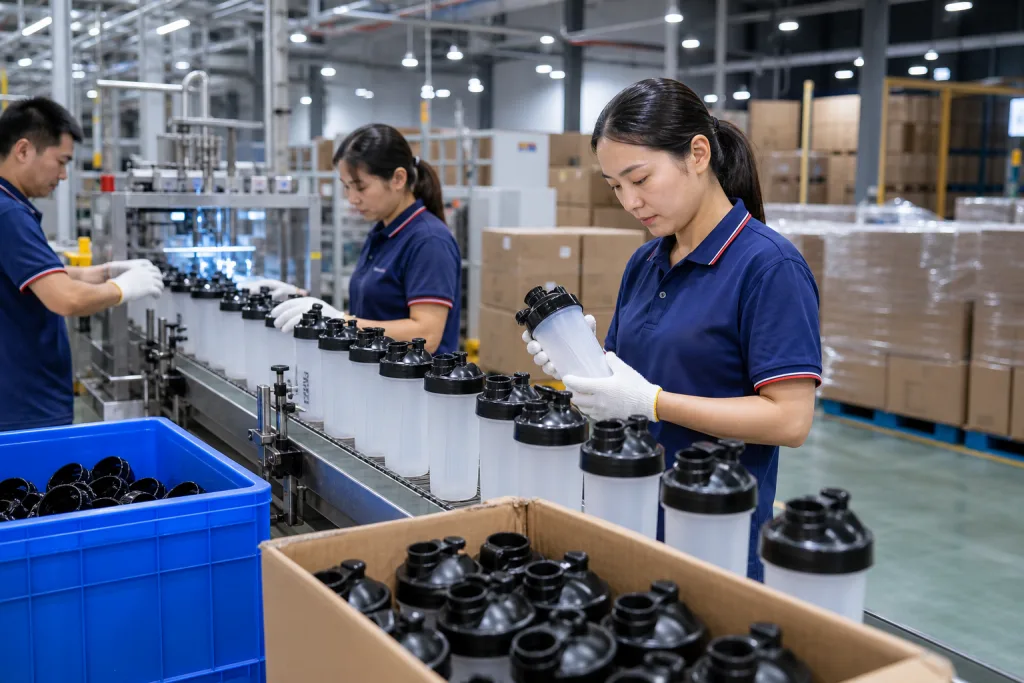
A bulk protein shaker looks simple until the first claim lands: flip caps that seep on courier runs, protein powder packed in the thread under the 70 mm lid, cloudy copolyester after two dishwasher cycles, or 1,200 units held at customs because the material file is missing one page. We run leak tests on the line with a 200 ml fill and a 15-second inversion, and that check catches problems the unit price never shows. Low price is the wrong question here. The real risk is a carton full of small defects that turn into chargebacks, bad reviews, and dead stock.
At our Hangzhou, Zhejiang factory network, we keep seeing the same misses in bulk drinkware programs: lid tooling with a weak hinge pin, logo artwork sent as a blurry JPG, an AQL plan that says “inspect carefully” and nothing else, and cartons that never got a 1 m drop test. QC pulled a sample with a 0.3 mm flash line on the mouth thread last week. China ships solid shakers, wholesale canteen orders, and beer tumbler bulk runs, but only when the buyer spec is locked before sampling starts. If the PO says “same as sample” and the sample is already wrong, the line will follow the wrong part every time.
Failure One: The Lid Leaks
Most bad bulk protein shaker projects fail at the lid, not the cup body. The buyer signs off on a clean render, the T1 samples pass on the meeting table, then 3,000 mass-production lids leak when shaken with 400 ml of water. We see four usual causes: cap hinge fatigue after repeated snap-open cycles, uneven silicone gasket compression at the parting line, weak thread engagement, or a flip spout plug short by 0.3-0.5 mm. QC pulled one sample last May where the plug looked fine by eye, but the digital caliper showed 0.38 mm under spec. That is enough.
Do not accept a generic “leakproof” line on the PI. Put the test method into the purchase order. For a shaker, we normally suggest filling to 80% capacity, closing the lid, shaking by hand for 30 seconds, then inverting for 10 minutes. For a gym retail program with rougher use, add a 1-meter drop test on the base and side, then repeat the leak test. If the item includes a wire mixing ball or internal agitator, test with both water and a light protein solution because powder residue changes how the seal behaves. We run this on a stainless test bench, not on someone’s desk, because one buyer already flagged “table was not level” in an inspection report.
Thread design matters. A lid with only 1.5 turns of engagement opens faster, but the math does not work when resin shrinkage moves by 0.2 mm across a hot production day. For PP lids, a 2.0-2.5 turn thread is safer. Silicone gaskets should be removable only if your market wants cleaning convenience; otherwise buyers complain that consumers lose the ring. If removable, ask for a spare gasket option packed at 1%-2% of order quantity. On the line, our mold technician checks the first 10 lids with a go/no-go gauge before packing starts.
This same issue appears in bulk canteen, canteen wholesale, and beer growler bulk projects. A bottle that holds water in a showroom can fail after truck vibration, 45°C warehouse heat, or 200 open-close cycles. Zhejiang factories can control this well, but only if the test is numeric, not verbal. We have seen this go sideways when a PO says “no leaking” and nothing else; the inspector then uses his own method, and nobody likes the result.
Failure Two: Plastic Smells Cheap
Odor claims hurt because they are subjective. One buyer signs off the sample; 3 weeks later, an end customer says it smells like chemicals. In bulk protein shaker production, we usually trace the smell to low-grade PP, recycled material contamination, wet resin before injection, or cartons stored beside ink, glue, or solvent drums. QC has pulled samples straight from a 530-ton injection line that looked fine but failed the simple hot-water sniff check after 30 minutes. Cheap FOB can hide a resin swap, and the math does not work when a USD 0.06 saving turns into 2,000 returned cups.
For food-contact shakers, lock the material on the PO and the pre-production sample tag. Common options are PP for budget shaker cups, Tritan for clearer premium bottles, or 304 stainless steel for insulated mixing bottles. If you sell into the EU, ask for LFGB or EU 10/2011 food-contact test reports where applicable, plus REACH/SVHC support for coatings and printed components. For the US, ask about FDA food-contact compliance and CPSIA if any child-oriented version is involved. Do not accept a report for “similar material” if your order uses colored resin, soft-touch coating, or a custom printed insert; we once saw a PO typo change “clear Tritan” to “clear AS,” and the buyer flagged it before mass production.
A practical smell-control line is simple: production units should be aired for at least 24 hours before final packing, and cartons should use water-based ink where possible. For opaque PP, ask whether virgin resin is used. If the supplier says “food grade,” ask two sharper questions: “virgin or recycled?” and “which test report covers this exact resin and color masterbatch?” We run this check before sealing the master carton, usually with 5 pcs per color sitting open on the packing table, because trapped odor gets worse after a 30-day sea shipment.
This is not just a shaker problem. The same material discipline applies when you buy drinkware wholesale, alcohol flask in bulk, growler wholesale, or the best wholesale drink bottle assortment for a retail line. China has plenty of capable resin and stainless suppliers, but the cheap quote often removes the control you assumed was included. We have seen this go sideways on a 5,000 pcs promotion order where the lid was fine, the cup body was fine, and the printed insert smelled because it was packed too soon after printing.
Failure Three: Capacity Is Misleading
Capacity disputes happen because the buyer’s spec and the factory test are often measuring two different levels. A shaker sold as 700 ml might reach 700 ml only at brimful, while the working fill is 600-650 ml after protein powder and shaking headspace. We had QC pull a clear PP sample on the line last month: with 35 g powder and 500 ml water, anything above the 620 ml mark sprayed through the flip cap during a 10-second shake test. For a bulk protein shaker, that becomes a return problem fast.
Write the capacity spec with three separate checks. Brimful capacity should say “filled to rim on a flat table,” usable capacity should state the recommended mixing volume, and the fill-line position should show exactly where the printed mark sits from the bottom in mm. A 750 ml shaker, for example, might have a 720 ml brimful volume, a 600 ml recommended mixing volume, and printed measurement marks every 100 ml up to 600 ml. If you sell in North America and Europe, print both ml and oz markings. Ask for tolerance on molded or printed scale marks; ±5 ml is tight, ±10 ml is more realistic for many plastic bodies. We check this with a digital scale and room-temperature water, not by eye.
Wall thickness changes how the cup feels in the buyer’s hand. For PP shaker cups, 1.2-1.5 mm wall thickness is common. Go thinner and the quote looks better, but the cup can feel cheap and deform under hot water; we have seen 1.0 mm bodies oval out after a 70°C rinse in the sink test. For stainless versions, 0.4-0.5 mm inner and outer walls are typical for vacuum insulated bodies, depending on diameter and target price. If the cup will be used with ice, powder scoops, or gym bags, chasing the thinnest gauge is the wrong question to ask.
The same capacity wording matters when your range includes bulk growler, wholesale growler, beer growler wholesale bulk, or bulk drinkware bundles. A 64 oz growler, 20 oz beer tumbler, and 24 oz shaker all need honest usable-capacity language tied to the label artwork and carton spec. We once had a buyer flag a PO typo where “24 oz usable” became “24 oz brimful,” and fixing it before mold text approval saved a full reprint. Better to correct the spec sheet before tooling than argue after retail labels are printed.
Failure Four: Logos Do Not Survive Use
Brand owners often approve the logo at sample stage and stop there. Wrong move. Abrasion, dishwasher detergent, hand sweat, and a wet gym bag can change the result fast. We have seen a clean silk screen logo pass the showroom test, then lose edges after 20 dishwasher cycles or rub off where the bottle touched a zipper in a nylon bag. A laser engraved logo on 304 stainless holds up for years, but it will not give the bright color hit that some sports nutrition buyers want. Pick the decoration for the use case, not the sample photo.
For plastic shakers, we run silk screen printing for 1-2 color logos on flat or slightly curved panels. Heat transfer is better for full-color graphics, but QC needs an adhesion check before bulk production; one buyer flagged peeling at the shoulder radius after only 8 hot-water washes. For stainless shaker bottles, common choices are laser engraving, powder coating, or UV printing, with each one priced and tested differently. Powder coating should be tested with a cross-hatch adhesion test and 3M tape pull. For retail drinkware bulk programs, we often run 50-cycle dishwasher checks for claimed dishwasher-safe items, though 6 out of 10 decorated plastic programs we quote should be labeled hand wash only. The math does not work if the buyer wants retail dishwasher claims and the cheapest ink system.
Artwork files should be vector format, usually AI or EPS; PDF is fine if the curves are not flattened into a low-resolution image. Define Pantone references, print area in mm, and placement tolerance on the PO, not in a separate chat message that nobody sees on the line. A reasonable mass production logo placement tolerance is ±2 mm on cylindrical items with standard jigs. We use a printed positioning film and a 0.5 mm ruler during first-piece approval, then QC pulled the sample every 500 pcs on one recent shaker run. If the shaker includes measurement marks, treat them as functional markings, not decoration. They need tighter alignment and stronger contrast, because a crooked 500 ml mark creates complaints faster than a slightly off-center slogan.
The same logic applies to wholesale drinkware, beer tumbler wholesale, alcohol flask wholesale bulk, and canteen bulk orders. A logo failure looks like a factory defect to your customer even when the original spec never asked for durability. We have seen this go sideways when a PO said “logo as sample” but the buyer expected dishwasher resistance after launch. If the product is promotional, lower durability can be acceptable; if it is retail, write the use case, wash claim, and test method into the decoration spec before we ship.
Failure Five: QC Finds Problems Too Late
The most expensive inspection is the one done after 4,000 cartons are sealed and the vessel booking is already fixed. At that point, you are talking about discounts, not defects. For bulk protein shaker orders, we run incoming material checks on the resin and gasket, first-article approval on cavity 1 and cavity 8, in-process checks at the line, and final random inspection under AQL.
For most B2B drinkware orders, we suggest AQL 2.5 for major defects and AQL 4.0 for minor defects. Critical defects should be zero tolerance. Major defects include leaking, wrong material, broken hinge, sharp burrs, unreadable measurement scale, serious logo damage, or incorrect capacity. Minor defects include small color variation, tiny specks, or slight printing misalignment within agreed limits. On one export lot, the buyer flagged a 1 mm scale shift on a 600 ml bottle, and that batch never cleared the chain. The wrong question is whether it looks small on a sample table; the question is whether it breaks the spec. If you are shipping to major retailers, the AQL table is usually tighter.
At BottleForge Industrial, a typical custom shaker MOQ is 3,000-5,000 pcs per color, with production lead time around 30-45 days after sample and artwork approval. Our Zhejiang partner lines can handle around 300,000-500,000 drinkware units per month across shakers, tumblers, and canteens, but capacity does not replace control. A 32-cavity mold can still push out bad lids all day if the torque check is skipped. The math does not work when a buyer wants six lid colors in one PO and asks for the same ship date.
Ask for inspection photos that show actual testing, not only beauty shots: water inversion, carton drop edges, logo close-ups, gasket placement, barcode scan, and carton marks. If the factory resists third-party inspection, that is a signal. On our floor, QC pulls samples from the last pallet, checks cap torque at 1.8-2.2 N·m, and writes the result on the tray card before the goods move to packing. A factory that ships clean freight is fine with SGS, Intertek, Bureau Veritas, or buyer-appointed QC teams walking the line.
Failure Six: Packaging Breaks the Margin
Packaging is where a cheap unit price turns into a painful landed cost. On our packing line, we have seen a shaker in a neat individual color box look retail-ready and still get hit with extra freight because the carton carried too much air. If the board is weak, one courier toss is enough to crush lids and trigger replacement claims. The buyer flags the box as “small,” then asks why the invoice moved up after freight. That is the wrong question.
Start with the sales channel. For B2B promotional use, a polybag or white box may be enough. For retail, we run a printed color box with barcode, material icons, washing instructions, and country-of-origin marking. For FBA, provide FNSKU labels if needed, carton labels on two sides, and keep carton weight below 15-18 kg unless the receiving program allows more. A common export master carton is 5-ply corrugated, but the flute and paper weight have to match the product weight and the stacking plan. We check this with a compression sample on the pallet rack, not with a guess. The math does not work any other way.
Run a carton drop test. For a 40-foot mixed drinkware load, we use a 1A-style practical drop sequence: one corner, three edges, and six faces at a height matched to carton weight. It is not a full lab certification unless specified, but it catches the obvious failures. QC pulled the sample after a 48-hour vibration run, and that is where weak inserts show up. If the product has a mixing ball, pill box, powder compartment, or detachable strap, check whether those parts scratch the cup in transit. Skip this step and you buy damage later.
This packaging discipline also matters for wholesale canteen, beer tumbler in bulk, alcohol flask bulk, and beer growler in bulk orders. Stainless items dent, plastic items scuff, and printed cartons rub. We once found a PO typo on the inner pack count, and the master carton moved from 24 to 30 pieces, which broke the pallet pattern before the load even left Hangzhou. Factory packing that works for domestic China freight can fail fast in Europe and North America. We have seen it go sideways too many times.
Failure Seven: The Quote Hides Reality
A low FOB quote helps only when you know what is buried inside it. For a bulk protein shaker, confirm resin grade, capacity tolerance in ml, lid type, mixing ball or grid, logo method, packaging, test reports, inspection standard, and export carton details. If two quotes differ by USD 0.18, the cheaper one may be using 0.8 mm thinner cup walls, no spare gaskets, recycled resin, 5-layer cartons changed to 3-layer cartons, or no food-contact testing included. QC pulled a 700 ml sample last month where the buyer approved “PP body,” but the PO missed “food grade”; that small typo cost 9 days and a new material declaration.
Use a simple comparison table internally: item specification, MOQ, sample cost, mold cost if any, production lead time, payment terms, FOB port, certification support, and defect responsibility. We run this before accepting any target price. Hangzhou and wider Zhejiang are strong for coordinating stainless steel, plastic injection, printing, and packaging supply chains, but the sourcing work still needs written assumptions: carton size in cm, gross weight per carton, barcode position, spare gasket ratio, and AQL 2.5 responsibility. Verbal agreements disappear when the line is full and the injection workshop is chasing a 20,000 pcs shipment before vessel cut-off.
Be careful when expanding a shaker program into related lines such as beer tumbler wholesale bulk, alcohol flask wholesale, growler bulk, canteen wholesale, and wholesale drinkware assortments. Each category fails in a different place. Growlers need cap sealing tested at the thread and coating checked after tape pull. Flasks need weld polishing and alcohol-contact material checks. Canteens need strap pull strength, cap retention, and drop test notes. Shakers need hygiene, odor control, clear measurement marks, and leakproof shaking performance; we normally shake filled samples 30 times over white paper because a slow lid leak is easy to miss on a wet QC table.
If you want the best wholesale drink bottle for your market, do not ask the factory for “your best model” first. That is the wrong question. Give a target retail price, capacity, material, test standard, decoration life, and packaging channel. Tell us if the carton goes to Amazon FBA, a gym chain DC, or a supermarket shelf tray, because the packing cost is not the same. A good supplier in China can then engineer toward your margin instead of guessing toward the lowest visible price; otherwise the math goes sideways by USD 0.12 to USD 0.35 per piece before the first container ships.
Send us your shaker spec before you quote
We will check material, MOQ, logo method, packaging, and QC risks before your next bulk drinkware order moves into sampling.
Frequently asked questions
What MOQ should I expect for a custom bulk protein shaker?
For a standard mold with custom logo, expect 3,000-5,000 pcs per color for most bulk protein shaker orders. If you need a custom body shape, new lid tooling, or an unusual color masterbatch, MOQ can move to 10,000 pcs or more. Stainless insulated shaker bottles often start around 1,000-3,000 pcs per color depending on coating and logo method. For mixed wholesale drinkware orders, factories may allow assortment across shakers, canteens, and tumblers, but color-specific MOQ still applies because injection and coating lines lose efficiency on short runs.
How long does production take after sample approval?
For existing molds, plan 30-45 days after final sample, artwork, deposit, and packaging approval. Add 7-15 days for pre-production sampling if the logo, color, or packaging is new. Custom tooling can add 25-45 days before mass production starts. Shipping is separate: ocean freight to Europe or North America commonly adds 25-40 days port to port, depending on route. If you need a launch date, work backward and include at least 10 days for final inspection, booking, and export documents.
Which material is best for protein shaker cups?
PP is the usual budget choice because it is lightweight, impact resistant, and cost efficient. Tritan is clearer and more premium, but the unit price is higher and you still need food-contact documentation for your market. 304 stainless steel works well for insulated shaker bottles, especially retail or gym brand programs, but it requires better welding, vacuum testing, and coating control. For EU sales, ask for LFGB or EU 10/2011 support where relevant. For US sales, confirm FDA food-contact compliance and avoid vague “food grade” claims without reports.
Can one supplier handle shakers, canteens, growlers, and flasks?
Yes, but check whether the supplier is a real manufacturer, trading company, or coordinated factory group. Bulk protein shaker production often depends on plastic injection, while wholesale canteen, alcohol flask wholesale, and beer growler wholesale projects may require stainless forming, welding, polishing, and coating. A coordinated Zhejiang supplier can manage all categories, but QC standards must be category-specific. Do not use the same inspection checklist for a PP shaker and a 64 oz stainless growler. The failure modes are different.
What inspections should I require before shipment?
Use final random inspection under AQL, typically 2.5 for major defects and 4.0 for minor defects, unless your retailer requires stricter limits. Include leak testing, capacity check, logo rub test, barcode scan, carton drop check, accessory count, and visual inspection for scratches or contamination. For shaker cups, inspect gasket fit, flip cap strength, measurement mark accuracy, and odor. If the order is over 5,000 pcs or time-sensitive, add an in-process inspection when 20%-30% of goods are produced so the factory can correct issues before everything is packed.