Key Takeaways
- A practical bulk kids water bottle MOQ starts at 1,000-3,000 pcs per color for most custom logo jobs
- Tritan, 304 stainless steel, and PP serve different age groups, budgets, and testing requirements
- School bottles need leak testing, drop testing, and lid cycle checks before mass shipment
- A realistic China production timeline is 25-35 days after artwork and sample approval
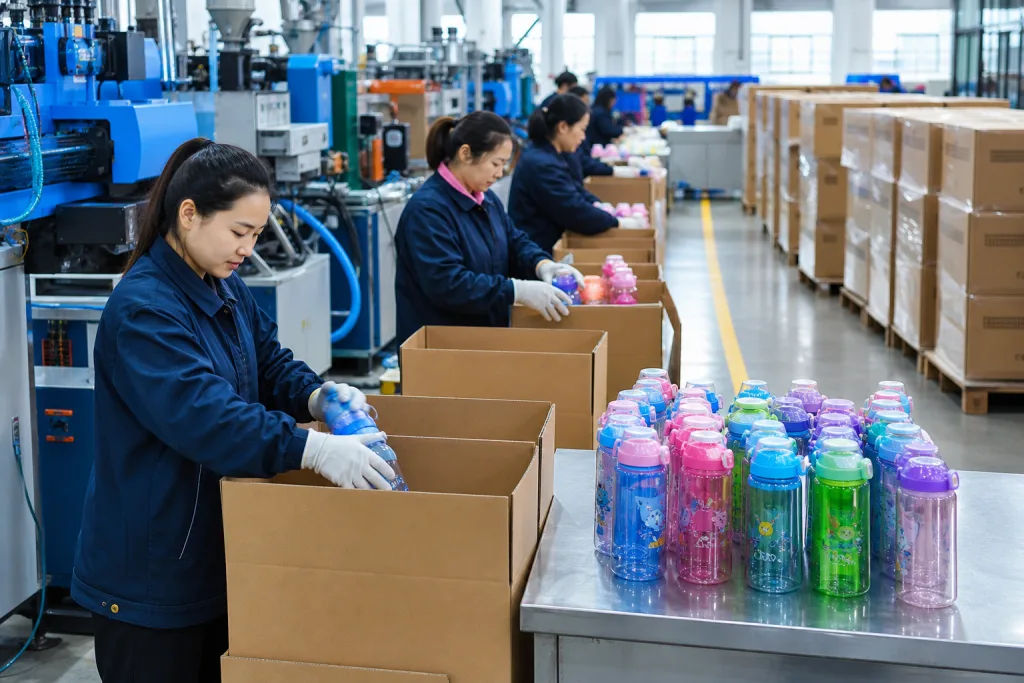
A bulk kids water bottle order looks simple until the quote sheet arrives. One supplier offers 350 ml Tritan with a flip straw, another quotes stainless steel with powder coating, and a third pushes a cheaper PP bottle that cracks after 2 or 3 months in a Grade 3 backpack. We’ve seen this go sideways. Last March, QC pulled 80 samples from a 3,000 pcs school order and found 11 lids with weak straw hinges after the 1.2 m drop test.
At our Zhejiang factory, we hear the same question from buyers in Europe and North America: which custom kids water bottle is safe, durable, and still inside budget? That is the wrong question to ask. The right spec depends on the age group, dishwasher use, logo process, test standard, and sales channel, whether you ship retail packs or run a children water bottle promotional campaign for 10,000 pcs. The buyer often flags the same issue first: “Can we hit the target price without using thin plastic?” Sometimes the math does not work, and we say so before the line starts.
Start With The Use Case
Do not start with color. Start with use place, user age, and cleaning method. A bulk school water bottle for a district lunch program is not the same SKU as a retail children water bottle wholesale line for gift shops. School buyers ask us about leakage inside backpacks, dishwasher temperature limits, and whether a 6-year-old can open the lid with one hand. Importers ask about 5-layer carton strength, barcode position, compliance files, and whether unit 1 and unit 20,000 look the same. We have seen this go sideways: one buyer picked a cute flip lid first, then QC pulled the sample because the latch cracked after 312 open-close cycles.
Here is the practical head-to-head view we use when helping buyers choose a bulk kids bottle:
| Use case | Best fit | Typical size | Branding | Watch point |
|---|---|---|---|---|
| Elementary school giveaway | PP or Tritan | 350-500 ml | Silkscreen or heat transfer | Lid hinge life and spare lid plan |
| Retail kids line | Tritan or 304 stainless | 400-600 ml | Full color print, sleeve, box | Pantone drift between batches |
| Sports club program | HDPE, PP, or stainless | 500-650 ml | One-color logo | Grip width and squeeze force |
| Premium school kit | 304 stainless vacuum | 350-500 ml | Laser or powder coat logo | Filled weight and landed cost |
If you are a children water bottle distributor, keep two product tiers instead of one. One low-cost custom school water bottle covers annual enrollment kits and bid projects where the buyer flags every 0.03 USD. A stronger custom made kids bottle, usually Tritan or stainless steel, fits retail, camp stores, and parent-paid programs. The math does not work if one bottle must win both jobs; we run different molds, packing specs, and AQL 2.5 checks for these orders.
Material Comparison That Actually Matters
The material choice sets the price, the test file, the shipping weight, and how long the bottle survives in a school bag. We still get POs that say “BPA-free plastic” and nothing else. That is the wrong question to ask. A proper children water bottle supplier needs the resin name, food-contact standard, wall thickness, and the test method before the quotation makes sense. On our line, QC pulled one sample last week because the PO missed the resin code.
Tritan is the cleanest choice for a lot of custom kids bottle jobs. It is clear, takes impact well, stays BPA-free, and prints hold color well on the sleeve or body. For a 450 ml bottle, we normally run 1.8-2.3 mm wall thickness, checked with a caliper at the gate and base. Buyers push back on price at first, but the math works when they want shelf appeal and fewer returns.
PP is the budget pick for a promotional kids bottle order. It is light, food-safe, and easy for a school bag or sports day giveaway. The trade-off is plain clarity, softer walls, and a less premium hand feel. If the FOB target sits around USD 1.20-2.20, PP is the lane we run, as long as the lid and packaging stay simple. We had one buyer ask for “premium look” on PP. It did not pencil out.
304 stainless steel is the better call when durability and shelf value matter. Single-wall stainless is lighter and cheaper; vacuum insulated stainless adds cost but keeps drinks cold for school runs and travel. For kids, we normally suggest a 0.4-0.5 mm inner wall and a 0.5 mm outer wall for vacuum bottles, checked after the seam weld on the line. Go thinner and the bottle dents fast. Go thicker and younger children feel it in the backpack.
Glass is not my first pick for school use, even with a silicone sleeve. It can work for older children or home-use retail, but most school districts reject it because breakage creates a real safety issue. We had a buyer flag a PO that asked for glass in a primary school set, and QC pulled the sample right away. For children water bottle bulk going into classrooms, skip glass unless the policy spells it out.
Lids Decide Complaint Rates
Most complaints on a custom kids bottle do not start with the bottle body. They start at the lid. On our line, a gasket seat off by 0.5 mm can turn into a wet carton in the buyer's warehouse. Leaking, broken hinges, missing straws, hard-to-clean valves, and weak carry loops create more after-sales noise than small cosmetic scratches. If you are comparing children water bottle manufacturers, ask for lid test records, not just material certificates.
Flip straw lids sell well for ages 4-10 because a child can drink without unscrewing the cap. The tradeoff is hygiene and spare-part control. A silicone straw should be food-grade, removable, and thick enough to resist tearing. We keep replacement straws in a marked tray at the packing table, and for school district buyers we suggest 1-2% extra quantity. Ship exact count only, and the first complaint is usually a missing part call.
Screw caps are simpler and cheaper. They fit older students, but younger children cross-thread them or leave them half-closed. Push-button lids feel premium, but the spring and latch need real testing. We run the latch on a fixture before release, and 3,000 open-close cycles on the mechanism is a fair factory test before mass production approval. The math does not work if you want a soft spring and zero returns.
For every bulk children water bottle order, request these checks:
- Leak test: inverted bottle for 30 minutes, plus horizontal shake test.
- Drop test: 1.0 meter drop on filled bottle, at least 3 positions.
- Torque check: cap open-close force suitable for children, not only adults.
- Straw fit: no loose tube after repeated cleaning and pulling.
A children water bottle vendor that only says “no leak” without a test condition is asking you to trust a slogan. This is the wrong question to ask. We had a PO last month with just “no leak” in the notes, and QC pulled the sample back because the condition was missing. For a school or importer order, put the test conditions into the purchase order. It saves a round of emails and stops loose claims on the line.
Branding Options Side By Side
A custom logo kids bottle can be branded 5 common ways, and the right choice comes down to bottle material, artwork file, order quantity, and dishwasher claims. School districts usually send a mascot, district name, sponsor logo, or safety message; half the time the AI file has a missing Pantone code, so our prepress team checks it before the line runs. Importers usually need retail graphics, seasonal designs, or private-label packaging. Different jobs. Different risks.
| Branding method | Best for | MOQ guide | Typical cost impact | Durability |
|---|---|---|---|---|
| Silkscreen | 1-2 color logos on a straight wall or large flat panel | 1,000 pcs | Low | Good on flat areas; QC checks ink edge bleed with 3M tape |
| Heat transfer | Multi-color cartoon artwork with gradients or full-wrap style graphics | 2,000 pcs | Medium | Good if cured properly; poor curing shows after the wash test |
| UV print | Short-run detailed graphics, name drops, and small pilot orders | 500-1,000 pcs | Medium-high | Depends on coating; curved bodies need tighter fixture control |
| Laser engraving | Stainless steel logos, school crests, and premium retail marks | 500 pcs | Low-medium | Excellent; no ink to rub off |
| In-mold color | Custom body color matched to a school or retail palette | 3,000-5,000 pcs | Low per unit | Permanent; color variance is checked against the approved chip |
If you want a customizable children water bottle program with 20 school names, do not open a new mold for every design. That is the wrong question to ask. We run one shared bottle mold, then change the print plate, lid color, hangtag, and carton mark; last season a buyer flagged one PO because “navy lid” was typed as “naby lid,” and catching that before mass production saved a messy rework. This keeps tooling cost near zero and keeps the schedule closer to 12 days for print setup instead of 18 days for repeated mold trials.
For a fully children water bottle customized project, such as a unique shape, character handle, or proprietary lid, tooling may run from USD 3,000 to USD 18,000 depending on complexity. The math works for importers planning 30,000+ units per year, because the mold cost spreads into the unit price and the line can hold a stable cycle time. It usually does not work for a single school district order of 2,000 bottles; QC pulled the sample on one similar job because the custom flip lid missed the bite-test target by 1.5 mm, and the delay cost more than a standard lid upgrade.
Testing And Compliance Documents
Kids products need tighter files than adult promo drinkware. A children water bottle manufacturer in Zhejiang, or any other China base, should show the test standard for your sales market before you place the PO. Do not accept a loose “FDA approved” line without a report number, material name, tested item photo, and the same SKU or drawing code; last month QC pulled a lid sample where the gasket material on the report was silicone, but the line was packing TPE.
For the United States, common requirements include FDA food-contact testing and CPSIA checks such as lead and phthalates, depending on the age claim. If the bottle is sold for children under 12, your importer of record may need a Children’s Product Certificate. For Canada, check food-contact material rules and bilingual labeling. For the EU and UK, ask for LFGB or EU food-contact testing, REACH screening, plus migration reports for plastics, silicone, coatings, and inks. We run a simple file match at sample stage: bottle body resin code, lid drawing, straw material, gasket color, and print ink all need to match the lab report.
Factory quality control should be written down, not promised on a call. At BottleForge Industrial, our kids bottle lines can produce about 300,000 units per month across plastic and stainless models, with standard lead time of 25-35 days after pre-production sample approval. We usually set AQL inspection at Critical 0, Major 2.5, Minor 4.0 unless the buyer requires a tighter plan. The line checks cap torque with a torque meter, and we record leakage after 30 minutes upside down because “no leak” on a sales sheet means nothing if the straw lid drips in a school bag.
For a bulk kids water bottle project, I suggest adding a compliance checklist to the RFQ. Short and strict works. We have seen this go sideways when the buyer sends artwork first and asks for test reports after the deposit, then the lab finds the coating needs a different migration test.
- Material declaration for body, lid, straw, gasket, and coating, with grade names and supplier lot numbers where possible.
- Food-contact test reports matching the actual material, not a similar bottle from 2022.
- BSCI, ISO 9001, or social audit documents if required by your retail channel; send the retailer’s audit wording because one typo on a PO can trigger a re-check.
- Ink adhesion and dishwasher test if decorated bottles claim dishwasher safety, including 3M tape pull or the buyer’s own wash cycle requirement.
- Carton drop test report for export packaging, with carton size, gross weight in kg, and drop height shown on the test page.
This can feel strict for a simple bottle, but this is the wrong question to ask. The issue is not whether a supplier is friendly before payment; it is whether they can produce the same documents, materials, and packed goods when 8,000 kids bottles are already on pallets.
Cost, MOQ, And Freight Reality
Buyers often ask for the lowest unit price first, then get surprised when freight, packaging, testing, and spare parts move the landed cost by 8-22%. Wrong first question. A children water bottle wholesale quote should show FOB China price, carton size, gross weight, packaging method, and MOQ by color. On our line, QC pulled one 480 ml PP bottle sample last month and the outer carton was listed as 12 kg on the PI but weighed 14.6 kg on the scale; that difference changes sea freight and warehouse receiving fees. Without those details, you are not comparing the same product.
As a working range, simple PP school bottles often land at FOB USD 1.20-2.50. Tritan custom children water bottle styles usually sit around USD 2.20-4.50. Single-wall stainless may be USD 3.00-5.50, and vacuum insulated kids bottles often run USD 4.50-8.50 depending on lid and coating. These are not promises. They are guardrails when a quote looks off. If one supplier offers a vacuum kids bottle at USD 3.10 with a flip lid, powder coating, and color box, we ask for wall thickness in mm, lid material, and a real packed carton photo before anyone celebrates.
MOQ depends on customization. For stocked colors with one-color logo, 1,000 pcs can work. For custom Pantone bottle colors, expect 3,000 pcs per color. For full heat transfer artwork, 2,000 pcs is a more realistic starting point. If you need five different school logos at 300 pcs each, tell the factory early. We run this by making blank bottle bodies together, then splitting decoration, barcode stickers, and packing at the end of the line. The buyer flagged this once because the PO said “blue” while the artwork file said Pantone 2925C; fix that before mass production, not after cartons are sealed.
Freight matters because kids bottles eat carton space. A 450 ml plastic bottle may pack 50 pcs per carton with carton dimensions near 55 x 45 x 40 cm. Stainless bottles weigh more, but some shapes nest tighter in the tray. If your order goes to an Amazon-style warehouse, ask for FNSKU labeling, master carton labels, and pallet height limits before production. We ship cartons with a 76 mm tape strip and printed carton marks checked against the packing list; repacking in North America or Europe usually costs USD 0.35-0.80 per unit, which kills the savings from a cheap quote.
How To Choose Your Supplier
A kids water bottle program needs a supplier that can repeat the same spec six months later. A school district will not accept a lid that changes fit because the factory swapped a spring from 0.8 mm to 1.0 mm. One promo order can absorb a miss. A long-term importer cannot. The better factory owns the mold, runs the lid line, prints the bottle, checks cartons, and ships the export pack without sending you to five different vendors.
Ask direct questions. Who owns the mold? What is the gasket material, EPDM or silicone? Can you keep the same lid color next season, and can you supply 1% or 2% spare lids? We had a buyer flag a PO typo once because the drawing said 280 ml and the order said 250 ml; that sort of mismatch turns into wasted weeks. Ask for a golden sample and ask the factory to seal one copy at QC.
If you are buying a customizable kids bottle for several districts, keep the platform small: two sizes, three lid colors, two decoration methods. That gives choice without flooding the line. Lock the bill of materials in writing. We run into trouble when a buyer says “same product” but the coating brand changes, the silicone durometer shifts, or the carton thickness drops from 5-ply to 3-ply because someone wanted to shave freight. The math does not work.
From Zhejiang, our rule is plain: buy the bottle that fits the child, not the spreadsheet. A USD 0.35 saving disappears fast if 5% of bottles leak in backpacks or if a school board rejects a missing test report. A good kids water bottle supplier in China should make the process dull: clear samples, clear tests, clear cartons, and a leak test that holds 12 hours before the container leaves the dock.
Send Your Kids Bottle Spec For A Factory Quote
Share size, material, logo, quantity, and destination. We will return a practical FOB quote with MOQ, lead time, and testing options.
Frequently asked questions
What is the best material for a bulk kids water bottle order?
For most school and importer programs, Tritan is the safest middle option because it is BPA-free, clear, impact resistant, and not too heavy. PP is better when the budget is tight, usually around FOB USD 1.20-2.50 for simple bottles. 304 stainless steel is better for premium retail or parent-paid school programs, especially 350-500 ml vacuum bottles. For children under 8, check total filled weight and lid opening force before choosing stainless. Glass is usually not recommended for school district use because breakage creates a safety issue.
What MOQ should I expect for a custom kids water bottle?
For a standard custom logo kids bottle using an existing mold and stocked color, 1,000 pcs is often workable. If you need a custom Pantone body color, plan for 3,000 pcs per color. Full-color heat transfer decoration usually starts around 2,000 pcs because setup and alignment take more labor. A fully custom made kids bottle with a new mold is different; tooling may cost USD 3,000-18,000 and annual volume should normally exceed 30,000 pcs to make sense.
Can one order include different school logos?
Yes, but structure the order correctly. The cleanest method is to produce one shared bottle body and lid color, then split the decoration by school logo. For example, a 3,000 pc order can be divided into six logos of 500 pcs if the print method allows it. Silkscreen works well for simple one-color logos. UV print can handle smaller batches but costs more per unit. Tell the factory the split before quoting so they can calculate setup charges, packing lists, and carton labels correctly.
Which tests should school district buyers require?
At minimum, require food-contact testing for all drink-contact parts, including bottle body, lid, straw, gasket, and coating if applicable. For the U.S., ask about FDA food-contact reports and CPSIA-related lead and phthalate checks if marketed to children under 12. For the EU, request EU food-contact or LFGB reports plus REACH screening where relevant. On the physical side, specify a 30-minute inverted leak test, 1 meter drop test, lid cycle test of about 3,000 openings, and AQL final inspection, commonly Critical 0, Major 2.5, Minor 4.0.
How long does production take from a China factory?
For existing molds with standard colors, expect 25-35 days after artwork approval and pre-production sample sign-off. Custom colors, full-wrap artwork, special packaging, or new tooling can add 7-30 days. Sea freight to North America or Europe often adds another 25-45 days depending on port, season, and routing. If bottles are needed for the first day of school, start sourcing at least 90 days before your delivery deadline. Rush orders are possible, but they reduce your room for testing and inspection.